The summer anime season has brought plenty of surprises, but few shows have generated as much buzz as Thunder 3, the TV adaptation of Ikeda Yuuki’s manga serialized in Monthly Shonen Magazine. The series has captured attention with its audacious visual concept: characters from the “Manga-verse” and the “Multiverse” sharing the same screen in a way that feels both unprecedented and inevitable.
【Story】
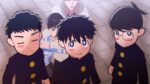
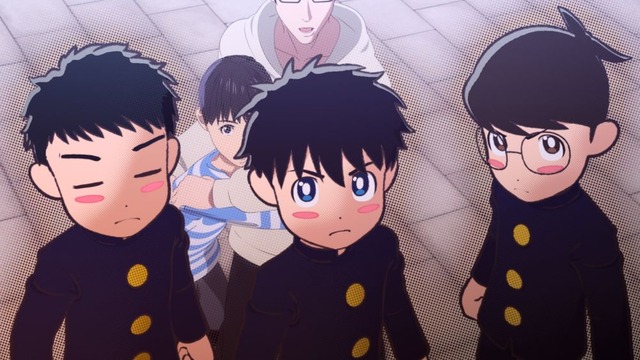
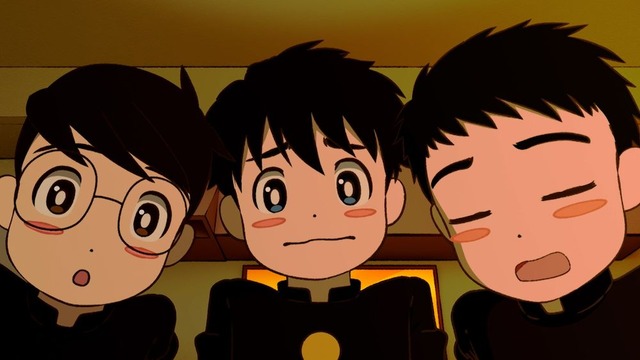
The story follows a trio of unremarkable middle schoolers—Pyontaro, Tsubame, and Hiroshi—known collectively as the “Small 3.” After playing a disc borrowed from their homeroom teacher Doc, they find themselves transported into the Multiverse, a world that exists on the other side of the television screen. What follows is an experience unlike anything they’ve ever encountered.
As the “Multiverse” keyword suggests, the series is packed with references that resonate with American comic book fans, while reimagining the classic Showa-era gag manga convention that “characters in comedy anime never die” as literal superhuman resilience. It’s a unique recipe that has earned the show a devoted following.
In this interview, we spoke with the three key members of the animation team—General Director Seshimo Hiroyuki, Director Ide Keisuke, and Assistant Director Sugai Susumu—about how they brought the manga’s distinctive visual language to the animated series.
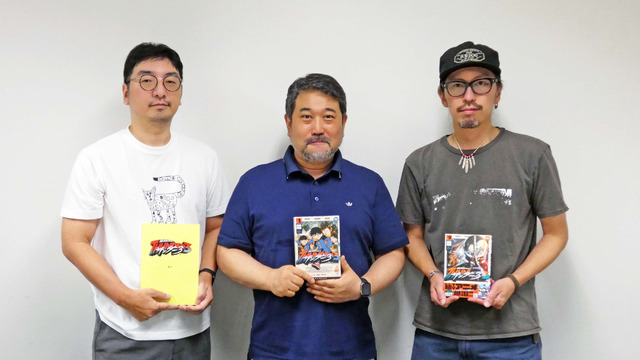
(From left) Assistant Director Sugai Susumu, General Director Seshimo Hiroyuki, Director Ide Keisuke
【Profiles】
Seshimo Hiroyuki (General Director): Director and CG director. Has helmed Sidonia no Kishi, Ajin, BLAME!, Lupin III vs. Cat’s Eye, and GAMERA -Rebirth-, among others. Also handled CG character direction for Shinkai Makoto’s Suzume no Tojimari.
Ide Keisuke (Director): Director and episode director. Worked on direction and storyboards for Ajin, and teamed up with Seshimo on Levius and Lupin III vs. Cat’s Eye.
Sugai Susumu (Assistant Director): CG director and episode director. Served as CG director and director on Sidonia no Kishi, Ajin, THE iDOLM@STER Shiny Colors, and Pacific Rim: The Black.
[Interview and text by Kegazawa Masashi]
A Trio of Directors, One Vision
—The title Thunder 3 seems fitting, given that the director’s role is also divided into three. How do you split the responsibilities?
Seshimo: Simply put, the general director sets the direction for the story, world-building, characters, and visual style. Ide, Sugai, and I then discuss and develop those ideas together, and I make the final call. In terms of episode direction, Ide handles the odd-numbered episodes and Sugai handles the even-numbered ones.
Our relationship isn’t a top-down hierarchy—it’s more like a collaboration between people with different strengths. Each of us keeps the whole picture in mind while taking responsibility for our own areas. All three of us come from a 3DCG background, so we share a deep understanding of the techniques and workflows involved, which makes communication smooth. Once we built an efficient system, this structure naturally emerged.
—So you all have roots in 3DCG.
Seshimo: I’ve been using CG in commercials, films, games, and exhibition videos since the 1980s. I simply loved the tool, and I moved into the anime industry hoping to one day make a feature-length CG animation. Back in 1980, producing one second of footage cost about one million yen. It wasn’t until Sidonia no Kishi aired in 2014 that we could finally produce CG animation within a TV budget.
—And now Thunder 3 has been brought to life as a 3DCG anime. What was your first impression of the original manga? Honestly, I felt “tricked” (laughs).
Seshimo: I was tricked too, and surprised (laughs). A friend told me about it early in the serialization, and from the very first chapter I thought, “I can’t wait to read more! I want to animate this!”
Ide: I also heard about it from an acquaintance.
—What drew you to it?
Ide: Mostly the loose, everyday scenes in the Manga-verse. The dialogue is distinctive—short exchanges that snap back and forth with great rhythm. What stuck with me was the opening line, “There are no underpants lying around.” It’s the kind of thing real middle schoolers would say, but there’s a realism to it that doesn’t feel like typical manga, and that dissonance is oddly comforting. I would have loved to see more of those conversation scenes.
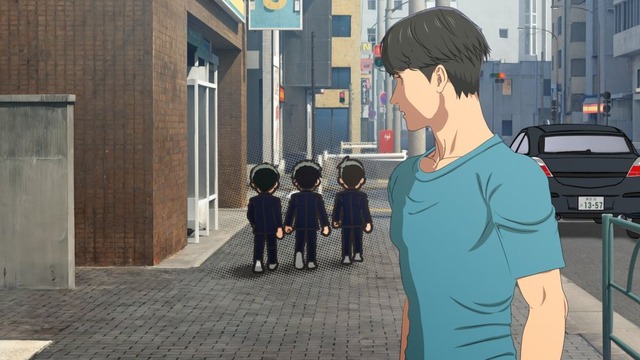
—I personally found the Multiverse so dystopian that the contrast nearly gave me a cold.
Ide: I always thought the Multiverse would look interesting in 3D. It’s a world that really stimulates the imagination, so I was surprised when I actually got to work on it.
Sugai: I read the manga after the project was confirmed. At first, looking at the cute art style of the Manga-verse, I thought, “I get to work on something this cute?!” And then suddenly the Multiverse hits you (laughs). I was genuinely shocked. It’s like an isekai but not really an isekai. I found the “something that feels familiar yet has never been done” quality fascinating, and it made me realize, “So this kind of expression is possible!”
Differentiating Manga-verse and Multiverse
—The series is tricky in the best way, but it also delivers catharsis through desperate battles against aliens. What did you prioritize when adapting it?
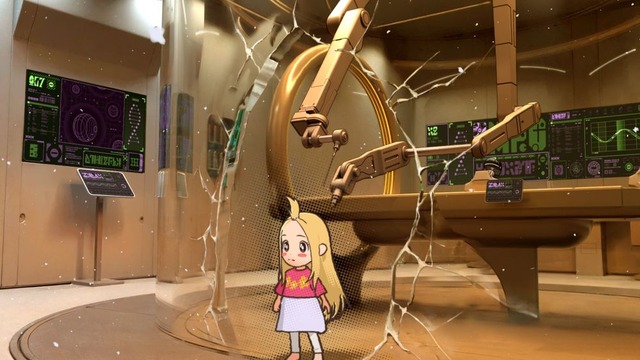
Seshimo: There were three pillars. First, the Manga-verse characters needed to deliver a unique sense of exhilaration and catharsis in battle. Second, rather than simply having them overpower everything, we needed to show their kindness. And third, Futaba and Puusuke had to be overwhelmingly cute. Above all, I wanted to make sure that Pyontaro and the others came across as deeply kind characters.
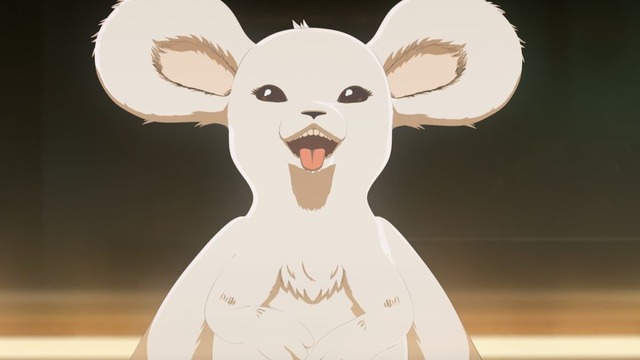
—Speaking of careful portrayal, episode 6 really stood out. The scene where the space creature Kyu-chan interacts with Futaba felt incredibly detailed.
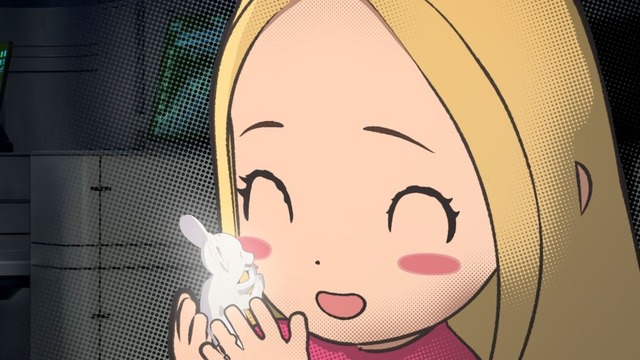
Seshimo: The original manga deliberately uses no dialogue in that scene, taking its time to build the moment. We struggled with how to recreate that essence and atmosphere in animation. The underlying principle was that no matter how serious the situation gets, Futaba, Puusuke, and the Manga-verse characters around them must remain adorable.
Ide: I was very conscious that the Manga-verse characters had to be appealing. 3DCG lines have a hard time with the “loose lines” of the original manga—they tend to come out too crisp and lose the ambiguity. That changes how they look compared to the source material. I also struggled with how to balance the visual differentiation between the Manga-verse and the Multiverse. We had a lot of discussions among the directors, and we ended up adding expressions that weren’t in the test footage.
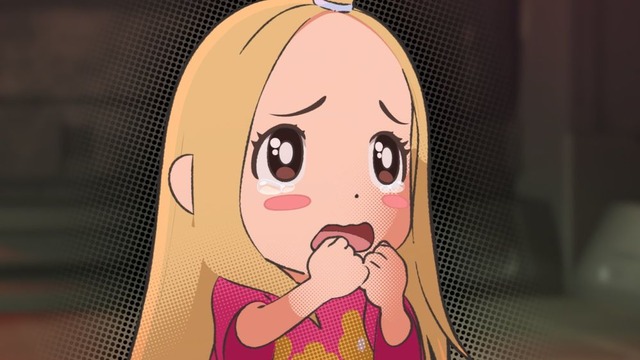
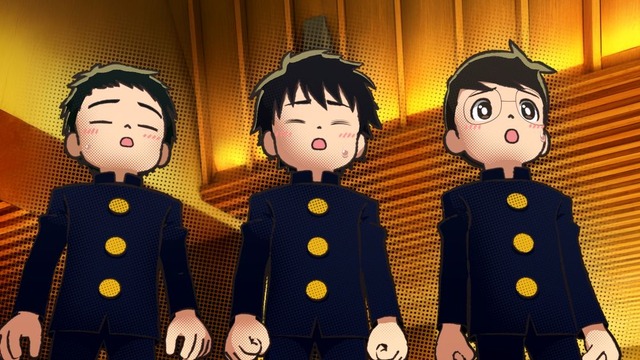
—The screen tone effect used for the Manga-verse characters is brilliant.
Ide: That expression was the result of all that trial and error. We call it the “amiten” (halftone) expression. We initially tested it as part of the 3D rendering, but it looked cheap, so we tried differentiating through outline thickness and lighting. We also tried a 2D halftone approach. In the end, the outline and lighting differentiation looked like a failed composite, and I personally thought, “This doesn’t work.” But the 2D halftone had potential, so we built on that and finally arrived at the current look. After trying many things, the team decided to return to the expression used in the original manga.
Sugai: What I focused on was also the differentiation between the Manga-verse and the Multiverse. But beyond visuals, I wanted to give each side its own personality in terms of performance. For example, Manga-verse characters have a lot of exaggeration—a coolness that looks slightly superhuman, the kind you wouldn’t see in realistic acting. Even when aiming for coolness, the quality of that coolness differs between the Manga-verse and the Multiverse, and I was conscious of that distinction.
Seshimo: In terms of action, the basic policy was to depict Manga-verse action for Manga-verse characters and Multiverse action for Multiverse characters. But if you’re not careful, “overwhelming strength” quickly inflates. So instead of making enemies fly through multiple walls to show how powerful a punch is, we focused on the reaction of the person being hit—that perfect “feeling of being defeated.” That’s how we pursued a kind of strength that doesn’t get boring, one that has variety.
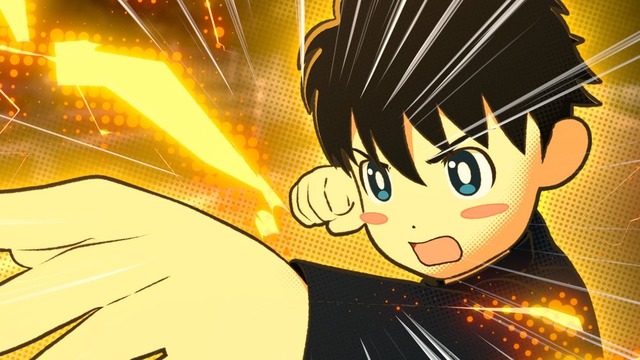
Sugai: After all, the protagonists are fundamentally middle schoolers.
Seshimo: Right. Battle skills don’t just appear in middle schoolers with no fighting experience. We wanted to preserve the impression of former “losers” fighting with everything they have. They don’t really want to hit anyone, and they have no intention of taking lives. It’s a story about kind characters who summon their courage to fight and save a little sister, so we thought carefully about what kind of action would work without losing sight of their charm.
—It’s the challenge of having two very different elements coexist.
Seshimo: In the early stages, we considered hand-drawn 2D for the Manga-verse and 3DCG for the Multiverse, but production would have become incredibly demanding. For example, the scene in episode 3 where an alien gets a giant swing requires a huge amount of work to composite 2D and 3D animation. Within those constraints, we kept experimenting to find a way to express the unique, uncanny humor of the original.
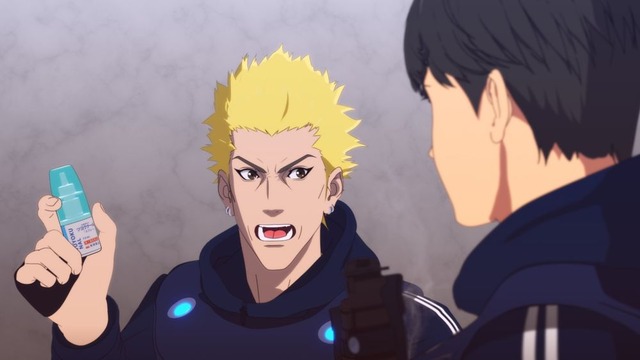
—Speaking of demanding, “Tsuyokunaru” must have been tough too. You had to create 3D models for all the weapons that appear through that ability.
Ide: It’s tough (laughs). But it’s also incredibly fun. The weapons are fictional, so that actually reduces the burden.
aimyon’s “Marigold”: “We’re Just Grateful”
—All that hard work has resulted in episodes that hit hard emotionally. Personally, I was deeply moved by the scene where Seshimo’s father dies and the house is destroyed, leaving his mother distraught. It was truly painful.
Seshimo: I’m glad to hear that. We carefully considered when Seshimo would finally break down, and it was a scene we built with great care. For important storylines like that, we paid attention to every single cut transition. It may not have the flashiness of a battle scene, but I’m very happy that the dramatic moments we put so much effort into were appreciated.
—And I was surprised that “Marigold” appears as-is.
All: (laughs).
—You changed some of the game console names from their real-world counterparts, but here you kept it as-is (laughs).
Seshimo: The opening and ending theme songs are from different music labels, but for the insert song “Marigold,” we were able to make it happen thanks to the understanding and cooperation of the production committee and everyone involved.
Ide: At first, it was more of a “wouldn’t it be nice if we could use it” kind of thing (laughs).
Seshimo: The scene involves the characters covering their train fare through street performance. If they were suddenly going to sing, it would feel unnatural unless it was a song everyone knows. We got excited thinking, “Marigold would work because everyone knows it,” but initially we thought, “There’s no way we’d get permission.” So when we actually did, I was truly astonished.
—Thank you. Finally, please share a message with the readers.
Ide: Futaba and Puusuke are drawn incredibly cutely from here on out, so please look forward to it!!
Sugai: What I feel on the production floor is that every staff member loves this work and is fully committed to it. I think fans can watch with confidence, so please support both the original manga and the anime!!
Seshimo: Above all, the original manga is genuinely entertaining. And when adapted into anime, it became entertaining as well. Each episode ends with a cliffhanger that makes you think, “It’s over already?” Please look forward to what’s coming next!!
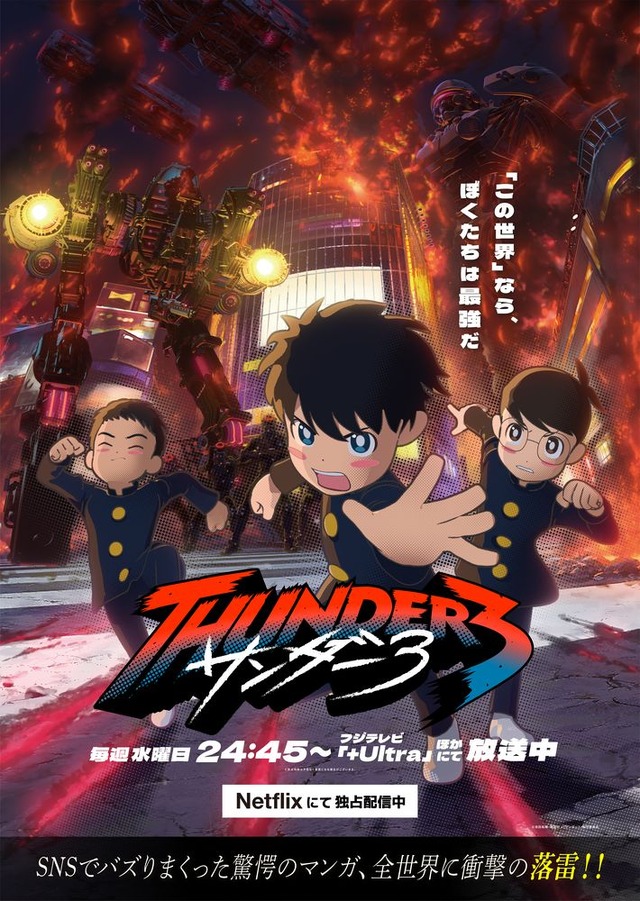
Broadcast Information
- Fuji TV: Every Wednesday at 24:45
- Kansai TV: Every Thursday at 26:15
- Animax: Every Saturday at 22:00
- Tokai TV: Every Saturday at 25:45
- BS Fuji: Every Sunday at 25:30
- Hokkaido Cultural Broadcasting: Every Thursday at 24:55
- TV Nishinippon: Every Thursday at 26:15
- Fukushima TV: Every Wednesday at 24:45
- Streaming on Netflix
Staff
| Original Work | Ikeda Yuuki (Kodansha, Monthly Shonen Magazine) |
| General Director | Seshimo Hiroyuki |
| Director | Ide Keisuke |
| Assistant Director | Sugai Susumu, Ryu Nari |
| Series Composition / Screenplay | Seko Hiroshi |
| Character Design (Original) | Onda Naoyuki |
| Animation Character Design | Yamanaka Junko, Moriyama Yuuki |
| Animation Director | Koji |
| Production Design | Tanaka Naoya, Ferdinando Patulli |
| Modeling Director / Lighting Director | Katashima Mitsunori |
| Mechanical Design | Hoashi Takehiko |
| Art Director | Kamei Yusuke, Nakamura Keigo |
| Sound Director | Yamaguchi Takayuki |
| Music | Frederic Chateau, Tateyama Akiyuki |
| Opening Theme | Yuuri “Thunderbolt” |
| Ending Theme | Otoha “Shururerira” |
| Planning & Production | Slow Curve |
| Animation Production | UNEND |
Cast
| Tezuka Pyontaro | Suzushiro Sayumi |
| Azuma Tsubame | Kawaida Natsumi |
| Ochanomizu Hiroshi | Akiyama Eri |
| Tezuka Futaba | Mitsubachi Honoka |
| Doc | Sakata Shogo |
| Segami Teiichi | Saka Taito |
| Tashiro Suzuka | Hirose Yuuki |
| Kisaragi Mio | Maekawa Ryoko |
| Sumeragi Kyuji | Ishiya Haruki |
(C) Ikeda Yuuki / Kodansha / “Thunder 3” Production Committee
![Which Anime Characters Do You Want to Nurse You? 3rd Place: “Gintama” Sakata Gintoki & “Kusuriya no Hitorigoto” Maomao, 2nd Place: “Kimetsu no Yaiba” Kochou Shinobu, 1st Place is… <2026 Edition> [#Kaze no Hi]](https://animeworld.info/wp-content/uploads/2026/01/827582.jpg)