




Yagami Junko Returns to Uchuu Senkan Yamato After 43 Years
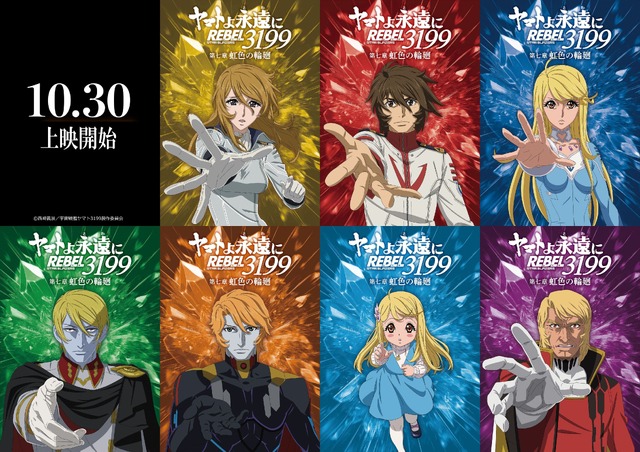
The final chapter of Yamato yo Towa ni REBEL3199, Chapter 7: Nijiiro no Rinne, has unveiled its ending theme and music video. The ending song, ‘Haruka e, Towa e,’ is performed by Yagami Junko, who last sang a theme for the series with Uchuu Senkan Yamato Kanketsuhen in 1983—43 years ago. Seven character visuals set against rainbow backgrounds were also released.
‘Haruka e, Towa e’ is based on ‘Shin Ginga Tanjou,’ composed by Miyagawa Hiroshi for Yamato yo Towa ni (1980). Miyagawa Akira handled the new arrangement, and Matsui Youhei wrote the lyrics, continuing from the previous chapter’s ‘Hikari no Nami.’
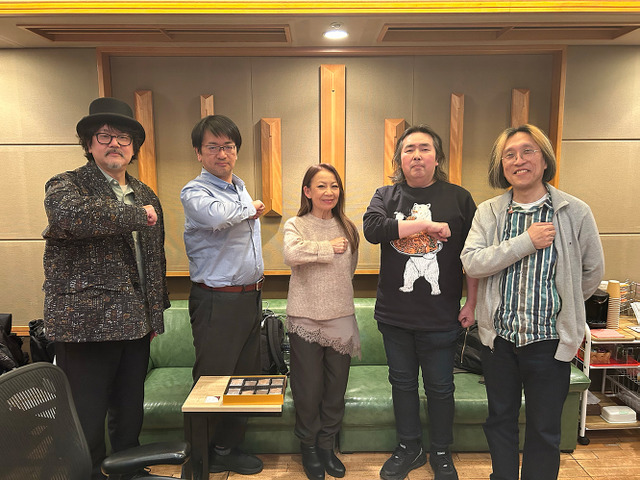
Yagami’s connection to Uchuu Senkan Yamato dates back to ‘Love Supreme ~Shijou no Ai~,’ released on February 5, 1983, as the theme song for Uchuu Senkan Yamato Kanketsuhen. The MV for ‘Haruka e, Towa e’ is now available on the official YouTube channel. A photo of five people, including Yagami, striking the ‘Yamato-style salute’ was also revealed.
Chapter 7 Story and Character Visuals
The production is the latest entry in the Uchuu Senkan Yamato 2199 series, based on the 1980 third theatrical film Yamato yo Towa ni and reconstructed with a new interpretation. It consists of seven chapters (26 episodes) and has been screening in theaters nationwide since 2024. The final chapter, Chapter 7: Nijiiro no Rinne, begins screening on Friday, October 30, 2026.
Chapter 7’s story revolves around the mystery of who the Dezarium are and whether their memories are true. The reality they believed in collapses, Sasha loses sight of the proof that she has lived, and Alphon reaches a conclusion after doubting his own existence. To resist the destruction threatened by the heavy nucleus bomb ‘Grand Reverse,’ which would initialize all humanity, the Partisan fleet gathers and the Space Battleship Arizona launches. With his promise to Yuki in his heart, Kodai Susumu takes the captain’s seat, and the Space Battleship Yamato plunges into the Dezarium home star in search of Earth’s future.
The seven character visuals use rainbow backgrounds to symbolize the chapter title Nijiiro no Rinne and express the feelings of a diverse cast that includes Kodai Susumu, Mori Yuki, and Sasha.
Staff and Cast
The general director, series composition, and screenplay are handled by Fukui Harutoshi, with Yamato Naomichi as director. Animation production is by Satelight. The cast includes Ono Daisuke as Kodai Susumu, Kuwashima Houko as Mori Yuki, Han Megumi as Sasha, and Yamadera Kouichi as Abelt Desler.
Main Staff
| Role | Staff |
|---|---|
| Original work | Nishizaki Yoshinobu (崎 is written as ‘tatsusaki’) |
| General director | Fukui Harutoshi |
| Director | Yamato Naomichi |
| Series composition and screenplay | Fukui Harutoshi |
| Screenplay | Oka Hideki |
| Character design | Yuuki Nobuteru |
| Mechanical design | Tamamori Jun’ichirou, Ishizu Yasushi, Akitaka Mika |
| Prop design | Edamatsu Sei, Hara Yoshitomo |
| Art directors | Satou Rirai (Inspired), Itai Rieko (Inspired), Hosoi Tomoyasu |
| Color design | Fukutani Naoki |
| Director of photography | Horino Daisuke |
| CG producer | Gotou Hiroyuki |
| CG director | Uechi Masahiro |
| Editing | Imai Daisuke |
| Music | Miyagawa Akira, Kanematsu Shuu, Miyagawa Hiroshi |
| Sound director | Yoshida Tomohiro |
| Original sound effects | Kashiwabara Mitsuru |
| Animation production | Satelight |
| Animation production cooperation | studio MOTHER, YANCHESTER |
| Distribution | Shochiku ODS Jigyoushitsu |
| Production | Uchuu Senkan Yamato 3199 Production Committee |
Main Cast
| Character | Cast |
|---|---|
| Kodai Susumu | Ono Daisuke |
| Mori Yuki | Kuwashima Houko |
| Sasha | Han Megumi |
| Abelt Desler | Yamadera Kouichi |
| Sanada Shirou | Ootsuka Houchuu |
| Shima Daisuke | Suzumura Kenichi |
| Domon Ryuusuke | Hatakenaka Yuu |
| Ageha Takeshi | Uemura Yuuto |
| Kitano Seiya | Toriumi Kousuke |
| Nanbu Kouzou | Matsumoto Shinobu |
| Toudou Shino | Shioda Tomoko |
| Serizawa Kotetsu | Genda Tesshou |
| Toudou Heikurou | Kojima Toshihiko |
| Alphon | Furukawa Makoto |
| Isidore | Horie Shun |
| Ramber | Eguchi Takuya |
| Sada | Inoue Marina |
| Skuldart | Uchida Naoya |
(C) Nishizaki Yoshinobu / Uchuu Senkan Yamato 3199 Production Committee (崎 is written as ‘tatsusaki’)
Comments from the Creative Team
Yagami Junko
Yagami Junko said she never expected to sing a Yamato theme again after more than 40 years. She recalled writing ‘Love Supreme ~Shijou no Ai~’ for Uchuu Senkan Yamato Kanketsuhen in 1983 and still remembers the emotion of recording with an orchestra under Miyagawa Hiroshi’s direction. From the moment she received ‘Haruka e, Towa e,’ she felt the grand cosmic vision Miyagawa Akira paints. She described the song as unusual for her because it continues in low tones, and asked listeners to hear it.
Miyagawa Akira
Miyagawa Akira noted that Miyagawa Hiroshi was a big fan of Yagami Junko during his lifetime, and that Yagami began singing because she admired The Peanuts. He said that he and Matsui Youhei, positioned between them, helped set the stage. He wondered if this would be Miyagawa Hiroshi’s first new song in a long time, but added that it might better be called a long-awaited act of filial piety.
Matsui Youhei
Matsui Youhei said that in 3199, every character is asked how they will live. He felt the conflict of having an anchor rooted in the time and place where one is born. He wrote the lyrics of ‘Haruka e, Towa e’ to be a song for people who raise that anchor and travel, overlapping with Yamato’s course toward the far ends of space and time. A person can light only one life, but that light shows they are here and can illuminate someone else’s path; he put that feeling into the song.
Ending Theme Credits
Yamato yo Towa ni REBEL3199 Chapter 7: Nijiiro no Rinne ending theme
‘Haruka e, Towa e’
Lyrics: Matsui Youhei
Music: Miyagawa Hiroshi, Miyagawa Akira
Arrangement: Miyagawa Akira
Vocals: Yagami Junko
Screening Information
Title: Yamato yo Towa ni REBEL3199
Screening: Yamato yo Towa ni REBEL3199 Chapter 7: Nijiiro no Rinne begins Friday, October 30, 2026.