




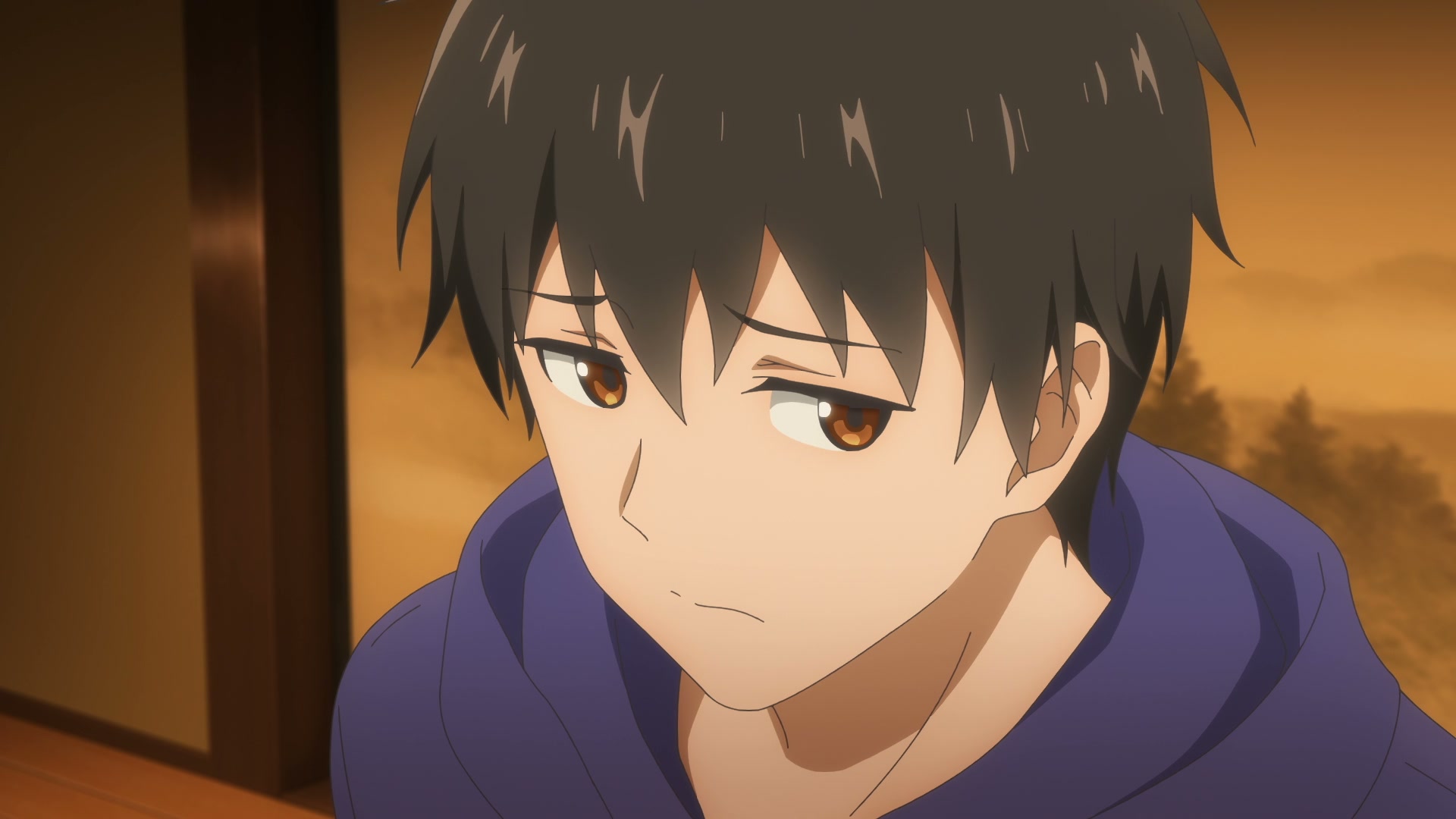
The first episode of Toumei na Yoru ni Kakeru Kimi to, Me ni Mienai Koi wo Shita does not announce itself with a dramatic hook or a sweeping romantic gesture. It opens with a line that feels almost like a thesis, spoken by a character we have not met yet: “I want to go on living even after my death!” Then the show cuts to a college welcome party, and the real protagonist, Sorano Kakeru, is already exhausted. He did not want to come. His roommate Narumi dragged him along after an all-night redecorating session, and Sorano spends the first few minutes radiating the kind of low-grade irritation that makes you wonder if this series is going to be a comedy about a grump. It is not. It is something quieter, more patient, and by the end of the episode I was genuinely curious where it plans to take these two people who could not be more different.
Sorano Kakeru Is Not Here to Make Waves
Sorano’s internal monologue is the backbone of the episode, and it is refreshingly honest in a way that could easily come off as whiny but does not. He watches his classmates jockey for attention, confessing to girls they just met, and his reaction is not amusement. It is discomfort. “I’ve never liked people who always need attention,” he tells Narumi. “It makes them look desperate.” Narumi, the easygoing foil, suggests that college is exactly the time to figure out who you want to be, but Sorano is not buying it. He does not even want to make a ripple.
The show does not treat this as a flaw to be immediately corrected. Instead, it gives us a brief, unvarnished look at why Sorano is like this. His mother was divorced, and they moved between relatives’ homes. He learned to keep his head down, read the room, and avoid standing out because standing out meant trouble. That backstory is delivered in a few lines of voiceover, and it lands because the episode has already shown us his behavior. He is not just shy. He has built a whole personality around not being noticed, and the party scene makes it clear that this is not a temporary mood. It is a survival strategy that has calcified into a worldview.
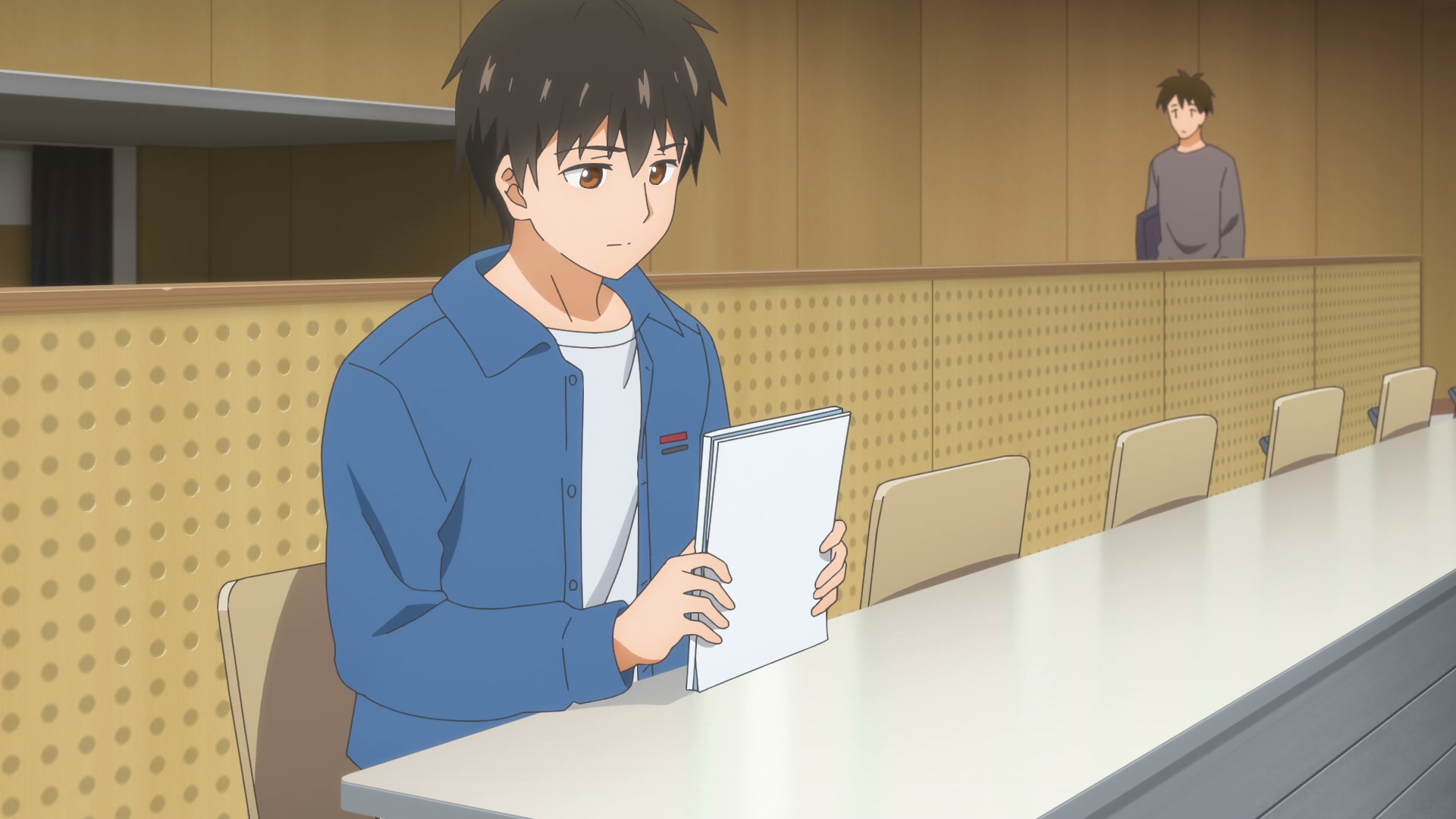
What makes Sorano interesting is that he is self-aware enough to hate himself for it. When Fuyutsuki Koharu, a blind girl he met at the party, drops her braille note-taker in class, he freezes. He hesitates, hopes someone else will help, and then feels relief that no one else is around. His internal narration in that moment is brutal: “I hate myself right now. First, for hesitating to react, then for wanting someone else to help, and then for being relieved no one else is around.” That is not the kind of self-flagellation you usually get from a romance lead in episode one. It is messy and specific, and it makes Sorano feel like a real person rather than a collection of relatable traits.
Fuyutsuki Koharu Does Not Need Your Pity
If Sorano is defined by his reluctance to engage, Fuyutsuki is defined by how naturally she moves through a world that is not designed for her. She is blind, and the episode handles that fact with a matter-of-factness that I appreciated. There is no swelling music when she reveals she cannot see. She just says it, and the guys who were sitting near her earlier have already moved away. Hayase Yuko, her friend and student guide, is blunt about it: “Those jerks got up and moved as soon as they found out Koharu-chan couldn’t see.”
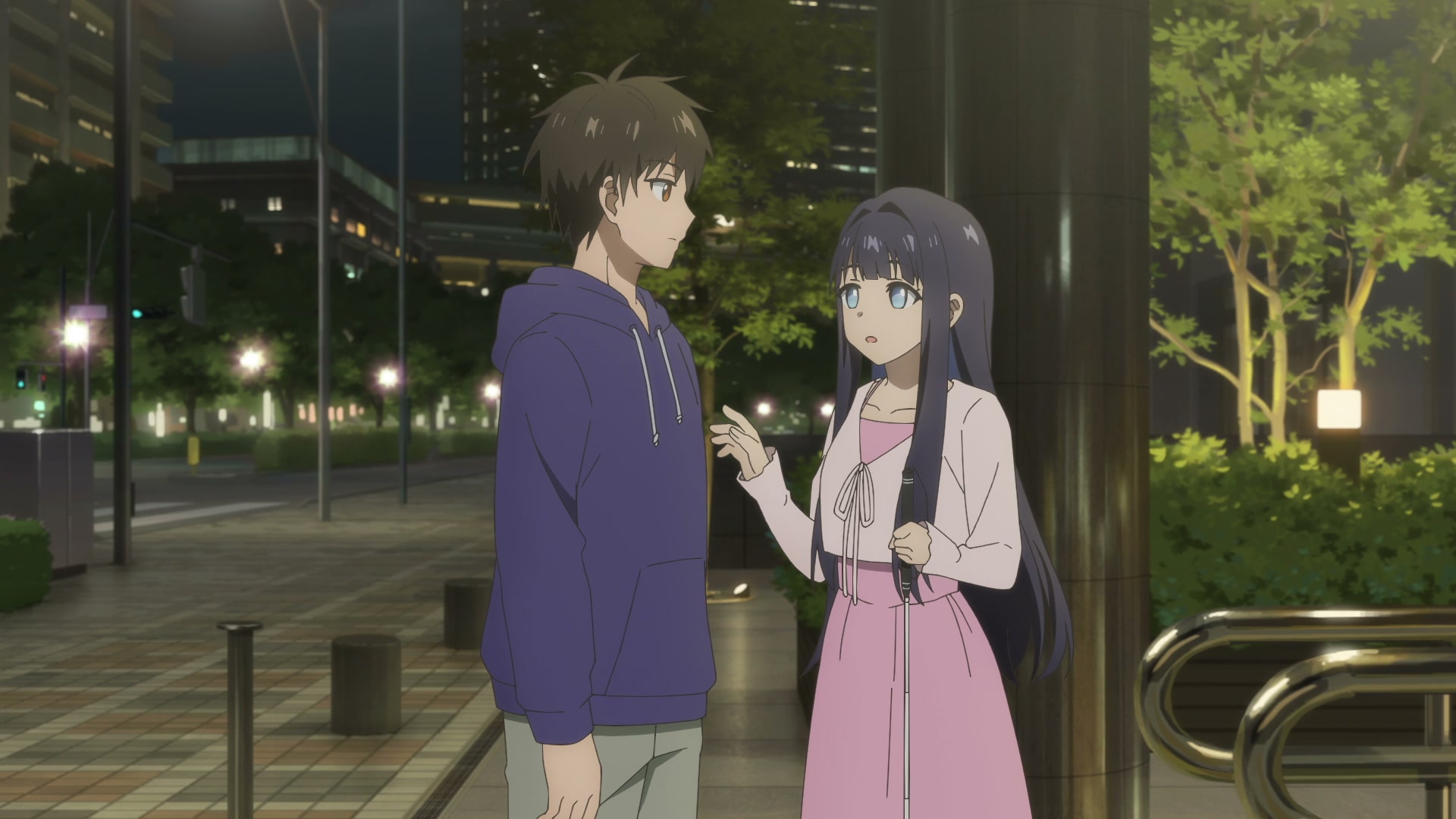
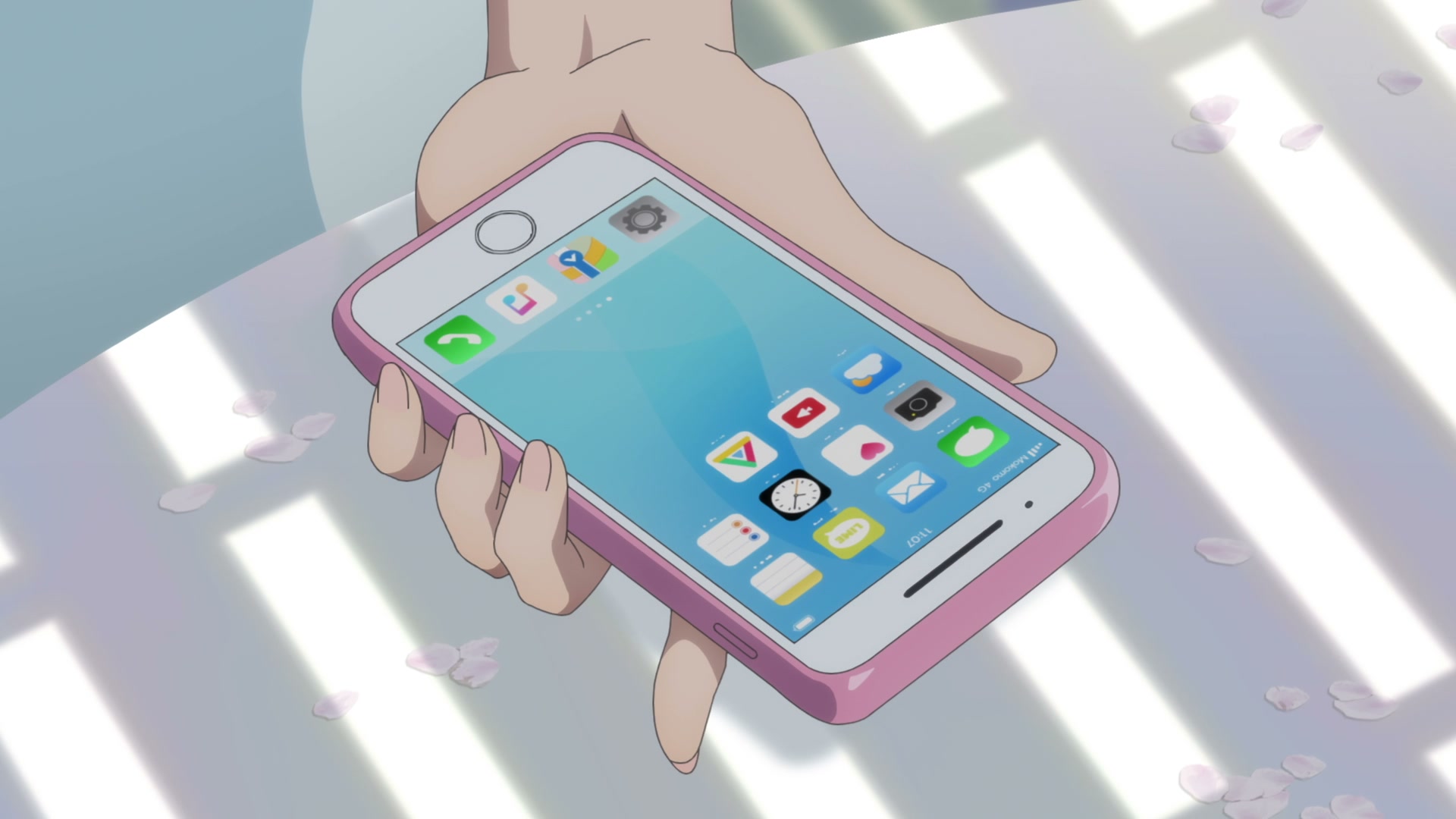
The show does not linger on that cruelty. It is there, and then the story moves on to the small, practical details of Fuyutsuki’s daily life. She uses a cane to feel tactile paving. She has memorized the buttons on a specific vending machine so she can buy milk tea without playing Russian roulette with bean porridge. She uses a screen reader on her phone, and when Sorano asks how she types, she explains voice input with a casual apology for any typos. These moments are not presented as inspirational. They are just how she lives, and the episode trusts the audience to find that interesting without underlining it.
Fuyutsuki’s personality helps. She laughs at Sorano’s awkward jokes, calls him out gently when he over-apologizes, and has a quiet warmth that never feels forced. When she says, “Even visually handicapped people like me can still do most of the things everyone else can,” it is not a dramatic declaration. It is an answer to a question, delivered with the same tone she uses to explain her vending machine strategy. The episode lets her be a person first, and that makes the moments where her blindness intersects with the story feel organic rather than didactic.
The Wall Sorano Built
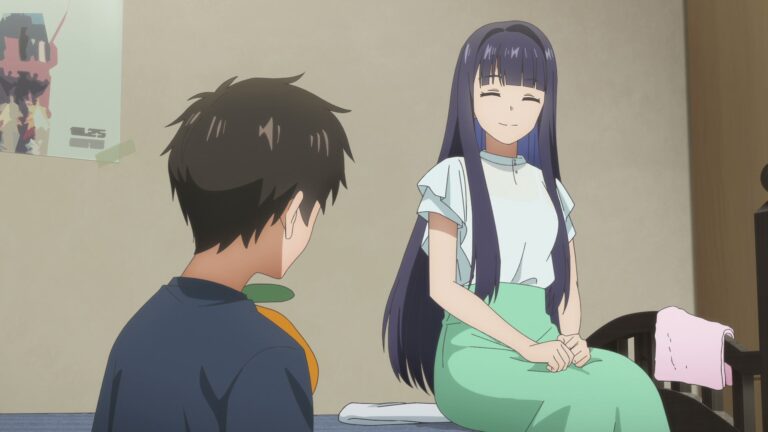
The central metaphor of the episode is an invisible wall. Sorano articulates it near the end, after spending time with Fuyutsuki: “I feel like there’s an invisible wall. A wall I built myself but still can’t see.” He knows he should just listen and open up, but knowing and doing are different things. The wall is not about her blindness. It is about his own fear of connection, his habit of keeping people at a distance so he does not have to risk standing out or getting hurt.
The episode does not tear that wall down. It just shows us a few cracks. The first is when Fuyutsuki almost trips over a bicycle parked on the tactile paving, and Sorano catches her hand. She remarks that his hands are warm, and he tells her to be more careful. It is a small moment, but the show holds on it long enough to feel significant. The second is when he picks up her dropped bookmark and returns it, and she thanks him with a sincerity that seems to catch him off guard. The third is when they kill time together after class, and he finds himself genuinely curious about how she uses her phone. By the time they exchange contact information, Sorano is still guarded, but something has shifted. He is not just tolerating her. He is paying attention.
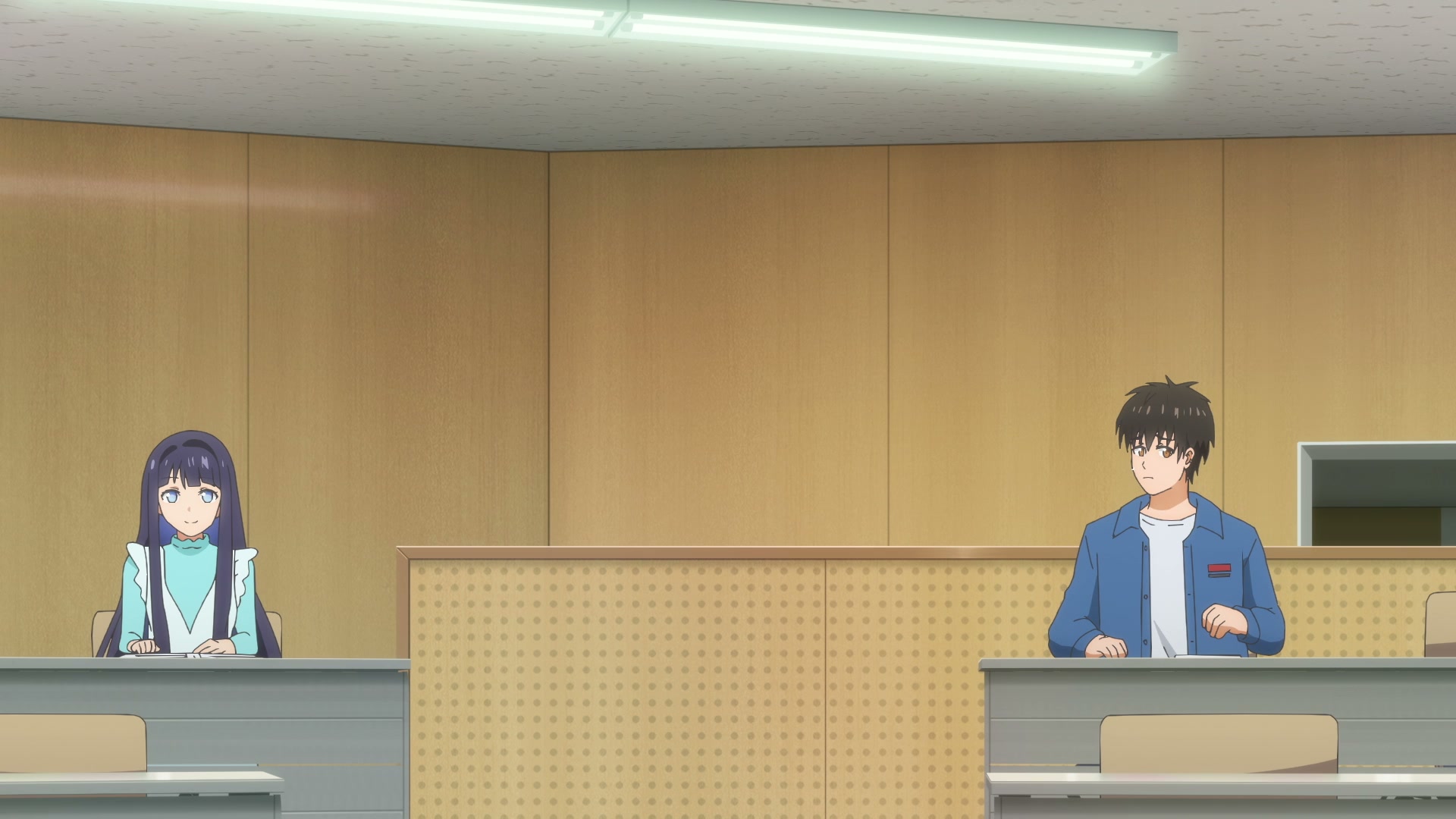
Hayase’s request that Sorano become Fuyutsuki’s student guide for their computer science class hangs over the episode. He does not agree right away. He says he will think about it, and his internal monologue makes it clear that he feels cornered. But the episode ends with him having her contact info and a new, uneasy awareness of his own walls. That is a small step, but it feels earned.
A Few Quiet Visual Choices
The direction in this episode is understated, but a couple of images stuck with me. The fireworks near the end of the party are a good example. Fuyutsuki cannot see them, but she says she likes fireworks and wants to shoot them off with friends someday. Sorano’s internal reaction is skeptical: “How could you see fireworks in a world that’s completely dark?” The show does not answer that question. It just lets the contradiction sit there, and the night sky behind them is clear and full of distant lights she will never see. It is a melancholy image, but not a cruel one.
Later, in the classroom, there is a shot of Fuyutsuki’s hands on her braille note-taker. The device looks tactile and worn, and the camera does not treat it as a curiosity. It is just part of her workspace, like Sorano’s notebook. That kind of visual restraint keeps the episode from feeling like an after-school special.
The vending machine scene is another small highlight. Fuyutsuki calls it “my vending machine,” and Sorano jokes that her family must own a vending machine company. She laughs, and for a moment the episode feels like a normal college hangout. The humor is dry and character-driven, and it works because both actors sell the timing.
Where This Leaves Things
This is not a flashy premiere. It is a slow, introspective introduction to two people who are both, in different ways, isolated. Sorano isolates himself by choice, out of fear. Fuyutsuki is isolated by a world that often does not know how to accommodate her, but she has learned to navigate it with a grace that Sorano cannot fathom. The episode does not force them together romantically. It just puts them in the same orbit and lets the awkwardness and curiosity play out.
I came away from this episode liking both leads and wanting to see how Sorano’s carefully maintained distance will hold up against Fuyutsuki’s quiet persistence. The show has a gentle, observational tone that reminds me of some of the better slow-burn romance dramas, and if it can maintain this level of character writing, it could become something special. For now, it has my attention.
Screenshots
All Toumei na Yoru ni Kakeru Kimi to, Me ni Mienai Koi wo Shita Season 1 posts →