





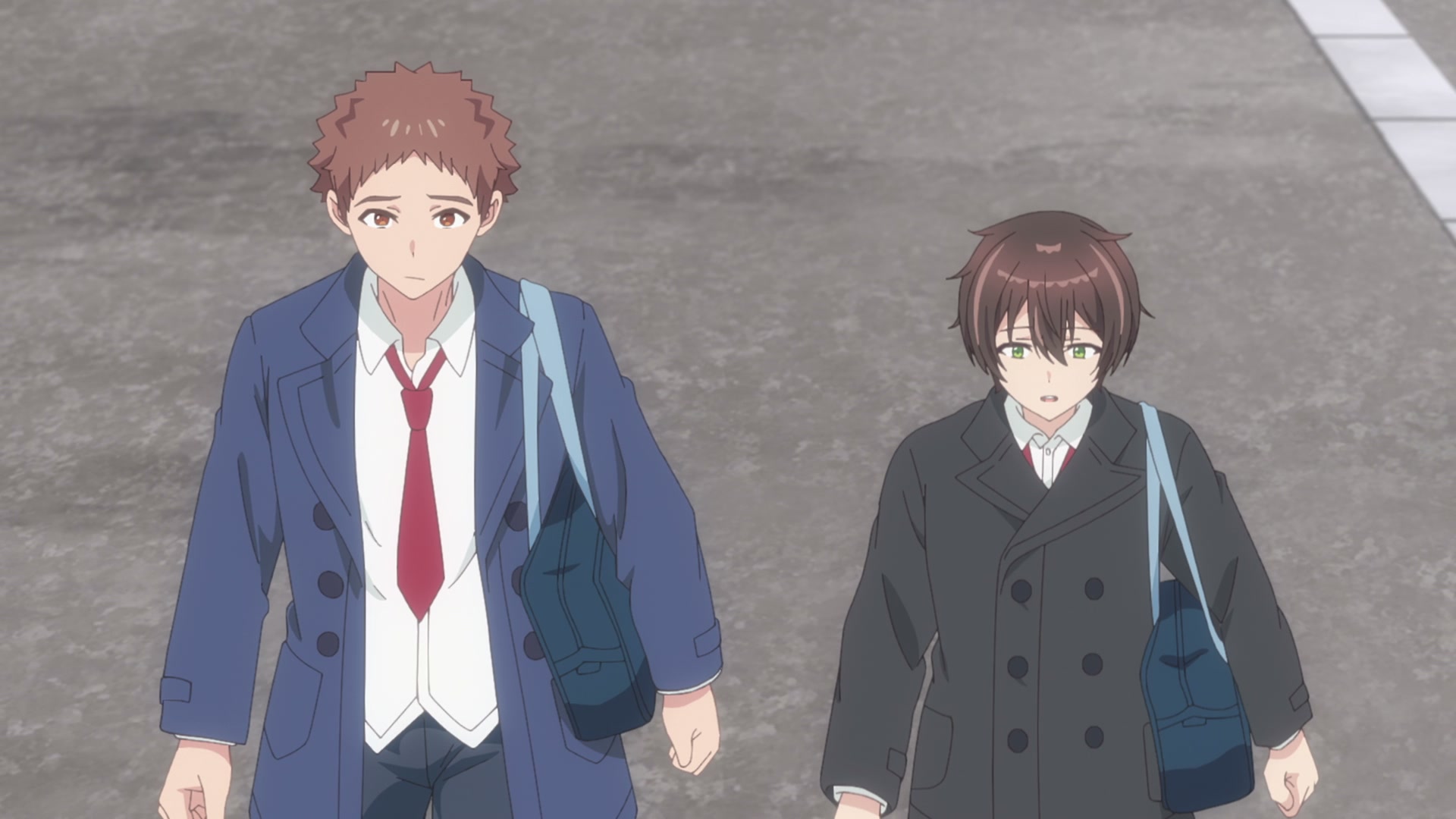
Class de 2-banme ni Kawaii Onnanoko to Tomodachi ni Natta doesn’t usually throw around episode titles like “Family Sights: Part Two,” but when it does, it means business. The previous episode ended with Maki running into his estranged father on the street; this one spends almost its entire run-time dealing with the emotional fallout, and it lands in a place that feels honest, not melodramatic. It also happens to contain one of the most quietly intense Umi moments so far and a Nina appearance that recontextualizes her as something more than a chaotic comic relief character. If you came into this season for the cozy junk food hangouts and gaming marathons, this episode asks you to sit still and listen for a while, and it absolutely earns the shift in tone.
Maki Finally Confronts His Father
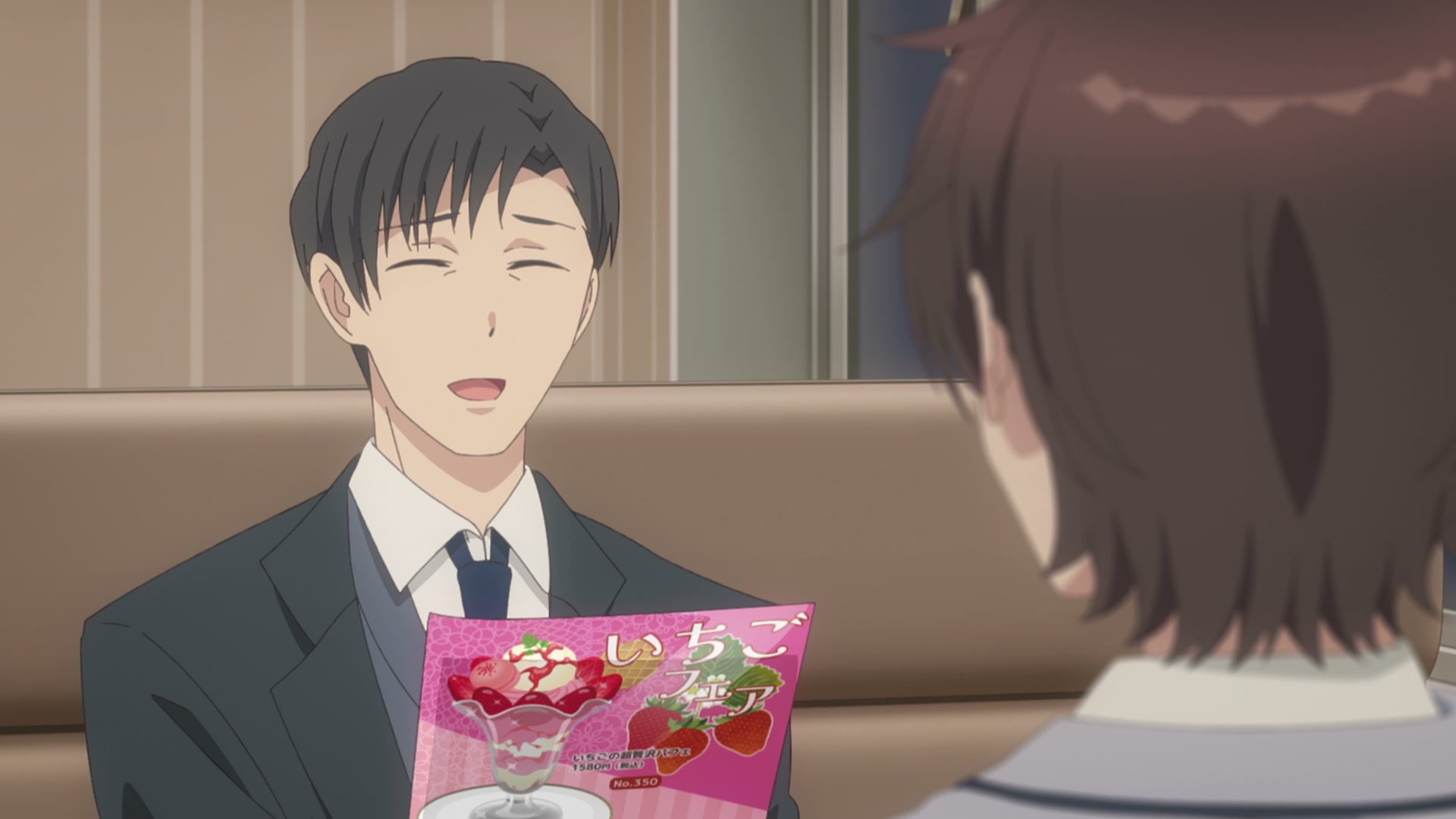
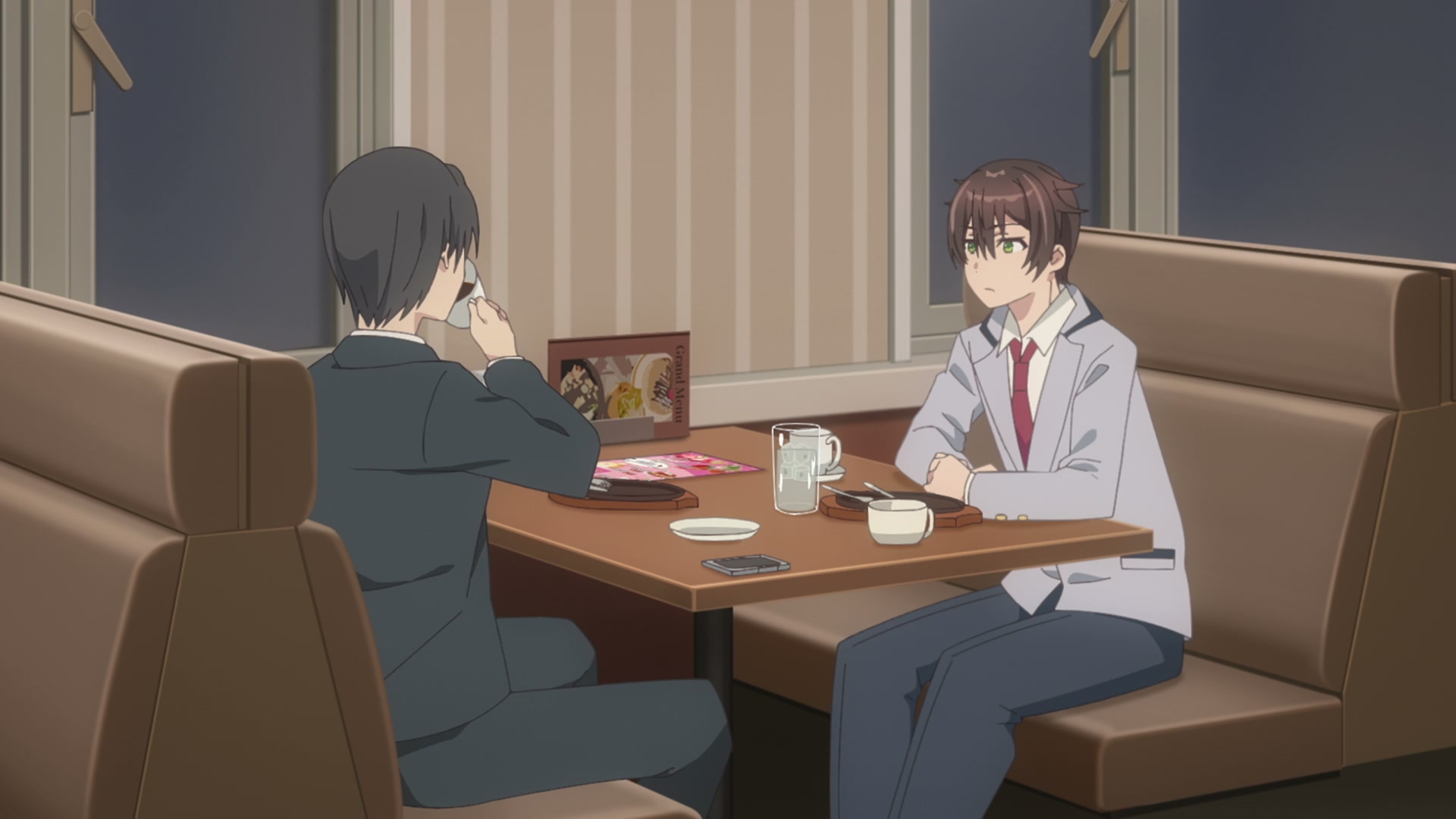
The long-anticipated dinner with Itsuki unfolds exactly how you would expect from Maki’s family history: polite, awkward, and full of things left unsaid. Itsuki is casually affable at first, even commenting on how Maki used to hold back when ordering food. Maki, however, does not hold back. He orders the monstrous A5 wagyu, fried tiger-shrimp, extra-large rice, and loaded strawberry parfait combo that Umi jokingly described to him earlier. It is a small act of passive aggression, or maybe just a way to show his father that he is not the boy who used to cling to his mother’s leg and beg for attention. Either way, Itsuki’s surprised smile registers the shift.
The conversation quickly moves to the raw center of Maki’s pain. He asks if his father still loves his mother. Itsuki’s answer is careful but unambiguous: he respects Masaki deeply, but that romantic love is gone. When Maki brings up the possibility of reuniting “if he were part of the deal,” Itsuki clarifies that custody was the one thing neither parent would budge on. They both love him, and they always will. That truth, spoken plainly, gives Maki a kind of closure he had not allowed himself to expect. Divorce does not mean a lack of love, it just means the shape of that love changed.
Then Maki pushes into the territory that has been eating at him since the karaoke date: Minato-san. Itsuki immediately understands what Maki is implying and swears there was no overlap. He and Minato only started meeting outside work after the divorce was finalized. Maki hears him out but does not let the question go easily. “Do you love Minato-san?” Itsuki takes a long pause, then admits that he does. It is the first time Maki has heard his father name a new feeling so directly, and it rearranges something. His father moved on. The world didn’t end.
That moment softens into a tiny, heartbreaking domestic note: Itsuki notices Maki’s dishpan hands and tells him to use hand cream before bed. It is the kind of paternal gesture Maki probably craved as a child, now arriving years too late, and the show lets it hang in the air without over-explaining. Maki still cannot call this man family, but the cold wall between them has thinned.
Nitta Nina, Unlikely Emotional Radar
Nina’s introduction into this episode is pure situational comedy at first. She’s at the same restaurant, yelling into her phone, stranded with a bill she cannot pay because her boyfriend ditched her to chase his “number one target.” Itsuki offers to cover the difference, but Maki cuts in and pays for her himself with a sharp, “You’re not family anymore, right? Quit trying to act like it.” It’s a small, defiant separation, and Nina clocks it instantly.
Outside the convenience store afterward, with a can of coffee that Maki also paid for, Nina drops the comic mask and speaks with the unnerving clarity she sometimes pulls out of nowhere. She tells Maki that his father’s emotional bomb was a dud: he missed his chance to explode, and now everything is too late. And then, without softening the words at all, she turns that lens on Maki himself. “You’re acting like you’re above it all, but you’re close to ending up a dud, too.” The metaphor is blunt and effective. Suppressing everything until you become emotionally frozen is exactly the path Maki was walking, and Nina sees it because she grew up watching adults who fought, made up, and let things break instead of calcifying.
Her advice, delivered with her usual lack of filter, is to “clean your pipes” with Asanagi. The double entendre is so shameless that Maki has to tell her not to make it sound dirty, but the core of the suggestion is sincere: stop bottling things up, let someone in, or you will lose the people you actually care about. It’s a Nina speech that lands because the episode lets it sit in the cold night air, not as a joke, but as a genuinely perceptive moment from someone who has been watching from the sidelines all season.
Maki’s immediate response is to say he’ll call Umi, and you know he means it.
The Hug That Says More Than Words
Before any of the father drama, the episode gives us a scene that will stick with me for a long time. The study session ends, Yuu and Nozomu leave, and Umi hangs back. She is not her usual playful self. Yuu had casually said she wished she had a guy like Maki-kun in her life, and that small, offhand remark burrowed under Umi’s skin. She hugs Maki from behind, pressing her face into his back so he cannot see her expression, and tells him she got a little worried.
She says, “If I lose you, I’m sure I’ll be traumatized for life.” The line lands with an almost physical weight because Umi rarely voices insecurity this nakedly. She’s always the one setting the pace, teasing, measuring out intimacy with lip balm metaphors. Here, she’s just afraid. Maki’s response is gentle and direct, telling her not to worry because he only has eyes for her, and the tension in her shoulders finally releases. She asks to stay like that a little longer, and the scene breathes with them for a full, quiet stretch.
Visually, the moment is all about the back-and-forth between Umi’s clenched hands and Maki’s stillness. It is one of those beats where the show remembers that romance is as much about letting someone see you unravel as it is about the cute flirting.
The Cream Bit and the Comedy That Still Works
The episode does not forget that this series is, at its core, a comfort watch. The study group sequence is full of the easy domestic charm that defines the trio’s hangouts, from Umi correcting Nozomu’s bracket placement to Yuu shouting “Let’s eat!” when the pancakes arrive. Maki gets cream on his face, and Umi, without any self-consciousness, reaches over and wipes it off for him. The gesture is so casually intimate that Yuu and Nozomu, in perfect unison, tell them to save it for when they’re alone. Maki and Umi apologizing in stereo, both flustered, is the exact kind of soft slapstick that makes their dynamic feel lived-in rather than scripted.
These little moments do not feel like padding. They remind you that Maki’s apartment has become a genuine refuge, and that the friendship circle now including Nozomu adds a new, easygoing rhythm where no one is an outsider. When the show pivots to heavier material immediately after, it does not feel jarring, because the warmth of that hangout is what makes the later vulnerability possible.
The New Panic: Meeting Umi’s Dad
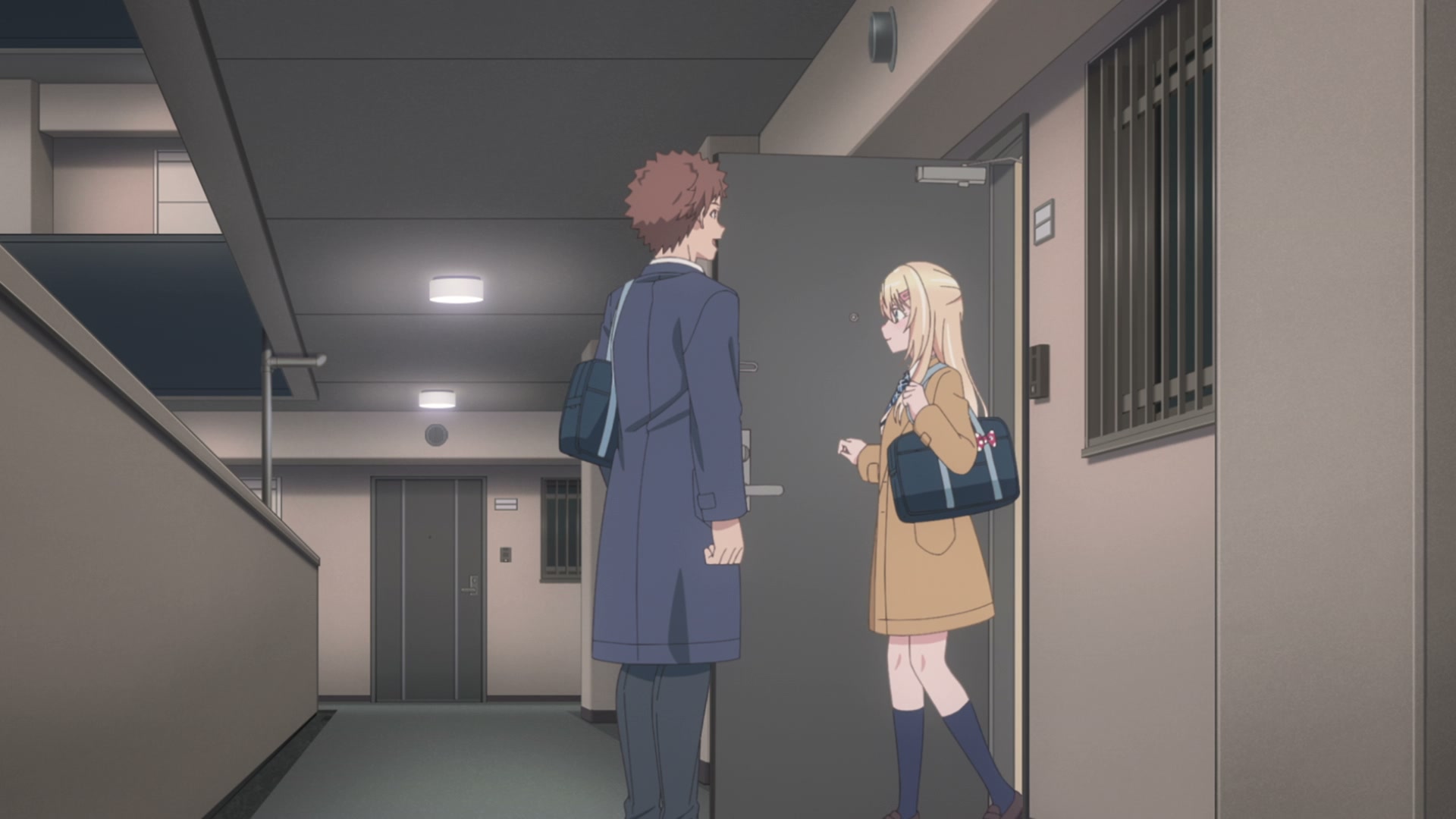
The episode’s final twist is a complete tonal swerve that also feels perfectly in character. With Masaki taking a break from work, the old Friday routine at Maki’s place suddenly isn’t viable, and Umi proposes a new idea: come over for dinner at her house. Her father, she casually mentions, will be there and wants to “get a good look at his face.” Maki’s immediate, full-body refusal is comedy gold, a frantic “Nope! Not happening!” that Umi shuts down with equal force. The episode ends on Maki’s internal narration saying that every worry weighing on him got blown into the ether by this new special event right before Christmas. That’s the show in a nutshell: it refuses to let any single emotion dominate for too long. The father reconciliation and the emotional processing are real, but so is the absurd terror of facing a girlfriend’s dad for the first time.
This ending also quietly repositions the relationship. Maki has just spent an entire dinner proving he can handle adult conversations about divorce, love, and forgiveness. Now he’s being asked to handle something far simpler and far more terrifying. It’s a reminder that growth isn’t linear, and the series has no interest in making him suddenly unflappable.
All in all, this episode does exactly what a good mid-season volume of a slow-burn romance should do. It resolves a long-simmering family thread without cheap sentiment, lets a secondary character step into a more layered role, deepens the central relationship through vulnerability rather than grand gestures, and then immediately throws a new, lighter challenge onto the pile. The balance is tricky, but Class de 2-banme ni Kawaii Onnanoko to Tomodachi ni Natta navigates it with the same quiet confidence it has shown since the beginning. This wasn’t just a necessary episode. It was a quietly excellent one.
Screenshots
← Episode 7 | All Class de 2-banme ni Kawaii Onnanoko to Tomodachi ni Natta Season 1 posts →
[…] ← Episode 8 | All Class de 2-banme ni Kawaii Onnanoko to Tomodachi ni Natta Season 1 posts → […]