






The TV anime adaptation of the acclaimed historical manga Tenmaku no Jaadougaru is currently airing on TV Asahi’s nationwide 24-station “IMAnimation” slot and BS Asahi. Based on the original manga by Tomato Soup (serialized in Akita Shoten’s Souffle), the story is set in 13th-century Mongolia and follows the journey of Shitara, a former slave girl who shakes the empire.
AnimeAnime.jp spoke with Ami Koshimizu, who voices Doregene—the sixth wife of the second emperor Ögedei, harboring a deep desire for revenge against the Mongol Empire. Koshimizu discussed her preparation, the character’s unique relationship with Shitara, and how performances by co-stars Hiro Shimono and Akira Ishida deepened her understanding of Doregene’s complex emotions.
Discovering the Appeal of Tenmaku no Jaadougaru Through History

TV Anime Tenmaku no Jaadougaru – Ami Koshimizu
—How did you feel when you were cast in this role?
Ami Koshimizu: There were two auditions—a tape audition and a studio audition. From the moment I started working on the role at home, thinking about how to express the lines and what kind of performance to give, I felt it was a very rewarding character. I found her extremely appealing, and when I advanced to the studio audition, I strongly wanted to play this role.
At the same time, I was deeply aware of the work’s charm and the original story’s interest, so I also thought, “It would be best if the person whose voice and acting match what Doregene needs is chosen.” Even if it wasn’t me, I would have wanted to see that person’s Doregene because the work is so compelling. So being selected was truly a joy.
—You read the original manga quite thoroughly during the audition stage?
Koshimizu: I read the original for the first time thanks to the audition. Then, before recording the tape audition, I also researched what kind of person existed in history who was in a similar position to Doregene, as well as figures like Genghis Khan who appear in the story.
What surprised me first was how little material there is. For example, looking at Wikipedia, it’s not that there’s no information, but compared to other historical figures, it’s overwhelmingly sparse. It seems that in Mongolia at that time, due to culture and the era, there wasn’t much written record. The remaining materials are mainly memoirs and records from people who visited Mongolia; the people of that time didn’t leave many writings themselves.
I didn’t go to the library to find specialized materials, so there may be more detailed research, but just from easily accessible information, I understood that it’s a time period where it’s truly difficult to know the historical facts. That made me naturally think about how much effort Tomato Soup-sensei must have put in and with what feelings they are drawing this story and its characters.
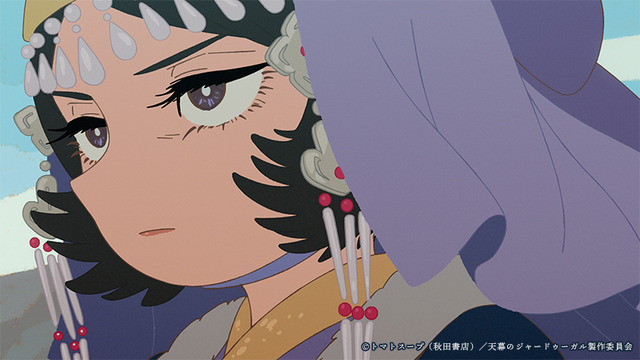
TV Anime Tenmaku no Jaadougaru – Scene Photo
—Through that research, did you come to appreciate the original work’s greatness even more?
Koshimizu: The conversations in the story—maybe they actually happened, maybe they didn’t. But the fact that they are depicted so humanly and beautifully is truly amazing. As voice actors, we actually speak the lines, and there’s no sense of discomfort. Even when I become the character’s emotions and talk with the other person, the flow of words and feelings feels very natural.
When you work on many productions, you sometimes encounter lines that make sense but feel a bit off as words. But in Tenmaku no Jaadougaru, that almost never happens. I think that’s because each character’s thoughts and background are carefully organized, and the words are chosen carefully to build the conversations. I felt that when reading the original, and I felt it even more strongly when actually performing.
—Do you often do such research for other works as well?
Koshimizu: Yes, it depends on the work, but if it’s based on real events or history, I’m curious how much of the historical facts are reflected, and if there are photos or portraits, I want to see them. However, just because I research doesn’t necessarily mean it directly leads to good acting (laughs). But for me, knowing something can give me a clue like, “Maybe this line’s emotion is something like this.” It’s close to finding hints for performance. So it’s half a hobby, and if time allows, I’m the type who wants to look things up as much as possible.
—That attitude of valuing “knowing” seems to connect to Shitara’s way of being in this story!
Koshimizu: Maybe so. Acting also benefits from experiences and feelings that later become hints for understanding a role!
Doregene’s “Stopped Time” and Delicate Heart: She Shows a Girl’s Face Before Shitara

TV Anime Tenmaku no Jaadougaru – Ami Koshimizu
—Earlier you called Doregene “appealing.” What parts of her do you find so?
Koshimizu: To put it simply, I think Doregene is a very delicate woman. She is someone whose time has stopped in some part due to a shocking past event. Of course, over the years she spent in Mongolia, she has aged, given birth, and experienced various things. But I feel that her “true self”—the honest emotions she doesn’t show anyone—remains stopped at that time. That kind of disconnect is one of Doregene’s major charms.
Usually she appears strong, sometimes even frightening. But before Shitara, she sometimes shows very girlish expressions and feelings. There’s no calculation or intention; it’s just her natural self coming out. I personally find people who retain such pure parts even as adults appealing, but in Doregene’s case, it remains in a somewhat special form. It’s as if time only moves before Shitara, and the self from the stopped time suddenly appears.
Of course, the strength she shows normally is also appealing. She may seem unapproachable at first glance, but I think that’s like armor she has put on. That figure is very dignified and cool. The fact that she has such various expressions is the charm of Doregene as a character.
—So there are charms that only become visible thanks to Shitara’s presence.
Koshimizu: This might be a feeling unique to someone playing the role, but I think the relationship with Shitara is truly wonderful. Normally, Shitara is much younger and should be someone you want to protect, but sometimes they look like classmates, and sometimes Doregene looks like an older sister she can rely on. That distance is very warm.
However, this work is based on history. The future has possibilities, but the past cannot be changed. Because I researched, I vaguely know the historical facts that lie ahead. Although it’s a part not yet depicted in the original, knowing that there is unchangeable history makes me personally think about various things the warmer the relationship between Doregene and Shitara appears.
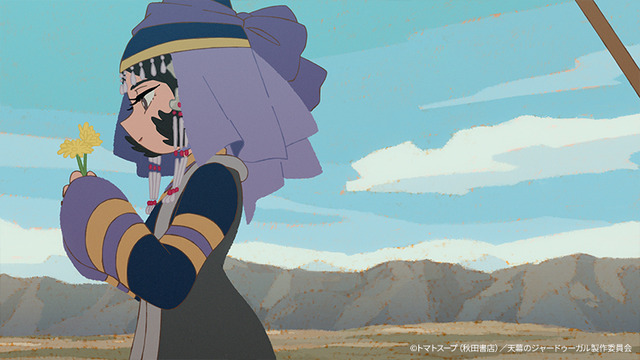
TV Anime Tenmaku no Jaadougaru – Act 3 (Episode 3) “The Unquenchable Flame”
—When we spoke with Akira Sekine-san (Shitara’s voice), she said, “There are no ‘villains’ in this work.” Do you also feel that unique charm of this work?
Koshimizu: I strongly feel that. For example, Doregene’s first words to Ögedei are, “I am not your wife. I am your enemy.” Of course, that feeling is not a lie. Doregene had her homeland taken and her husband killed, and she hates the Mongol Empire and Ögedei. That desire for revenge is the driving force that has supported her.
But on the other hand, Doregene has lived in Mongolia for many years. There are people who care for her, and Ögedei himself is not depicted as a mere tyrant but as a charismatic person who attracts others. So I feel that within her, emotions that cannot be reduced to hatred alone are gradually emerging. Still, she cannot forget the pain of the day she lost her husband or the memory of her stolen homeland. She must not lose sight of the self who swore revenge. So I think those words, “I am your enemy,” are not only a declaration to Ögedei but also a reminder to herself.
To hold back that wavering, she deliberately puts it into words and tells herself. To not forget the stopped time and the feelings she doesn’t want to lose, she keeps the flame inside from going out. That’s how I interpret that scene.

TV Anime Tenmaku no Jaadougaru – Ami Koshimizu
—That really connects to Sekine-san’s words about “no villains.”
Koshimizu: That’s why this work isn’t a simple story of what is justice and what is evil. When depicting history, politics, and nation-building, one person’s justice may not be another’s. As a country grows, there is bloodshed and opposition behind it. Normally, these things cannot be easily judged as good or evil.
What I find amazing about the original is its sense of balance. It doesn’t unilaterally depict “this person is bad” or “this person is right.” It naturally shows each character’s position and circumstances. Before you know it, you’re seeing the story from various characters’ perspectives. You empathize with one character, then learn about another’s situation and your heart wavers. You can’t keep supporting just one person.
That’s why I grow attached to all the characters, and it makes me think about many things. We live in a relatively peaceful and convenient era, but what kind of history lies behind it? What is happiness for people? This work makes you ponder even such questions.
—It’s a work that broadens interest not only in history but also in the culture and daily life of the time.
Koshimizu: Exactly. And the food is also very appealing! The story features Mongolian food culture a lot, and I became very interested after looking into it. There are sweets like dried yogurt, and I thought, “I want to try that!” (laughs). There are also depictions of slaughtering and eating animals, but because the art style is cute, it’s easier to accept, and the anime carefully depicts it with sound, making you realize again that we live by receiving life.
This work gives you opportunities to become interested not only in history but also in culture and food, so I hope viewers pay attention to those aspects as well.
Deepening Doregene’s Emotions Through Exchanges with Hiro Shimono and Akira Ishida

TV Anime Tenmaku no Jaadougaru – Ami Koshimizu
—Sekine-san also said that her expression changed through the exchanges during recording. Did you also discover new aspects of Doregene’s emotions through the recording process?
Koshimizu: Yes! Before recording, I had my own role preparation and a plan for how I wanted to express certain emotions. But when I actually recorded with the other actors, I was influenced in unexpected ways.
In particular, Hiro Shimono-san’s performance as Ögedei was like that. I had a strong preconception of him as “the enemy Doregene must hate.” But when we actually performed together, Ögedei is really a charmer (laughs). He’s calm and gentle, making you want to let your guard down. I understood intellectually why Doregene wavers, but actually receiving his performance made me realize, “Ah, this is why she wavers.” It was an unexpected discovery even for me.
—So you experienced Doregene’s emotions as if you were going through them yourself.
Koshimizu: Exactly. And another big factor was Akira Ishida-san, who plays Dayir Usun. He was truly gentle and beautiful. There were political reasons behind Doregene’s marriage, and of course there was calculation. But from Ishida-san’s performance, love beyond those things naturally came through. He conveyed that he cherished her like a daughter, like family, straightforwardly. There was no pretense, and before I knew it, I myself truly liked him.
The farewell scene was painful because of that accumulation. It’s a difficult expression, but while conveying romantic love, there was no unpleasantness or rawness. It was truly clean, pure, and beautiful love. Ishida-san’s performance that naturally made me feel that was truly amazing.
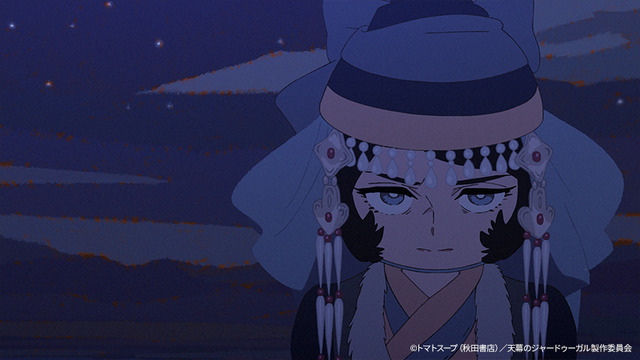
TV Anime Tenmaku no Jaadougaru – Scene Photo
—That’s why the conflict Doregene carries feels so convincing.
Koshimizu: There is anger toward Mongolia. But there are also memories of being loved. There are pasts that cannot be forgotten and feelings that she doesn’t want to forget. Through the exchanges with all the co-stars, those complex emotions became clearer even within me. Actors really are amazing…! I think this work has many things that were born precisely because of this casting. I hope everyone will follow this story while touching each character’s position and feelings.
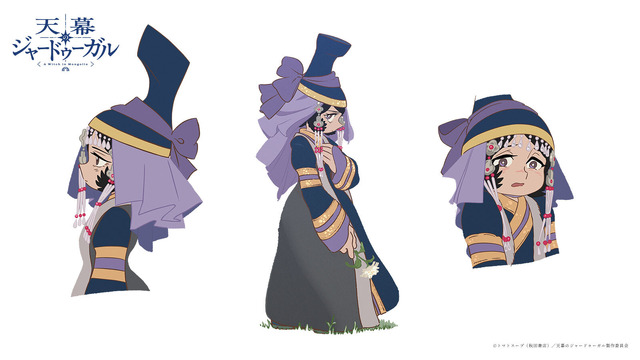
TV Anime Tenmaku no Jaadougaru – Doregene
■TV Anime Tenmaku no Jaadougaru
Currently airing on TV Asahi’s nationwide 24-station “IMAnimation” slot and BS Asahi!
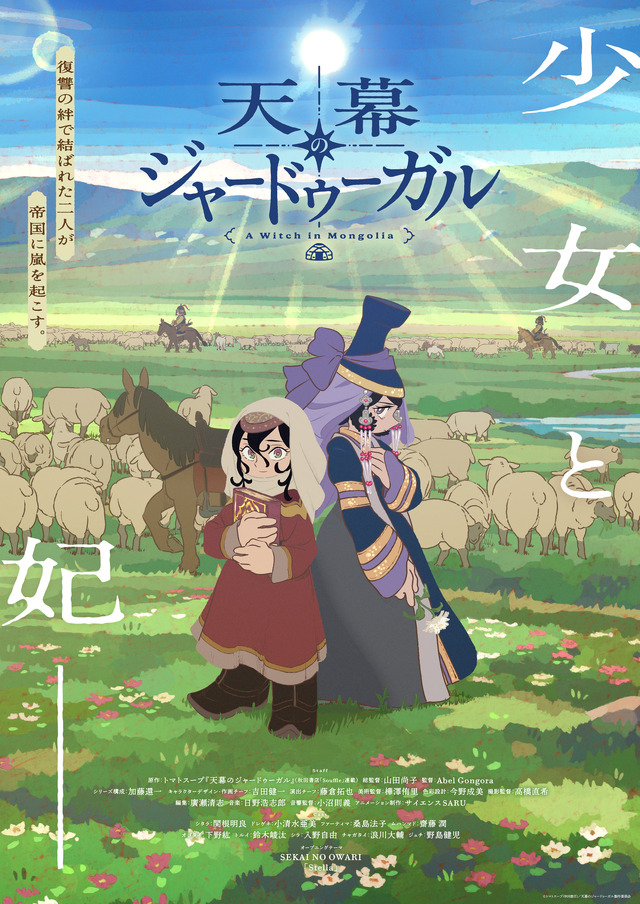
【Staff】
Original: Tomato Soup, Tenmaku no Jaadougaru (serialized in Akita Shoten’s Souffle)
General Director: Naoko Yamada
Director: Abel Gongora
Series Composition: Kanichi Katō
Character Design & Chief Animation Director: Kenichi Yoshida
Chief Episode Director: Takuya Fujikura
Art Director: Yuri Kabasawa
Color Design: Narumi Konno
Director of Photography: Naoki Takahashi
Editor: Kiyoshi Hirose
Music: Koshiro Hino
Sound Director: Noriyoshi Konuma
Animation Production: Science SARU
【Cast】
Shitara: Akira Sekine
Doregene: Ami Koshimizu
Fatima: Houko Kuwashima
Muhammad: Jun Saito
Ögedei: Hiro Shimono
Tolui: Ryota Suzuki
Shira: Miyu Irino
Chagatai: Daisuke Namikawa
Jochi: Kenji Nojima
Sorkoktani: Misaki Kuno
Möge: Ayaka Asai
Kyrgyzstani: Mayumi Shintani
Boraqchin: Kujira
●Opening Theme: SEKAI NO OWARI “Stella”
●Ending Theme: Queen Bee “Hoshi”
(C) Tomato Soup (Akita Shoten) / Tenmaku no Jaadougaru Production Committee
Interview by Kaori Yoneda