





Episode 1: My Childhood Friend Refuses to Accept Defeat
The first episode of Aishiteru Game wo Owarasetai plants its flag firmly in childhood-friend-romance territory, but with a twist that makes the familiar setup feel freshly self-aware. Asagi Yukiya and Sakura Miku have been playing a game since sixth grade: take turns saying “I love you,” and the first one to blush loses. Four years later, they’re entering high school, the rules have evolved into a chaotic anything-goes battle of nerves, and absolutely nothing has been resolved—because neither of them wants to be the one who cracks first.
What sets this premiere apart is how it treats the “I love you” game not as a random quirk, but as the central nervous system of their relationship. It’s the excuse that lets them orbit each other without ever having to be vulnerable. And the show knows it.
The Basics of an Unwinnable Game
The episode lays out the history efficiently. In sixth grade, Miku would fire off “I love you” at Yukiya just to see him react. Yukiya, perpetually losing at everything else, saw the game as his one shot at seeing her flustered. The turning point came in their second year of middle school, when a single “I love you” from Miku finally made Yukiya’s heart stumble. The subtitles mark the moment with a simple “THUMP-THUMP” and a quiet confession: “That was when I first realized I had feelings for her.”
Since then, the game has become a high-stakes endurance race. They’ve added rules that let them do practically anything—teasing, sudden kabedon, even subtle outfit sabotage—to force a blush. The win condition has shifted from “make the other person react” to “extract an admission of romantic interest.” Yukiya is so terrified of the teasing that would follow if Miku found out he actually likes her that he’s turned the game into a battle of pride. Miku, meanwhile, wants Yukiya to see her as a girl, and she’s convinced that winning the game means he finally will. It’s a deliciously circular stalemate: both want the same thing, but the game they’ve built around it actively prevents them from getting it.
A Duel of Stubborn Hearts
The comedy in this episode is all in the timing and the sheer volume of ways these two try to one-up each other during the walk to their high school entrance ceremony. Yukiya, armed with a new haircut and a few pages of sparkly shoujo manga research, tries to pull off a cool kabedon. Miku counters by casually fixing the loose button on his uniform—an act so domestically intimate that it short-circuits his bravado. When he grabs her hand, she’s the one who flakes. Neither can hold the upper hand for more than a few seconds, and the show wrings every drop of awkwardness out of that.
The kabedon sequence is a perfect miniature of their dynamic: Yukiya makes his move, Miku immediately calls it out as dated (“Is kabedon even a thing anymore?”), and yet neither of them is immune. Miku’s fingers touch his collar and his entire cool-guy persona evaporates. That the show acknowledges how played-out kabedon is while still letting it work on the characters is the kind of self-aware humor that keeps the bit from feeling stale.
Later, Miku deliberately loosens her uniform to show a little skin, and Yukiya’s first instinct isn’t to blush but to tell her to button up—because “other guys will see you that way.” The possessiveness slips out before he can filter it, and it’s one of the few moments where the game’s thin veneer of “just a contest” cracks. Miku, of course, interprets it as a victory. She’s not wrong.
When the Inner Monologue Speaks Louder
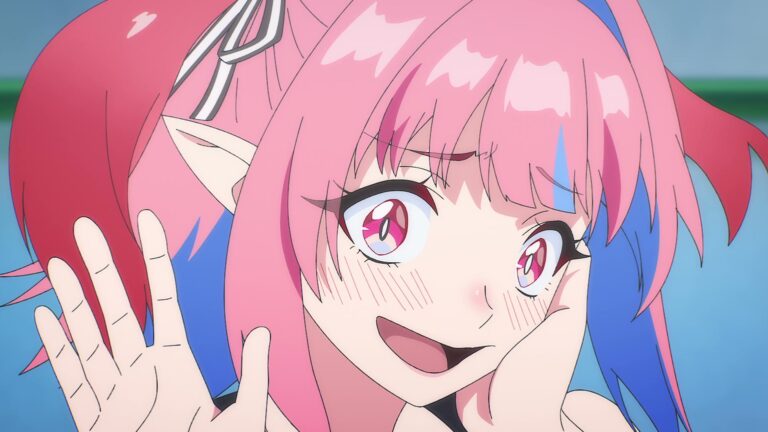
One of the episode’s smartest choices is how it lets us hear both sides. Yukiya monologues about training himself in ninth grade—getting taller, changing his hair, even studying shoujo manga for the “every girl’s hopes and dreams” blueprint. He’s desperate to become “such an awesome man that she has to admit defeat.” Miku, meanwhile, got up two hours early to perfect her skin and picks her uniform specifically to get a rise out of him. She’s been in love with him since she was a kid and wants him to acknowledge her as a girl “in his own words.”
Two of the episode’s best visual moments lean into that parallel. Around the fourteen-minute mark, as Miku internally catalogs every improvement in Yukiya’s appearance—his styled hair, his height, the way the uniform sits on him—the screen softens. She’s been imagining him in that uniform for ages, she tells herself, but it’s clearly knocking the wind out of her anyway. Meanwhile, Yukiya’s earlier “what if” montage, around the eight-minute mark, is a stark little daydream about a world where the game never existed and Miku slipped away. The episode doesn’t need to be dramatic about it; the brief, quiet framing does enough to show that the game isn’t just a joke to him.
Little Visual Moments That Land
The direction knows when to lean into manga-inspired exaggeration and when to pull back. The shoujo-manga research scene—complete with a panel of a girl going “You may as well be mine” and Yukiya’s sweatdrop—is a direct wink at the audience. The recurring PIKULULU drink, with its “contains live lactobacillus cultures” label, becomes an absurd prop for an almost-indirect-kiss moment that Miku immediately hijacks to tease him. The entrance ceremony sequence ends with both of them sneaking glances at the class placement list and then simultaneously trying to act indifferent. It’s the kind of beat that could feel generic, but the short, sharp mutual panic (and the subsequent fantasy sequences about sitting next to each other in class) gives it just enough personality.
The episode also makes smart use of its on-screen text. “THUMP-THUMP,” “BA-DUMP,” “I LOVE YOU,” “WHAT IF…,” and the deadpan “ALAS” that precedes Yukiya’s middle-school revelation are deployed with a light touch that adds to the comedic rhythm rather than overwhelming it.
The Friends Who Know Exactly What’s Happening
Hinako and Masaru serve as the audience’s surrogate observers, and they’re already tired of the two idiots. Hinako calls Yukiya “completely infatuated,” and Masaru calmly explains that the game has become an endurance race because neither can admit their feelings. Their deadpan reactions keep the episode from feeling too insular—someone in this world has noticed that the game stopped being a game years ago. Masaru’s observation that the rules changed to “allowed to do anything to win” is delivered almost as a weary caveat, and it makes the whole situation funnier.
Wakana, Yukiya’s little sister, only gets a couple of lines—including the episode’s next-episode preview—but her embarrassed “So embarrassing, Onii!” when she catches him reading shoujo manga is a tiny, well-placed sibling moment.
What This Premiere Gets Right
For a show about two people who can’t be honest, Aishiteru Game wo Owarasetai episode one is surprisingly upfront about what’s going on. It doesn’t pretend the attraction is ambiguous. It just puts all the tension in the gap between what the characters feel and what they’re willing to say. The game is a proxy, a safety net, and a constant source of mutual torment. The premiere sells that premise with enough comic energy and genuine sweetness to make their stubbornness endearing rather than frustrating.
The class placement list ends with both of them in Class 1-1, and their matching internal screams of “I can’t wait!” say everything. The game isn’t ending anytime soon—and that’s exactly the point.
All Aishiteru Game wo Owarasetai Season 1 posts →
Series archive