




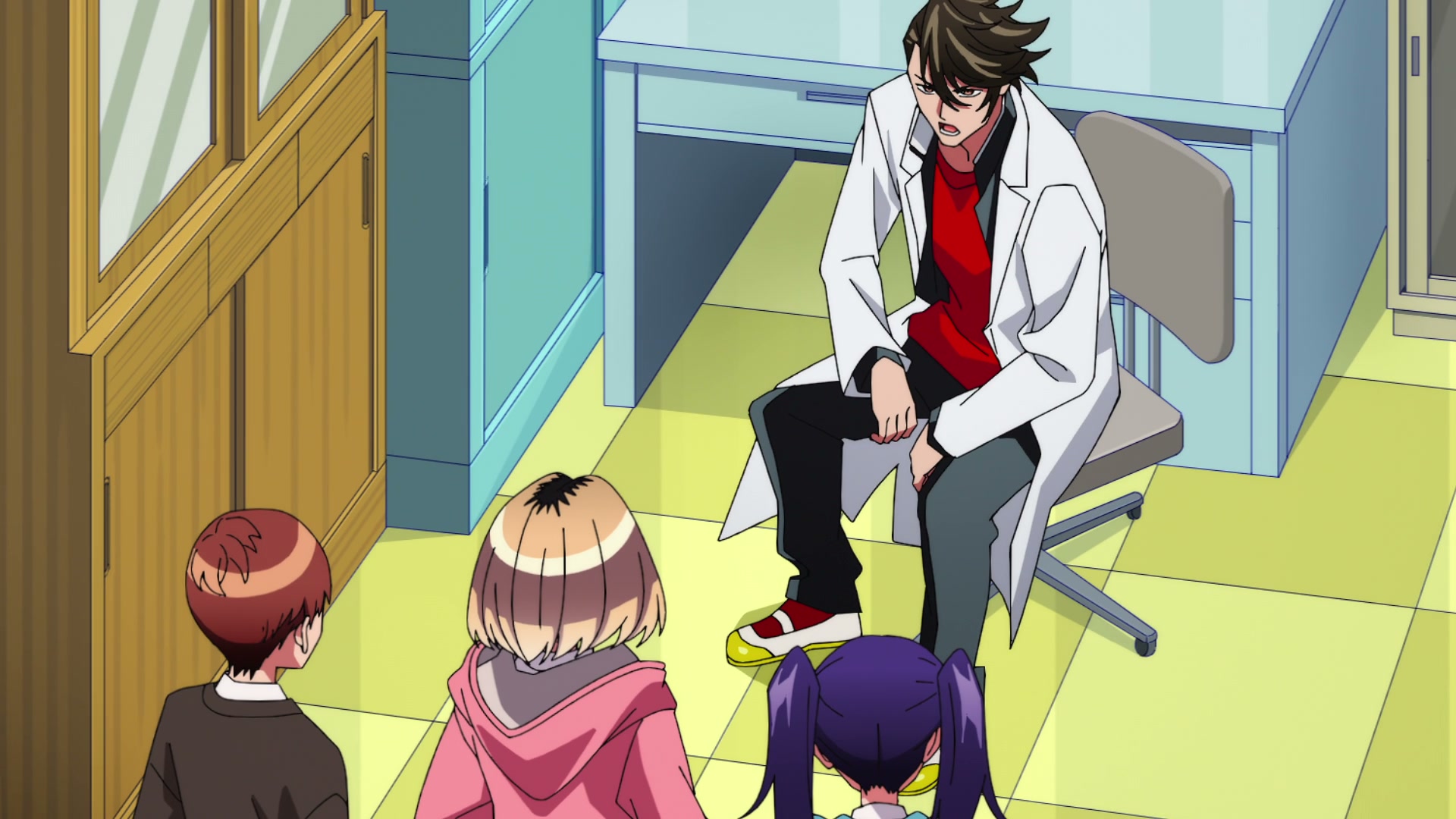
Episode 3 kicks off with the kind of small-scale chaos that this series has already made its signature. Someone new is at the school gate, and the entire social order of Sakuradaimon Togo’s rigid morning routine threatens to collapse. The reason? A “super sexy gyaru” upperclassman with a skirt far shorter than anything the rulebook would sanction. And Togo lets her through without a word.
For the girls who get lectured every single day about skirt lengths and dress code violations, this is an immediate betrayal. Poem, Tasaki, and Akina can’t believe what they’re seeing, and Togo’s excuse, that she’s an “exception,” only makes things worse. The group’s outrage sends them hunting through the school to find this mysterious woman, leading to one of the episode’s best early gags: the moment they corner her, she simply evaporates. Tsukishima, safely inside his library domain, goes pale at the mention of her. Izubuchi, who normally faces down anyone with a snarl, flatly warns them to “give up on her. She’s bad news.”
When the truth comes out, it’s less a twist and more a perfect encapsulation of what this show does well. The super sexy gyaru is Yamato Nadeshiko, the student council president. And she was wearing that outfit deliberately, not out of rebellion, but to understand why female students alter their uniforms in the first place.
The President Gets It
The bubble tea shop scene with Nadeshiko and Poem is where the episode clicks into a gentler gear. Instead of a lecture, Nadeshiko asks genuine questions. She zeroes in on Poem’s own fashion choices, and when Poem blurts out that she just thinks a short skirt is cute, Nadeshiko accepts the answer immediately. No scolding, no power play. She simply needs the information to do her job better.
There’s a quiet wisdom in the president’s approach that the series hasn’t fully shown from an authority figure before. Togo is well-meaning but completely literal about rules. Izubuchi is abrasive. Tsukishima hides from everyone. Nadeshiko, by contrast, is confident enough to step into a completely different persona and risk looking absurd, all to gather firsthand data. She even admits she enjoyed being fashionable for a day, which makes the whole thing feel less like a stunt and more like genuine curiosity.
At the same time, she doesn’t let Poem off entirely. She acknowledges that male students can’t help noticing, and suggests keeping things in moderation. It’s a balanced read of the situation, and it instantly recontextualizes the “exception” Togo made earlier. He wasn’t playing favorites. Nadeshiko was on a sanctioned mission, and Togo, being Togo, followed the chain of command.
The Compliment That Only Belongs to Her
Right after this conversation, Togo catches up to Poem outside the shop. He has clearly been stewing over something, and what comes out is one of his most endearingly blunt confessions yet.
“The first time I told a woman she was attractive was you, and you’re the only woman whom I’ve called ‘wonderful’!”
He says this like it’s a statement of fact, expecting it to clear him of any charge of womanizing. Poem, to her credit, sees the sweetness underneath the social obliviousness. The entire exchange is wrapped in the series’ ongoing joke that Togo has zero guile and even less awareness of how his words land, but the warmth is genuine. She tells him he’s fine, and he brightens immediately, adding that from now on he’ll take care to only say that to her. Poem yells at him not to, but the damage is done. Togo has carved out a category for her alone, and she knows it.
It’s a small moment, but it’s the kind of thing that makes their dynamic more than just a comedy routine. The show trusts its audience to remember that Togo started the series as a relentless scold, and that this softness is hard-won.
The Fundraising Battle
The second half pivots into a student council fundraising competition, and that’s where the episode introduces its other major new piece: vice president Kogori Kaoru. Where Nadeshiko is flexible and observant, Kaoru is proud, blunt, and perpetually frustrated. His first instinct is to throw his family’s wealth at the problem. His second instinct, when that fails, is to declare war.
Nadeshiko, predictably, uses the whole situation to her advantage. She casually suggests that each council member pursue their own fundraising method, then proceeds to recruit practically the entire school to help her. Her ability to command loyalty (or, in Tsukishima’s case, reluctant forced participation) is played for laughs, but it also shows why she holds the president’s seat. She knows how to motivate people without browbeating them.
Kaoru, in contrast, tries to rally sports clubs with promises of air conditioning and ends up having to fund it out of his own pocket. The secretary Tokoro, whose name he never gets right, trails behind him like a polite but exhausted shadow. The comedy is broad but well-timed, and Tsukishima’s brief reappearance as the library prince, sweet-talking a passerby into donating more money, is the exact kind of two-faced gag that his character exists to deliver.
When the results come in, Kaoru wins by a narrow margin. He’s triumphant. And then Nadeshiko congratulates him warmly, with no trace of defeat. She tells him he lived up to her expectations, and the camera lingers on Kaoru’s realization that he was never actually competing against her. He was dancing in her palm the whole time.
The Night Shift
The payoff lands after the contest ends. Kaoru, we learn, didn’t just rely on his wallet. He spent the previous night doing manual labor, road repairs in the dark, and he put that paycheck into the donation box. Nadeshiko saw him. She calls him out gently, not as an antagonist but as someone who has known him long enough to call him by his first name. The bubble tea she offers him afterward is a less sweet kind, a small gesture that shows she knows his tastes.
Kaoru’s line, “since the day I met this woman, I’ve never once been able to beat her,” lands with a mix of bitterness and admiration. The episode doesn’t try to resolve that tension, and it’s better for it. It simply establishes that these two are woven into each other’s lives, and their battles are part of a long history we’re only starting to see.
Little Moments That Stood Out
A few beats from the episode that deserve extra love. The entire school chasing a gyaru who turns out to be the president is objectively hilarious. Tasaki and Akina’s total 180 on Togo, calling him an idiot for playing favorites, then immediately forgiving him once the truth comes out, is pure friendship energy. Izubuchi, despite his tough talk, folds instantly when Nadeshiko threatens to share stories of how she “pulverized” him. The implication that the president has physically defeated the school’s toughest delinquent is too good to leave unexamined. Togo’s existential crisis over whether he can donate his lunch money, weighing a 500 yen coin from his mother against disaster relief, is peak Togo. The man turned a simple donation into a moral philosophy exam.
Visually, the episode keeps its colors warm and its character expressions sharp. The bubble tea shop scene in particular is a nice break from the school setting, and the final night sequence with Kaoru under the streetlights gives his pride a quiet, almost lonely visual weight.
Where This Leaves the Series
Episode 3 broadens the world without losing focus on the central pair. Nadeshiko and Kaoru are welcome additions not because they bring high drama, but because they show different styles of responsibility and stubbornness that reflect back on Togo and Poem. Nadeshiko’s willingness to bend the rules to learn, and Kaoru’s refusal to admit defeat even when he knows he’s been outplayed, both feel like future mirrors for our leads.
That the episode still finds room for a genuinely sweet Togo-Poem exchange in the midst of all this is a testament to the series’ priorities. The plot mechanics of the fundraising war are never more important than the small gestures. That’s the right instinct for a show built on misunderstandings, slow-burn affection, and the quiet chaos of trying to do the right thing in a school full of people who refuse to make it easy.
Screenshots
← Episode 2 | All Ponkotsu Fuuki Iin to Skirt-take ga Futekisetsu na JK no Hanashi Season 1 posts →