

Television anime continues to raise its visual quality year after year, with many shows now being praised as “movie-like.” Amid this trend, one area where every production pours in extra effort is the opening and ending sequences that air weekly.
Non-credit versions uploaded to YouTube often generate buzz similar to promotional videos. OP/ED sequences, being short, frequently boast higher quality than the main episodes. They also tend to emphasize concept over formulaic structure, making them a space where directors’ authorship shines through.
This article picks out three such pieces — the “face of anime” — directed by rising talents.
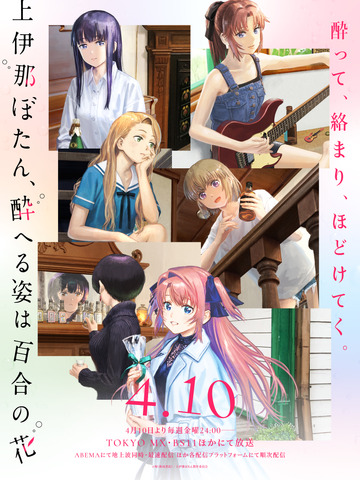
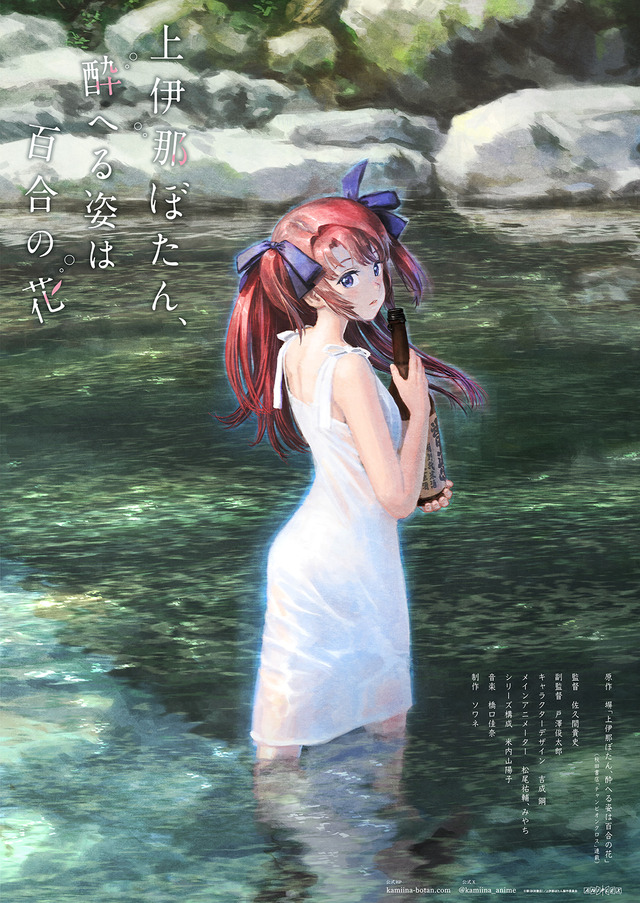
Director: China — “Kamiina Botan, Yoeru Sugata wa Yuri no Hana” OP “Mezame no Toki”
Young director China has gained attention for experimental visual compositions using format and perspective, such as the 4:3 imagery in the MV “Detarame na Sekai no Melodrama” (music: CreepHyp “Rinto”) and “Sore o Ai to Yobu dake” (music: Mafumafu), and the impressive first-person POV in the second cour OP of Kusuriya no Hitorigoto (“Kusushiki,” music: Mrs. GREEN APPLE).
The accumulation of these experiments takes shape in the OP for Kamiina Botan, Yoeru Sugata wa Yuri no Hana (hereafter Kamiina Botan), titled “Mezame no Toki.” This sequence has reached a level of completion worthy of film festival recognition — it even participated in the Hiroshima Animation Season competition.
It pursues a texture reminiscent of footage shot on 8mm film. Instead of the standard 24 fps, it adopts 18 fps, and adds camera shake that suggests a character holding the camera while filming. Another feature is that a “complete version” exists alongside the TV broadcast version. The complete version uses a 4:3 aspect ratio instead of 16:9, recreating the form of once-popular home video on 8mm film. Given that Kamiina Botan depicts female college students who love culture — drinking, bands, movies, travel — this 8mm-style expression feels like a natural choice.
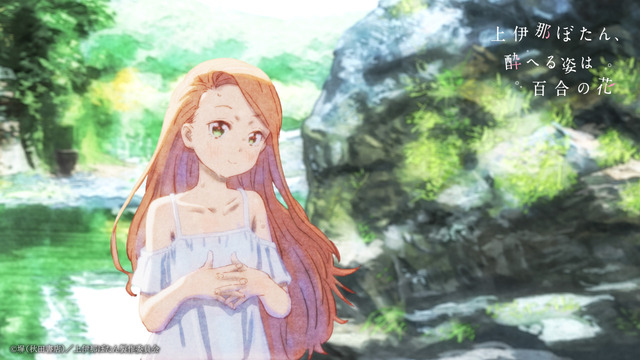
The sequence also employs the “cine-calli” technique of directly scratching lines and writing on the film surface to capture the characters’ sensibilities. While TikTok-style self-filming shots are common nowadays, an OP combining 8mm aesthetic with cine-calli is extremely rare. This expression is uniquely possible for Kamiina Botan, whose characters would indeed film themselves on 8mm.
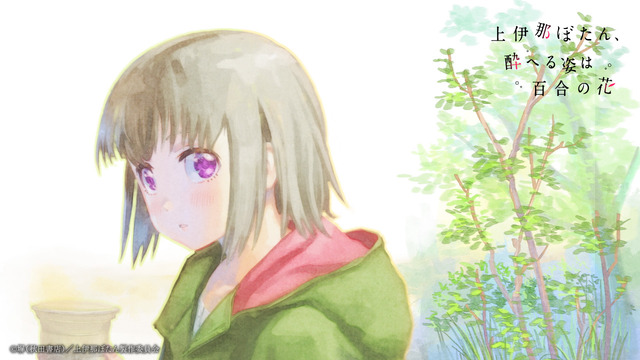
Though the visuals appear unified as a “home video” from the characters’ perspective, directorial tricks are embedded within that consistency. For example, at the point where the cine-calli drawn text “nee” in the chorus synchronizes with the lyrics, a dolly zoom technique is used, giving a different impression from the amateur home-video style of other parts. This slight deviation from overall unity creates the viewing pleasure and uplifting feel expected of an OP.
◆Opening Theme
yonige “Mezame no Toki”
Lyrics & Music: Arisa Ushimaru
Arrangement: yonige
Director: Ken Yamamoto — Shunkashuutou Daikousha Haru no Mai OP “Petals feat. Natsuse”
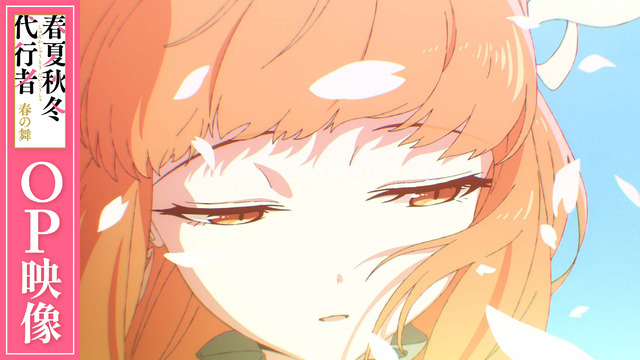
The OP “Petals feat. Natsuse” (hereafter “Petals”) was directed by series director Ken Yamamoto himself. Yamamoto made his feature directorial debut with Uma Musume: Pretty Derby – Beginning of a New Era, and this series marks his first TV series directorial role. He has previously directed OPs such as 86-Eighty-Six second cour (music: amazarashi “Kyoukaisen”) and WIND BREAKER Season 2 (music: SixTONES “BOYZ”), gaining attention for his compositional skill and visual expression. He also has close ties with China, and they have appeared together in talk events for Anime Fantasista Japan, making him one of the most notable young directors.
In “Petals,” Yamamoto’s characteristic “back shot” directing stands out. As seen in 86 and WIND BREAKER, he captures characters from behind, showing wind-blown hair and clothes without revealing expressions, thereby emphasizing a posture of “facing forward.” This maximizes the emotional impact when the character’s face is finally shown.
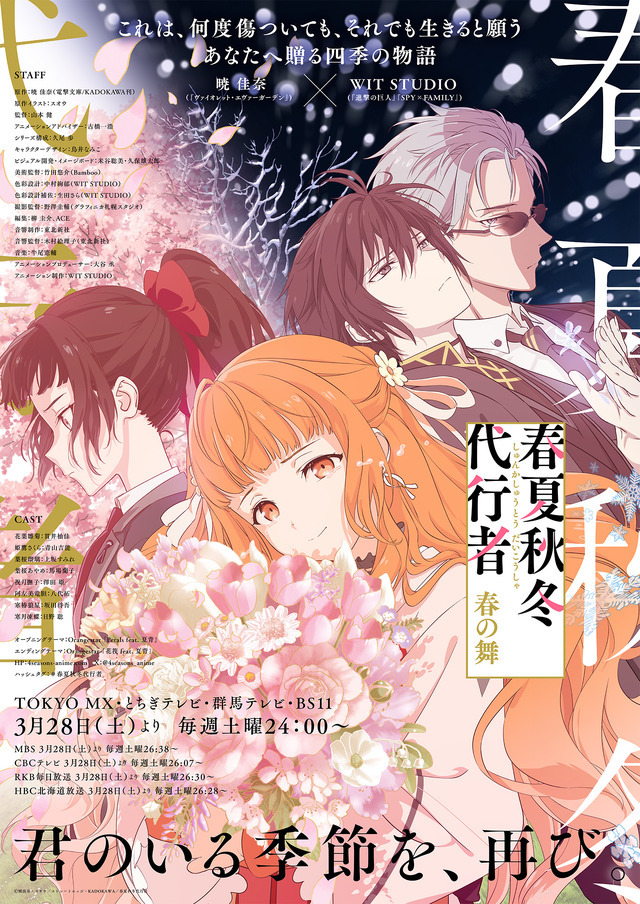
The OP functions as a symbolic illustration of the story’s themes. The shot of protagonist Hinagiku reaching out to herself represents her internal disintegration after a kidnapping incident. The cut transitions at the moment her hand almost touches herself, leading to a scene where Hinagiku and her attendant Sakura join hands, clearly presenting the possibility of reconciling “two Hinagikus” and the relationship between the two.
◆Opening Theme
Orangestar “Petals feat. Natsuse”
Lyrics & Music: Orangestar
Arrangement: TAKU INOUE, Hironao Nagayama, Orangestar
Storyboard & Direction: Moaan — NEEDY GIRL OVERDOSE ED “Revision”
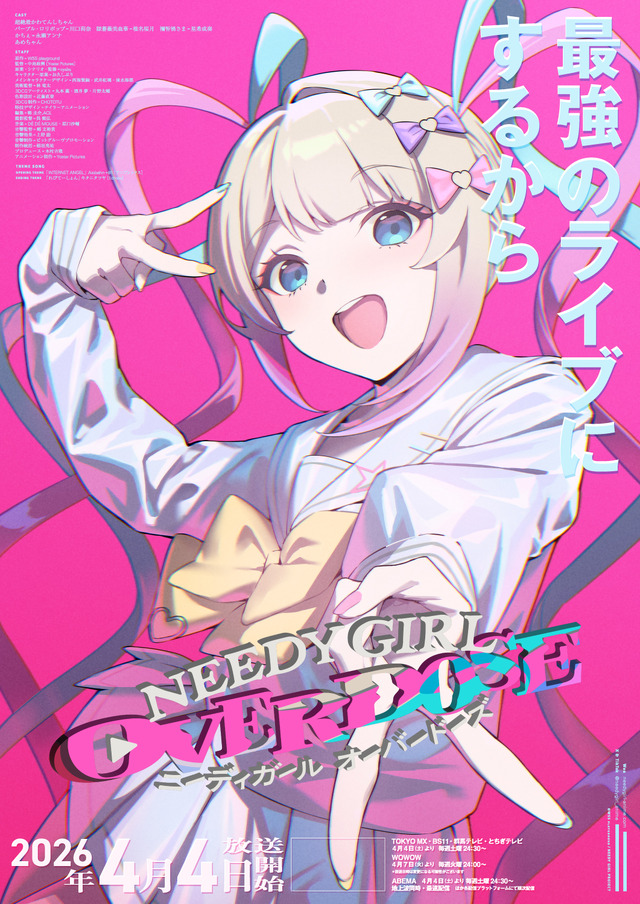
The ED “Revision” for NEEDY GIRL OVERDOSE (hereafter Nidiga) is directed by Moaan, who worked on storyboard and direction for Akebi-chan no Sailor-fuku episode 7 and the ED of Blue Archive The Animation (music: Abydos High School Countermeasures Committee). Moaan also collaborated with China (director of the Kamiina Botan OP) as a key animator and animation supervisor, showing deep industry connections.
As an animator, Moaan is praised for delicate everyday acting; as a director, his forte is meticulous visual composition that combines “voyeuristic angles” and “subjective angles.” This precise direction, reminiscent of Mamoru Hosoda’s technique of composing works with hidden cameras and point-of-view cameras, matches Nidiga‘s ED surprisingly well.
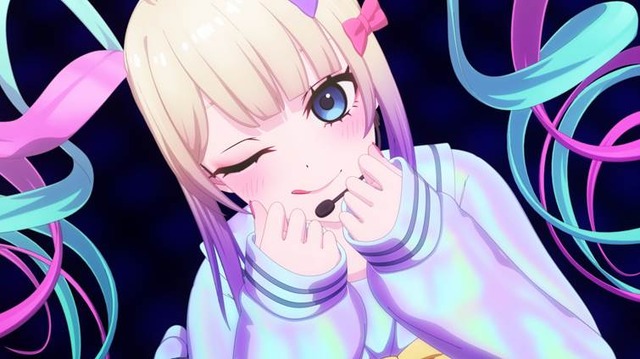
The OP is an upbeat, high-tempo song — self-deprecatingly described in the show as “You garbage kids just stream short videos with fast music and enjoy life efficiently” — while the ED contrastingly focuses on an urban stillness that is surprisingly quiet.
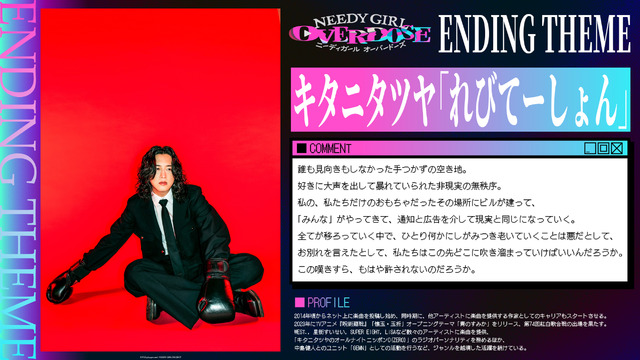
The inorganic cityscape, apparently based on thorough location scouting, is so realistic it could be mistaken for live-action. The characters placed within it create a sense of both discomfort and beauty, as if 2D characters were composited into live-action footage. This technique echoes recent trends seen in Make Heroine ga Oosugiru! ED “LOVE2000” (music: Anna Yanami (CV. Hikaru Tohno)) and the MV for SUNFADED (music: Hatsuboshi Gakuen), but Nidiga‘s ED achieves a unique fusion by treating the background strictly as “drawn” artwork.
The use of desaturated colors built on brightness, approaching monochrome live-action imagery, along with camera work heavy on hand-shake and zooms that mimic actual filmed footage, likely realizes this live-action cinematic texture.
Whereas Kamiina Botan achieved a “sense of being filmed by characters” through animation, the Nidiga ED reproduces a texture akin to “2D characters inserted into actually filmed footage” — a combination of 2D and live-action — as pure animation, making it intriguing both technically and conceptually.
In the short span of one and a half minutes, OP/ED sequences condense the director’s authorship. They are now expressive domains that deserve discussion alongside the main story. Directors China, Ken Yamamoto, and Moaan are already accomplished yet still young, and their future work across various fields is highly anticipated. The next expressions they show us — these OP/EDs may one day be remembered as their “origin points of authorship.”
Kuko