






The first episode of Grow Up Show – Himawari no Circus-dan wastes no time establishing its tone: a little bit cruel, a little bit warm, and completely unapologetic about how much it loves the circus. Tsurumaki Mizuka, our protagonist, is dragged into the world she claims to despise, and the show makes her eat those words with a side of barley tea and a 39,800 yen debt. It is a premiere that juggles slapstick, genuine circus spectacle, and a surprisingly sharp edge, all while introducing a cast of misfits who already feel like a family, even if they would never admit it.
A Reluctant Arrival
Mizuka collapses from dehydration on the side of the road, having walked nearly 100 kilometers from Oomori after her father stopped sending money. She is rescued by the Himawari Circus, a small traveling troupe based in Odawara. Her first instinct upon waking up is to leave. Her second instinct is to eat three days’ worth of food in one sitting. The show immediately paints her as someone who has been burned by the circus life, but also as someone who cannot fully escape it. Her body still moves like a performer’s, and her eye for technique is razor-sharp. When she watches Kawasumi Ouka’s trapeze practice, she does not just admire it; she dissects it, noting the muscle development and the wasted potential.
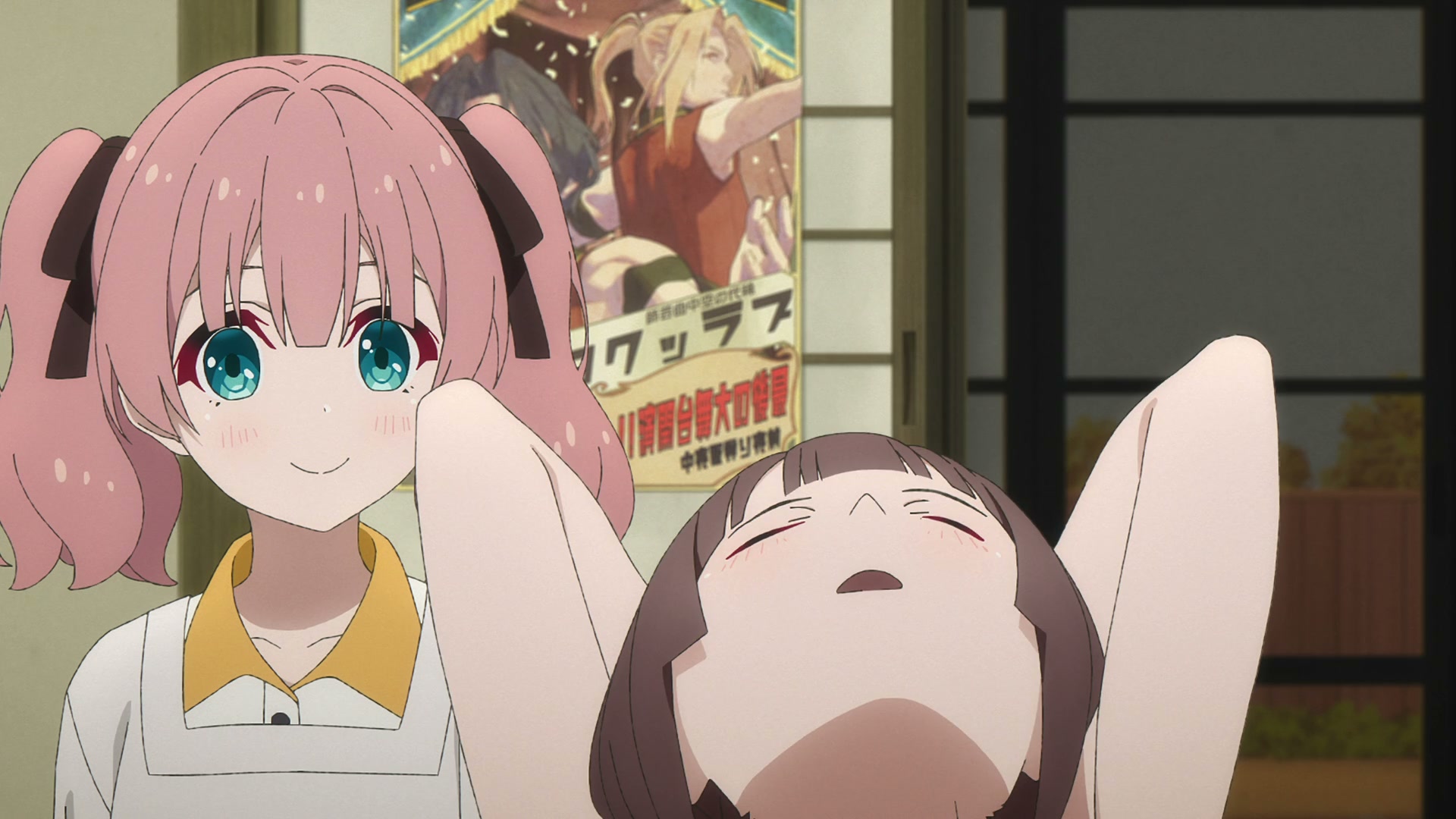
The comedy in these early scenes lands because Mizuka’s deadpan hostility bounces off the troupe’s relentless friendliness. Rin, the girl who found her, offers barley tea and a place to rest. Maria, the tiny ringmaster, greets her with a knowing smile and a debt contract. The contrast between Mizuka’s “I’d rather die” attitude and the circus members’ matter-of-fact kindness creates a rhythm that never feels forced. When Mizuka finally blurts out that she hates the circus, Rin’s quiet “Oh…” is funnier than any punchline.
The Circus as a Found Family
The Himawari Circus is explicitly a refuge for girls with nowhere else to go. Rin explains that many of them grew up in institutions, and Maria took them in. The troupe is poor, constantly moving, and barely scraping by, but there is a genuine warmth underneath the threadbare tents. The morning meeting where Maria introduces Mizuka as an advisor from the legendary Lotus Circus is a perfect microcosm of the group dynamic. Everyone is immediately suspicious and defensive. Aoi and Akane, the juggling duo, bristle at the idea of an outsider judging them. Isuzu, the globe walker, stays quiet but clearly unhappy. Shizuku, Ouka’s aerial partner, is the most vocal in her refusal to perform.
What makes this work is that the show does not pretend the troupe is a perfect, harmonious unit. They bicker, they have egos, and they are fiercely protective of their own way of doing things. When Mizuka delivers her brutally honest critique, calling their acts “hopeless” and “bland,” the anger feels earned. She is not wrong, but she is also an outsider who has not earned the right to speak that way. The episode understands that found families are messy, and trust has to be built, not assumed.
Mizuka's Circus Trauma
Mizuka’s hatred of the circus is not just teenage rebellion. The flashbacks to her childhood training under the Lotus Circus are played for dark comedy, but the underlying trauma is real. Her father, whom she calls a “paramecium,” subjected her to acts with names like “The Cordless Bungee Jump of Death” and “The Human Juggling of Death.” The recurring demand to “smile more” has left her with a Pavlovian response: whenever she is on a stage or under pressure, a terrifying, rigid grin spreads across her face. It is the kind of detail that could easily be a one-note gag, but the show treats it with a strange mix of humor and pathos. When she flashes that smile before her trapeze performance, the other characters are creeped out, but the audience understands it is a scar from years of conditioning.
This backstory gives weight to her refusal to perform. She is not just being difficult; she is actively avoiding a world that nearly broke her. The fact that she still carries the skills, and still cannot help but analyze and improve others’ acts, suggests a deep, unresolved relationship with the art form. The episode does not resolve this tension, but it plants it firmly in the soil.
The Aerial Duel
The centerpiece of the episode is the impromptu competition: Mizuka must perform the same aerial routine as Shizuku to prove she can bring out Ouka’s true charm. The setup is pure circus drama. Maria, ever the manipulative ringmaster, frames it as a way to silence the doubters, but it is clearly a test for both Mizuka and Ouka.
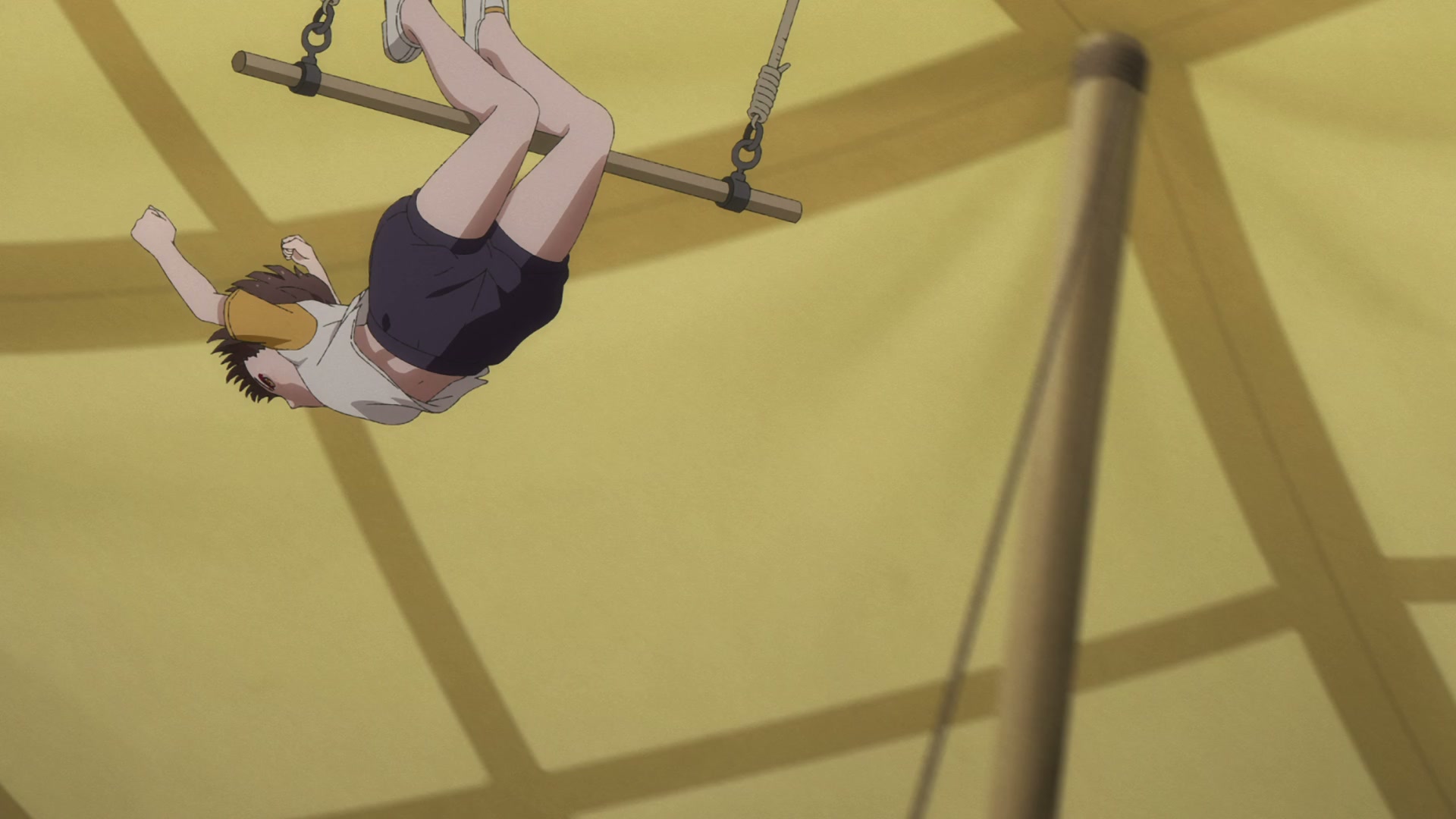
The first attempt is a disaster. Mizuka’s timing is off, and she cannot match Ouka’s speed. The troupe immediately calls for Shizuku to win by default. But Mizuka asks for one more chance, and the second run is where the episode’s visual storytelling shines. The trapeze sequence is animated with a fluidity that makes Ouka’s movements feel genuinely weightless. When Mizuka adjusts the tempo, Ouka’s flight becomes something else entirely: not just a technical display, but a moment of pure, soaring beauty. Shizuku, to her credit, admits defeat with grace, acknowledging that she cannot draw that out of Ouka. It is a small but significant character beat that prevents Shizuku from becoming a simple rival archetype.
The episode does not linger on the mechanics of the act, but the brief glimpses of Ouka’s expression mid-flight, the way her body seems to hang in the air a beat longer than physics should allow, sell the magic of the circus without needing to explain it. This is a show that trusts its audience to feel the difference between a good performance and a transcendent one.
Maria's Machinations
Maria is the episode’s quiet MVP. She appears as a tiny, doll-like figure, but every line she delivers carries the weight of someone who has been running a circus on a shoestring budget for years. She knows exactly when to push and when to pull back. The reveal of the debt contract, complete with Mizuka’s own thumbprint, is a masterstroke of comedic cruelty. Mizuka was sold for 39,800 yen, and Maria presents this fact with the same cheerful tone she uses to welcome a new member. It is dark, but it fits the show’s tone perfectly. The circus world is not kind, and Maria is not a saint. She is a survivor who sees potential in Mizuka and is willing to use underhanded methods to secure it.
Yet Maria is not a villain. The final scene, where she welcomes Mizuka to the troupe with a simple “Welcome to the Himawari Circus,” is understated and oddly moving. The camera holds on Mizuka’s face as she mutters “that damned paramecium” one last time, and you can feel the resignation and the tiniest spark of something else. Maybe it is the beginning of acceptance. Maybe it is just hunger. Either way, the episode earns that ambiguous note.
Closing Thoughts
The first episode of Himawari no Circus-dan is a confident introduction that balances circus spectacle with character-driven comedy. Mizuka is a prickly, compelling lead whose skills are undeniable but whose heart is still closed off. The supporting cast is already distinct, from the earnest Rin to the quietly competitive Shizuku, and Ouka’s quiet intensity hints at deeper layers to come. The show’s willingness to let its characters be petty, defensive, and occasionally cruel makes the moments of warmth feel earned rather than saccharine.
If the series can maintain this balance of sharp humor and genuine affection for the circus arts, it will be something special. For now, I am just happy to watch Mizuka suffer through another day of forced smiles and unexpected kindness.
Screenshots