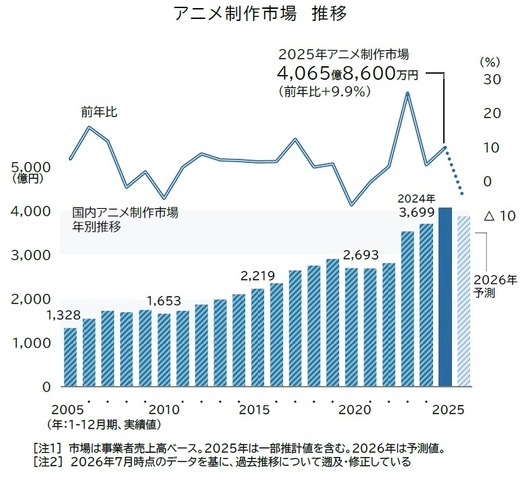






Teikoku Databank has released its latest survey of the anime production industry, based on its corporate credit report file “CCR” and other external data. The survey, now in its 11th iteration following the previous one in August 2025, found that the production market exceeded 400 billion yen for the first time—but also raised the possibility that the market may have peaked. With labor shortages placing limits on production capacity, the report predicts the market will shrink in 2026 for the first time in five years.
2025 anime production industry trends
According to the survey, the market size of the anime production industry in 2025 (based on fiscal year-end results from January to December) reached 406.586 billion yen, up 9.9% from the previous year’s 369.874 billion yen. This growth rate surpassed the prior year’s 4.9%, and the market exceeded 400 billion yen for the first time, setting a new record. Demand from video streaming platforms such as Netflix, in addition to the traditional TV broadcast market, remained strong, and the overall number of productions was very high for the year. Large-scale projects such as theatrical films were also delivered in concentration, giving both prime contractors and specialized studios a rich volume of work.
Across the market, licensing (IP) businesses including secondary use performed well, and some production companies saw significant revenue increases by receiving returns from secondary revenue through investment in production committees, or by strengthening their production capabilities to take on original and tie-in projects. The shift away from reliance on traditional TV anime series toward higher-priced, longer-format theatrical films and full CG for games—media demanding high quality and high unit prices—also accelerated.
The average sales (revenue) per production company in 2025 was 1.337 billion yen. Although this figure had temporarily declined due to production delays during the COVID-19 pandemic, it has increased for five consecutive years since 2021, reaching the highest level since records became available in 2000. Growth was particularly notable among “prime contractors and gross contractors” (including both orderers and contractors), while “specialized studios” acting as subcontractors saw only modest gains. Despite these differences by production type, the overall upward trend in sales continued.
In terms of business performance in 2025, 39.7% of anime production companies reported increased revenue. This was the first time in four years (since 2021) that the share of revenue-increasing companies fell below 40%. Meanwhile, the share of companies with “flat” revenue (39.7%) rose 4 percentage points from the previous year, reaching the highest level in the past decade. The share of companies with decreased revenue was 20.5%, down 1.5 points from the previous year’s 22.0%, marking the lowest level since 2001 when such data became available.
On the profit side, 45.7% of companies reported increased profits, marking the fourth consecutive year that more than 40% of production companies saw profit growth. While the shares of companies with decreased profits (18.9%) and losses (34.6%) both fell from the previous year, high labor and outsourcing costs have become a persistent issue. Additionally, the sustained weak yen has driven up overseas outsourcing costs, and the increasing complexity of production processes has led to longer production periods and delays. This has caused many cases where delivery slips into the next fiscal year, creating a structural risk of sudden losses in a single year.
Demand for anime production is expected to remain stable in 2026. However, the reaction to the mega-hit theatrical films that were common before 2025 is already causing revenue declines, particularly among major studios. Even original works commissioned by streaming platforms—which have driven the anime production market—are seeing a slowdown in the unlimited flow of production funds, suggesting that the investment phase for Japanese anime is cooling. On the production floor, the shortage of animators has become severe, and production capacity has reached its limit. Some studios are unable to accept new projects in order to maintain quality and improve working conditions. If the current performance pace continues, the 2026 anime production market could fall below the previous year for the first time since 2021.
Trends by production type
Looking at average sales by production type, “prime contractors and gross contractors”—companies capable of directly undertaking and completing production—saw average sales of 2.795 billion yen in 2025, up 289 million yen from the previous year’s 2.506 billion yen. This marked the fifth consecutive year of increase and a new record high.
In terms of performance, 53.8% of these companies reported increased revenue (up 2.9 points year-on-year), while 17.3% reported decreased revenue (down 4.1 points), with the share of revenue-declining companies falling below 20% for the first time in three years. On the profit side, 48.4% reported increased profits, a significant rise from the previous year. Conversely, the share of companies with decreased profits fell 5.1 points to 21.9%, and those with losses fell 5.7 points to 28.1%. Combined, the share of companies with worsening performance (losses or decreased profits) stood at 50.0%.
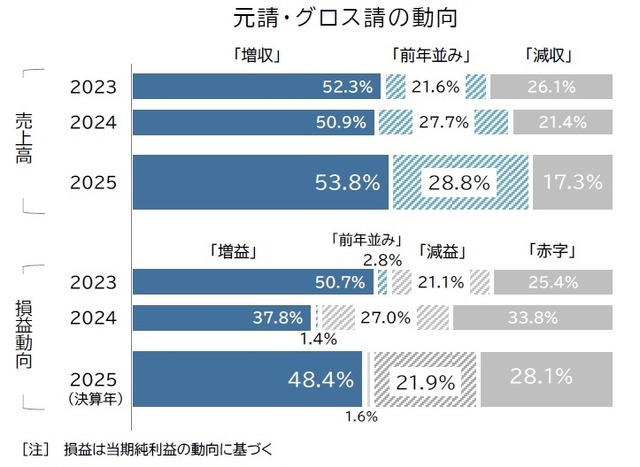
Prime contractors and gross contractors
Among prime and gross contractors, a structure of extreme polarization in profits has become established, depending on whether a company owns IP (secondary use rights) and how well it can control production costs (outsourcing and labor costs). In recent years, the trend has shifted from anime production with high cost ratios and thin margins toward revenue models that leverage self-owned IP—such as distribution of past works via VOD services, revivals, and character-based secondary use—which offer higher profit margins.
Production companies that can develop secondary uses of their own IP, including overseas distribution, game adaptations, and merchandising rights, have seen stable performance and, in some cases, record-high profits thanks to merchandise sales and distribution revenue. Moreover, with rising demand for anime production, price negotiations have tilted in favor of production companies. Many have successfully raised per-episode prices by passing on higher labor costs at the estimation stage and negotiating with production committees and major publishers.
Even companies that find it difficult to pass on costs have shifted toward prioritizing profitability in their order selection, deliberately limiting the number of productions and avoiding parallel work on multiple projects to prevent delays and rising outsourcing costs.
On the other hand, mid-sized and smaller prime and gross contractors without their own IP rely on “flow revenue” from production and delivery, and are strongly affected by the industry-wide labor shortage and rising outsourcing costs. While they have secured revenue by taking on more projects, the shortage of animators makes production schedules prone to delays, and many are falling into a situation where costs far exceed income. Outsourcing rates for freelance animators and overseas studios have also risen sharply, and companies with weak negotiating power cannot pass on these cost increases, leading to a vicious cycle where the more they produce, the deeper their losses. Some companies are trying to improve profitability by increasing in-house production ratios and hiring animators directly, but this also inflates fixed labor costs, and the pace of cost increases often far exceeds revenue growth, resulting in many companies reporting decreased profits or losses.
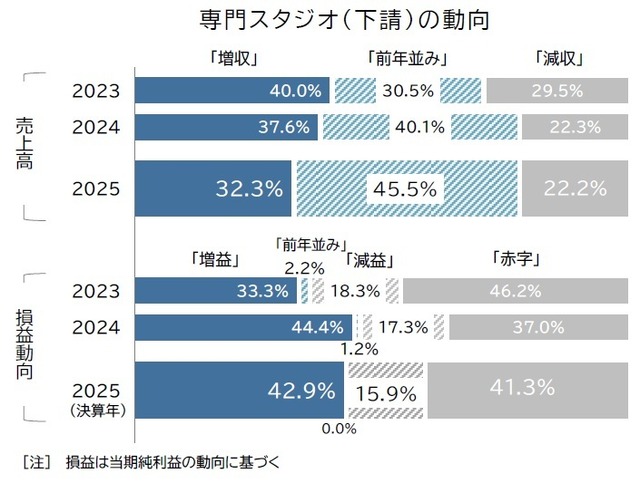
Specialized studios (subcontractors)
Specialized studios, which work as subcontractors in anime production, saw average sales of 499 million yen in 2025, up for the fifth consecutive year. This was the second consecutive year that this category maintained sales above 400 million yen, following the previous year’s recovery to that level for the first time in 17 years (since 2007, when it was 422 million yen).
In terms of performance, 32.3% of specialized studios reported increased revenue, 22.2% reported decreased revenue, and 45.5% reported flat revenue—the largest share. On the profit side, 42.9% reported increased profits, down from the previous year’s 44.4%, which had been the second-highest level in the past decade (after 2018’s 46.3%). The share of specialized studios reporting losses rose to 41.3%, up from 37.0% the previous year.
Specialized studios often depend on low-priced gross contracts and spot orders from major companies, and their own “operating staff count” tends to set the ceiling for sales. However, in recent years, with strong content demand, prime and gross contractors have been outsourcing more animation, key animation, and in-between animation work that they cannot handle in-house, boosting sales for specialized studios. Companies with strengths in digital animation and CG production, or those that have actively invested in digital hardware, have also increased revenue by taking on higher-priced projects such as event video production.
On the other hand, the animator shortage also affects specialized studios. Some have seen physical processing capacity decline due to employee resignations or leaves, forcing them to accept lower revenue. Others have taken on orders exceeding their capacity, leading to ballooning outsourcing costs for freelancers or other studios, and ultimately falling into losses as costs rise faster than sales. In recent years, some specialized studios have also attempted to break away from traditional subcontracting by taking on prime contractor work independently. While this can improve profit margins, it also means bearing all production costs that were previously covered by the prime contractor. If production does not go as planned, delays occur, and insufficient manpower is supplemented through outsourcing, the losses can widen.
Future outlook
The anime production market in 2025 exceeded 400 billion yen for the first time, setting a new record. Demand remains high, especially for domestic and international streaming platforms, but the rapid rise in labor and outsourcing costs is pushing the limits of profitability for production alone. Moreover, the severe animator shortage is lengthening production periods and causing delivery delays, which further drives up costs. The situation has become one of “busy without profit,” where increased demand does not translate into earnings.
Recently, there have been sporadic bankruptcies among anime production companies. Against the backdrop of production capacity limits relative to rapidly expanded demand and the sharp rise in production costs, the industry is being called to shift from simply processing orders to prioritizing production efficiency and profitability.
Looking ahead, the anime production industry is expected to see clearer polarization or multipolarization based on management foundations and business models. Major and affiliated production companies with strong self-owned IP and secondary use rights are leveraging high stock revenue from VOD distribution and merchandising to invest in technologies such as AI, improve working conditions to secure talent, and strengthen production capacity through M&A and the consolidation of smaller studios into their groups. Boutique specialized studios with unique technical strengths, such as full CG production and advanced digital compositing, are also securing high profitability by winning high-priced orders from major companies. In contrast, flow-dependent small studios that lack their own IP and rely solely on production contracts have little pricing power against rising labor and overseas outsourcing costs, and face difficulty in training in-house talent. Many of these companies are suffering from prolonged losses and deficits as they bear the brunt of cost increases.
As Japanese anime continues to become a global content through internet distribution and other channels, challenges remain in normalizing labor conditions, maintaining quality, and passing on technical skills to future generations. In the latter half of the 2020s, the anime production industry is expected to move from a phase of expanding sales through increased production volume to a phase focused on profitability-oriented management and digital-driven production efficiency. At the same time, industry restructuring—including the consolidation of the more than 300 existing production studios—may accelerate, with the potential elimination of small and micro studios that lack profitability.
《Nakase Koutarou》