





The “Megami’s Voice” interview series in Megami Magazine features artists who perform theme songs for anime and games, discussing their music. For the September 2025 issue, Nakajima Megumi, who released her mini-album “invitation” after a six-year hiatus, made an appearance.
A Mini-Album Expressing Her Life So Far
—It’s been about six years since your last mini-album, “Lovely Time Travel,” which was a cover mini-album.
“Lovely Time Travel” was a special celebratory mini-album to commemorate my 10th debut anniversary. I even had the opportunity to produce it myself. I have mixed feelings about how much time has passed since then — on one hand, it feels like a long time, and on the other, it feels like it flew by in an instant.
—Excluding the instrumental prologue and epilogue, four of the five tracks on the album have already been released digitally. Did you always intend to release them on CD eventually?
Yes, that’s right. I released a full album called “green diary” in 2021, and I considered that to be a culmination of my work with FlyingDog-san. Afterward, I changed agencies, and my staff changed, too, creating an environment where I was encouraged to “tell us anything you want to do.” Even before, my wishes were granted more than sufficiently, but now things moved even more quickly. My “equal” release in 2023 was conceived as a fresh start, like a new business card. After that, I gave my staff a “wishful thinking plan” outlining themes for every six months, with specific people I wanted to write the music and lyrics, and the hope of releasing a CD in 2025. They responded with, “Let’s do all of it,” and that’s how we got to where we are now.
—At the “wishful thinking plan” stage, what kind of theme did you envision for the CD?
I wanted to create an album that would be a counterpart to “green diary.” “green diary” had a theme of showing a little glimpse into the diary of my life’s thoughts, with the color green symbolizing Ranka Lee, the character I portrayed in “Macross F.” However, at the time of its production, I wanted to pursue the highest quality, and I wasn’t confident in my own ability to craft words, so I had various creators interview me and then write about my life, almost like “original story by Nakajima Megumi.” It’s an album I love and am very satisfied with. But as I moved to a new agency and stepped out, I thought perhaps I should also look outward a bit. Still, I felt it was too early to suddenly entrust everything to entirely new creators in a new environment. So, this time, the concept became an “invitation” for everyone into my life. Since this album is built upon “green diary,” the “wishful thinking plan” came to mind quite easily.
—At the “wishful thinking plan” stage, was the track order also decided?
Rather than me deciding it myself, it was more due to wonderful coincidences. “equal,” released in 2023, is a song about Ranka, and it coincided with my 15th debut anniversary. After that, I received an offer to perform a live concert again in my hometown, Mito City in Ibaraki Prefecture, and a reservation at the newly built Mito Civic Hall was secured for December 24th. It was six months after “equal,” and I thought it would be nice to perform a new song as a surprise, which led to the creation of “Kuchibiru no Oku no Uchu.” About six months later, GUMI, the character for `Megpoid` — for whom I provide the voice — had her 15th anniversary. Another six months after that would be my 16th solo debut anniversary as Nakajima Megumi. I realized I could release new songs to match these anniversaries! [laughs] And then, around June 2025, approximately six months later, coincided with my birthday and the release month of Ranka’s debut song “Seikan Hikou.” So, it felt like a good idea to release a song I requested from May’n-chan. The timing overlapping with the “Macross F” live was a complete coincidence, but it felt like the pieces of a puzzle fit perfectly, creating a miracle.
—Please tell us about each song. For “equal,” you co-wrote the lyrics with Kodama Ameko-san.
I consulted Nishiwaki Tatsuya-san, who is the bandmaster for my live shows and has deep ties to “Macross F” and “Macross Delta.” I told him, “I want the music to be simple, to sing with a live, raw sound, surrounded by the band.” When I received a one-chorus demo and listened to it, lyrics came to mind, thinking about how I would sing it. I’m usually a shy person, so I’ve never shown unfinished work to others before, but I just sent it on an impulse and received a lot of praise. However, I’m not good at crafting words and wasn’t confident I could finish it alone. I also felt that Kodama-san’s light yet incisive and sharp touch was necessary for this song, so I asked her to co-write, and she readily accepted. She provided lyrics in response to my one-chorus, almost like a letter exchange. Since I work as “Ranka Lee = Nakajima Megumi,” it was hard for me to say “I love you” directly to Ranka, but Kodama-san put those words into the song, and I was so glad we co-wrote it.
—Is “equals” that strong of a concept for you, Nakajima-san?
Yes, it is. I sometimes receive feedback from my fans who support me, saying, “We want you to show your love for Ranka more!” But it feels almost like self-praise, so it’s difficult for me to do. However, with this song, I feel like I’ve been able to declare that “my love for Ranka is second to none.”
—When approaching this song, how did you plan to sing it?
I also consulted Kodama-san, and we came to the conclusion that if Ranka’s essence naturally came through, that would be fine. As a result, I think my expression now in my 30s and the freshness of my teens when I first met Ranka are naturally blended. I hope people can feel both nostalgia and newness, as if moving back and forth between the present, future, and past.
—”Kuchibiru no Oku no Uchu” features lyrics solely by you, Nakajima-san.
I was part of an entertainment agency from the age of 13, but until I graduated high school, I lived in my hometown of Mito, simply listening to music and singing because I loved it. According to my parents, from the age of two, I would grab something to use as a microphone, climb onto a makeshift stage, and sing. This song is about my time in my hometown and myself before I started working. I realized that only I knew myself up until about age 18, so I felt I had no choice but to write the lyrics myself [laughs]. Even so, I’m still not good at writing lyrics, so when I considered how to approach it, I remembered a quote from Tamura Mitsuyoshi-san, the producer of my fourth album “Curiosity”: “You can make a song even if you have nothing to say.” That made me think it would be fine to just go with lyrics that convey “me, who was bad at speaking but enjoyed singing in my hometown.” Bandou Yuuma-san’s music seems to resonate with me; I could feel the atmosphere of how he wanted it sung, which made writing the lyrics smoothly.
—In a good way, your rather understated singing style is also striking.
I was happy that I could sing it that way. I had always forced myself to smile, but I tried singing without forcing a smile or raising my voice, almost speaking in short bursts, and it just fit. I feel this song became one where my energy was relaxed, bringing out my true foundation, rather than forcing power.
—”Lil Romantic feat. GUMI” is a duet with GUMI. You haven’t sung GUMI’s songs or performed duets with her before, have you?
Ever since GUMI was released, I’ve had a principle of “not covering GUMI.” When she was released in 2009, I was genuinely nervous, thinking, “GUMI might take my jobs in the future!” [laughs] When I considered how to face her, I thought it would be best if we both stood as independent artists and maintained a distance where we weren’t overly familiar. So, when GUMI celebrated her 15th anniversary in 2024, I felt that now was the time for our paths to cross. However, while I might want to cover GUMI someday, I instinctively felt that now wasn’t the right time. So, we decided to use the “V4” version from about 10 years ago, allowing me to sing with GUMI, who uses my voice from a decade ago. I think very few people can sing a new song with their past self from 10 years ago, so I feel it’s truly a treasure.
—Regarding the song, was there also a feeling of celebrating her 15th anniversary?
Absolutely. Also, I wanted to sing simple love songs and cheering songs like I used to, so I asked Kanako Kato-san, who wrote bright love songs for me at the beginning of my career, for the lyrics, and Nishiwaki Tatsuya-san for the music. There are absolutely no hidden meanings; it became a song where GUMI and I are chatting, like “Where should we go?” or “Isn’t it hot?” while eating sweets. It was fun to sing such a cheerful song, and I feel it has become a centerpiece that I want to include in my live performances for a long time.
—The next song, “Tenshi no Yuuutsu,” is, on the contrary, a calm and heavy song.
It’s a song that feels like it has nothing but hidden meanings, isn’t it [laughs]? My debut song, “Tenshi ni Naritai,” is a song sung towards “incomplete adults,” but there came a time when I felt I had become one of those adults. So, first, I wanted to sing from the perspective of an “incomplete adult.” Also, I asked Haruyuki-san and Shigenaga Ryousuke-san to create a song that would express the struggle of a girl who always sang “I want to protect you,” then moved on to “Can I protect you?”, realizing that “wanting to protect” alone isn’t enough to live. When the word “Yuuutsu” (melancholy/depression) came up for the title, I hesitated a bit. I had always felt I needed to be cheerful, so it felt too strong. But I realized there was no more fitting word than “Yuuutsu,” so I decided on that title.
—”Tenshi no Yuuutsu” was recorded by your first director, we hear.
He was the one who worked on my music production up to my 1st album “I love you” and then continued to be my manager; someone I deeply respect. I thought it might be important to approach this song with the feeling of being a newcomer again, so I consulted him, and he readily accepted. However, singing in front of him again after more than a decade made me nervous, feeling like I was being tested on everything I had done until now, and how I had lived my life. But I feel it was good that I was able to sing straightforwardly, without calculation or ulterior motives. The director was always the type to praise me with “That’s great!” even back then, and he was the same this time, so I felt relieved and could sing comfortably.
—The word “angel” also appeared in “Lil Romantic,” didn’t it?
I guess the image of Ranka is still strong. Ranka might have some selfish aspects, but I think she’s also a wonderfully innocent child, one that people wish she would be, so I suppose some people hold a soft, angelic image of her. Personally, I was relieved that no one thought, “Nakajima Megumi, singing about angels *now*…?” [laughs]. But I’ve never once thought of myself as an angel!
—What kind of requests did you make to May’n-chan for the creation of “I AM”?
I asked for an uptempo song that could be sung at the beginning or end of a live show, but with a slight hint of loneliness or sadness. Beyond that, I just conveyed that I would be happy if the lyrics could express “Nakajima Megumi as seen by May’n-chan.” After May’n-chan’s concert in May, she rewrote the song in response to my feedback on her song “WE ARE,” but I haven’t heard the previous version. Someday, when time has passed, I’d like to ask what kind of song it was.
—How did you feel when you actually saw the finished lyrics?
There was a time when I thought that May’n-chan and I, given the “Macross F” atmosphere, had to be fiercely competitive. And when we were younger, live rehearsals were so intense that we didn’t even have time to talk during breaks. So, we spent a long time without having deep conversations. But about seven or eight years ago, we gradually started to be able to share our feelings, and since we decided the setlist together for “MACROSS CROSSOVER LIVE 2019” in 2019, we became able to speak openly. When I heard May’n-chan express a kind of vulnerability, I was so surprised that I jokingly said, “May’n-chan, you’re human after all!” After realizing that even strong people have worries, I also became able to confide my concerns, which in turn surprised May’n-chan. May’n-chan is a passionate person, but she doesn’t forcefully cheer me up or impose her views; she responds with gentle words, and that’s reflected directly in the lyrics. In her eyes, I appear as “someone who is lost, struggling to find a reason to sing.” That was spot on; she truly saw me as I am.
—What was memorable about the recording?
May’n-chan sang a guide vocal, so I listened to that and practiced. It’s a song where you start out feeling down but gradually recover. However, when I sang it without thinking, I started out cheerful, became anxious in the middle, and eventually got depressed. That happened with this song too, but she said it was unexpected but interesting. Of course, I could have sounded cheerful if instructed, but she told me it was good to go without forcing it, so I ended up with a take that had a bit of hesitation. May’n-chan affirmed me, saying, “It’s just like Ai-chan to be contradictory — saying you’re anxious but still standing on stage.” That made me feel like it’s okay not to force a smile, and it’s okay to suddenly feel down; that’s just who I am. I feel this was a song that only May’n-chan could create.
—”I AM” was performed for the first time at your June live concert, and your expression seemed a bit tense.
Perhaps that reflected the feeling that it was okay not to be cheerful. But looking at the video afterward, I thought, “I should have smiled a bit more!” [laughs]. I’ve never prioritized anything over being Ranka Lee = Nakajima Megumi; I’ve always lived wanting to be Ranka, feeling I had to be Ranka. But life can’t continue with just that. As a result, with this CD, I feel I’ve been able to express that Nakajima Megumi isn’t just cheerful, but also someone who wants to have fun and live with a smile.
—”prologue” and “epilogue” are instrumentals, but they include chorus, right?
Both songs were created from my simple desire to do a cappella and multi-track recording. Kanno Youko-san taught me a lot about multi-tracking and choruses during the “Macross F” era, and I still love it, so I wanted to make that the main focus. In an age where choruses can be created digitally, I specifically challenged myself to do it this way.
—The jacket photo is simple yet striking.
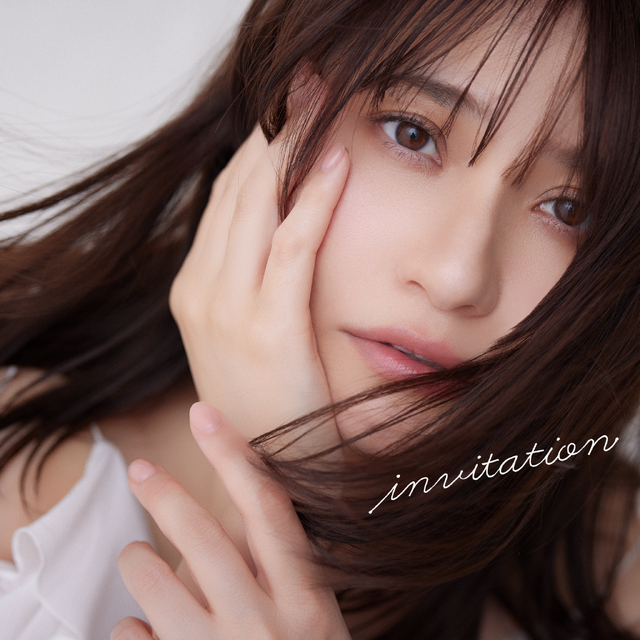
I had heard from the art director and photographer for “Tenshi ni Naritai” that “a close-up of the artist’s face from the front is their trump card.” They also told me back then that it was too early for me, as life shows in your eyes. I was deeply moved by that, so despite having a complex about my frontal face, I always wanted to try a frontal shot someday, and that wish came true. With slightly sad eyes and eyebrows, I feel it turned out wonderfully, conveying the journey I’ve been on. “invitation” also apparently means “temptation,” so I think it also conveyed a sense of being drawn in by the eyes.
—What are your thoughts now that the CD is complete?
This time, not only the music production but also the jacket costume and photos were chosen by me after discussions, and I’m glad I got to know the production process deeply. I was able to complete the production responsibly, so now I feel a stronger sense of relief.
—Looking ahead, what kind of activities do you want to pursue as an artist?
When I started this job, I already felt my dream had come true, and I knew that making a living from this work wouldn’t be easy, so I’ve avoided making strong promises. But what I started out of love has become my profession, and now I feel it’s my life’s work. I don’t think I’ll ever grow to dislike singing or acting, so I want to continue at my own pace, adjusting to my health and condition, so that I can still do a “kira~” in 2059, the setting of the “Macross F” story. But I debuted in 2008, and it’s flown by so quickly, so from now on, I need to cherish each day and each performance, or 2059 might arrive in the blink of an eye [laughs].
—Once again, please give a final message to your readers.
To those who have been supporting me for a long time, those who feel nostalgic, and those who are meeting me for the first time, I would be happy if “invitation,” a mini-album depicting my life, could be an opportunity for us to connect again. Whether on CD or digitally, please listen to it in whatever way is easiest for you to access.

Profile
Nakajima Megumi / Born June 5th. From Ibaraki Prefecture. Debuted as an artist in 2009 with the single “Tenshi ni Naritai.”
To date, she has released 13 singles, 5 albums, 1 cover mini-album, 1 best album, and 1 character song album.
Information
“invitation”
Currently on sale
Strobo Music
2500 yen (tax included)
Nakajima Megumi’s mini-album after a six-year hiatus. It contains a total of 7 tracks, including songs related to Ranka Lee, her hometown Mito City in Ibaraki Prefecture, `Megpoid`’s image character GUMI, her debut song “Tenshi ni Naritai,” one song provided by her “comrade-in-arms” May’n, plus a prologue and epilogue. It’s a collection filled with Nakajima Megumi’s current thoughts and vocals.
《Megami Magazine Editorial Department》
_