




![Eiga KimiPuri: Sing, Dance, and Time Slip!? With WanPuri and HiroPuri for a Kirakki Raibu♪ Producer’s Thoughts Poured into the Work [Interview]](https://animeworld.info/wp-content/uploads/2025/10/799605.jpg.jpg)



“Eiga Kimipuri”: Singing, Dancing, and Time-Traveling!? A Sparkling Live with Wanpuri and HiroPuri! Producer Shares Thoughts Behind the Work 【Interview】
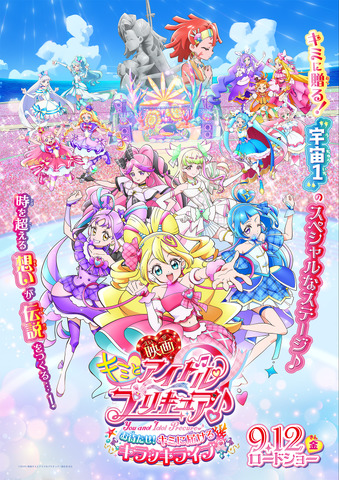
The movie Eiga Kimi to Idol Precure♪ Omatase! Kimi ni Todokeru Kirakkulive! (hereafter referred to as *Eiga Kimipuri*, which can be translated as “Kimi to Idol Precure The Movie♪ Hold On! A Sparkling Live Delivered to You!”), released on September 12, 2025, is currently a massive hit in theaters!
It’s packed with highlights, including the idol Precures’ exciting activities and live performances, a deeply moving story, and even appearances by past Precure generations! Many fans are flocking to cinemas, eager to rewatch their favorite scenes and receive “fan service” on the big screen.
But how did this highly acclaimed work, which has delighted so many fans, come to be? We had the pleasure of sitting down with producer Minagawa Hibiki, who shared his thoughts, passions, and meticulous attention to detail that went into creating this film!
※Please be aware that this interview contains spoilers regarding the story and direction of *Eiga Kimipuri*.
[Interview and Text by Hashibiroko]
The Desire to See the Idol Precures Shine on Screen
――Minagawa-san, you also served as an assistant producer for the TV series *Kimi to Idol Precure♪* (hereafter, *Kimipuri*). How did you feel when you were selected to be the producer for *Eiga Kimipuri*?
I was incredibly happy, and I strongly felt that I wanted to make a film where the five idol Precures could truly shine. I’ve been involved with the TV series since its inception and have watched the *Kimipuri* five grow, so I knew the origins of how these characters were brought to life. Because of that, I believed I could approach this movie with a stronger emotional connection than anyone else.
――How did you decide on the direction for *Eiga Kimipuri*?
While I proposed elements I wanted to include during the planning stage, the core message of the work was decided through discussions with director Ogawa Kouji. Movies in the “Precure” series invariably feature antagonistic characters. The story typically converges as the Precures confront these adversaries. Therefore, the antagonist’s feelings often encapsulate the work’s central message. For this film, Director Ogawa and I discussed how to intertwine the emotions held by Amas and the concept of “idols.”
――How did the original characters for *Eiga Kimipuri* come into being?
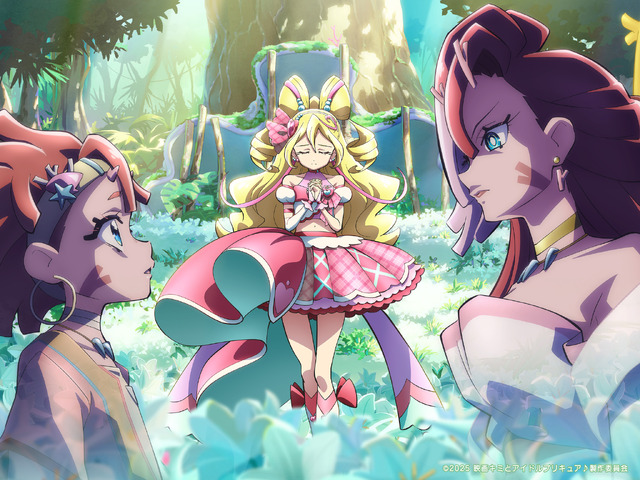
Most of the characters’ positions and personalities were crafted by scriptwriter Yoshino Hiroyuki. His ideas were excellent, and all the characters felt vibrant and authentic, giving the storyline a clear progression. In particular, through Terra’s perspective, the charm of Cure Idol / Sakura Uta really shone through.
――Were elements like the relationship between Amas and the legendary idol, or time travel, decided from the early stages of production?
These elements gradually took shape as the scenario developed. What I requested from Yoshino-san was a story centered around a festival, where the idol Precures could shine brightly. Later, Yoshino-san presented a time-travel narrative, using the difference in lifespans between coral fairies and humans as a compelling hook.
――So, the coral motif was also Yoshino-san’s idea?
Yes. However, the Yami Kurage (Dark Jellyfish) was originally a different creature. We pondered, “What would be an enemy to coral?” and the crown-of-thorns starfish was initially suggested. But its appearance was a bit too terrifying, so it was changed to a jellyfish.
――What did you keep in mind when developing the story?
We had extensive discussions about whether a “time-travel” story would resonate with children. Concepts related to time can be complex, making them potentially difficult for younger audiences to grasp. Therefore, we made sure that even if children didn’t fully understand the concept of “time travel” itself, the overall flow of the story would still be conveyed to them as we proceeded with production.
Additionally, we were careful not to make the scene where Terra falls asleep too sad. I’m personally delighted that the film ended up being one where all the characters, including Amas, find their salvation.
――The film featured some unexpected team pairings, such as Uta & Meloron, and Nana & Kokoro & Prirun. Why were these teams chosen?
From the early planning stages, we anticipated that it would be difficult to keep all five characters together throughout the entire film. If we were to split them into two teams, we decided Nana and Kokoro would act separately from Uta. We wanted to portray what these two would think and do when not with Uta—aspects that only a movie could explore. This approach successfully highlighted the trio’s bond of trust, showing how “Uta would think this way,” and “Nana and Kokoro would act like this.”
Moreover, by the time the movie was released, the five characters were already known as “Idol Precure” in the TV series, so Meloron being with Uta felt natural. As for Prirun, since she had been with Uta from the beginning of *Kimipuri*, we believed separating them would create a sense of novelty. We consciously aimed to incorporate as much special movie-exclusive content as possible from the planning stage.
A Spectacular 70 Minutes: Battles and Live Performances Galore!
――Please tell us about the dedication to the live performance scenes in this film.
We put a lot of effort into making the live scenes unique to a movie. Since the film runs for 70 minutes, we wanted to include more songs and longer performances than in the TV series. All the songs performed in the TV series, except for the late ending theme, are scattered throughout the film. I also told the director that I wanted to clearly show the idols’ expressions when the camera focuses on them during their live performances, just like a real idol concert.
――How did you decide on the song order and timing of their performances?
We emphasized “why this song is played at this particular moment.” Yoshino-san, at the scenario stage, had already imbued each scene with a reason for a song to be performed. For instance, the first live performance is a rehearsal scene. In the middle section, by singing “Trio Dreams” and “Awakening Harmony,” the idol Precures become known to the villagers as “idols.” The songs and the story are intricately linked.
――The song medley towards the climax was also perfectly suited for the battle scenes.
Director Ogawa Kouji meticulously calculated and structured it, asking, “What songs would further lend conviction to the characters’ lines and the message of the film?”
Initially, even I questioned, “Why is this song playing at this moment?” For example, after Cure Idol sings “Egao no Unison♪” (Smiling Unison♪), usually Cure Wink would follow with “Mabataki no Gosenfu” (The Staff of a Blink). But in this movie, Cure Kyun Kyun sings “Kokoro Revolution” first. This is because the lyrics of “Mabataki no Gosenfu” overlapping at that specific moment significantly amplify the scene’s impact and conviction.
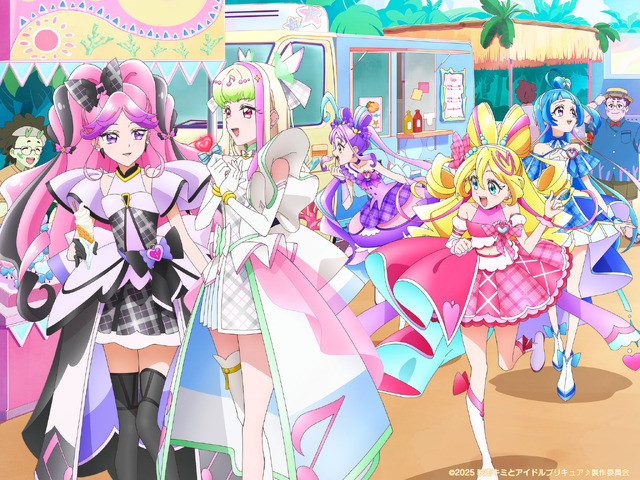
――It must have been a treat for fans to see Cure Wink and Cure Kyun Kyun perform the theme song of *Hirogaru Sky! Precure* (hereafter, *HiroPuri*), and Zukyuun and Kiss perform the theme song of *Wonderful Precure!* (hereafter, *Wanpuri*). How were these vocal arrangements decided?
Actually, there was an idea to reverse the vocal assignments, but the songs were ultimately decided based on the production staff’s opinions. From my perspective, since the *Wanpuri* song depicts the “bond between two” (owner and pet), Zukyuun and Kiss, who share the theme of “bonds,” seemed fitting. Furthermore, I believe the “soaring high into the sky” image of the *HiroPuri* theme song perfectly suits Cure Wink and Cure Kyun Kyun, who transformed into Precures thanks to Cure Idol.
《Hashibiroko》