




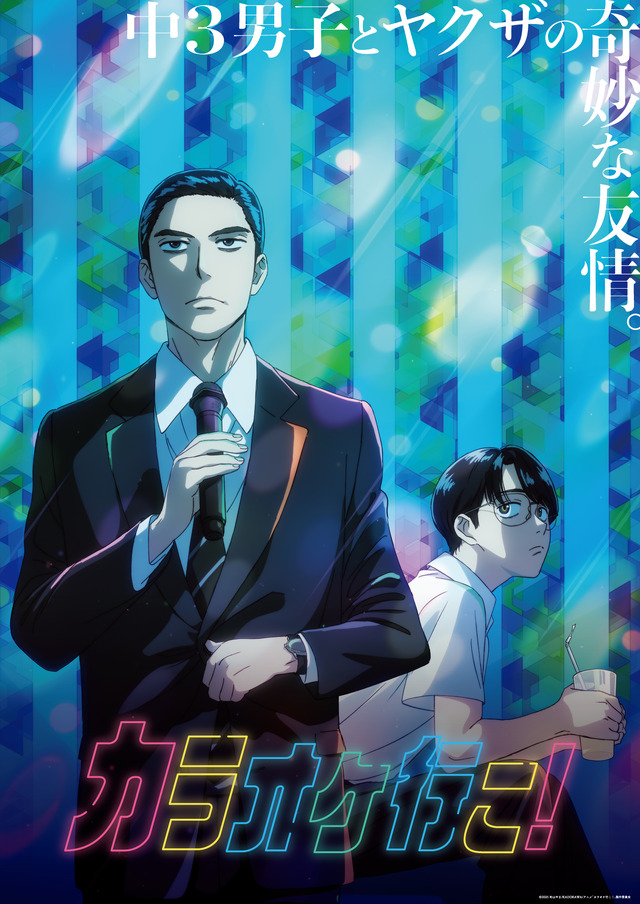
The TV anime **Karaoke Iko!** started broadcasting on July 24, 2025. This series beautifully illustrates the unexpected bond formed between Narita Kyouji, a formidable yakuza man who desperately needs to improve his singing for a high-stakes “karaoke competition” that represents his gang’s pride, and Oka Satomi, a middle school choir club president he meets by chance.
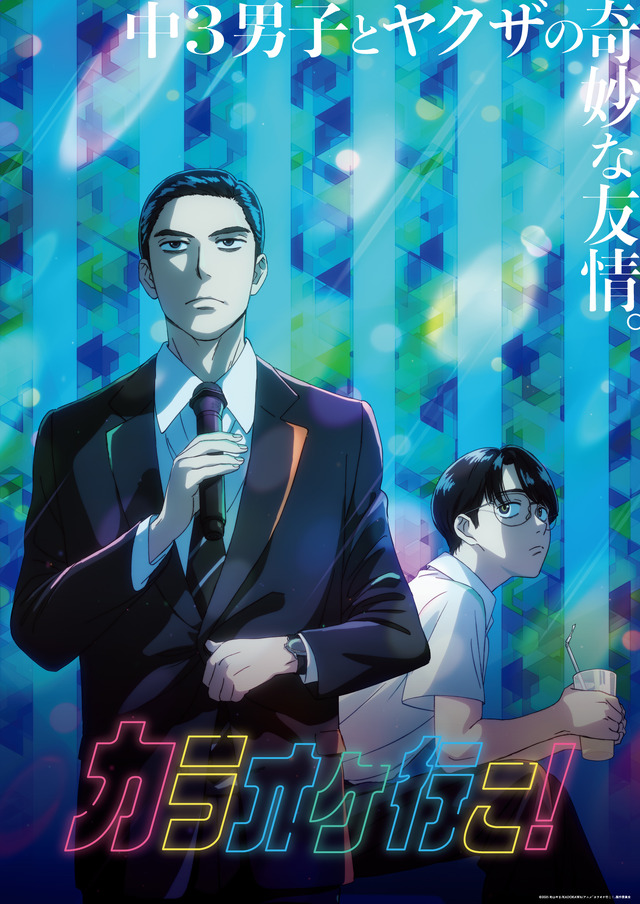
The premise alone is a fantastic hook: a tough-faced adult and a young boy whose voice hasn’t even fully changed yet, hunkering down in a karaoke box to practice singing together. This striking contrast is instantly captivating, promising an interesting watch even for those unfamiliar with the original manga.
While **Karaoke Iko!** is brimming with comedic elements, the character of Narita Kyouji stands out as particularly memorable. Here is a powerful figure from the underworld, earnestly consumed by the rather mundane problem of wanting to “sing better.” Seeing him struggle with vocal melodies instead of violent confrontations elicits laughter, yet also a peculiar sense of empathy from viewers.
Typically, `gokudou` characters in fiction, such as dramas and movies, are often portrayed as archetypes of fear and brutality. They usually embody villainous traits: sharp, menacing gazes, impeccably tailored suits, intricate `irezumi` on their backs, and rough, intimidating language. They might be depicted chasing down protagonists or heroines as relentless debt collectors, embodying the quintessential antagonist.
However, in recent years, particularly in anime and manga, `gokudou` characters are frequently given “gap” elements that cleverly subvert these stereotypes. They might appear ruthless but reveal a clumsy side, or show unexpected gentleness towards certain individuals. Before you know it, readers and viewers find themselves completely captivated by these men, full of such surprising contradictions.
**Karaoke Iko!**’s Narita Kyouji
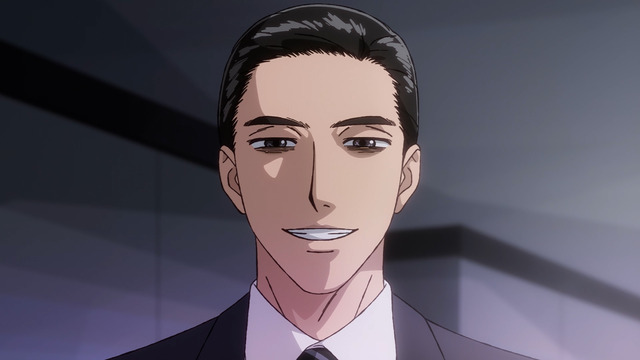
Narita Kyouji is perhaps the most straightforward embodiment of this “gap” phenomenon. His urgent desire to improve his singing skills stems from an annual event held by his gang, the Sairin-gumi: a dreaded karaoke competition.
What happens if you come in last? A truly dreadful penalty awaits: being branded the “King of Bad Singers” and getting an uncool `irezumi` tattooed by the `kumichou` (boss). For Kyouji, this karaoke competition is a matter of life and death, and he absolutely must avoid the ignominious title of “King of Bad Singers.”
What makes the situation even more amusing is that vocal prowess isn’t the only key to victory. Song choice also requires discerning taste. Participants must avoid the `kumichou`’s favorite songs or his personal repertoire, and it’s strictly forbidden to sing the same song as other gang members. There’s even an absurd anecdote about one member who once sang a Nishino Kana song and gravely upset the `kumichou`’s mood. It’s truly a chaotic situation, blending incomprehensible rules with intense seriousness!
Kyouji has apparently always challenged himself with X JAPAN’s “Kurenai,” but given its notoriously high difficulty, many viewers must have thought, “Isn’t that an impossibly ambitious song choice?!” As a result of forcing himself to sing a song that doesn’t suit his key, Satomi even gives him a harsh critique: “Your falsetto is consistently unsettling.”
Incidentally, in the first episode of the anime, the “bad singing” performance by Ono Daisuke, who voices Kyouji, is so exquisitely nuanced that it becomes a memorable scene. It not only elicits laughter but also heightens Kyouji’s sheer desperation. It’s definitely something you won’t want to miss!
Kyouji’s charm, however, doesn’t stop there. While he often seems to maintain a certain distance, he also reveals unexpected glimpses of kindness, showing genuine care for Satomi.
One moment, he’ll offer an umbrella in the rain, uncaring if he gets wet himself, then in another scene, he’ll casually step back and give space. The unexpected kindness he shows as an adult is equally appealing, quickly making it clear that Kyouji is far more than just a “gag character.” His relationship with Satomi is also particularly pleasant, evolving while maintaining a comfortable distance without falling into a typical, overly sentimental friendship trope.
ABEMA has announced a special marathon screening of **Karaoke Iko!** episodes 1-4. Be sure to check it out when it airs on August 28 and 29, 2025.
**Raise wa Tanin ga Ii**’s Miyama Kirishima

Konishi Asuka’s manga is the original work for the TV anime **Raise wa Tanin ga Ii**. Miyama Kirishima from this series is another captivating `gokudou` character full of “gaps.”
On the surface, Kirishima is the quintessential “dangerous man.” As the `souchou` of the Miyama family, a direct affiliate of the Kantou’s largest crime syndicate, the Togusa-kai, he maintains a nonchalant attitude and shows absolutely no mercy to his enemies. He is brilliant and cunning, a perfect strategist possessing the cold ruthlessness needed to survive in the underworld. In his first appearance, upon being disillusioned with the heroine, Somei Yoshino, he even reveals a callous side by suggesting she take up work in adult entertainment.
However, his attitude drastically changes once he begins to take an interest in Yoshino. His usual nonchalant composure crumbles, and he can’t hide his possessiveness or finds himself speechless in front of her. Viewers can’t help but smirk at these surprisingly straightforward and almost vulnerable displays.
Kirishima is a cold and dangerous man, yet he possesses an undeniable, irresistible charm that makes him hard to ignore. The more menacing he appears, the more his “wavering” and vulnerability towards Yoshino stand out as a powerful and impactful character “gap.”
**Gokushufudou**’s Tatsu
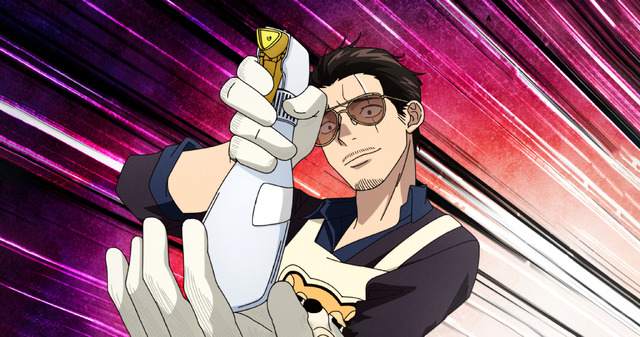
Tatsu, who appears in the TV anime **Gokushufudou**, based on Oono Kousuke’s manga of the same name, is a quintessential “yakuza gap character.” He was once feared as the “Immortal Tatsu,” a legendary `gokudou` whose name alone would make those in the underworld tremble. But now, he has left that life behind, dedicating himself entirely to household chores as a full-time househusband, going to the supermarket, cleaning, and cooking with full effort.
Despite his terrifying appearance, what he does is more domestic and heartwarming than anyone else. This gap is incredibly amusing and utterly endearing.
His `gokudou`-honed way of speaking is still very much present, leading to hilarious misunderstandings. For example, there’s a scene where he asks a store clerk, “Where can I find white powder?” while looking for flour at the supermarket. While he’s completely serious, to everyone around him, it sounds like he’s asking about something highly suspicious, almost like he’s planning a “crime.”
What’s more, Tatsu’s domestic skills are genuine; his cooking and cleaning are on a professional level, easily rivaling any expert. Seeing him display such impressive dexterity, utterly unimaginable from his menacing aura and tough appearance, is truly remarkable.
Even with his intimidating language and formidable appearance, what emanates from his interactions with his wife and neighbors is an inherent kindness. The man who was once a symbol of terror now dedicates all his efforts to protecting his small world: his family. This thoroughgoing and brilliant “gap” is precisely the greatest charm of **Gokushufudou**.
These outlaw `gokudou` characters are brimming with “gaps,” where even their clumsiness and weaknesses appear endearing. Ultimately, perhaps it’s not perfection that truly captivates human hearts, but rather a profound sense of flawed humanity. That’s why, despite being the strongest (and often wildest), we can’t help but be drawn to these somehow lovable and unforgettable characters, unable to look away.
TV Anime **Karaoke Iko!**
<Streaming Information>
- ABEMA: Starting July 24 (Thursday), every Thursday at 22:00 JST
- Other sites: Starting July 27 (Sunday), from 22:00 JST sequentially
ABEMA has announced a special marathon screening of **Karaoke Iko!** episodes 1-4!
- Episodes: 1-4 [Free video for 2 weeks]
Date & Time: August 28 (Thursday) 12:00 – 14:00 JST - Episodes: 1-4 [Free video for 2 weeks]
Date & Time: August 29 (Friday) 8:00 – 10:00 JST
Click here for ABEMA/Cafe [Recommended Programs Feature]
<STAFF>
| Original Work: | Wayama Yama, **Karaoke Iko!** (Beam Comics / KADOKAWA) |
| Director: | Nakatani Asami |
| Assistant Director: | Tsukahara Yukiko |
| Series Composition: | Narita Yoshimi |
| Character Design: | Matsuura Mai・Taniguchi Junichirou |
| Main Animator: | Nozawa Karen・Nakamata Yukino |
| Chief Animation Director: | Taniguchi Junichirou・Inate Haruka・Morita Rina |
| Art Director: | Hirama Yuka・Matsuura Narumi |
| Art Setting: | Ishihara Erina・Koyama Mayuko |
| Color Design: | Itou Yuka |
| Director of Photography: | Kuwano Takafumi |
| Editing: | Hasegawa Mai |
| Sound Director: | Kimura Eriko |
| Sound Effects: | Yaso Shouta |
| Music: | Iga Takurou |
| Music Production: | KADOKAWA |
| Animation Production: | Doga Koubou |
<CAST>
| Oka Satomi: | Horie Shun |
| Narita Kyouji: | Ono Daisuke |
| Wada: | Tokudome Shinnosuke |
<Theme Song>
“HOWL” by Ayumu Imazu
(C)2025 Wayama Yama/KADOKAWA/Anime “Karaoke Iko!” Production Committee
(C)Yama Wayama
《Sunakujira》