




The Latest Work from the Creator Duo of Odd Taxi, the Movie Hoosenka, is a Beautiful ‘Love Reversal Story’ Woven with Images and Sound [Director Kinoshita Mugi Interview].
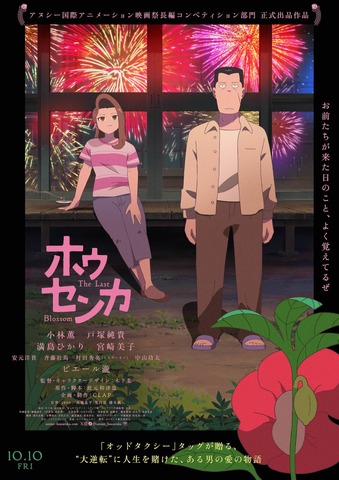
The creative duo behind the TV anime Odd Taxi, Kinoshita Mugi and Kimoto Kazuya, have reunited to bring us a heartwarming theatrical film, Hoosenka, a “grand reversal drama” that promises to captivate audiences!
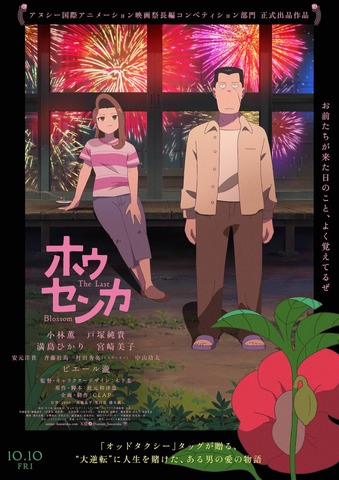
An elderly convict serving a life sentence, Akutsu, finds his only companion in a hoosenka flower. The strange recollections of these two souls journey back to 1987, unfolding into a magnificent story of love’s reversal!
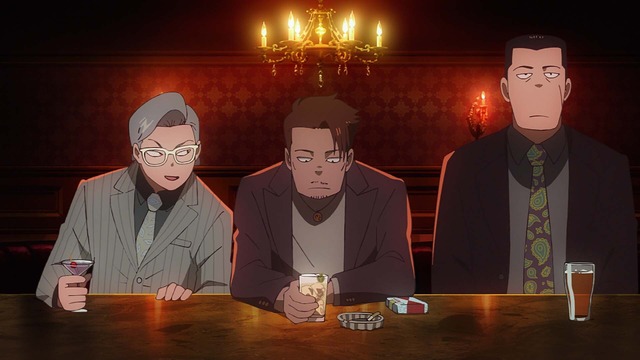
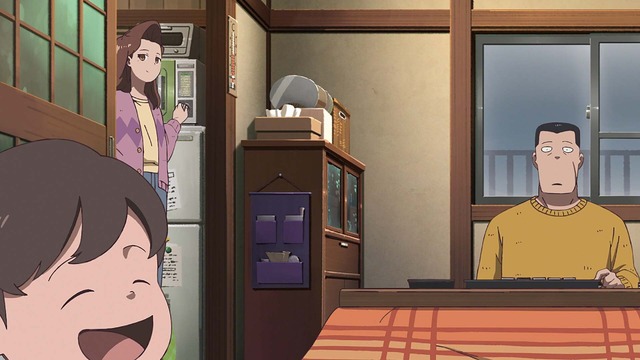
The main characters are Akutsu Minoru, a lowly yakuza; Nagata Nana, who shares a life with him in a relationship “less than family”; and their newborn son, Kensuke. Supporting this pseudo-family is Tsutsumi, Akutsu’s elder companion. Akutsu’s fortunes soar after a successful land speculation scheme, but his life takes an abrupt turn due to unforeseen circumstances. How will he manage to reverse his plight?
“Only those who cut off their escape routes are left with a chance for a grand reversal.”
In this article, we delve into an interview with Hoosenka director Kinoshita Mugi-san. We’ll explore the film’s origins, its charm, and the “beautiful story” the director aimed to portray.


Movie Hoosenka Long PV
A Pure Love Story: A Daring Challenge for Our Modern Era
――Your previous work, Odd Taxi, was a TV series, but Hoosenka is a theatrical film. Could you tell us how it came to be a movie?
Kinoshita Mugi (hereinafter, Kinoshita): I had been talking with Matsuo Ryoichiro-san, who serves as the producer for Hoosenka, about “creating something together” for a while, and this project brought that to fruition. Initially, Matsuo-san and I discussed a short-form original anime. However, when we asked Kimoto Kazuya-san to write the script, it grew to about 60 minutes in length, and it was decided that if we were going to visualize something of that scale, a movie would be the best format.
――So, if it had remained a short film, it might have been released via online streaming or similar channels?
Kinoshita: I believe so.
――The story revolves around a former yakuza, now serving a life sentence, looking back on 1987 by talking to a hoosenka flower. How did you come up with this unique premise?
Kinoshita: When we were still planning a short-form original anime, I presented Kimoto-san with about five initial ideas I had conceived. Among those, he chose the idea of “a former yakuza who became a lifer talking to a flower” as a topic he could easily write about. From there, Kimoto-san and I brainstormed and fleshed out the core setting and other details.
――1987 is the primary setting. Was there a specific reason for choosing that era?
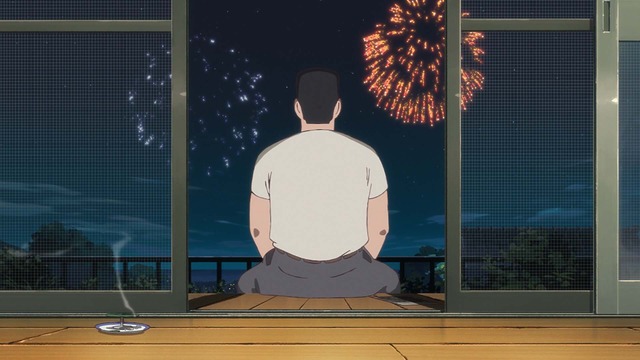
Kinoshita: Hoosenka, or balsam, bursts open and scatters its seeds far and wide. From that idea of “bursting,” I thought about fireworks, the life of a man… and as I explored these concepts, the “Bubble Era” emerged as a strong candidate. After some brainstorming, once Kimoto-san felt he “could write it,” I left the rest to him. I try not to interfere once he starts writing. He crafts stories with intricate, puzzle-like structures, so interfering would disrupt the rhythm. There, I have complete trust in him.
――What were your impressions when you first read the completed script?
Kinoshita: I was incredibly impressed by the script’s precision. With Odd Taxi, the comedic elements were stronger, but this time, the comedy is minimal. The straightforward depiction of a love story felt incredibly pure and unflinching. I also thought that in our current era, depicting a love story so genuinely and directly is both challenging and wonderful. After all, if you’re going to create a new work, you want to take on new challenges.
――Indeed, the mellow and embracing tone was striking. At the same time, the way elements introduced in the story gradually combine creates the same exhilarating feeling as Odd Taxi.
Kinoshita: That’s undoubtedly the power of the script. It appears tranquil, yet the developments are dizzying. It lays down groundwork and meticulously picks up all the threads at the end, and the skillful execution of that is remarkably elegant and satisfying. That’s the script’s strength and Kimoto-san’s greatest charm, I believe.
Combining Items and Music to Express the Era and Characters’ Emotions
――While it’s a happy ending, there’s still room to wonder if “another kind of happiness was possible,” and even now, a night after watching the main story, I’m still lost in its afterglow. By the way, the film is set in 1987, but you weren’t born yet then, were you, Director?
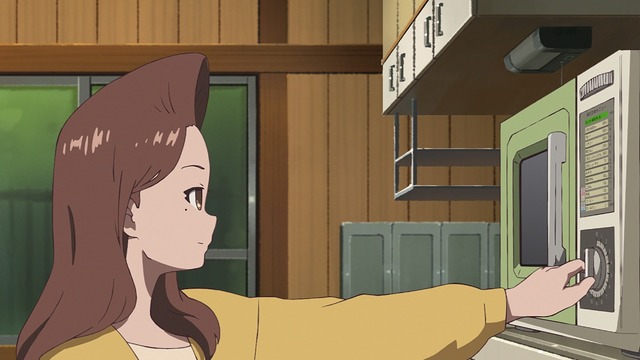
Kinoshita: I wasn’t born yet. So I researched various aspects of the era extensively.
――What kind of image do you have of the 80s?
Kinoshita: An image of people being giddy with the rapid changes happening in the world.
――I also paid close attention to the depiction of the era, and personally, the smoking scenes really made me feel the 80s.
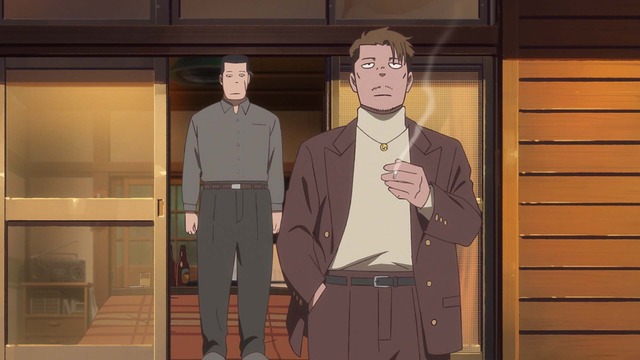
Kinoshita: You’re referring to the scene where Tsutsumi comes to Akutsu and Nana’s room and starts smoking, right? Indeed, at that time, there were many smokers, and ashtrays were everywhere.
――It’s amazing how much the use of cigarettes conveys; not only does it show the era, but Akutsu lighting the cigarette Tsutsumi holds also reveals their hierarchical relationship. And in the scene where Tsutsumi warns a subordinate smoking on the street not to litter cigarette butts because “it would be a nuisance,” it shows that Tsutsumi actually cares about ordinary people. It’s truly impressive how much can be explained with just one prop, and the depiction was meticulous and wonderful.
Kinoshita: Thank you. I remember one of our younger staff members, in their early twenties, commenting, “It feels odd for people to smoke indoors.” But that was just how things were in that era.
――And the song “Stand By Me” was used very effectively in the film; that immediately transported me to the 80s.
Kinoshita: “Stand By Me” was a request from Kimoto-san. Beyond its historical context, as a famous song everyone knows, it also serves to bring popular appeal to the work.
――Speaking of music, why did you choose the music unit “cero”—consisting of Takagi Shohei-san, Arachi Yu-san, and Hashimoto Tsubasa-san—to compose the score?
Kinoshita: Hoosenka is also a story of a single night, as recalled by Akutsu, a lifer. For that reason, I wanted a “stillness of the night,” “mystery,” and “grandeur” that would suit the tone. I felt cero-san’s music, which is calm yet grand and mysterious, would be a perfect fit. When commissioning them, I first had them look at the storyboards and understand the content, and then asked them to “score this scene.”
Discovering Beauty Through the Film: “People Have Value Just by Living”
――Akutsu is a yakuza, and Odd Taxi also involved stories from the underworld. Why do you choose to feature yakuza?
Kinoshita: I’ve always admired the yakuza films directed by Kitano Takeshi. In his films, the characters aren’t warlike; they simply live quietly, yet due to their circumstances, they’re often forced to get entangled in situations. I appreciate how he depicts the cold realities of the world. The yakuza in his films have no grand dreams or goals, nor are they the type to achieve something monumental.
I feel like there’s an atmosphere in our current era where people feel they “must achieve something” or “must become somebody,” but I don’t think that’s necessarily true. People have value just by living. That’s why I wanted to focus on those who have fallen outside of society, and this time, I expressed that through a “lowly yakuza.”
――So, rather than the character of a “yakuza,” you’re more drawn to what lies beneath that archetype?
Kinoshita: That’s right. Akutsu is not a perfect person. He makes mistakes. He exists outside the usual societal loop. However, from a different perspective, even an ordinary life has its beautiful aspects. It’s precious. I would be happy if viewers gained such a perspective after watching my work and found a little courage.
――If you had to describe Hoosenka in one word, what keyword would come to mind?
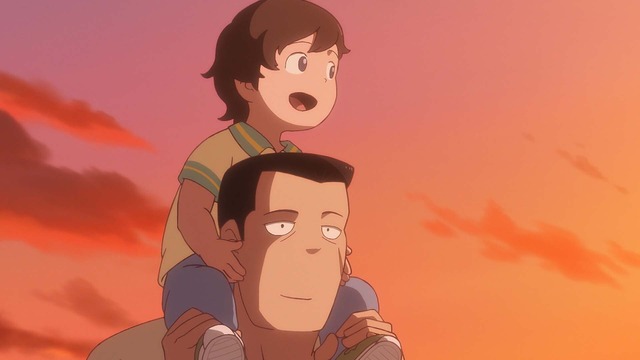
Kinoshita: “A beautiful film.” The beauty of the visuals, the beauty of human actions—anything. I hope that after watching this film, people will notice the beauty of a leaf or the blueness of the sky. Beyond material things, the beauty of emotions and the importance of conveying love to someone are also beautiful aspects of this work. I can say with confidence that it’s a beautiful and good film.
――Who would you like people to watch it with at the cinema?
Kinoshita: Family. I’d also like couples to watch it.
――Finally, do you have a message for our readers?
Kinoshita: We paid close attention to the sound design, so please listen carefully to the mundane sound effects in everyday scenes. You’ll probably hear many subtle sounds that you wouldn’t notice outside of a theater. And please, do come and experience this beautiful love story.
Movie Hoosenka Main Feature Opening 7-Minute Video
Movie Hoosenka Main Feature Opening 7-Minute Video
Original Anime Movie Hoosenka Official Trailer
Movie Hoosenka Release Information
Released on Friday, October 10th
CAST
| Name | Role (if specified) |
|---|---|
| Kobayashi Kaoru | |
| Totsuka Junki | |
| Mitsushima Hikari | |
| Miyazaki Yoshiko | |
| Yasumoto Hiroki | |
| Saitou Souma | |
| Murata Hideshige (Toro Salmon) | |
| Nakayama Kouta | |
| Pierre Taki |
STAFF
| Role | Name / Company |
|---|---|
| Director・Character Design | Kinoshita Mugi |
| Original Work・Script | Kimoto Kazuya |
| Planning・Production | CLAP |
| Music | cero (Takagi Shohei, Arachi Yu, Hashimoto Tsubasa) |
| Direction | Kinoshita Mugi, Harada Nana |
| Concept Art | Michinoku Touge |
| Layout Animation Director | Tera Eiji |
| Animation Directors | Hosogoe Yuji, Miyoshi Kazuya, Shimamura Shuichi |
| Color Design | Nobori Haruko |
| Art Director | Satou Ayumu |
| Director of Photography | Hoshina Takumi, Hondai Takahiro |
| Editing | Ushiroda Yoshiki |
| Sound Direction | Kasamatsu Koji |
| Recording Direction | Shimizu Hiroshi |
| Production Producers | Itou Kinue, Matsuo Ryoichiro |
| Publicity | Miracle Voice |
| Distribution | PONY CANYON |
| Production | Hoosenka Production Committee |
The beautiful scenes in the film are always accompanied by beautiful melodies that color the movie. We highly recommend paying attention to the charm of the music, not just the visuals.
(C) Kimoto Kazuya / Hoosenka Production Committee
《Kigasawa Masashi》