





A Fading Neighborhood, a Leaking Roof, and the Alien in the Closet
Some stories shout. NieA_7 mumbles. It shuffles into the room with a grumbling stomach, pokes through the garbage for discarded treasure, and collapses onto a tatami mat without asking permission. It is a series so unconcerned with making a grand impression that it almost dares you to stop watching, to dismiss it as a minor, shaggy comedy from the turn of the millennium that never quite figures out what it wants to be. But if you stay, if you settle into its odd rhythms and let its particular melancholy take hold, you’ll find something rare: an anime that understands what it feels like to be broke, directionless, and quietly terrified that the few things you love are about to disappear.
Produced in 2000 as an original collaboration between character designer Yoshitoshi ABe and producer Ueda Yasuyuki, NieA_7 occupies an uncertain space in anime history. It arrived at the tail end of the cel era, just as digital production was becoming standard, and it carries the aesthetic signatures of that transitional moment. Far from the otaku-baiting spectacles and high-concept genre exercises that dominate so many anime seasons, this is a slice-of-life story set in a world where the extraordinary has become so ordinary that nobody bothers to look up anymore.
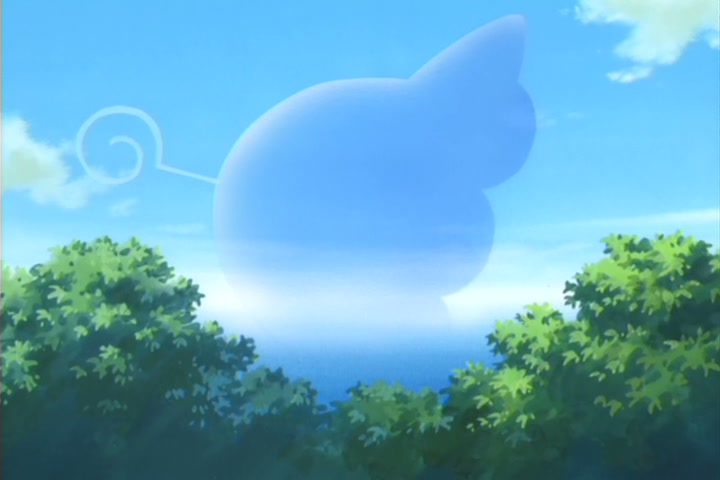
The premise is quietly subversive. Aliens have come to Earth. A vast Mother Ship hovers in the sky above the Enohana district. And absolutely nothing of consequence has changed. The aliens are just another marginalized population, sorted into an arbitrary class hierarchy of Pluses and Unders, living in shacks near the crater, running failing convenience stores, and working dead-end delivery jobs. The Mother Ship is a brooding presence, always visible on the skyline, but it might as well be a mountain for all the attention anyone pays it. When it finally vanishes during a typhoon, the world barely blinks.
Story and Themes: The Weight of the Ordinary
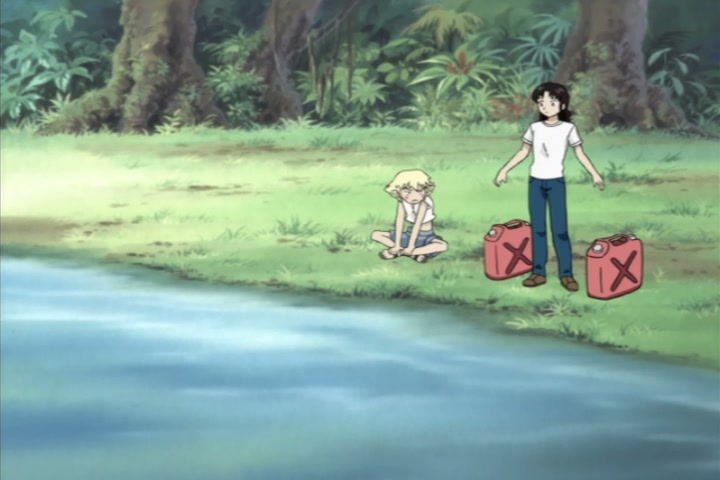
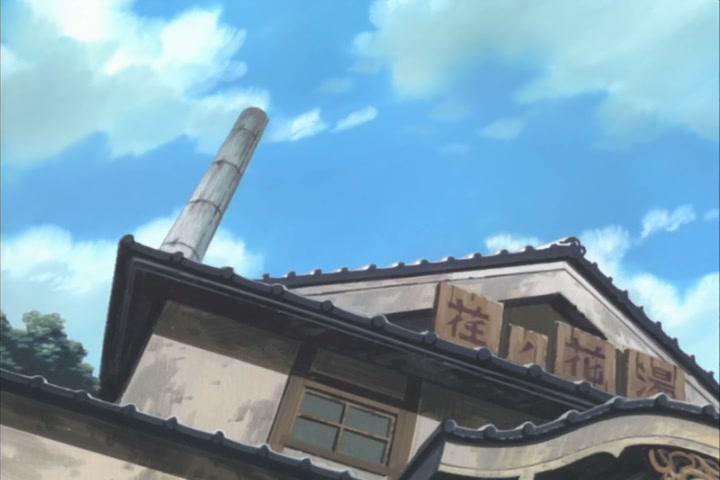
NieA_7 follows Chigasaki Mayuko, a cram school student supporting herself through newspaper deliveries and waitressing at a struggling restaurant. She lives in a tiny room above Enohana Bathhouse, a decaying public bath in a shitamachi neighborhood that feels like it belongs to a Tokyo that vanished decades ago. Her roommate is NieA, an alien of the lowest possible social rank. Under Seven aliens lack the antenna that marks their higher-status counterparts, and in the eyes of the official registration system, they don’t even exist.
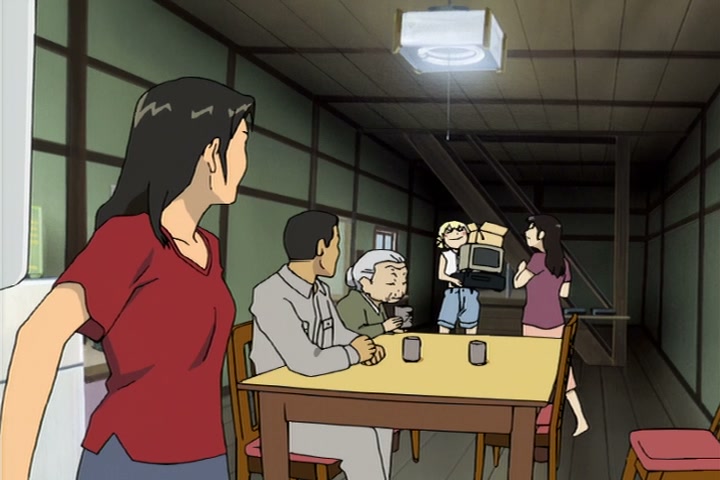
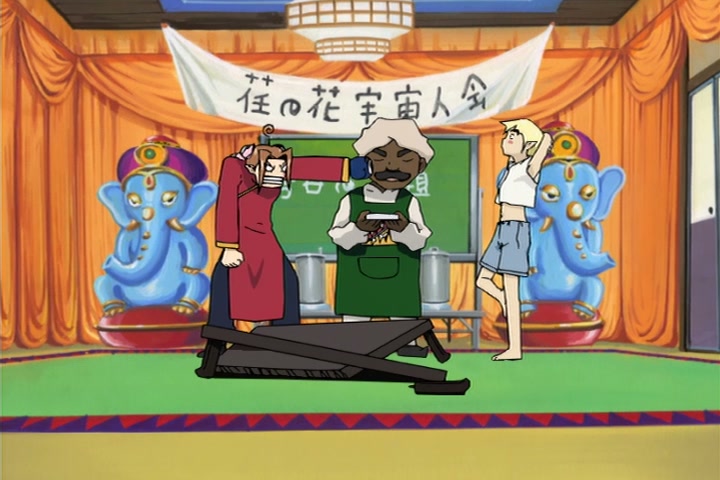
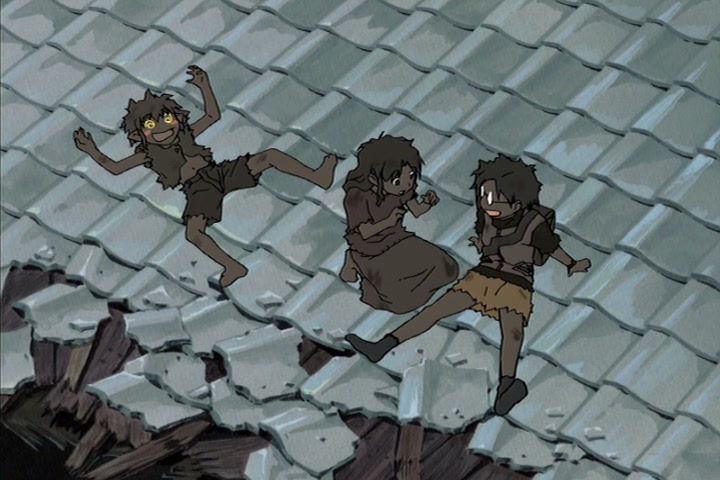
The series unfolds across a single summer and autumn, structured as a loose succession of episodes that initially play like domestic comedy. NieA builds junk UFOs that crash through the roof. The bathhouse staff schemes to attract customers with harebrained events like a “Cosmic Bath” powered by mysterious crater oil or a retro game tournament. Alien society meetings devolve into curry-throwing brawls between NieA and the status-obsessed Karna. It’s all shambolic, charming, and faintly ridiculous.
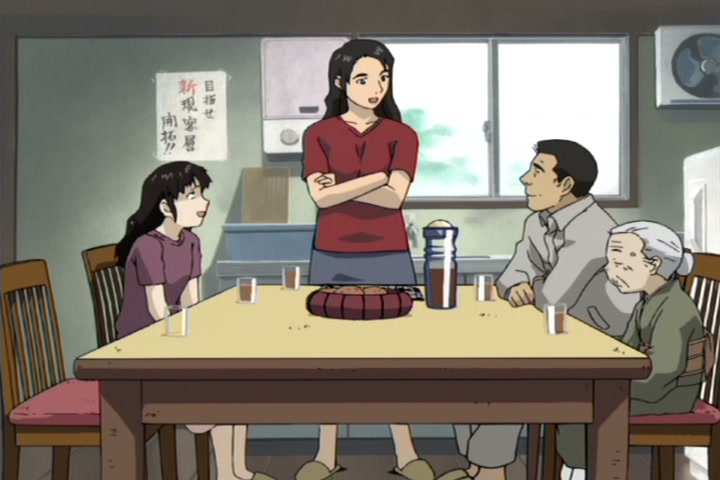
But the comedy is a delivery system for something quieter and more painful. The bathhouse is deep in debt. Kotomi, the young owner, works two jobs and can barely keep the doors open. Mayuko scrounges for discounted meat, counts every yen, and cannot afford a haircut or a nice outfit for a college mixer. The possibility of a buyout hangs over the entire community, threatening to erase the one place that has anchored Mayuko since childhood. And the Mother Ship, that great silent monument to the alien arrival, is slowly breaking apart, whispering a farewell that only NieA can hear.
The series builds its thematic architecture from three interlocking concerns. The first is impermanence. Everything in Enohana is fading: the bathhouse, the Mother Ship, Mayuko’s memories of her deceased father. Her father’s old wristwatch runs slow and sometimes stops, but she refuses to replace it. It’s a perfect metaphor for her relationship to the past. She clings to something that cannot keep accurate time, cannot be fixed, and yet is irreplaceable. When the Mother Ship disappears, it’s not a cataclysm but a quiet erasure. Nobody mourns it except Chiaki, the UFO-obsessed classmate who has built her identity around alien mysteries. The series argues that monumental things end without ceremony, and that this silence is itself a kind of grief.
The second concern is class and the arbitrary nature of social hierarchy. The alien Plus/Under system mirrors human prejudice with satirical clarity. Karna, an elite Plus Five, constantly berates NieA for lacking an antenna, calling her a “no antenna” and an “under-under below standard alien.” Yet Karna herself is a dropout elite working in a cheap Chinese restaurant, her high-powered antenna frequently crossing signals and picking up stray takeout orders. NieA, who has no status to lose, is immune to the insults. She simply calls Karna a “spinning lollipop head” and goes back to mooching food. The series pointedly gives the most profound perception, the ability to hear the Mother Ship’s farewell call, to the one alien who officially doesn’t exist. Hierarchy is an illusion, it insists. The system protects no one. Worth is not determined by rank.
The third concern is poverty, and NieA_7 treats it with a respect that anime rarely musters. Mayuko’s life is a battle for calories. The “sushi” she prepares one evening is vinegar-splashed rice with green peas, a single piece of mackerel shared (or fought over) between two people. She inhales the fragrance of an empty soy sauce bottle and pretends it’s autumn matsutake. These moments are played for comedy, but they’re rooted in a reality that many viewers will recognize: the exhaustion of constantly calculating whether you can afford to eat, the shame of not having the right clothes, the way poverty shrinks your world until even a small kindness, a bag of gifted rice, feels overwhelming. Food becomes the series’ love language. Affection is expressed through what little one can give: a pickled plum, a croquette, a plastic turtle model kit mistaken for a gourmet dinner. NieA’s obsession with “gourmet food” is ridiculous, but it’s also a window into a life defined by scarcity. She dreams of feasts because she’s never had one.
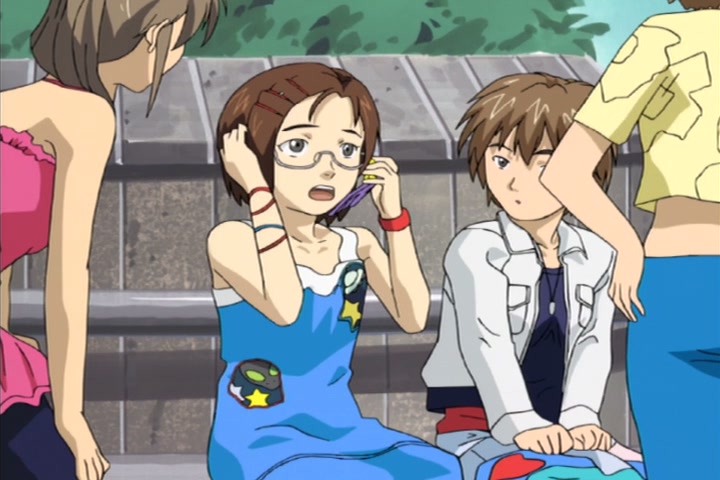
Unlike many anime that adapt manga or light novels, NieA_7 is an original work. There is no source material to condense, no skipped arcs to lament, no adaptation compromises to dissect. The pacing, the meandering subplots, the long silences all feel intentional. The series trusts its audience to sit with discomfort. When Mayuko cancels on a group date at the last minute, paralyzed by shame over her appearance and her poverty, the episode doesn’t resolve the situation neatly. She simply fails to go, and the show lets her failure linger. Kotomi tells her gently that she needs to decide what she wants and communicate it clearly. It’s the kind of advice that sounds simple but exposes how completely Mayuko has been drifting, too busy surviving to imagine a future.
The final episodes bring the threads together without forcing them into tidy resolution. The buyout looms. NieA disappears for days. An old photograph arrives from Mayuko’s mother, showing her as a child at the bathhouse with her father. Mayuko breaks down, finally admitting to Kotomi that she doesn’t want the place to close. It’s the most openly emotional she gets in the entire series, and Kotomi holds her and says, “That’s it, that’s enough.” Permission to grieve, granted without conditions.
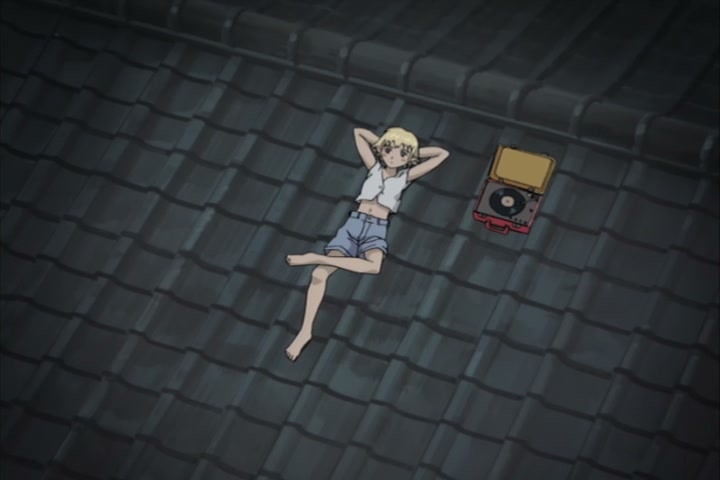
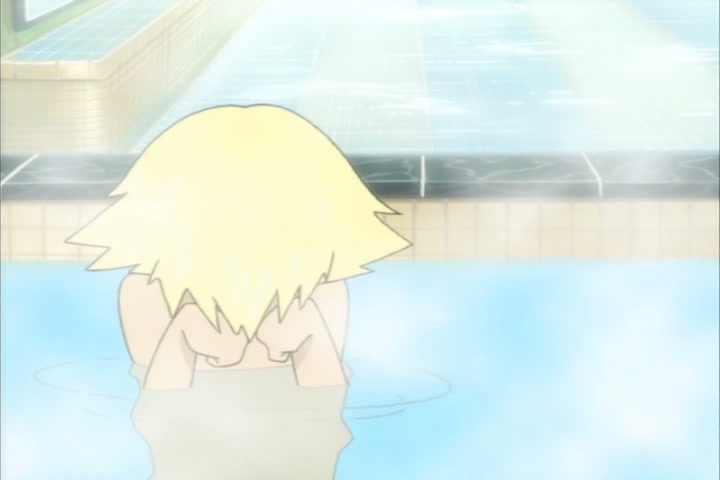
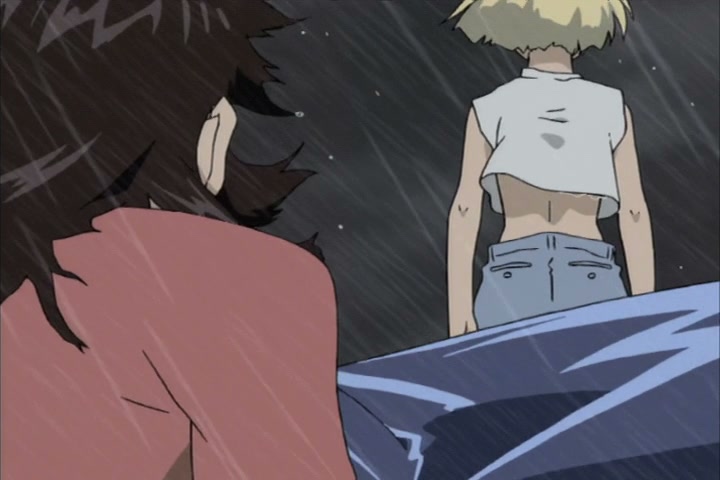
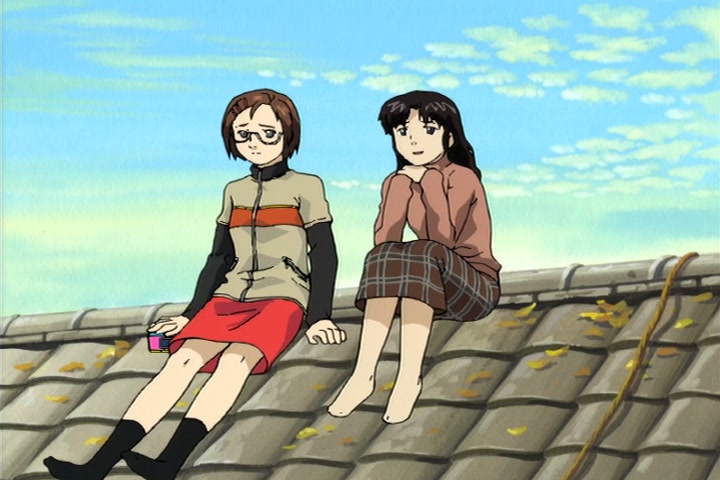
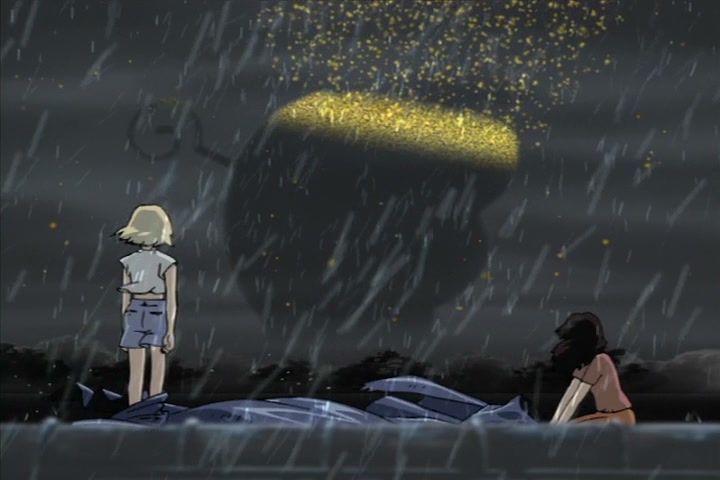
NieA returns as suddenly as she left, appearing in the bathhouse tub and demanding sushi as if no time has passed. Mayuko screams at her, then feeds her. During the typhoon, they scramble onto the roof to hold down a tarp, bickering the entire time while the wind howls and the Mother Ship flickers out of existence. NieA murmurs “Sayonara,” then “See you later.” The series doesn’t explain what she heard, why she could hear it, or where she went. It simply records the moment and moves on, because that’s what life does.
Characters: The Messy, Hungry, Trying-Their-Best Inhabitants of Enohana
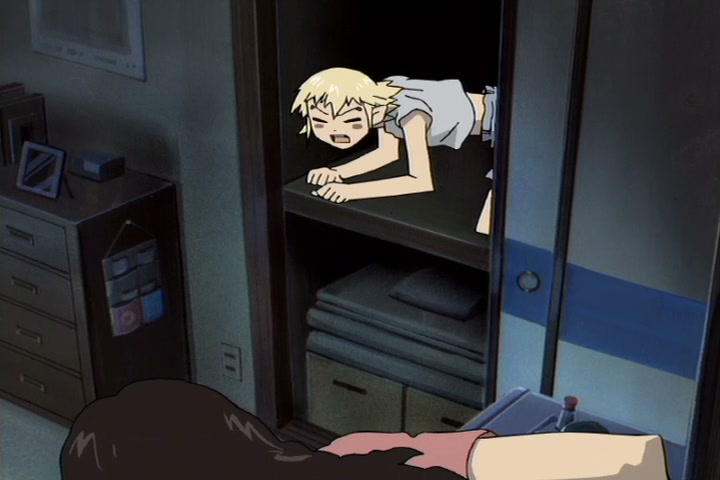
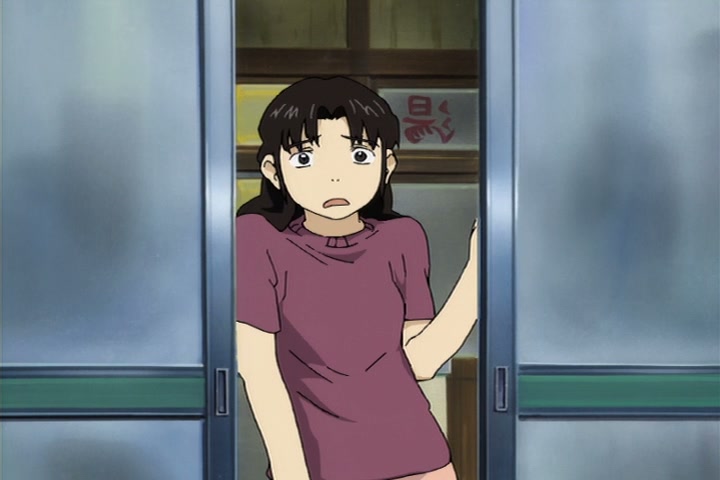
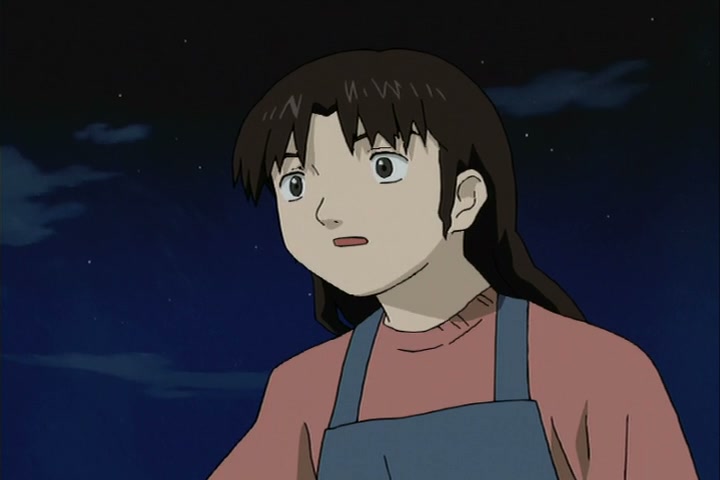
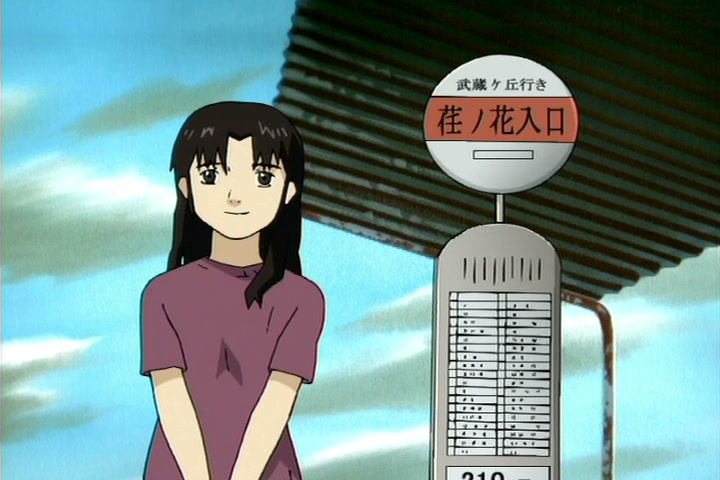
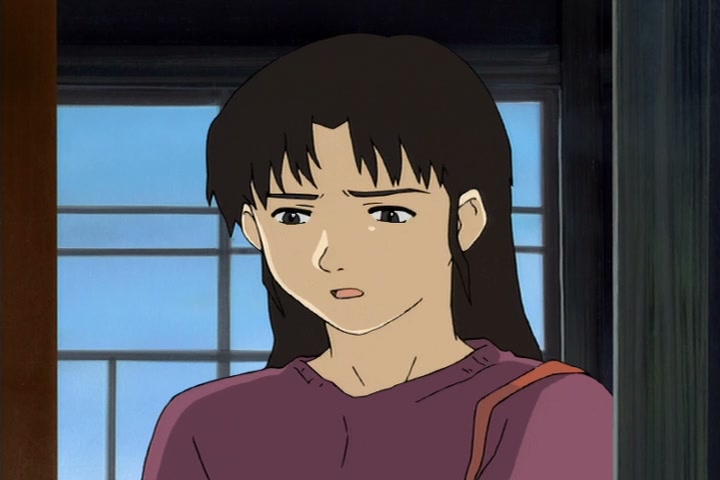
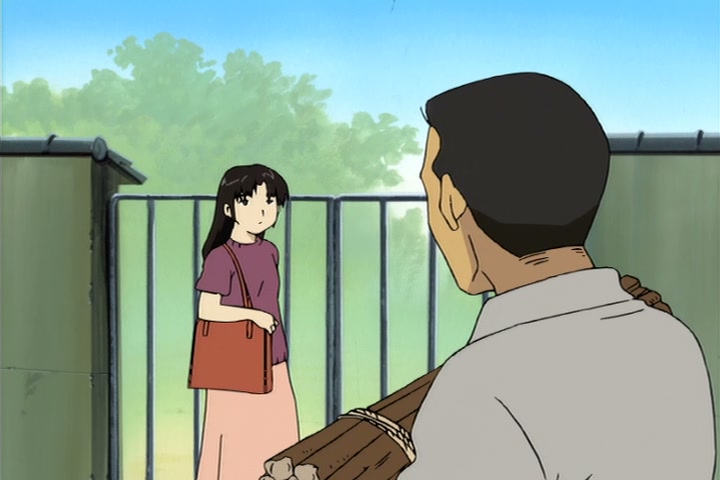
Chigasaki Mayuko is one of the most quietly authentic protagonists I’ve encountered in anime. She’s not especially talented or charming. She’s tired. She budgets obsessively, snaps at the freeloader in her closet, and cannot articulate what she wants from her future. When her childhood friend Genzo asks what she plans to do after college, she has no answer. She’s been in survival mode for so long that she’s forgotten how to want things. Genzo later reveals something she’s buried completely: as a child, she used to tell him stories whenever he was bullied. She would invent tales to comfort him, and she always looked happiest while telling them. She has no memory of this. The revelation is a gift and a wound, a reminder of a creative, expressive self that poverty and obligation have crushed.
NieA is Mayuko’s opposite in every way: shameless, impulsive, perpetually hungry, and utterly unconcerned with productivity or status. She’s often treated as comic relief, a rubber-faced gremlin who steals food, builds dangerous junk, and whines about discrimination whenever someone points out her flaws. But the series gradually reveals her as its most intuitive character. She’s the only one who hears the Mother Ship’s voice, even though she lacks the antenna that should make such perception impossible. Her refusal to internalize the alien class system is a quiet form of rebellion. She doesn’t aspire to rise; she simply wants to eat, build UFOs, and nap on the roof. In a world obsessed with rank, her indifference is a kind of freedom. Her relationship with Mayuko, built on bickering, exploitation, and grudging care, is the series’ emotional engine. They drive each other crazy, but when NieA disappears for days, Mayuko’s frantic search betrays an attachment she can’t admit aloud.
Kotomi, the bathhouse owner, is the community’s anchor. She’s calm, cheerful, and relentlessly hardworking, juggling two jobs while keeping the bathhouse open despite mounting debt. Her decision to ask the staff for their honest feelings about the buyout is a moment of vulnerability that reveals how heavily the burden weighs on her. She’s not a martyr; she’s someone who chose to carry a failing business because she loved it, and she’s trying to share that weight without crushing anyone.
Yoshioka, the boiler-man, is devoted to Kotomi in a way he’ll never verbalize. His love for her expresses itself through labor, burning fuel in the boiler, scouting the crater for mysterious oil, and supporting every scheme she proposes. His pyromania is a running gag, but it doubles as a metaphor for devotion that consumes without expecting anything in return.
Komatsu Chiaki starts as comic relief, the wealthy UFO fanatic who gushes about aliens and treats Mayuko to outings she can’t afford. Her devastation when the Mother Ship disappears is played for laughs initially, but it becomes something more. She’s built her identity around the alien mystery, and without it, she feels empty. Mayuko gently redirects her toward smaller beauties: a red autumn leaf, the changing season. The rich girl learns to find wonder in the ordinary. The poor girl learns to accept kindness without shame.
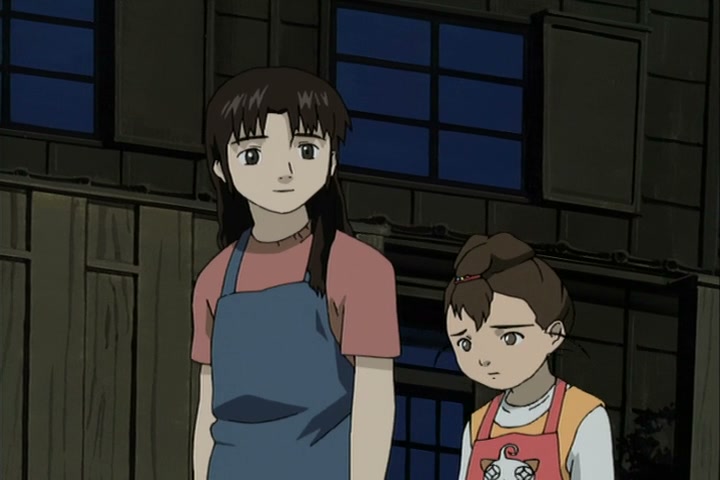
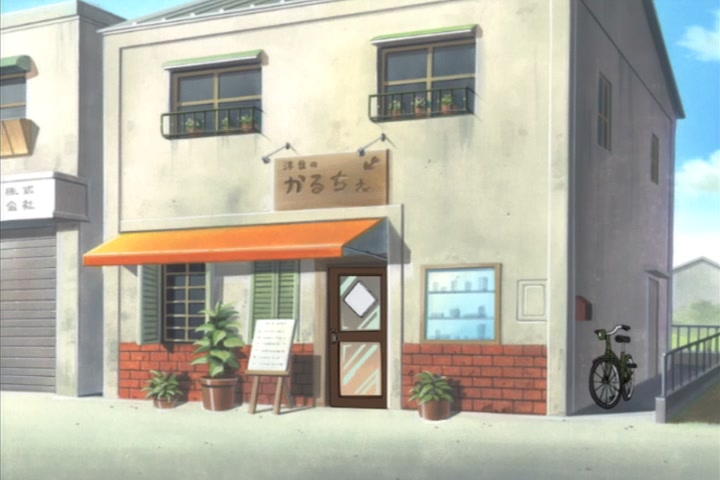
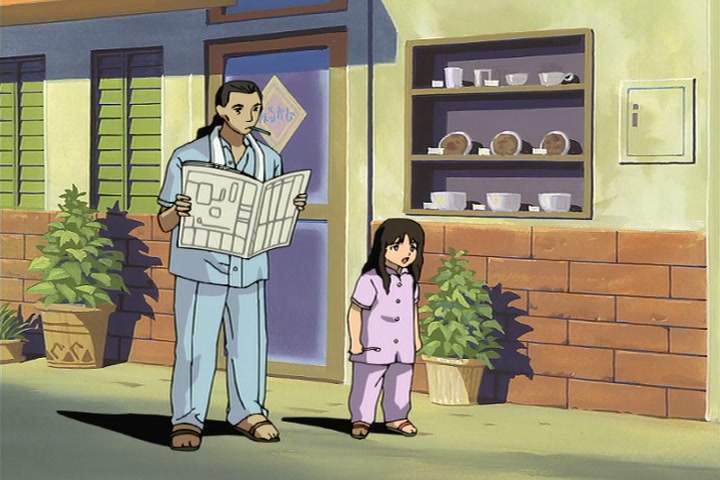
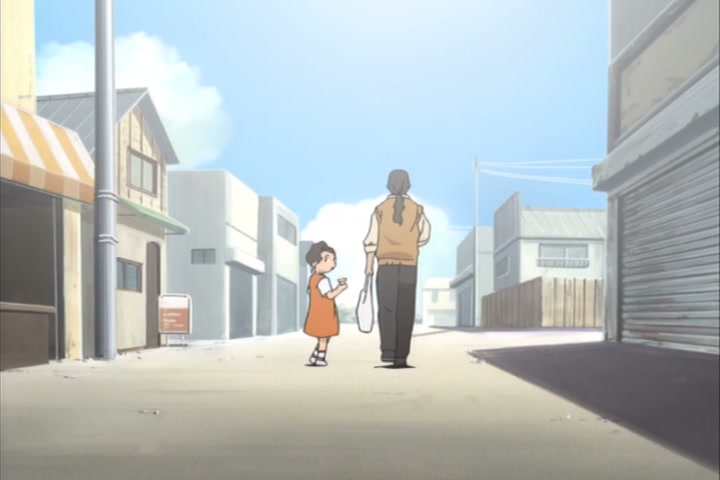
Chie, the elementary-school daughter of the Karuchie restaurant owner, is a pint-sized force of nature. She bosses her father around, haggles over potatoes, and tells Mayuko she should marry her dad. Her fierce pride in the shabby family restaurant, despite complaining that the name is embarrassing, teaches Mayuko about dignity in imperfection. You can be frustrated by your circumstances and still love what you’re building.
Genzo, Mayuko’s childhood friend, is a gentle giant who delivers rice and speaks in halting sentences. He remembers things Mayuko has forgotten. His devotion is steady, undemanding, and expressed through small acts: a bag of rice, a memory shared, an awkward “Good luck” before exams. He represents the past that Mayuko can’t return to, but also the continuity that persists despite loss.
Visuals and Animation: The Beauty of the Rough Edge
Let’s be honest about what NieA_7 is not. It is not a sakuga showcase. The animation budget was modest even by the standards of its era. Action sequences, such as they are, feel stiff and weightless. NieA’s UFO flights lack speed and fluidity. The physical comedy sometimes lands with a jerky thud rather than a snappy snap. Characters in wide shots simplify noticeably. There are moments where figures appear flatly composited against backgrounds, lacking the ambient occlusion that would ground them in the scene. If you’re looking for fluid movement or technical dazzle, this series will disappoint.
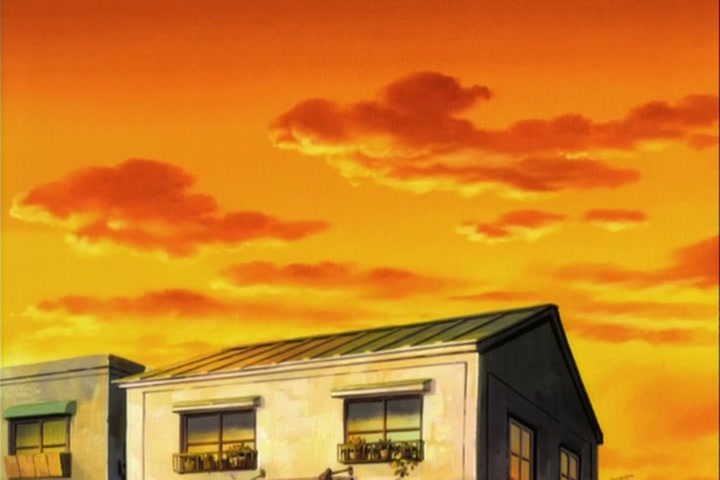
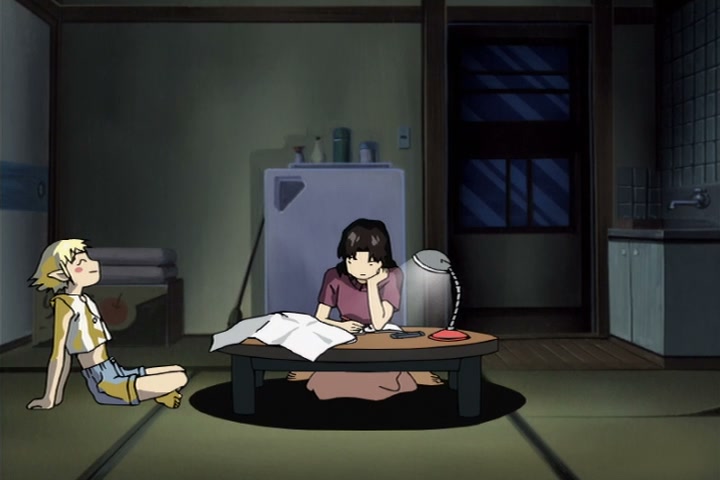
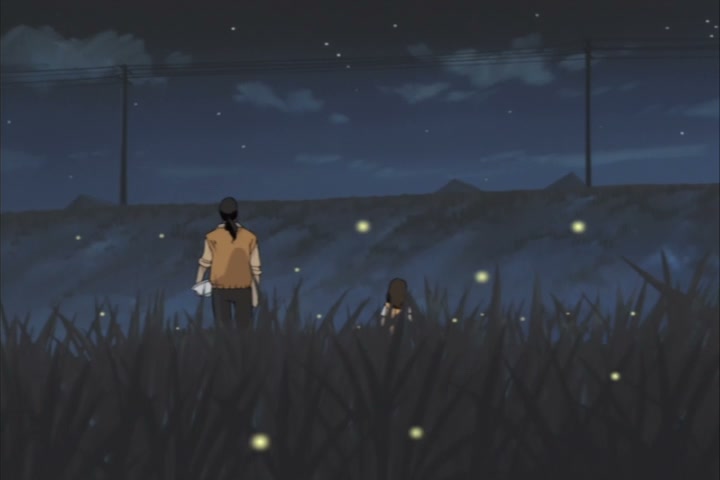
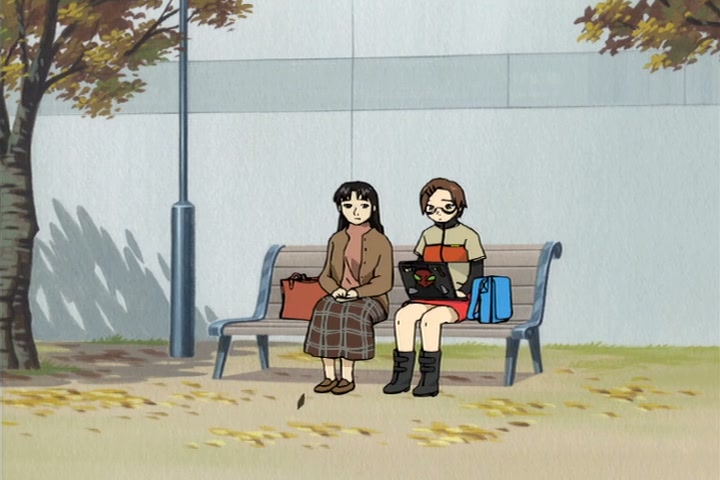
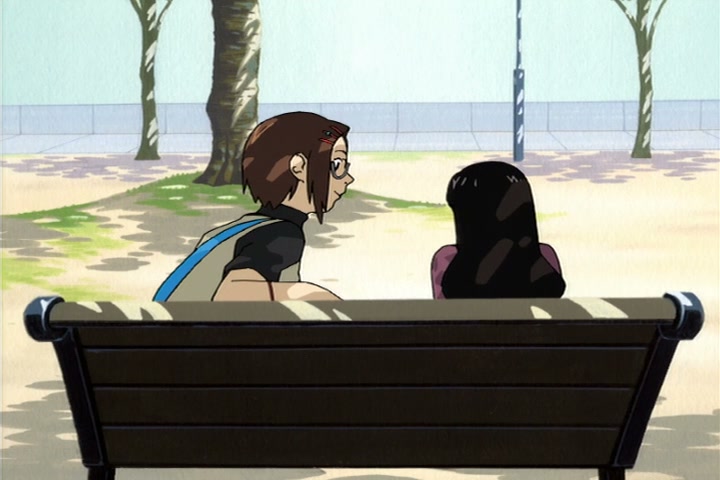
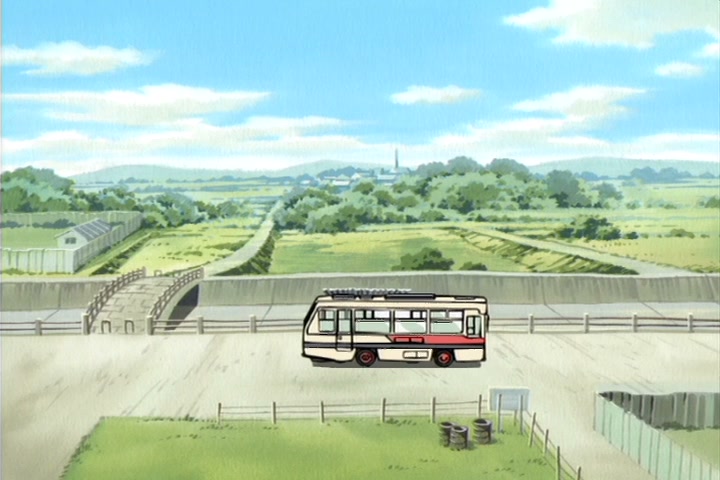
But that’s not what it’s trying to do. NieA_7 is a triumph of art direction, not animation fluidity. The background art is the show’s crowning achievement. It employs a painterly, watercolor-inspired approach with visible texture, almost a paper grain, that gives every environment a handcrafted warmth. The Enohana bathhouse feels like a real place: chipped paint on the walls, stacks of old buckets, light filtering through dusty windows. The narrow streets, the cluttered interiors, the overgrown crater, all of it hums with a quiet, melancholy beauty. The colors shift with the emotional weather: hazy overexposure for the oppressive summer heat, cool blues and grays for rainy nights, warm amber glows for the bathhouse interior and the single desk lamp in Mayuko’s room.
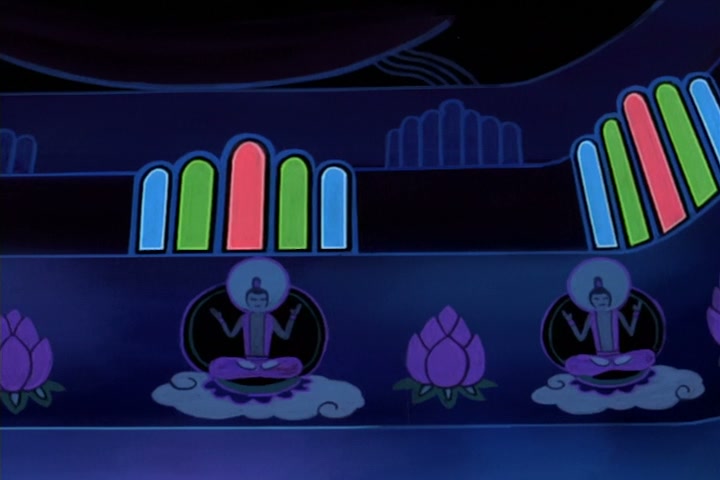
The Mother Ship itself is an understated marvel. It’s a translucent, ghostly form, always present on the skyline but rarely the focus. It doesn’t look like a spaceship so much as a monument or a scar, something that has become part of the landscape whether anyone wants it there or not. When it vanishes, the sky simply looks a little emptier, and the show doesn’t linger on the absence. The world moves on.
Character designs by ABe are naturalistic and grounded. Humans look like real people, with soft features, unremarkable proportions, and clothing that reflects economic reality. Mayuko’s wardrobe is plain, functional, and limited. Kotomi wears simple, practical outfits. NieA’s design marks her as other without veering into the grotesque: slightly pointed ears, wild hair, and most significantly, the absence of an antenna. That missing feature carries enormous symbolic weight, and ABe was wise to make it understated rather than flashy.
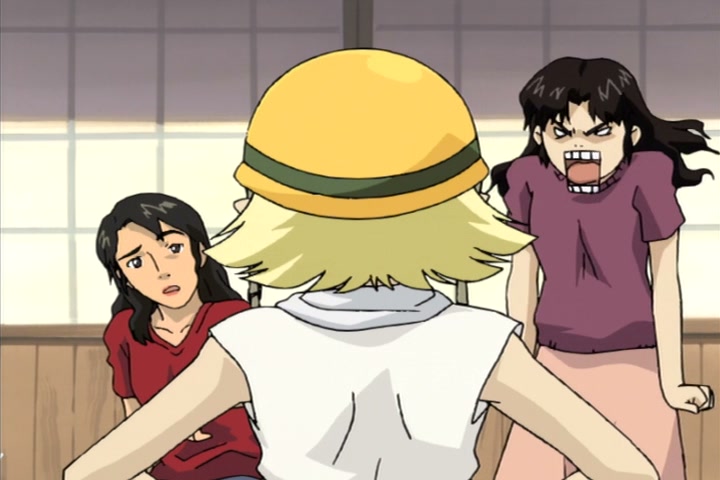
The facial acting deserves particular praise. In dramatic scenes, the expressions are subtle: Mayuko’s weary, half-lidded eyes, Kotomi’s gentle smiles that don’t quite erase the exhaustion beneath them, NieA’s rare moments of unguarded stillness when she listens to the Mother Ship’s call. For comedy, the show deploys elastic, exaggerated expressions: blocky shouting mouths, bulging vein marks, deadpan horizontal eyes. NieA in particular is a rubber-faced chaos agent, her expressions swinging from manic glee to theatrical indignation in a single cut. The contrast between Mayuko’s restrained, often drained expressions and NieA’s cartoonish exuberance creates a visual dynamic that perfectly mirrors their personalities.
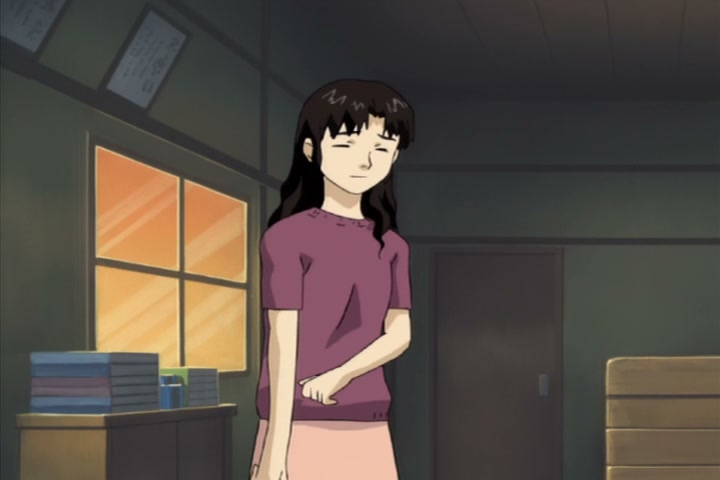
The series also understands when to be still. Many of its most powerful scenes are essentially tableaux: Mayuko sitting alone in her dark room, the bathhouse after closing, Kotomi dozing at the table with paperwork, the rooftop at dusk. These moments don’t need movement. Their power comes from lighting, composition, and the audience’s willingness to sit with the silence. This is not limited animation failing to deliver; it’s intentional pacing that trusts the viewer to absorb the mood. The frame-within-a-frame compositions, doorways, closet openings, foreground foliage, create a sense of intimacy or gentle voyeurism that suits the series’ preoccupation with private, unglamorous lives.
Sound and Music: Atmosphere Over Spectacle
The sound design of NieA_7 follows the same philosophy as its visuals: subtle, atmospheric, and rooted in the textures of everyday life. The ambient audio emphasizes the creaks of an old building, the splash of bathwater, the distant hum of cicadas in summer, the patter of rain on a leaky roof. These sounds aren’t flashy, but they build a convincing acoustic environment. The Enohana bathhouse sounds lived-in, which matters enormously for a series so invested in the feeling of place.
The opening theme, “Koko made Oide” (Come Here), sets the tone with a gentle, slightly whimsical melody that captures the series’ blend of warmth and melancholy. It’s not an earworm designed to top the charts. It’s an invitation, a beckoning into a small, specific world. The ending theme sustains the reflective mood, winding down each episode with a sense of quiet closure rather than dramatic punctuation.
Voice acting across the cast is strong and well-calibrated to the material. Mayuko’s seiyuu navigates the tricky balance between her character’s irritation and her underlying vulnerability, making her complaints feel like the release valves of accumulated stress rather than mere petulance. NieA’s performance is all energy and appetite, her voice swinging from whining demands to gleeful scheming to the eerie calm that descends whenever the Mother Ship’s voice intrudes. The contrast between these two lead vocal performances, one grounded and weary, the other flighty and insatiable, is a large part of what makes their odd-couple chemistry work. The supporting cast fills out the world convincingly: Kotomi’s gentle steadiness, Yoshioka’s flustered devotion, Karna’s shrill indignation, Chie’s precocious bossiness, Chada’s confused cheer.
The musical score is used sparingly, often ceding ground to ambient silence or the sounds of the environment. When it does surface, it tends toward understated acoustic arrangements that reinforce the nostalgic, slightly mournful atmosphere without overwhelming the dialogue. This restraint is a choice that pays off. By refusing to signal every emotional beat with a swelling string section, the series allows its quietest moments to breathe. The silence around the Mother Ship’s disappearance, broken only by wind and rain and NieA’s murmured “Sayonara,” is far more powerful than any orchestral crescendo could have been.
Overall Verdict: A Minor Masterpiece for Those Who Love the In-Between Moments
NieA_7 is not for everyone. It isn’t paced for binge-watching. It doesn’t build toward a climactic battle, a romantic confession, or a tearful graduation ceremony. It resists resolution. The bathhouse’s fate remains uncertain. Mayuko still faces her exams. NieA is still building useless UFOs, and the latest one, powered by a ridiculous electric generator at the end of the finale, still crashes. Life continues, messy and unresolved, but the characters have learned something small and essential: how to share a meal you can barely afford, how to hold a tarp together in a storm, how to say goodbye to something vast and silent without demanding explanations.
The series captures a specific kind of Japanese experience that anime rarely examines with this much honesty. It’s about the beauty and ache of a fading communal tradition, the sentō where neighbors stripped away status along with their clothes. It’s about the grind of student poverty, the loneliness of self-sufficiency, the weight of a parent’s absence. It’s about the strange, quiet integration of the alien into the mundane, not as a threat or a miracle but as just another neighbor in a run-down neighborhood.
Visually, it’s imperfect but soulful. The background art alone justifies the watch, and the character acting, especially in the quieter scenes, communicates emotional nuance that more polished productions often miss. The animation is limited, but the art direction is so confident and the aesthetic so unified that the technical shortcomings feel less like failures and more like the texture of the thing itself. It’s a series with edges, and those edges are part of its identity.
If you need tight plotting, fluid action, or unambiguous emotional payoff, NieA_7 will frustrate you. If you’re looking for something that lingers in the in-between moments, that finds grace in a shared croquette and dignity in a shabby restaurant and strange comfort in the presence of an irresponsible alien who refuses to let you sink into silence, this series is a quiet treasure. It reminded me why I love anime that aren’t afraid to be small, to be shaggy, to trust their audience to find the meaning in what isn’t said.
NieA says “Sayonara” to the vanishing Mother Ship, and Mayuko stands beside her on the roof, holding a tarp against the wind. The ship disappears. The storm passes. The summer ends. And they go back downstairs to make fake sushi and argue about who gets the mackerel. That’s the whole philosophy of the show, really. Say goodbye to what won’t last, and then go share whatever you have left. It’s enough.

Gallery