
Mao’s worldview runs on ships. Her parents are the ultimate OTP, her brother and Rinko are HaruRin, and anyone who interferes is a narrative villain. So when she overhears her parents arguing and learns she isn’t Masashi’s biological daughter, her entire canon collapses. Episode 8 takes that childhood crisis and spins it into the most chaotic, self-aware installment of the season, one where Satsuki finally says the quiet part out loud and Usaharu gets called out by his own little sister without her even realizing it.
Mao’s Shipping Logic Is Surprisingly Solid
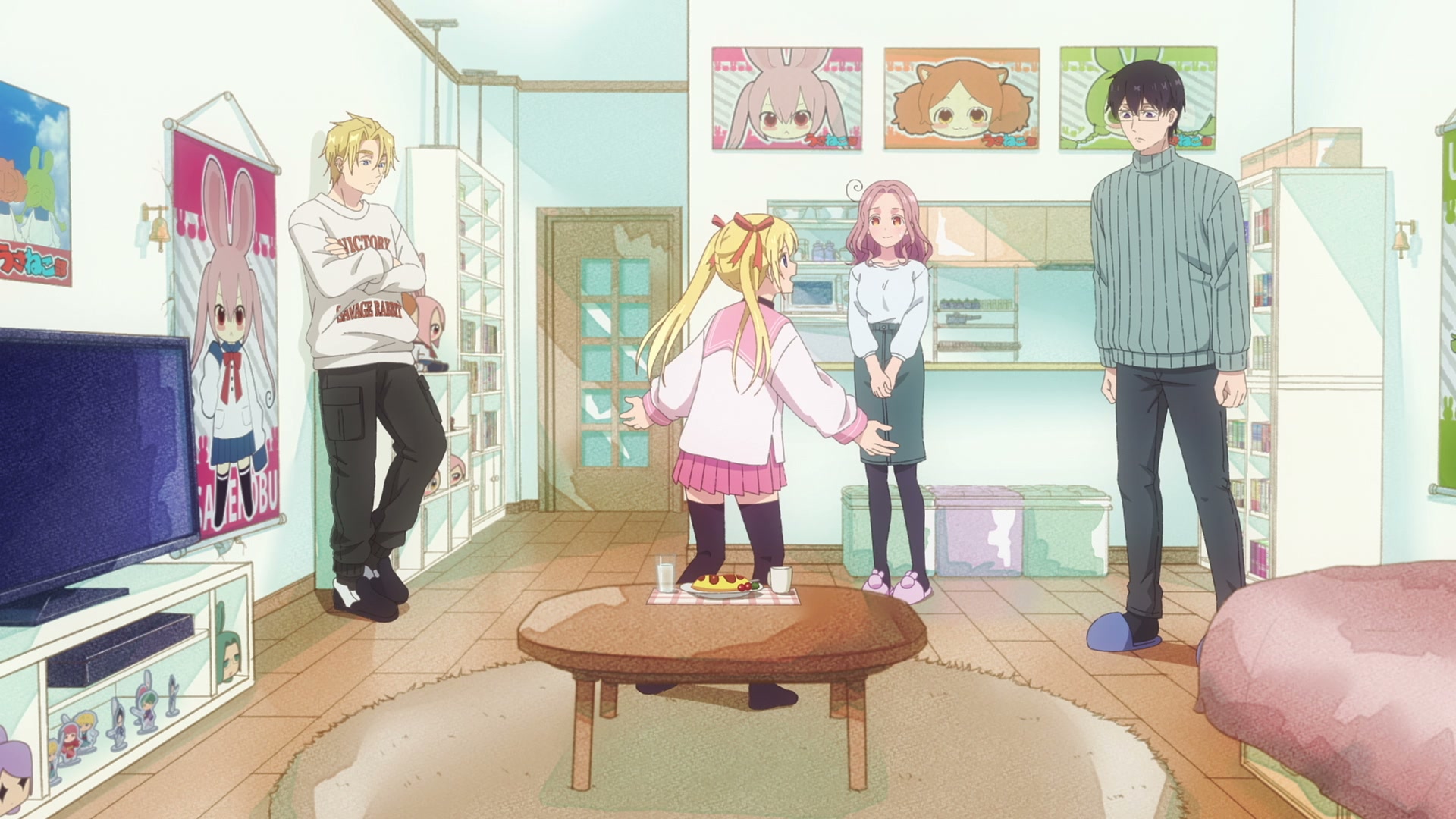
Mao shows up at Usaharu’s apartment in full catastrophe mode, clutching a rice ball and wavering between tears and fury. Usaharu tells her to pick one lane, but Mao instead launches into a full-blown origin story presentation for her parents, complete with dramatic narration, flashbacks, and a genuine reverence for the writer-editor romance that birthed Cat Time. Her retelling of young Carol nervously handing Masashi an unfinished manuscript, only for him to demand more with the intensity of someone meeting their lifelong purpose, is both sweet and hilariously framed like a sports anime backstory. Mao treats every detail as sacred lore because, to her, it is. The way she describes Masashi’s role, “the one who drew that part of her out into the world,” makes it clear she’s not just a fangirl. She’s a historian of love.
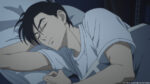
And then she delivers the gut punch: “They don’t need me. I’m not part of their story.” The episode lets that sit while Mao, having screamed herself out, falls asleep mid-sentence. There’s a quiet shot of her slumped over, completely spent, that captures how thoroughly a child can internalize the feeling of being a narrative extra in her own family.
Usaharu’s Backstory Adds Complicated Layers
Usaharu fills in what Mao left out, and the picture gets messier. Carol and Masashi each had other relationships before marriage. Carol’s true love was forbidden, the families were at odds, and when a child was born, Masashi stepped in. That child was Usaharu, which reframes everything about his own place in the family and why he might understand Mao’s confusion better than anyone. He even calls it a “sham marriage” without much bitterness, though you can feel the weight underneath.
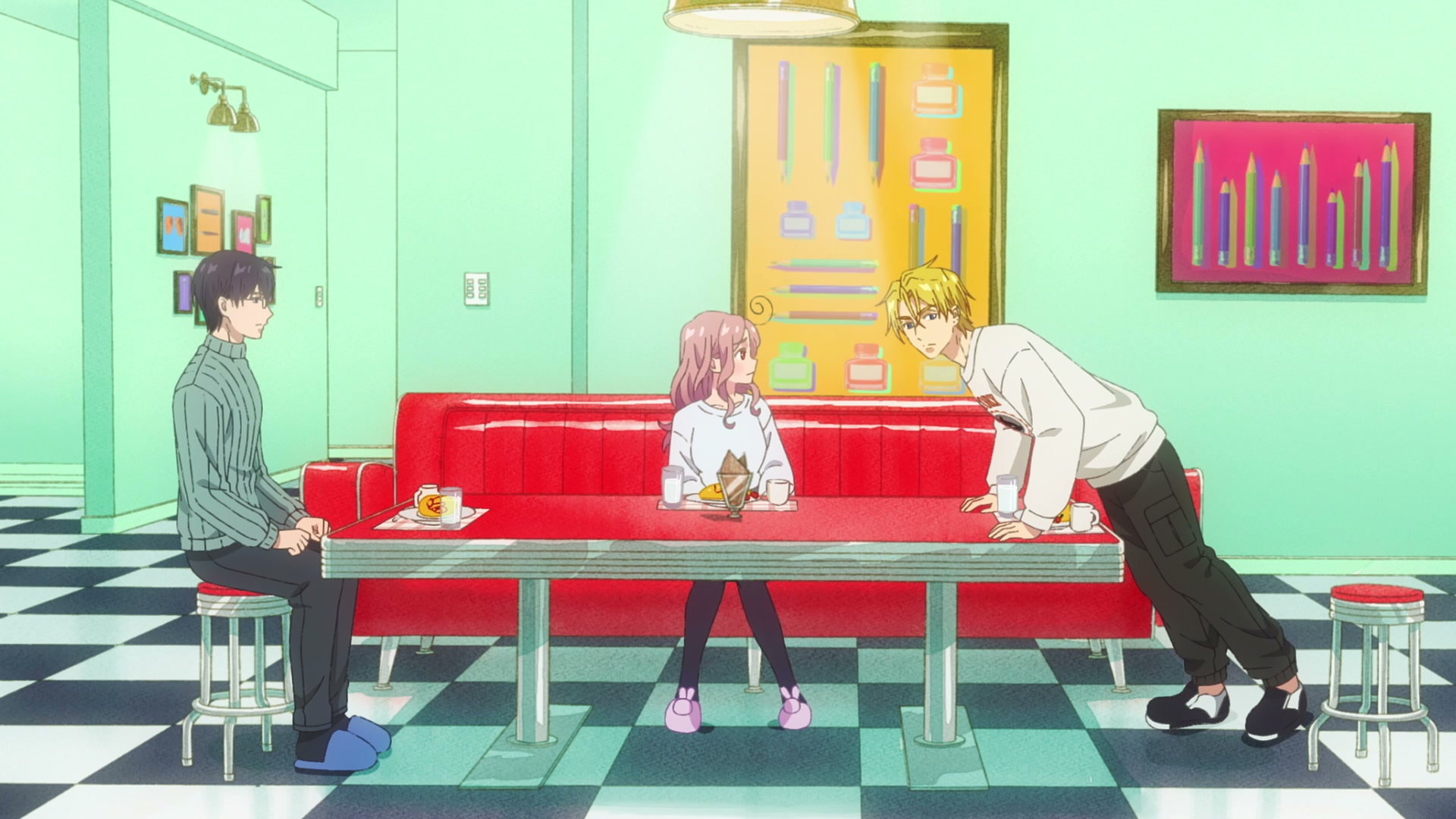
The practical fallout lands immediately: during a Christmas visit, his parents got the impression Rinko is his girlfriend, and now they want to meet her. Usaharu asks Rinko to play along, dragging Satsuki into an already crowded performance. Satsuki, ever the voice of reason, objects, but Rinko’s instinct to help overrides any awkwardness. The moment is pure this show: a small domestic lie piled onto an already teetering tower of half-truths.
Satsuki Drops the Pretense, and Usaharu Protects Him
Mao, now awake and fully invested in the HaruRin ship, declares Rinko and Usaharu should get married. When Satsuki pushes back, she challenges him to a round of Usaneko Puzzle, the in-universe game that serves as this show’s go-to conflict resolution device. Satsuki wins decisively, the kind of methodical, lurking victory Usaharu narrates like a nature documentary about an assassin snake. After the loss, Mao concedes and agrees to call him Satsuki, no honorifics, a tiny detail that shows she respects a worthy opponent.
Then Satsuki does something unexpected. He tells Mao directly that he doesn’t think HaruRin are meant to be because he wants Rinko’s true love to be him. Not the fake boyfriend. Him. In front of everyone. Mao’s brain short-circuits: “Satsuki, you’re… an ‘other man’?!” She spits the phrase like a curse, because in her shipping framework, there is no greater sin. Satsuki corrects her, calling it “illicit love” instead, which is somehow even more scandalous to a kid raised on romance tropes.
What follows is a scene that should be pure chaos but lands with surprising emotional coherence. Satsuki turns to Rinko and says, plainly, “I like you, Rinko-chan.” Rinko, still stuck in today’s fake-girlfriend script, tries to politely decline as part of the act. Mao screams at her to dump the neighbor. And then Usaharu yells for everyone to stop. Not to protect the ruse, but to protect Satsuki. He tells Rinko not to reject him, because “you can’t help falling in love,” and if Satsuki gets shot down now, it’ll feel like Usaharu himself is being stabbed. He even admits, out loud, that forcing an illicit love while knowing someone is taken is exactly what he’s doing.
This is the most honest Usaharu has been about his own romantic position since the kiss in episode 6. He sees Satsuki as a mirror, and the empathy that spills out of him temporarily overrides his usual ego. Mao, utterly lost, calls the whole situation “super bad” and storms off, which is the correct reaction for a ten-year-old watching her brother endorse love-triangle anarchy. Usaharu mutters that Satsuki is using his sister to call him out, and he’s not wrong. The self-awareness in that line, combined with Satsuki’s quiet “I don’t plan on destroying the times the three of us could happily spend together,” keeps the confession from feeling like a cheap escalation. It’s a statement of intent that respects the fragile equilibrium the trio has built.
Mao’s Name Carries the Resolution
Just when the episode seems ready to end on romantic tension, Michio shows up. He’s the Usada family housekeeper, the artist behind Cat Time’s covers, and, as it turns out, Mao’s biological father. Carol and Masashi arrive, and Mao initially refuses to go home because her parents’ “ship is officially over.” Masashi’s response is the most dad thing possible: he tells her that her name is “the result of three people,” the “Ma” from Masashi and the “O” from Michio. Mao was never a secret kept from her. She was named with intention, a blend of the two men who would raise her together.
The reveal recontextualizes the entire argument from the cold open. Carol and Masashi weren’t fighting about infidelity. They were likely debating whether to tell Mao the truth, and Masashi’s insecurity was about how he measures up, not about Carol’s past. Mao’s immediate pivot from despair to “this is a godlike official plot twist” is pure, unfiltered fandom brain, but it’s also deeply sincere. She embraces both dads instantly, because the canon just got better, not broken.
The visual of Masashi and Michio standing together, both reaching for Mao, is understated but effective. No one is pushed out. The family expands rather than fractures.
Satsuki’s Other Secret Barely Steps Into the Light
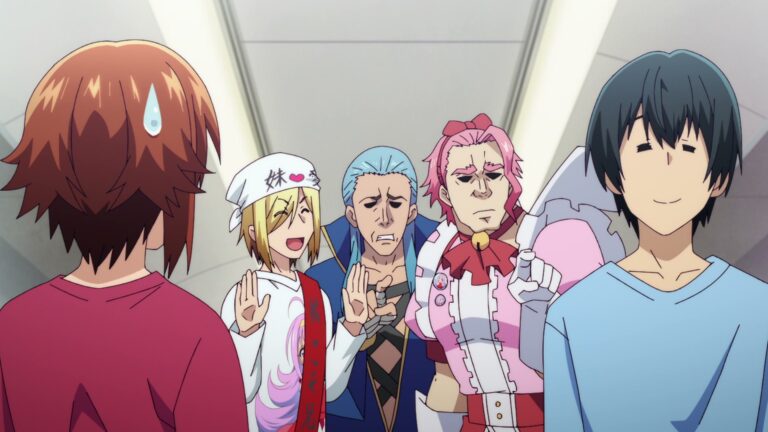
The episode tucks a tantalizing thread into its final moments. As the family leaves, Mao calls for Satsuki to come out and see her off. When Masashi catches sight of him, his reaction is immediate and reverent: “My word! Sensei!” Satsuki’s expression stays neutral, but the title lands like a small explosion. Masashi, an editor, recognizes him as someone significant. Given that Satsuki’s job has been a running mystery, with only vague hints about writing and a dark joke about killing people, this adds a new layer. Next episode’s title, “Satsuki-san’s Secret?!,” promises to finally pull that thread.
That tease, combined with Satsuki’s confession and Usaharu’s protective outburst, sets up a turning point. The trio’s dynamic can’t stay frozen forever, and Mao’s visit, for all its absurdity, forced a conversation that had been simmering under pretend-boyfriend politeness. The episode ends not with resolution but with a quiet sense that everyone just got a little more honest, and that honesty is going to demand a response.
Screenshots
[…] ← Episode 8 | All Tadaima, Ojamasaremasu! Season 1 posts → […]