






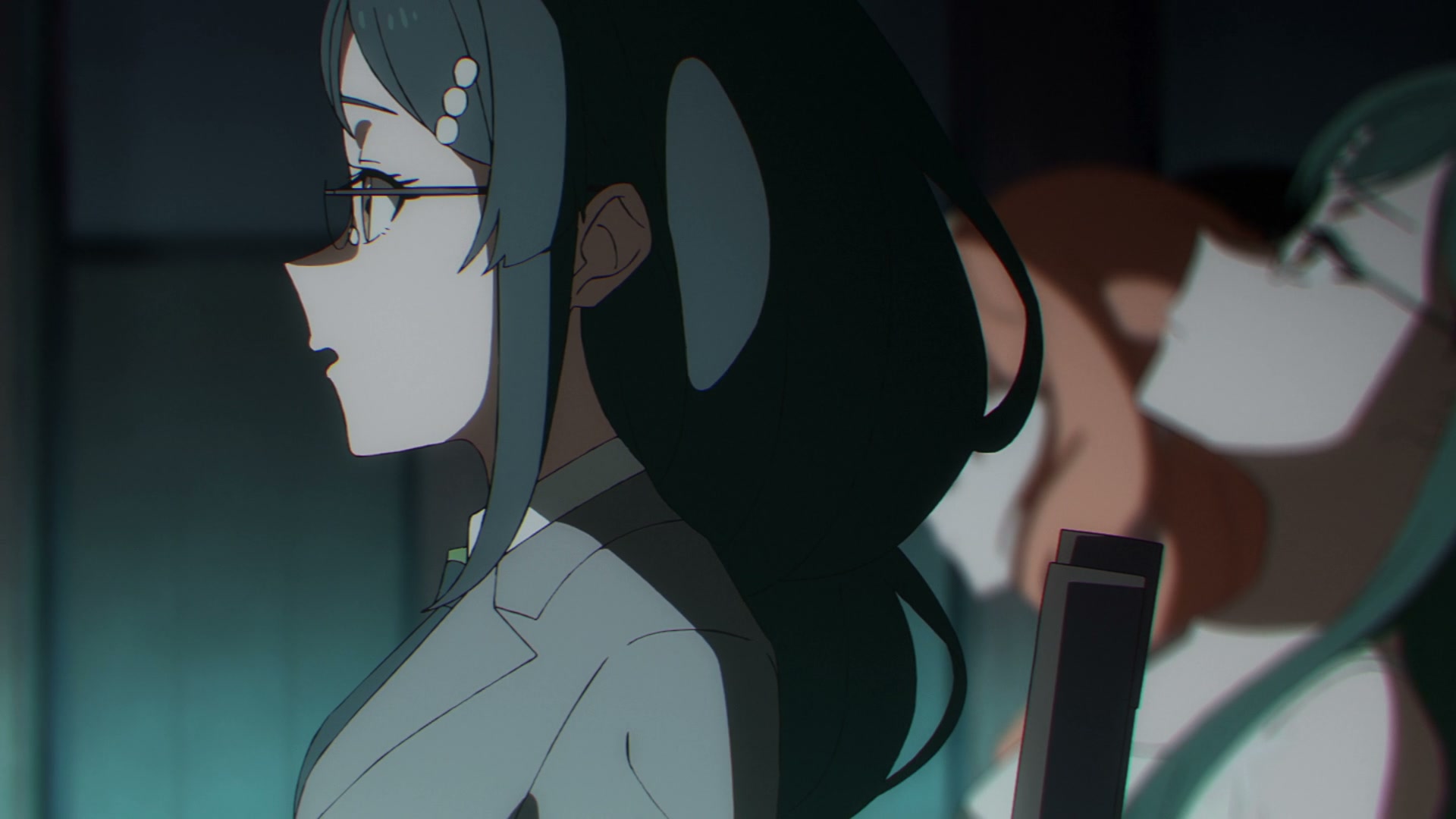
The quiet horror of this episode is that Misuzu Henderson genuinely believes she is doing something kind. The way she holds Nadeshiko’s chin, the soft voice, the patient repetition of “I’m your mom from now on.” It’s all the more unsettling because we know exactly where this leads, not from abstract villainy but from the firsthand testimony Hinagiku gave two episodes ago. Misuzu isn’t just after an Agent’s power. She wants a child, and she has decided Nadeshiko will fill the hole her own loss left behind. That single obsessive need makes her scarier than any ideological rant could.
The Nadeshiko-Misuzu scenes are the episode’s coldest, most claustrophobic stretch. Nadeshiko immediately refuses the mother act with clear, stubborn logic: “You’re not my mother, and you might be an insurgent, so I will not.” That line alone shows she is far savvier than her age suggests. She demands Rindou, asks about the palace staff, and her voice wavers only when Misuzu ignores every question and just keeps smiling. The moment Nadeshiko finally whispers “Rindou… help” lands with a sickening weight because we’ve seen her treat him as her prince, and we know he isn’t coming through that door. Misuzu’s tactic is straightforward isolation: “They abandoned you. No one came to save you. I’m the only one you have left.” It’s a direct echo of the woman who held Hinagiku, the insurgent “mother” who brainwashed her with affection and death threats. Only this time, the captor is wearing a pleasant smile and baking cookies, and she has already decided that a seven-year-old goddess will be her replacement daughter.
Hinagiku understands the danger better than anyone, and the episode draws that parallel with a single devastating beat. When Rindou asks why an insurgent would kidnap an Agent after trying to kill her, Hinagiku answers that Misuzu wants “to make the Agent of Autumn into her own daughter.” The room goes silent. Rindou, who has been running on adrenaline and guilt, can barely process it. Hinagiku doesn’t elaborate with emotional detail; she just states the fact, and that clinical delivery says more about her own captivity than any flashback could. She knows Misuzu’s type because she lived with someone like her for years.
Rindou spends most of the episode on the verge of breaking. His guilt is so heavy it borders on self-destruction, and his earlier cold philosophy about managing Nadeshiko’s affection has been obliterated by the reality of losing her. When Sakura challenges him, “Are you a Guard or aren’t you?”, it’s not cruelty. She’s pulling him back from the same helplessness she felt ten years ago, watching Hinagiku walk into captivity. Sakura’s speech about taking advantage of others for the sake of the one you serve, about refusing to let bureaucrats treat Agents as interchangeable parts, is the emotional core of the coalition. She isn’t just rallying Rindou. She’s speaking to her own younger self, the girl who couldn’t protect Hinagiku and has been burning with that failure ever since. The difference now is that Sakura isn’t alone. The united front she called for in the previous episode is actually moving, and that gives her voice a force it hasn’t had since the S01E08 flashback.
Hinagiku’s quiet advice to Rindou is the gentlest thing in the episode. She tells him not to lose heart, that a retainer is their Agent’s light, and that Nadeshiko must be waiting for him. She frames it as simple truth, but the undercurrent is pure experience. Hinagiku spent years wondering if anyone needed her, if her survival even mattered, because the system treats Agents as replaceable. The Village Head of Spring’s cold, “Even if their Agent does not return, her successor will emerge eventually,” is exactly the attitude that nearly killed her will to live. But Rindou’s desperation, his raw “she must be worried about me,” is proof that someone is waiting. Hinagiku recognizes that because she eventually found people waiting for her, too. Sakura. Rousei. Even Itechou, who is off in the background threatening to bury Spring Village in ice if they don’t support Hinagiku properly. The old guard’s loyalty still exists, even if it’s buried under a decade of shame.
Itechou’s scene with the Spring elder is a welcome blast of cold air in an episode that otherwise stays confined to the Autumn palace. He walks in without ceremony, tells her they’re forming a united front and she will stay out of the way, and then drops the threat: “Take good care of Hinagiku and Sakura from now on. If anything happens to them, the Village of Spring will end up buried in ice.” It’s the same controlled, deadly calm Itechou used when he shut down Ishihara’s skepticism back in episode one. The elder calls him a monster, and she’s not wrong, but in this moment that monstrous loyalty is exactly what the alliance needs. It also reminds us that Rousei’s camp is not merely offering polite assistance. They are willing to strongarm their own bureaucracy to protect the person Rousei loves.
Rousei himself stays in the background this episode, but his brief exchange with Rindou over the phone is quietly effective. “Don’t make a big deal out of it” is his reflexive response to gratitude, but the advice he gives Rindou about regrets eating away at body and soul is clearly drawn from his own decade of self-recrimination. He tells Rindou to focus on saving his autumn for now. It’s practical, almost too calm, and it shows how much of Rousei’s own emotional landscape remains locked away even as he acts. He isn’t ready to talk about Hinagiku directly, but he’s protecting her through action, and that’s the only language he knows.
The united front that Sakura summoned is now fully materializing. Summer brings tracking and Life Operation, though Ruri’s attempt to follow the trail goes cold at an airport. Winter brings political muscle, intelligence, and the blunt force of Itechou’s threats. Spring brings the personal knowledge of the enemy and the emotional anchor of Hinagiku’s presence. Autumn is broken but clawing its way back under Rindou’s raw motivation. The episode wisely splits them: Ruri and Ayame head out to track the insurgents, leaving Hinagiku and Sakura at the palace. Ruri’s offhand remark that Winter’s arrival will make Rousei “over the moon” if he finds Hinagiku there is a small, bright moment of teasing that acknowledges the romantic thread without overplaying it. Ayame’s immediate “Ruri!” is pure older-sister exasperation, a reminder that the Summer dynamic hasn’t lost its edge even in crisis mode.
Hinagiku’s final reflection is the episode’s most fragile, beautiful passage. Speaking to Sakura, she says she was a girl no one wanted. If she never came back, another Agent would emerge right away. No one needed it to be Hinagiku. So she thought she should just hurry up and die. That isn’t self-pity. It’s the cold arithmetic of the Agent system, as seen through the eyes of a child who internalized her father’s blame and her captor’s manipulation. But then she says she chose to live. And after she lived, she found out people did need her. People were waiting. Being alive let her do more than just spring. The final question she asks, “Maybe this is what Hinagiku came back for,” isn’t resolved, but it doesn’t need to be. It’s enough that she is asking it at all. The girl who once handed her emotional self to a colder persona to survive captivity is now tentatively claiming that her existence has worth beyond seasonal function.
The episode doesn’t treat this as a triumphant breakthrough. It’s a quiet, almost whispered hypothesis, offered in the privacy of her conversation with Sakura. But coming after everything she just did for Rindou, after recognizing Misuzu’s pattern and using her own trauma as a map to help Autumn, the words feel earned. Hinagiku is not the dissociated child from the flashback. She’s someone who looked at her own broken past and used it to give another retainer hope.
It’s a dense episode that could have easily collapsed under the weight of its own exposition. Instead, it moves with grim focus from one tense conversation to the next, balancing the immediate horror of Nadeshiko’s captivity with the slow, quiet rebuilding of Hinagiku’s sense of self. The insurgents have made their demands, the coalition is operational, and the search is on. But the real work this episode does is emotional. It draws a line directly from Hinagiku’s lost decade to Nadeshiko’s current nightmare and says: we have seen this before, and this time we are not letting it end the same way.
Screenshots
← Episode 9 | All Shunkashuutou Daikousha – Haru no Mai Season 1 posts →
[…] ← Episode 10 | All Shunkashuutou Daikousha – Haru no Mai Season 1 posts → […]