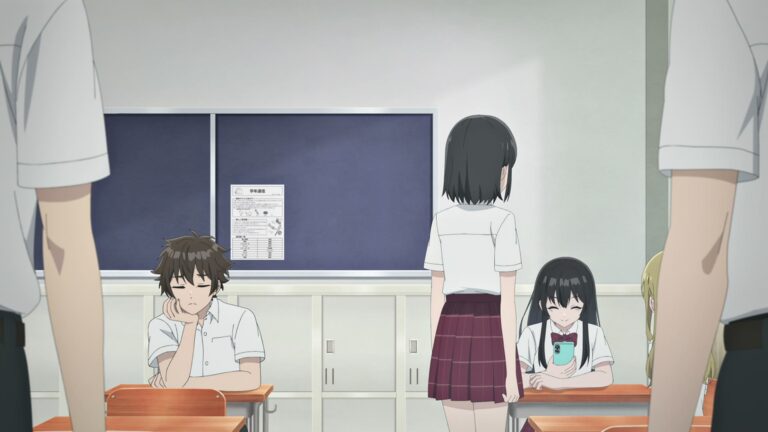







The episode opens with Maria on the phone, and it is the most Maria phone call possible. She is negotiating a venue, getting stonewalled, pivoting to conditions, and somehow ending the call with a cheerful “Thank you very much” while her face says she just swallowed a lemon. The troupe’s financial precarity is not a new plot point, but hearing her navigate it in real time, with that mix of forced politeness and sharp calculation, sets the tone. Himawari Circus is always one missed payment away from disaster, and Maria is the tiny ringmaster who refuses to let anyone see her sweat.
Then we cut to the kitchen, and the potato situation has escalated to crisis levels. Potatoes for breakfast, lunch, and snack. Mizuka, deadpan as ever, slides her portion toward François with a muttered “Give these to François later.” The troupe’s poverty has been a running joke since episode one, but the potato monotony is hitting a new low. It is the kind of detail that makes the Himawari Circus feel lived-in. They are not just “struggling” in the abstract. They are eating the same damn tuber three meals a day and trying to joke about it.
Mizuka’s Secret Comes Out, and It Lands Hard
The real pivot of the episode starts with a magazine article. Ouka and the others are flipping through a circus publication that asks whether Sumeragi Nanami can surpass the legendary Lotus Circus. The conversation drifts to Black Lotus, his five consecutive Circus Collection wins, and his partner Aiden Mitscher. Someone pulls up a photo of a young, absurdly handsome foreigner, and the girls swoon. It is a light, gossipy moment until Mizuka, offhandedly, drops the bomb.
“I never once thought he was cool. Who thinks their own father is cool, anyway? Especially not a paramecium like him.”
The room freezes. The troupe’s reaction is a perfect mix of shock and delayed comprehension. Rin already knew but kept quiet out of respect for Mizuka’s privacy. The others are reeling. Akane and Aoi, who have been suspicious of Mizuka from the start, look like they just had their entire understanding of her rewritten. Ouka, who idolizes Black Lotus and the Lotus Blossom act, is suddenly face-to-face with the fact that her dream partner is the daughter of the man she worships, and that daughter despises him.
Mizuka’s microbiology insult habit gets a new entry here. “Paramecium” has been her go-to for her father since the beginning, but now she mutters it in front of everyone, and the context makes it land differently. It is not just a quirky insult. It is a window into years of abuse and resentment. The troupe does not press her for details, but the weight of the revelation hangs over the rest of the episode.
Maria, ever the pragmatist, immediately reframes the situation. Mizuka is a “huge asset” and a “real bargain,” especially given their finances. She admits she feels a little bad but plans to use the debt as leverage to keep Mizuka working with the circus. Rin calls her a demon, and Maria does not deny it. This is the Maria I have come to love: cheerful, tiny, and absolutely ruthless when it comes to keeping her circus alive.
Micchan Arrives and Immediately Takes Over
The next morning, a giant of a man vaults through the window, tackles someone, and sends the entire troupe into a panic. It is Aiden Jett Mitscher, Black Lotus’s former partner, and he looks nothing like the magazine photo. The man has aged, filled out, and traded his pretty-boy looks for a rugged, bear-like presence. The troupe’s confusion is played for laughs. “Doesn’t he look completely different from the photo?” “Now that you mention it, I have aged quite a bit.” “That’s your concern?”
Mizuka’s reaction is ice cold. She greets him with a flat “It’s been a long time. How’ve you been?” and when he says he came to see her face, she replies, “Well, you’ve seen it now. Goodbye.” She tries to leave for grocery shopping, and Micchan’s response, “My, how cold,” is delivered with the kind of fond exasperation that suggests he has known her since she was small and is used to this.
The troupe fills him in. Mizuka is coaching but not performing. The brutal training she endured left her traumatized, and she says she hates circuses. Micchan’s expression shifts. “Trauma, huh? Then I’ll see for myself.” He does not push her to talk. He just decides to observe.
What follows is a flashback to Mizuka’s childhood training, and it is as horrifying as it is absurd. Micchan blindfolds himself, throws knives at an apple on her head, and then there is the “Cordless Bungee” bit where the cord is missing and he just drops her. The troupe watches in horror. “If they did this to her as a child, no wonder she’s traumatized.” The show has always balanced its darker elements with comedy, but this flashback lands squarely in the “this is genuinely messed up” category. It recontextualizes every time Mizuka has flinched at physical contact or shut down emotionally.
The Coaching Session That Exposes Everything
Ouka, ever earnest, asks Micchan to watch her aerial act. She wants to show him what she can do, and Maria negotiates his coaching fee down to one night’s lodging and a meal. “All we have to serve is potatoes, though.” The potato joke is still alive and well.
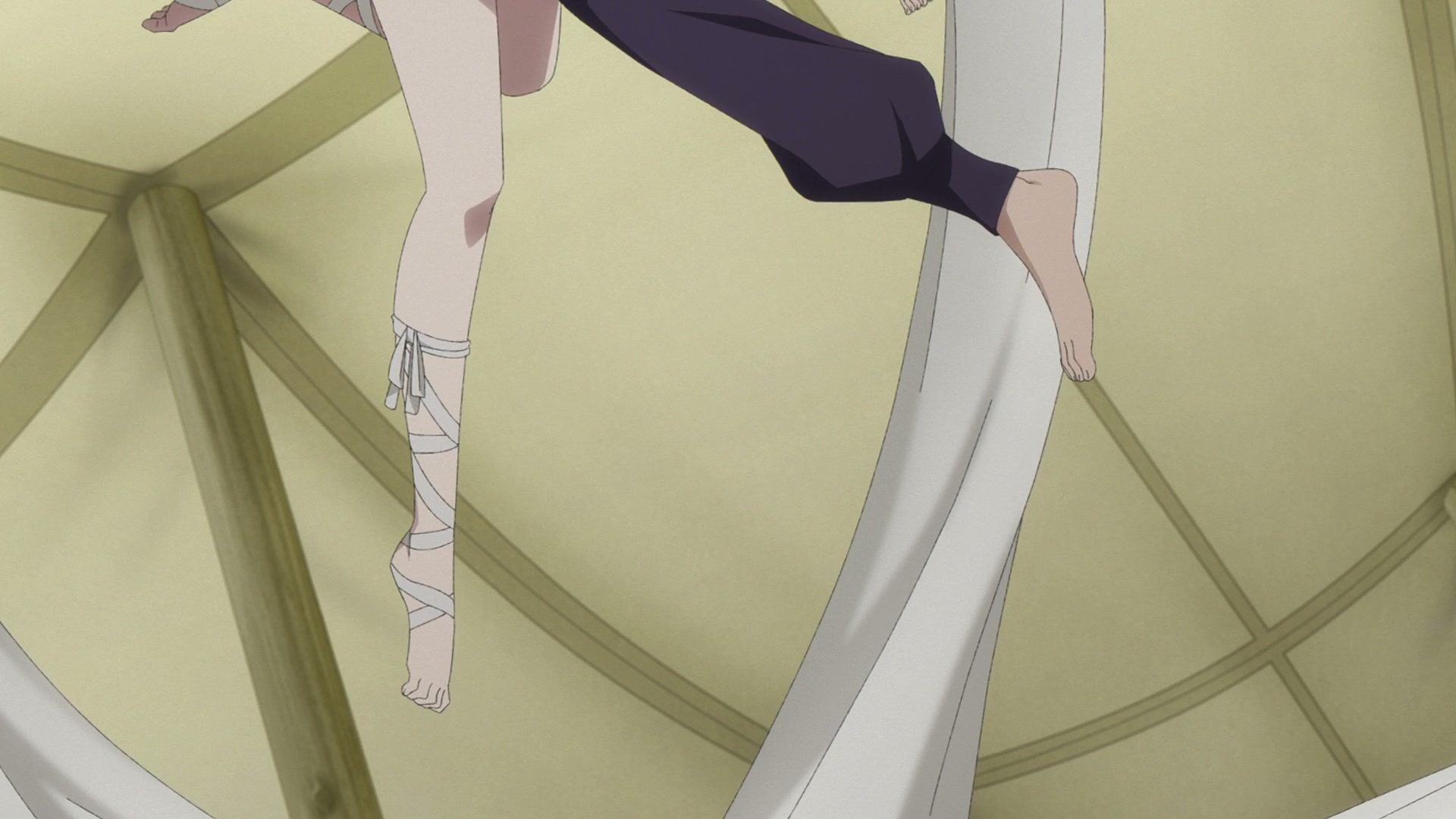
Ouka’s performance is beautiful. Micchan watches with a professional eye, and when she finishes, he says, “You did something interesting there.” He then points out a bad habit she has picked up, and Maria immediately blames herself. But the real gut punch comes when Micchan turns to Mizuka, who has been watching from the sidelines, and asks for her advice on the aerial silks performance by Shizuku and Svetlana.
Mizuka gives a perfectly competent critique. Timing, lightness, suppleness. It is the kind of feedback a good coach would give. Micchan listens, then says, “No good. No good at all. That goes for you and that performance.” He proceeds to tear apart not just the performance but Mizuka’s entire approach to coaching. “You have no talent for coaching. Stop coaching and focus on performing onstage. You’d at least be a little better at that.”
This is the moment the episode has been building toward. Mizuka has been hiding behind her coaching role, using it as a way to stay connected to the circus without confronting her own trauma. Micchan sees right through it. He does not let her off the hook. When she protests that she does not want to be a performer, he points out that she is already flying with Ouka. “That just sort of happened… Or rather, I was forced into it.” “That’s pretty rude to Kawasumi-san, you know.”
The exchange is brutal but necessary. Mizuka has been coasting on her technical knowledge while avoiding the vulnerability of actually performing. Micchan, who knows exactly what she is capable of, refuses to let her settle for less.
Svetlana’s Hidden Past
While all this is happening, the episode drops another revelation. Svetlana, the quiet, deadpan member of the troupe, is actually Svetlana Rosen Yamada, a former child prodigy who performed with the Soviet Union’s top-tier Landishi Circus and competed in the Circus Collection finals twice. The troupe’s reaction is priceless. “That’s amazing, Suve-nee!” “Come on, can’t you see Svetlana is embarrassed?” “No, Yamada.”
Micchan’s comment that Maria has “assembled quite a strong lineup” is not just flattery. Himawari Circus is a collection of discarded talent, and Micchan sees the potential. If they are trained properly, they could challenge for the Circus Collection finals. But the key phrase is “if their coach is up to the task.” And right now, that coach is Mizuka, who Micchan has just declared talentless.
The Offer That Changes the Game
The episode’s final scene is a quiet conversation between Micchan and Mizuka. He asks why she stays with the troupe if she hates circuses so much. She says she owes them a debt. He offers to pay it off. “That way, you can quit, right?” When she hesitates, he offers to pay in installments. He will even take over coaching.
Mizuka’s response is not a yes or a no. It is a deflection. “You still don’t understand what the circus is really about.” Micchan’s reply is the kind of line that makes you lean forward. “Want to know? Then I’ll teach you… what a real circus is.”
The episode ends there, and it is a perfect cliffhanger. Not a life-or-death stakes cliffhanger, but an emotional one. Micchan is offering Mizuka an escape route, but he is also challenging her to confront what the circus means to her. Is it just a source of trauma, or is there something deeper she has been refusing to acknowledge?
Closing Thoughts
This episode does something I have been waiting for since the series began. It forces Mizuka to stop hiding. Her coaching has been a crutch, a way to stay involved without risking herself. Micchan, who has known her since she was a child, sees the waste and calls it out. He is not cruel. He is direct in a way that only someone who genuinely cares can be.
The potato gags, the magazine swooning, the window-vaulting entrance, all of it keeps the episode from feeling too heavy. But underneath the comedy, there is a real turning point. Mizuka’s debt has always been a narrative device to keep her tied to the troupe. Now someone is offering to erase it, and the question becomes: does she actually want to leave?
The introduction of Svetlana’s backstory also adds a new layer. Himawari Circus is not just a ragtag group of misfits. It is a collection of genuinely talented performers who have been discarded or overlooked. Micchan’s assessment that they could reach the Circus Collection finals is not hyperbole. It is a promise of where this story could go.
I am genuinely excited to see what “a real circus” means to Micchan, and whether Mizuka will finally step back onto the stage not as a coach, but as a performer. This episode felt like the end of the prologue and the beginning of the real journey.
Screenshots



← Episode 5 | All Grow Up Show – Himawari no Circus-dan Season 1 posts →