



A Father, a Rap Battle, and the Power Strip That Almost Was
Episode 4 of Ponkotsu Fuuki Iin to Skirt-take ga Futekisetsu na JK no Hanashi does something I didn’t expect this early: it pulls back the curtain on Poem’s entire family and gives her father one of the most memorable introductions I’ve seen in a rom-com in a while. What starts as another morning of Togo being Togo, patrol armband firmly in place on his day off, spirals into breakfast at the Kohinata household, a PreChure flashback, a thwarted power strip purchase, and a rap battle outside the train station. This show continues to have no business being this funny while also quietly building out its characters.
The Kohinata Household, Fully Assembled
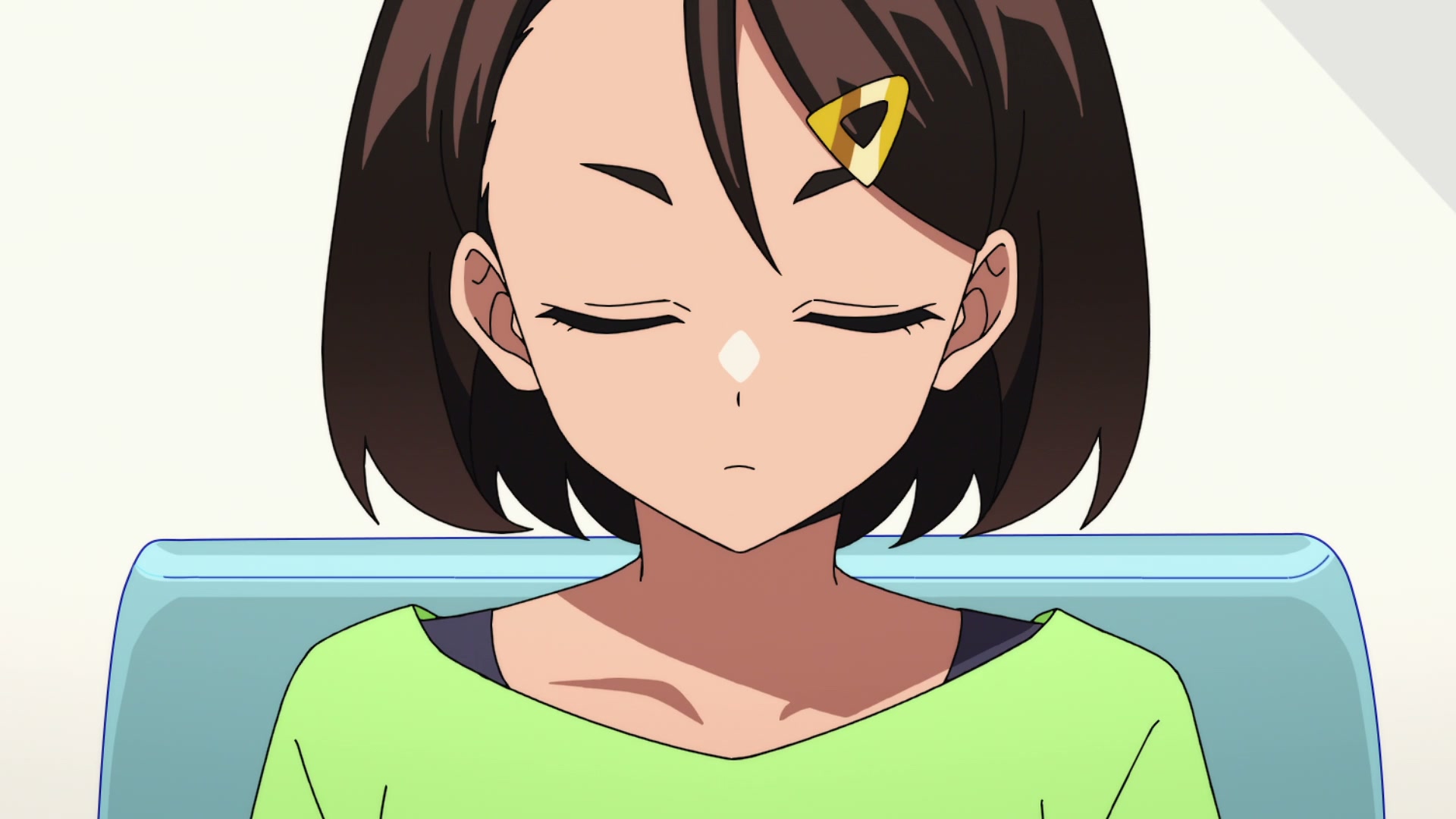
The episode opens with Togo running into Lyric, Poem’s younger sister, during his morning jog. Lyric is immediately recognizable as a Kohinata. She has the same sharp eyes and even sharper tongue, but where Poem’s barbs are flustered and defensive, Lyric’s are cool and appraising. When Togo mistakes her for Poem from behind, she doesn’t get embarrassed. She just files away the information and starts probing.
“You’re not going out, right? You two?” she asks over breakfast, having already assessed the situation. Togo’s immediate “Right! We’re not dating” followed by Poem’s indignant “Huh?” at his speed is one of those small timing beats this series nails. He answered too fast. She noticed.
Lyric is in her third year of middle school, putting her around fourteen or fifteen, and she operates like someone who decided years ago that her older sister needed a manager. She pushes. She teases. She asks Togo what his type is and then, when he flounders through a painfully earnest non-answer, just says “How about my older sister?” with the energy of someone filling out paperwork. Poem’s protests are loud but ineffective. Lyric has already decided to be the catalyst.
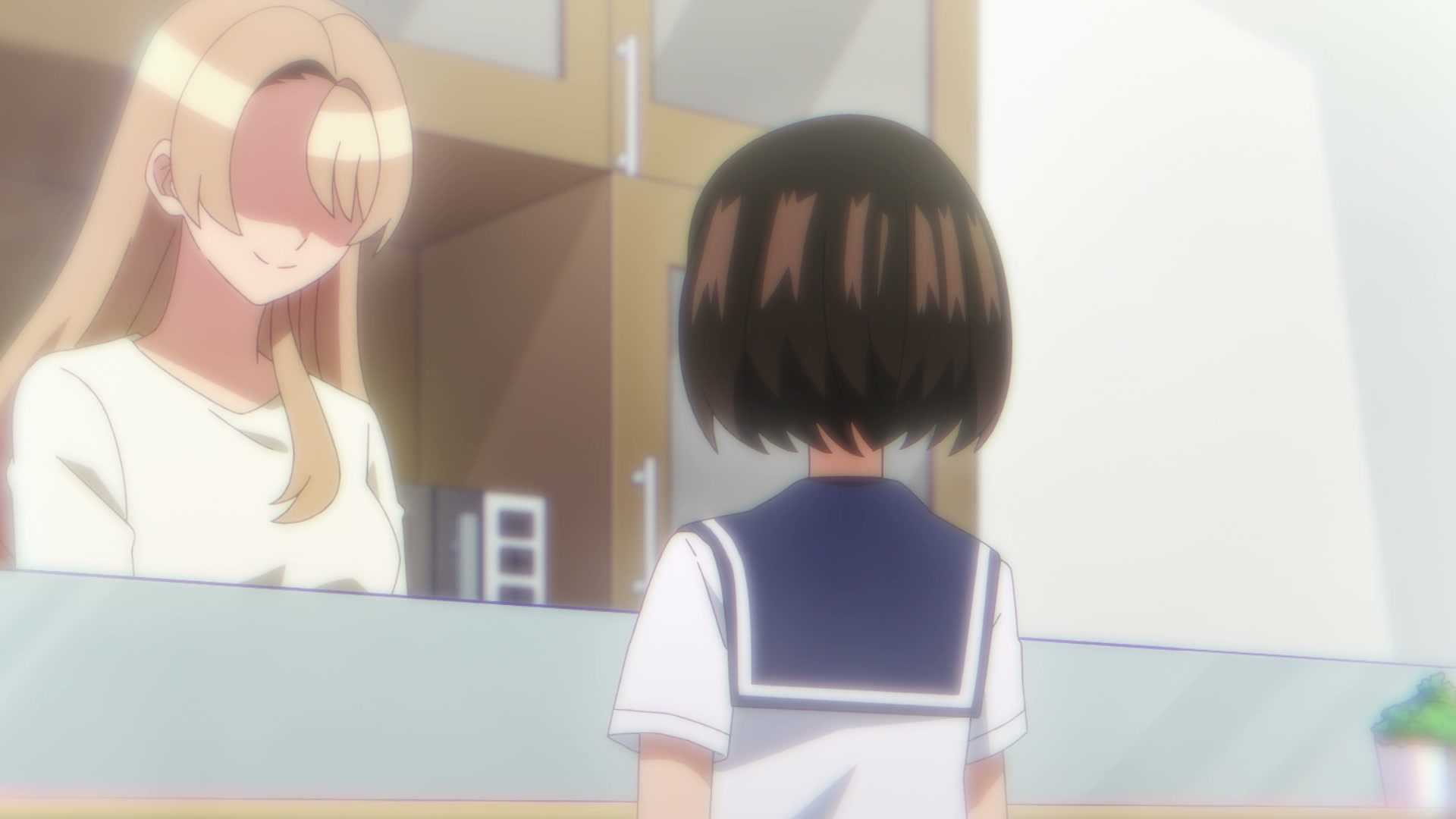
Mirai, their mother, is exactly as warm and overwhelming as her brief appearance in Episode 2 suggested. She drags Togo inside the moment she spots him, piles food onto his plate, and reminisces about the family trip to a PreChure movie like it was yesterday. The flashback to young Poem and little Lyric waving their light wands in the theater, while Mirai sobs about how cute they are, is the kind of family embarrassment that feels lived-in rather than cartoonish. These people genuinely like each other. That matters for what comes later.
Togo, for his part, is delighted by all of it. He calls the pancakes “wonderfully perfected PreChure” with zero irony. He tells Poem she’s “a cute, kindhearted, and all-around wonderful woman” directly in front of her mother and sister, causing Poem to physically strike him while Lyric just watches, fascinated. The boy has no filter and no sense of when he’s saying too much, which is either his greatest flaw or his greatest strength depending on who’s asking.
The Power Strip Negotiation
After the breakfast chaos, we cut to Togo later that day, standing in a store, genuinely considering buying a power strip as a thank-you gift for the Kohinata family.
I need to sit with this for a moment.
A power strip. He landed on a power strip. His logic, when Poem runs into him and demands an explanation, is that it “looks like something the whole family could use.” He says this with the same conviction he applies to enforcing school regulations. Poem has to explain, slowly and with mounting exasperation, that gift-giving between friends doesn’t work like this. If he brings a gift, her mother will feel obligated to respond with cookies, and then Togo will feel obligated to respond to the cookies, and they’ll be trapped in an infinite recursion of gratitude.
Togo considers this. “If she returned my thanks with more thanks, then I’d have to thank her yet again!” He says it like he’s just discovered a new law of physics.
The bit ends with Poem convincing him that sentiment is enough, and Togo immediately pivoting to “Then allow me to visit one more time to show my appreciation.” When she hesitates, he asks “How about today?” and her strangled “That’s far too sudden!” is the sound of a girl who cannot handle this boy’s momentum. He’s like a very polite freight train.
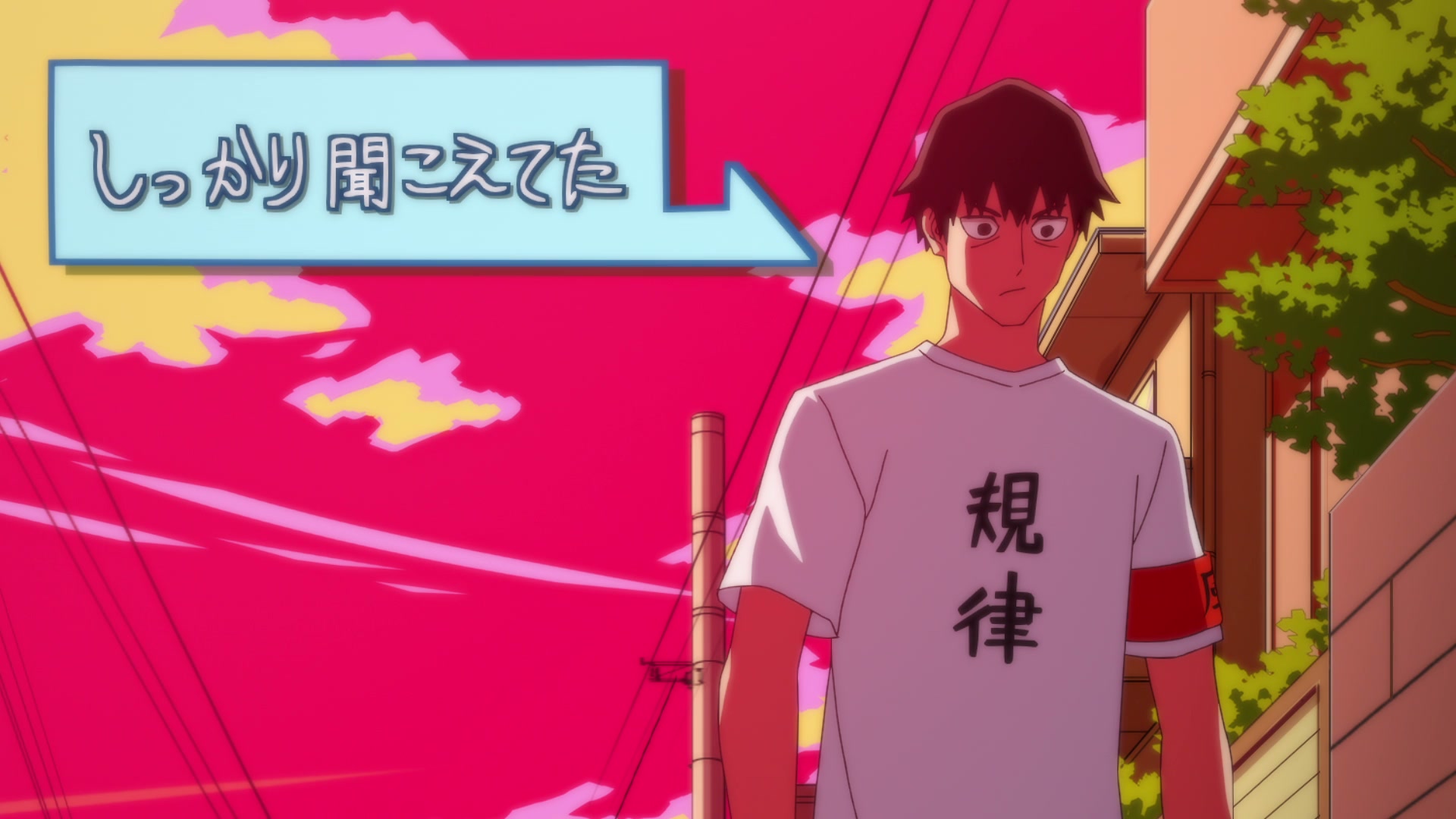
A small detail I appreciated: during this whole shopping district exchange, Togo is still wearing his class monitor armband. Poem points out that he already went home and changed, so why is it still on? “Because I’m a class monitor, of course!” Not an answer. He knows it’s not an answer. He doesn’t care.
Rhyme Enters the Scene
And then we meet Kohinata Rhyme.
The episode introduces him with a self-narrated walk home from work. He’s thirty-seven. He describes himself as a devoted family man, a diligent father, someone who used to be a handful in his youth but has long since settled down. His daughters, he notes with gentle resignation, barely talk to him anymore. “Like most girls their age.” There’s a melancholy to it that feels specific and real.
But Rhyme has a secret, and the episode reveals it with a beautifully understated visual transition. He passes a group of young men forming a rap cypher near the station. His internal monologue shifts. The vocabulary changes. “When I was young, back before I met my wife, it was the one thing I was passionate about.” He watches one of the rappers spit a weak diss about someone’s appearance and mentally dismisses it as “the lowest of the low.” He has opinions. Specific, technical opinions.
This is a man who retired from the street seventeen years ago and has been quietly raising a family ever since, but the instincts never left. The way the episode handles this feels almost like a different show briefly broke into the rom-com. It takes Rhyme seriously while also letting the inherent comedy of the situation breathe. He’s a dad. He’s a former battle rapper. Both things are true.
The Rap Battle Nobody Asked For
The trigger, the thing that drags Rhyme’s past into the present, is Togo.
Togo spots the group of students outside the station and immediately recognizes them as kids from his school. His response is not to walk away. It is to walk directly into the cypher and announce, “As a class monitor, I can’t overlook this!” The students are startled. Rhyme is bewildered. Everyone watching braces for a public execution.
What happens instead is that Togo, faced with a rap battle he did not prepare for and does not understand as a format, simply applies his existing skillset. He lectures them. In rhyme. About sleep schedules and biorhythms and the importance of not damaging the school’s reputation. His delivery is stiff. Rhyme clocks it immediately, noting the “stiff” rhymes and “stiff” lines. But Togo’s content, the actual substance of what he’s saying, lands differently than anyone expects.
When the club president fires back with a defiant speech about how grades don’t matter and school can eat shit and his crew is the only real thing in his life, Togo doesn’t argue. He pivots. He compliments their wit. He points out that they’re clearly smart enough to turn their grades around if they wanted to. He expresses genuine jealousy at how many friends they have. And then, the killing blow: “Why not do things nice and proper? Found a club and make it prosper!”
The word “club” hits like a revelation. The delinquent leader, who’s been posturing as a hardened street rapper, had literally never considered forming a school club. It’s such a simple, obvious, thoroughly Togo solution that it circles back around to being kind of brilliant. He’s not fighting their culture. He’s offering them a way to legitimize it.
Rhyme, watching from the sidelines, is visibly moved. When he approaches Togo afterward, he says “You remembered to show respect instead of just ending with a diss. That was very cool. What a great rap battle!” This is not sarcasm. This is a retired battle rapper recognizing something genuine. He even asks for a match someday.
The Reveal
And then Poem shows up.
She’s been looking for Togo. He wandered off. She’s annoyed. She calls him a klutz. And Rhyme turns around and says “P-Po-chan?” in the voice of a man whose brain just blue-screened.
The episode ends on Rhyme demanding to know Togo’s relationship with his daughter while Poem desperately tries to explain. “Feast on this iron fist that’ll leave weblike cracks in the asphalt!” he bellows, and suddenly all those jokes Poem made earlier about her father punching any man who enters their home don’t feel like jokes anymore.
What This Episode Adds
Meeting Poem’s family recontextualizes a lot about her. Her mother Mirai is affectionate to the point of embarrassment, her sister Lyric is perceptive and pushy in a way that clearly runs in the family, and her father Rhyme is a reformed street rapper who loves his daughters so fiercely that he threatens to crack pavement with his fists. Poem grew up surrounded by big personalities who express their love loudly and without reservation. No wonder she’s easily flustered. No wonder she has trouble being direct about her feelings. She’s the quiet one in a family of forces of nature.
Togo, meanwhile, fits into this household with a kind of accidental grace. He matches Mirai’s enthusiasm beat for beat. He takes Lyric’s interrogation seriously and answers every question with complete sincerity. And his rap battle, witnessed by Rhyme, establishes him as someone with an odd integrity that even a former street rapper can respect. He’s weird. He’s rigid. He’s incapable of reading social cues. But he’s also genuine in a way that cuts through the noise.
The closing moments, with Poem watching Togo leave and muttering “You could have taken it a bit more seriously. Dummy,” hit differently after everything we’ve seen. She’s not just annoyed. She wanted him to mean it. Lyric’s follow-up warning, “That one’s going to be difficult, you know? He’s all kinds of off,” is both an accurate assessment and a challenge. The show isn’t rushing toward a confession, but it’s making it very clear that Poem is already there, waiting for Togo to catch up.
Also, we narrowly avoided a power strip becoming a recurring prop. I choose to believe Mirai would have loved it.
Screenshots
← Episode 3 | All Ponkotsu Fuuki Iin to Skirt-take ga Futekisetsu na JK no Hanashi Season 1 posts →