





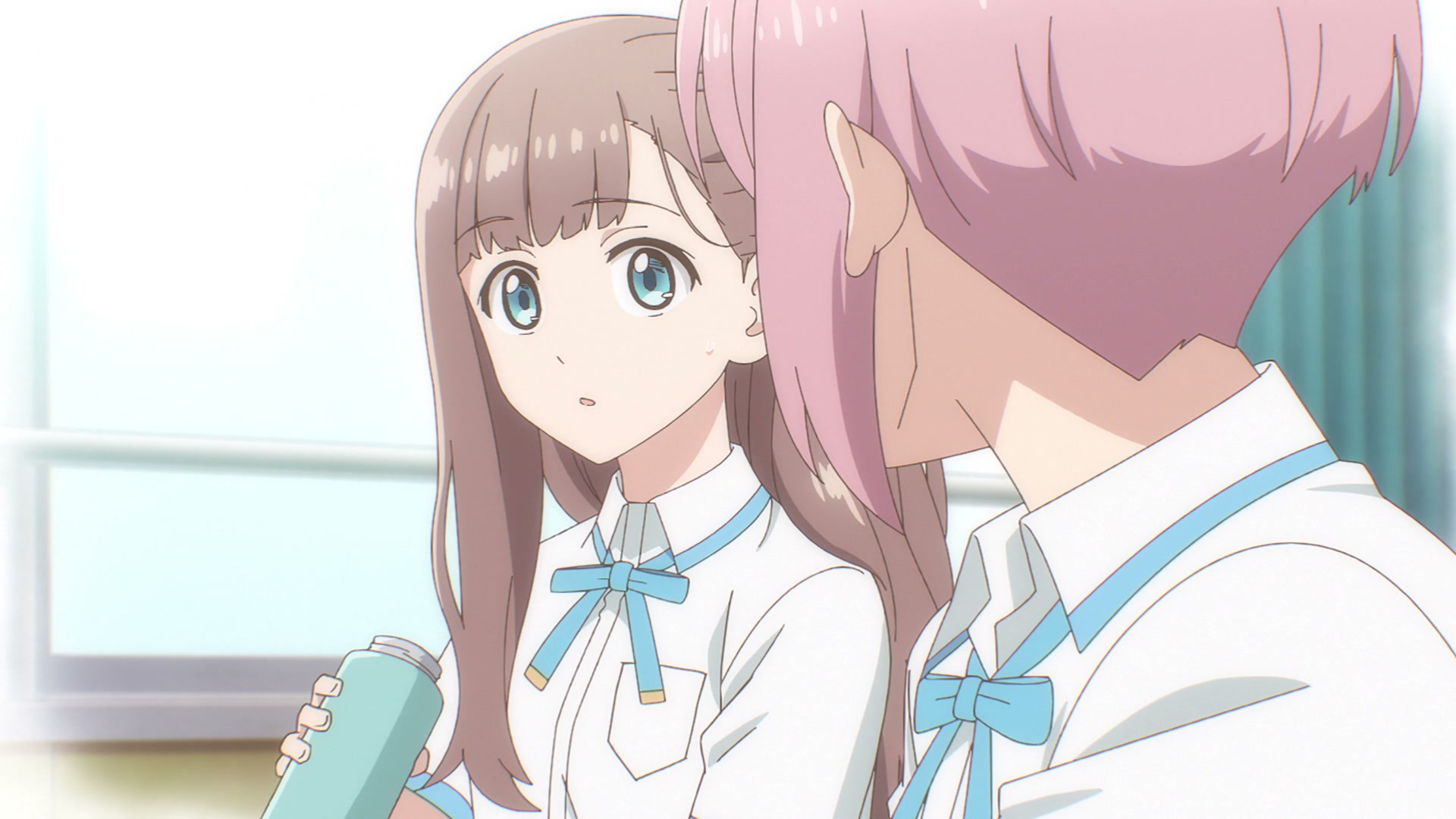
For most of its run, Replica datte, Koi wo Suru has kept its replica secret tightly contained: Nao, Aki, and the handful of people who know their true nature. Episode 7 cracks that container wide open, and the person holding the hammer is Mori Suzumi, the student council vice president who once tried to disband the lit club with a smile and a forest fairy gimmick. I expected the flyer culprit to be a jealous rumor-spreader or someone from the basketball team’s orbit. I did not expect Suzumi to stand in front of Nao and calmly declare, “I’m a doppelgänger like you.”
The episode packs a lot into its runtime without feeling rushed. Early scenes let the cast breathe, then the second half hits with two heavy emotional setpieces: Mochizuki Shun’s raw, unfiltered frustration about his stalled confession, and the art room confrontation that redefines what it means for replicas to find each other.
Satou’s Hit-and-Run Wisdom
The lunch table gathering is a small slice of Seiryo High social life that adds texture before the serious stuff lands. Satou, the drama club’s energetic organizer, has this wonderfully self-aware philosophy about group dynamics. She calls it “hit-and-run tactics”: if she butts heads with people, she drifts to another group for a while, and by the time she circles back, everyone has forgotten the fight. It’s a survival strategy that feels very real for high school politics, and Satou delivers it without a shred of self-pity.
The conversation also lets the girls prod at Nao about kissing, which flusters her in a way that’s quietly funny. Satou’s offhand remark about the haunted house being “dark enough to steal kisses” is exactly the kind of mischievous energy she brings to scenes, and her request for a book recommendation leads to a perfect throwaway joke where she recasts Run, Melos! as a personal vendetta against box-smashing Yoshii. It’s the sort of clubroom banter that makes the literature club’s fusion with drama feel less like a plot necessity and more like a natural, chaotic family.
Mochizuki Lets It All Out
The hallway argument between Mochizuki and Suzumi is the episode’s first gut punch. He’s furious about her test score, and on the surface it looks like a senior scolding a junior for slacking off. But the real wound isn’t the grade. Over summer break, Mochizuki asked Suzumi out at the Abe River fireworks festival, and she still hasn’t given him an answer. He’s been waiting, watching her talk to him like nothing happened, and every day of normal interaction feels like being “tortured to death.” The line is melodramatic in exactly the way a high school theater kid would mean it, and it lands because Mochizuki is usually so controlled. Seeing him crack is painful.
Suzumi’s defensive explosion is just as revealing. “You don’t know me!” she shouts, and in retrospect, that line carries a double weight. She isn’t just pushing back against his assumptions about her study habits; she’s guarding a secret that makes her entire identity feel provisional. At the time, I read it as a teenager lashing out under pressure. After the final act, it’s hard not to see a replica terrified that her cover is slipping.
Nao’s intervention is small but perfect. She coaxes Mochizuki through the abdominal breathing exercises he taught the cast for the play. It’s a callback that doesn’t feel forced, and it shows how Nao has absorbed the theater club’s rhythms. Mochizuki regains composure, thanks her, and even asks if she’s dating Sanada, only to immediately back off: “You wouldn’t want to brag in front of a guy who’s still waiting around.” That mix of self-awareness and self-pity is so utterly Mochizuki.
Ricchan and Nao, Partners in Detection
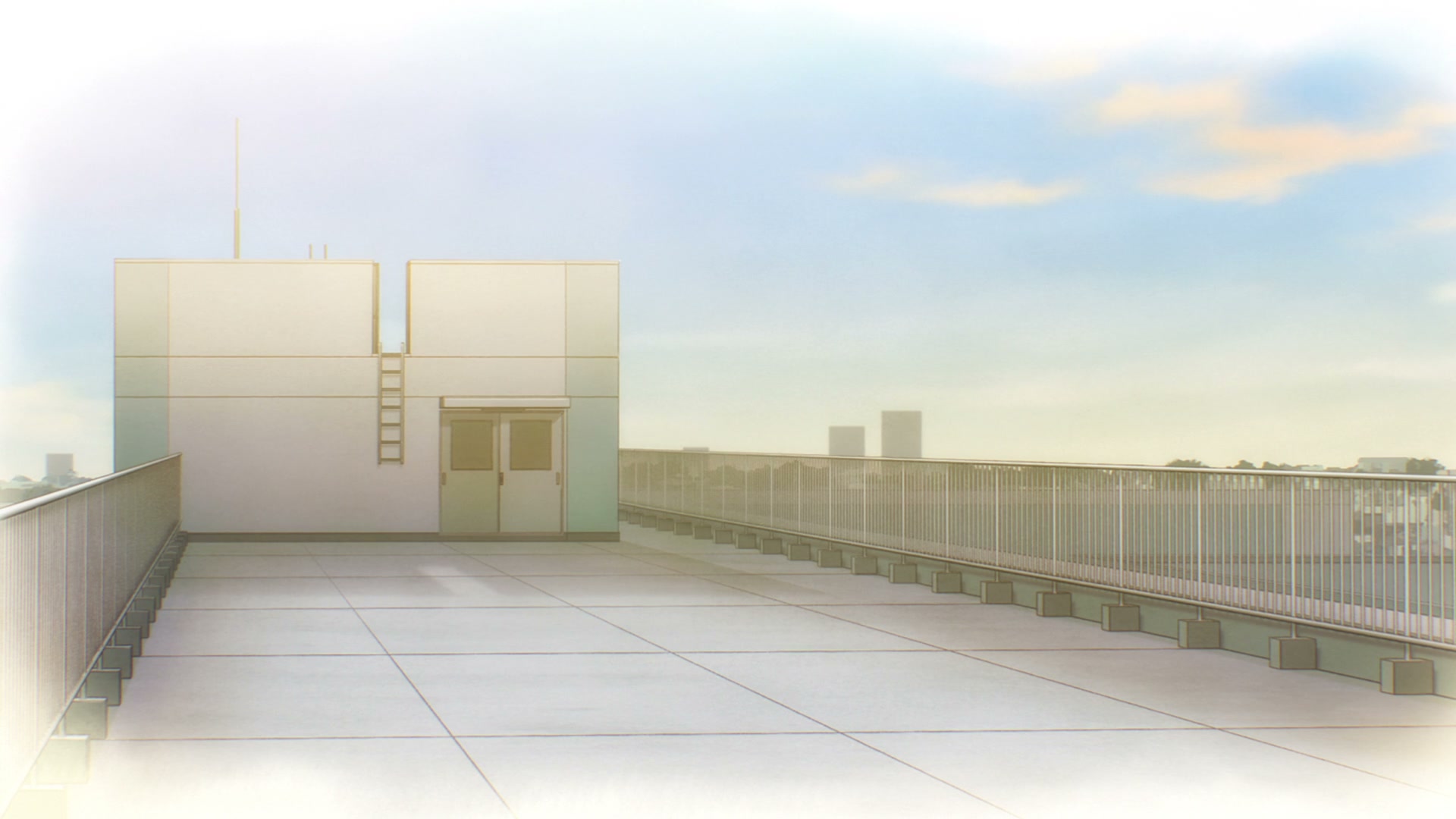
The flyer investigation has been simmering since last episode, and Ritsuko’s detective energy is a joy. She’s narrowed down that the papers were thrown from the rooftop during an unlocked window on October 1st. The stakeout sequence, with Nao and Ritsuko lurking near the roof door, is ridiculous in the best way. Ritsuko shouts “Police! Freeze!” at a group of boys playing stickball, and the chaos that follows—them fleeing, Nao recognizing Yoshii—deflates the tension just enough before the actual revelation.
Yoshii, caught skipping cleaning duty, is hilariously transparent. When Ritsuko asks if anyone passed through the roof that day, he wavers, then remembers. The person he saw was Suzumi. The way the episode pivots from this comic interrogation to Nao confronting her senpai later in the art room is efficient and deliberate. There’s no drawn-out chase; the story knows the real weight is in the conversation that follows.
Suzumi’s Confession Changes Everything
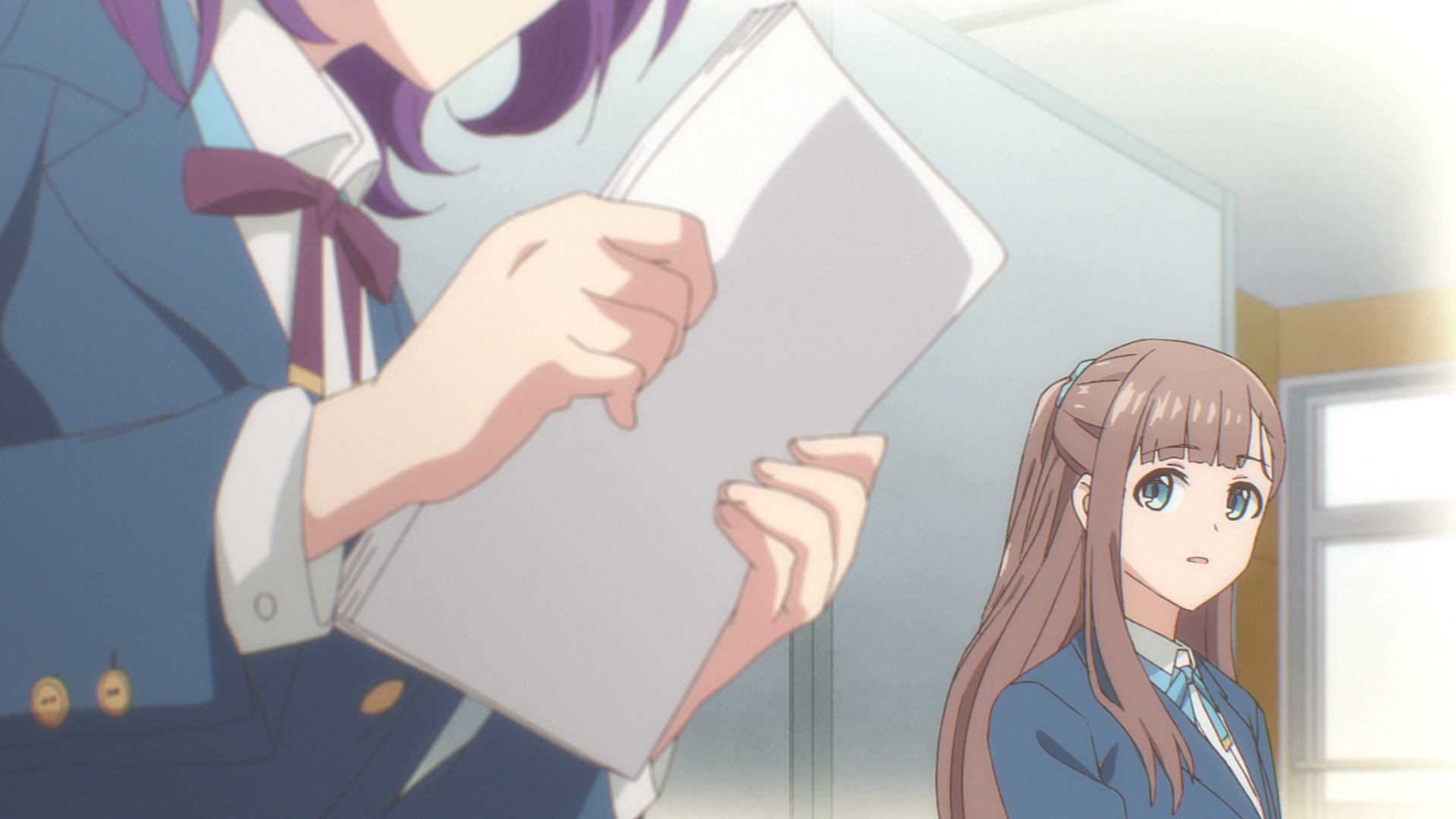
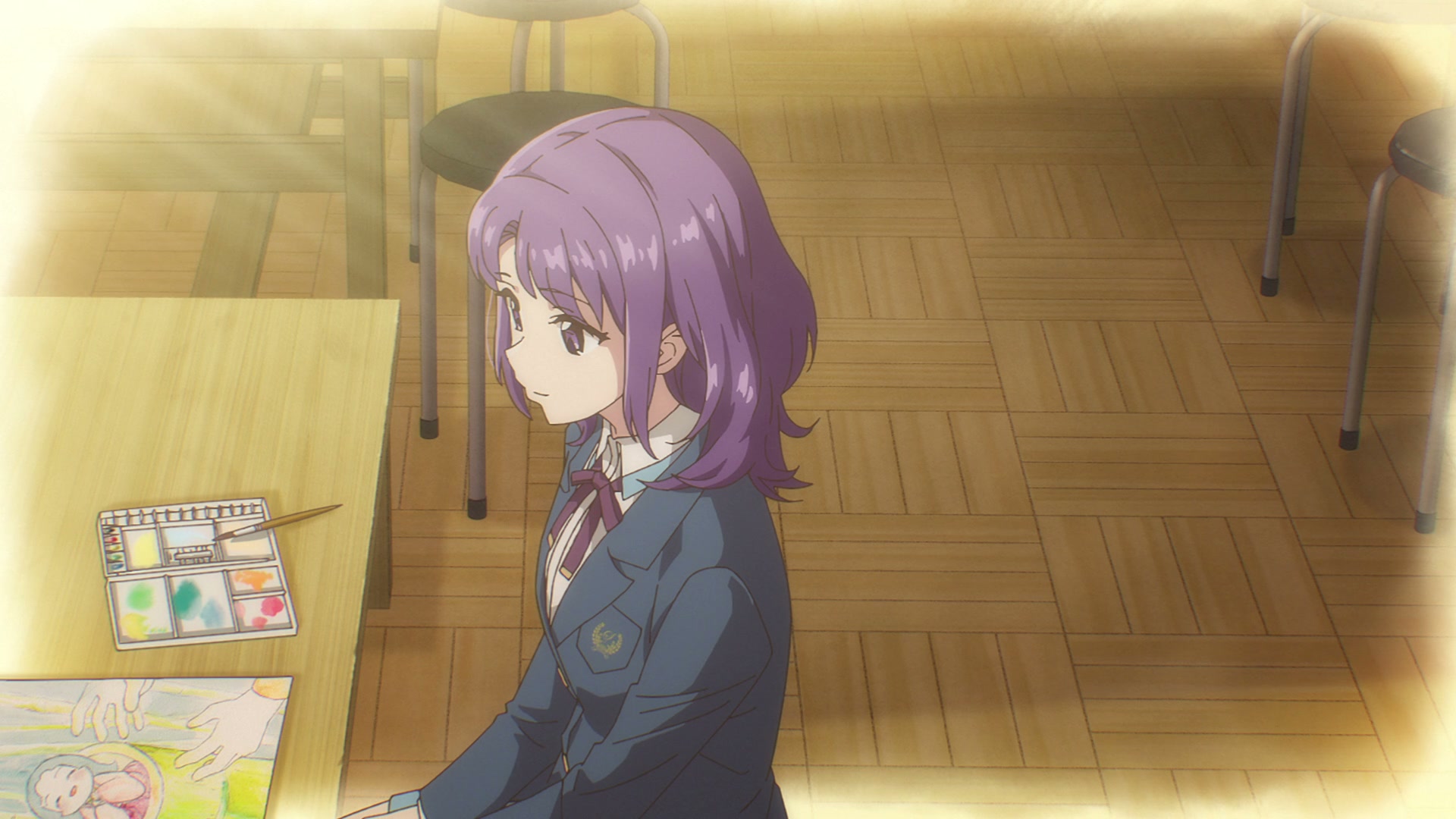
Suzumi presents the finished poster—a warm, family-oriented vision of Kaguya with the elderly couple—and it’s genuinely beautiful. Ritsuko’s spin-off novel, written from the grandmother’s perspective, moved Suzumi to tears earlier because it captured something she understood deep down: the idea of being cherished by people who aren’t your blood. That moment of vulnerability softens the blow before Nao asks the direct question.
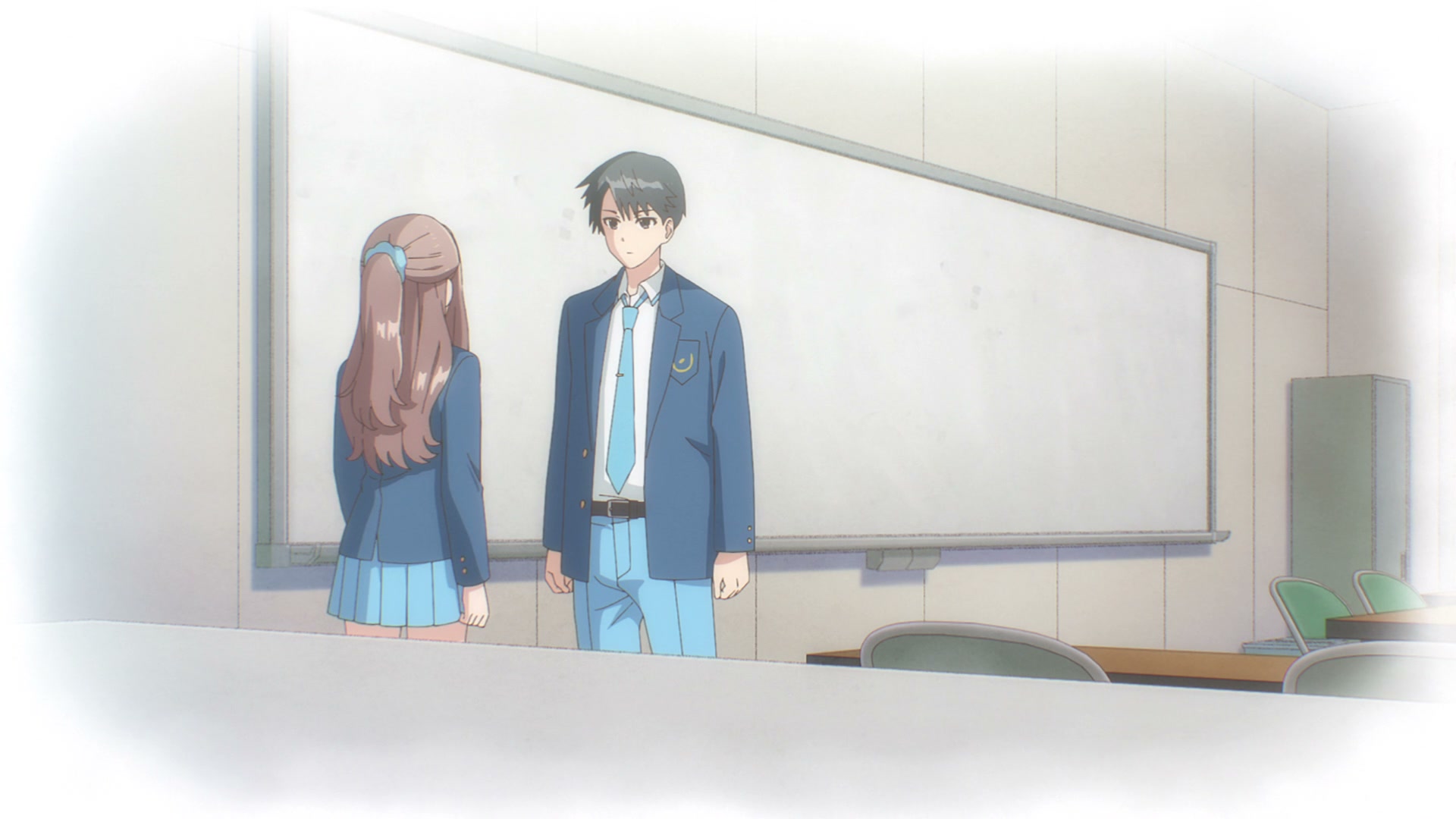
And Suzumi doesn’t dodge. She admits she printed a hundred flyers and dropped them from the roof. She even jokes about not sending Nao to a lab for dissection, which is a weirdly disarming way to announce she knows Nao’s true nature. But her tone shifts when she presses for information. She wants to know if an original who is “very badly injured” can be healed, or if a replica can transfer that injury to themselves. Then the knife: “If you die for the original, will it save her?”
That question hits like a freight train because it inverts Nao’s entire journey. Nao nearly erased herself out of a belief that replicas shouldn’t exist. Suzumi is contemplating the same self-erasure, not out of despair, but as a desperate act of love. She wants to die so her original can live. Nao can only tell her what she knows: if a replica dies, the original can summon them back. But the other way around? If the original dies, the replica is finished. There’s no known way to trade a replica’s life for an original’s.
Suzumi’s reaction is a quiet, exhausted acceptance. She’s been searching for answers and found only a dead end. When Aki steps in and reveals he’s a replica too, the dynamic shifts again. Suddenly the literature club isn’t just a haven for Nao and Aki; it’s a place where another replica surfaced, driven by a crisis completely different from theirs.
A World with Other Replicas
What makes this twist work so well is that it doesn’t resolve Suzumi’s situation. She leaves with the same dilemma she brought. We don’t know exactly what’s wrong with the original Suzumi, only that it’s serious enough for a replica to consider trading her own existence. The episode doesn’t hand Nao a solution or a new power. It hands her a mirror: someone else who understands what it’s like to be a substitute, carrying a burden the original can’t shoulder.
Aki scolds Nao for putting herself in danger, and he’s right. She approached Suzumi alone, hoping to connect replica-to-replica. That hope isn’t naive; it’s the logical extension of everything she’s learned since the basketball revenge arc. If replicas can love, if they can build lives, then they can also reach out to others like them. The episode ends with Nao wondering aloud if they’re the only replicas at Seiryo, and the question feels less like paranoia and more like the beginning of a search.
Mori Suzumi was introduced as an obstacle, the smiling bureaucrat delivering bad news. She became a creative collaborator, then a friend who cried over Ritsuko’s story. Now she’s the first replica outside Nao and Aki’s closed circle, and her presence reframes the show’s core question. It’s not just “can a replica fall in love?” It’s “can replicas find each other and build something together?” Episode 7 doesn’t answer that yet, but it opens the door wide enough to let the possibility in.
Screenshots
← Episode 6 | All Replica datte, Koi wo Suru Season 1 posts →
[…] ← Episode 7 | All Replica datte, Koi wo Suru Season 1 posts → […]