




Introduction
There are very few anime that can make you laugh until your ribs ache and then, without warning, hit you with a moment of such genuine tenderness that you forget you were ever laughing. Baka to Test to Shoukanjuu is one of those shows. On its surface, it is a cacophony of screaming idiots, chibi avatar battles, and nosebleeds that could irrigate a small farm, but underneath that glorious chaos is a story about the quiet value of being seen, of being loved not despite your flaws but alongside them.
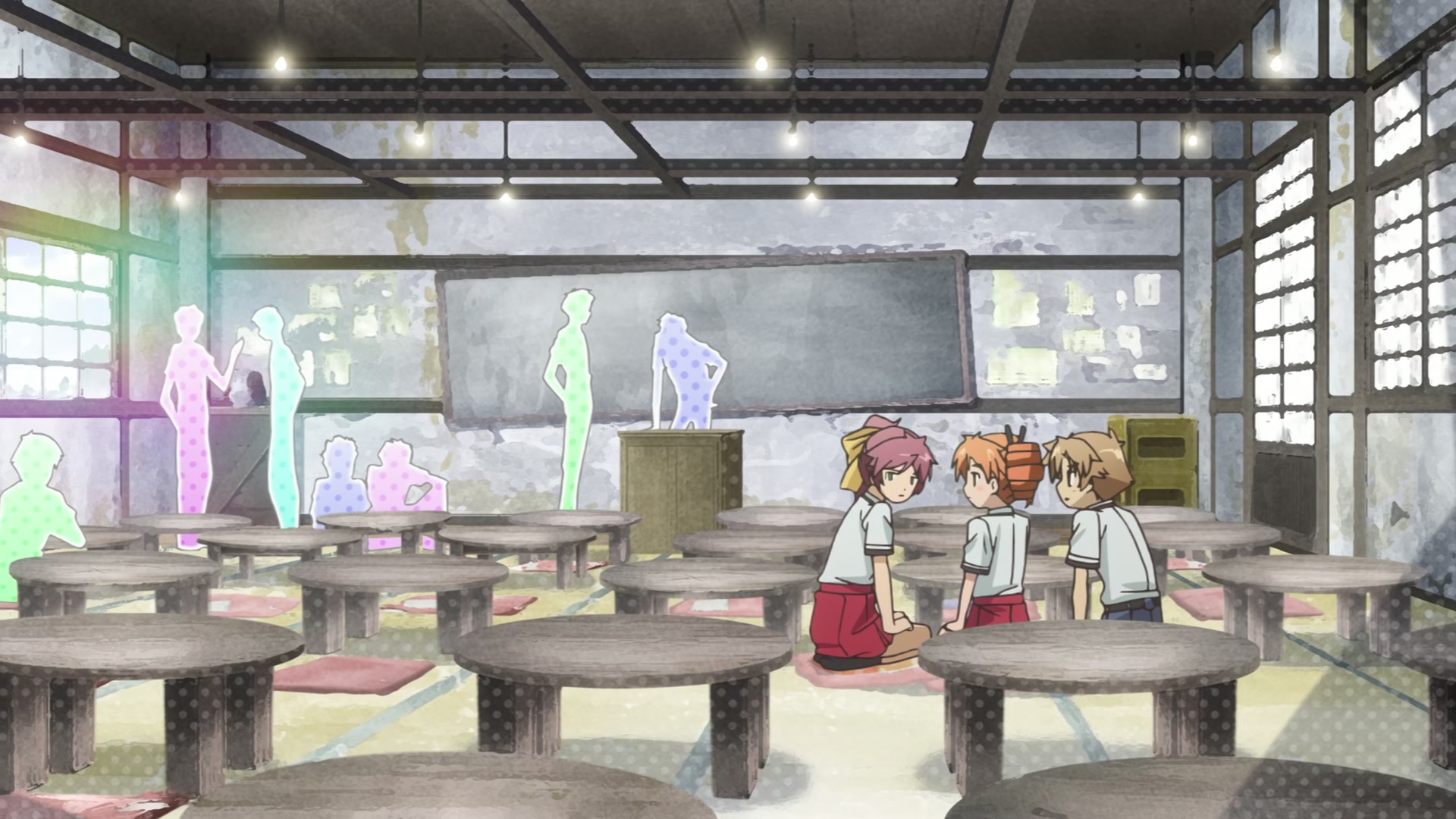
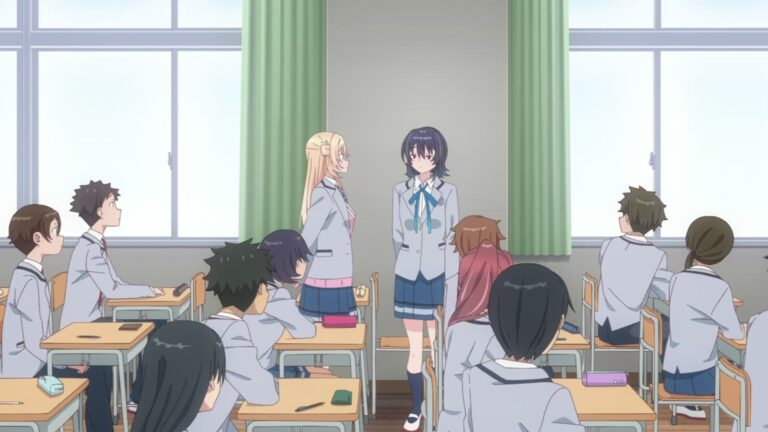
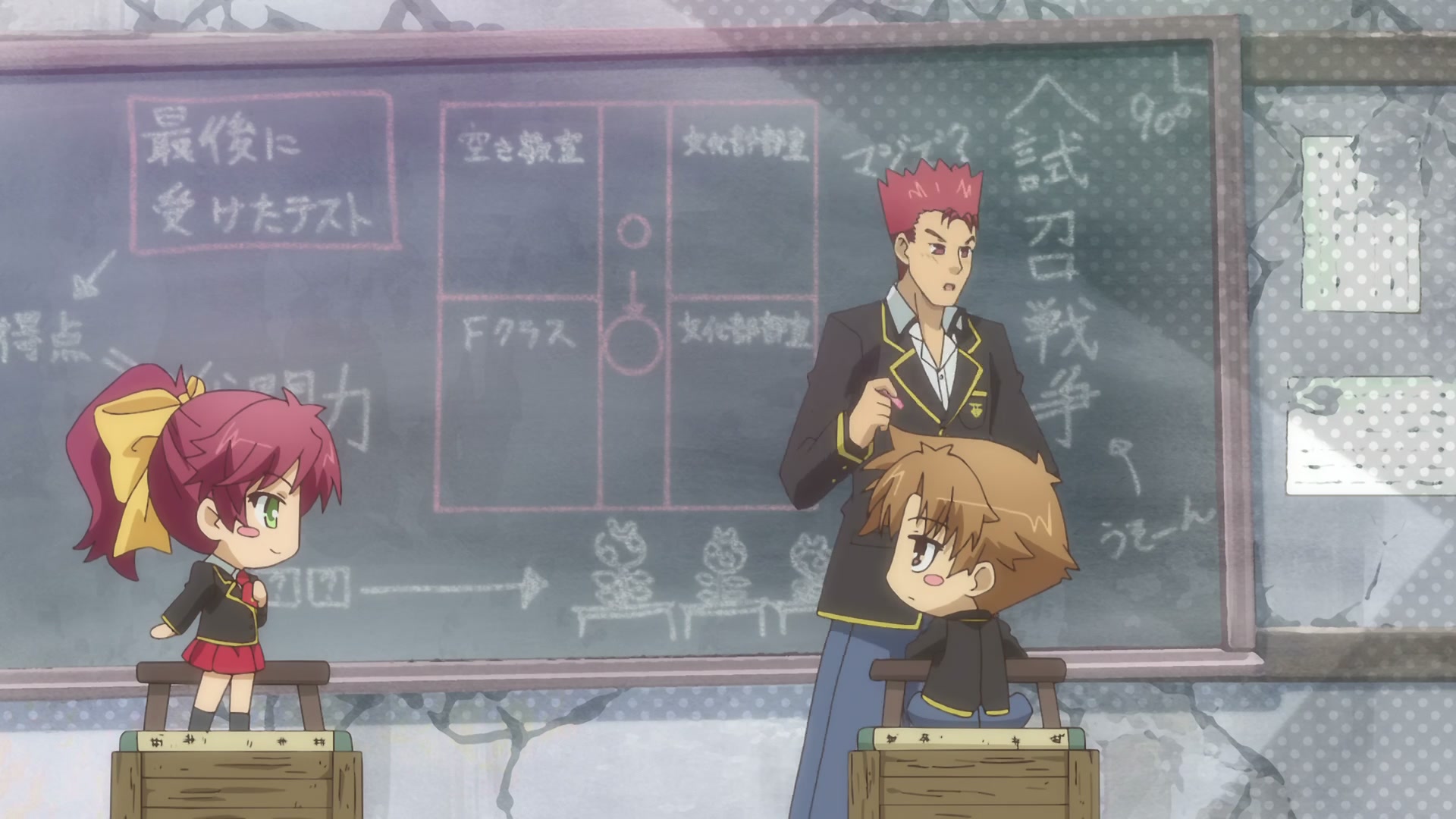
The premise is gleefully absurd and instantly compelling. Fumizuki Academy is a school where academic performance dictates everything. Students are sorted into classes from A down to F based on a single placement exam, and the facilities follow accordingly: Class A students lounge in leather reclining chairs with individual laptops and free snack bars while Class F students kneel on cracked tatami mats, huddle around flimsy tea tables, and stuff newspaper into broken windows to keep out the wind. But the academy has one mechanism for the downtrodden to fight back. The Summoned Being Exam War system lets students call forth tiny, super-deformed avatars whose combat power is pegged directly to their test scores. If a lower class defeats a higher class in one of these wars, they can swap classroom setups, climbing the social ladder one victory at a time.
Enter Yoshii Akihisa, a boy so profoundly stupid that the series formally designates him a “Punishment Inspector,” a probationary student whose Summoned Being is uniquely capable of touching physical objects, which mostly means he gets drafted into manual labor and feels the feedback pain of every desk his avatar crashes into. Alongside a gloriously dysfunctional cast that includes a frail academic prodigy who collapsed during the placement exam, a sharp-tongued returnee from Germany with a flat chest complex, a silent pervert with a photographic memory for female anatomy, and a boy so beautiful that the school has given him his own bathroom category, Akihisa finds himself in Class F. Their leader, Sakamoto Yuuji, a former child prodigy whose grades have mysteriously cratered, proposes they wage an Exam War against the classes above them. What follows is two seasons of escalating warfare, deepening friendship, and some of the most chaotic romance ever animated.
My overall impression is one of deep, abiding affection. This is a series that understands comedy not as a series of setups and punchlines but as a rhythm of life, a way that people who care about each other express that care through insults, through absurdist gambits, through shared suffering. If you are a longtime anime fan, someone who has internalized the grammar of tsundere violence, pervert-guy nosebleed gags, fourth-wall-shattering narrator swaps, and the specific emotional cadence of a school-life comedy that can pivot to sincerity on a dime, this series will feel like coming home.


Story and Themes
The narrative structure of Baka to Test to Shoukanjuu is deceptively simple across its two seasons. Each arc is organized around an Exam War or a specific school event. Class F identifies a target. They scheme. They train. They fight. They win, or they lose, and either outcome fuels the next arc. This formula would grow stale in lesser hands, but the series keeps it fresh by treating each battle as a puzzle rather than a clash of numbers. Victory never comes from raw academic power (Class F simply does not have any) but from psychological manipulation, battlefield trickery, and the creative weaponization of everyone’s specific brand of oddness.
The first season moves from Class F’s initial war against Class E, through a humiliating loss to Class A over a question about the Taika Reforms, to a climactic sudden-death academic duel where Akihisa, against all probability, wins the right to grant Himeji Mizuki a placement retest. The second season expands the scope significantly, detouring into a beach vacation, a training camp arc stretched across multiple episodes, and a final test-of-courage event that pits the second-years against arrogant third-year antagonists.
Pacing within individual episodes is breakneck, almost manic. The show rarely spends more than a few minutes on a single bit before it pivots to another gag, another character reaction, another narrator break. Yet the season-level arcs are surprisingly patient. The blackmailer storyline that dominates the training camp episodes is stretched across four installments, each night’s peeping operation building on the failures of the previous one until a truly insane all-male assault on the girls’ bath culminates in the entire male student body getting suspended. The series trusts its audience to remember details and to care about the slow accumulation of strategic knowledge.
Thematically, Baka to Test to Shoukanjuu is built around a single, defiant question: what if the things that matter most cannot be graded? The academy’s entire system is a blunt metaphor for meritocratic cruelty. A single exam, taken on a single day, determines whether you get a massage chair or a cardboard box for a desk. Himeji Mizuki is Class A material in every measurable sense, but she collapsed with a fever during the placement exam and was given a zero, which dropped her into Class F. The school’s rules did not care about her illness, her capabilities, or her potential. The score was the score.
This is a world that has confused measurement with value, and the Summoned Being Exam War is the only mechanism that allows the devalued to challenge their valuation. But the rules are rigged. Losers cannot declare war for three months. Higher classes are free to attack weakened opponents immediately after a war. Recovery exams exist but are gated. The academy preaches meritocracy while systematically insulating the powerful from challenge. It is an unsubtle but entirely effective satire of educational systems that claim to be objective sorting mechanisms while reproducing existing hierarchies.
The series literalizes its themes through its visual language. The Summoned Beings are chibi versions of their summoners, and when the system malfunctions, they become exaggerated avatars of inner truth. Akihisa’s transforms into a headless knight: a gallant figure without a brain, which is so on-the-nose it circles back around to genius. Minami’s becomes an impassive wall. Himeji’s becomes, well, enormous breasts floating in space. The beings are externalizations of how the students see themselves and how the school sees them, the tension between those two images driving much of the comedy and the pathos.
Cultural context enriches the satire significantly. Japan’s examination culture, the legendary “examination hell” that funnels students through high-stakes testing with lifelong consequences, is the invisible antagonist of the entire series. The placement exam that damns Mizuki to Class F is the same kind of gatekeeping mechanism that determines high school admissions, university placements, and career trajectories in the real world. By making this system literally combat-ready, the series argues that the people who thrive in it are not necessarily the most worthy. They are simply the ones whose particular talents align with what the test measures.
The Taika Reforms become an unexpected thematic anchor. Yuuji teaches an incorrect year (645 instead of the historically accurate 625) to a young Kirishima Shouko, and this mistake propagates through the narrative in increasingly meaningful ways. It costs him an Exam War. It threatens Akihisa’s sudden-death match. And it ultimately becomes the instrument of Shouko’s most romantic gesture: she deliberately writes the wrong year on her answer sheet, sacrificing her victory because she “promised never to forget” what Yuuji taught her. A factual error, born from a childhood lie, becomes a promise, becomes an act of love. The series is arguing, in its roundabout way, that accuracy is not the same as truth, and that holding onto a wrong thing for the right reason is more valuable than being correct.
Regarding adaptation, I should note that this analysis is based entirely on the anime as a self-contained work. I have not read the original light novels by Inoue Kenji and cannot speak to skipped arcs, compressed character development, or changes in tone between media. What I can say is that the anime tells a coherent, emotionally complete story. The second season’s test-of-courage finale carries the feeling of an anime-original capstone, a way to create a climactic joint effort without source material to draw from, and it works on its own terms. If light novel readers have specific grievances, those are legitimate within their frame of reference but do not diminish the anime’s internal integrity. The show ends at a place that feels like an ending, or at least a resting point, and that is more than many adaptations manage.


Characters
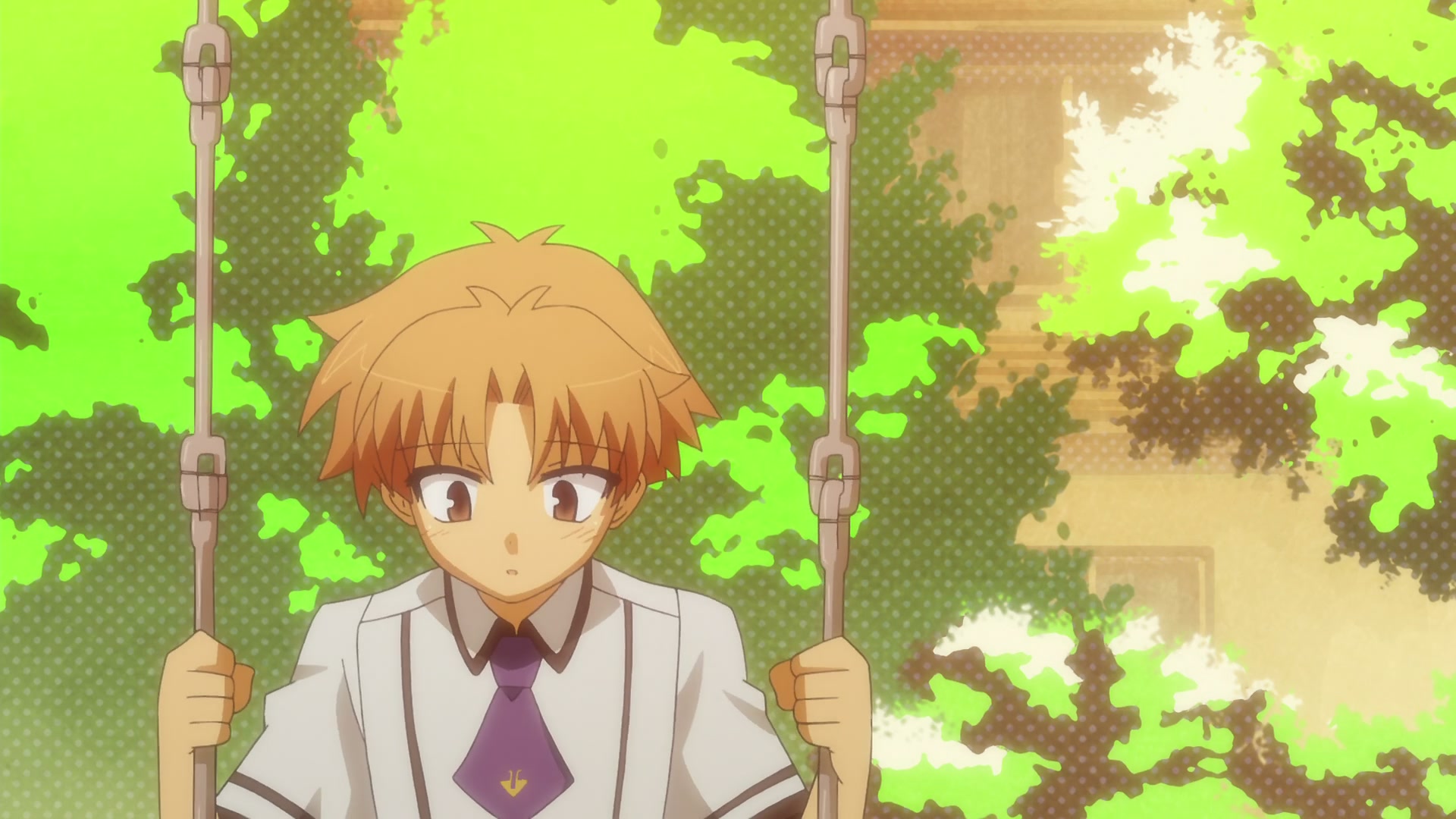
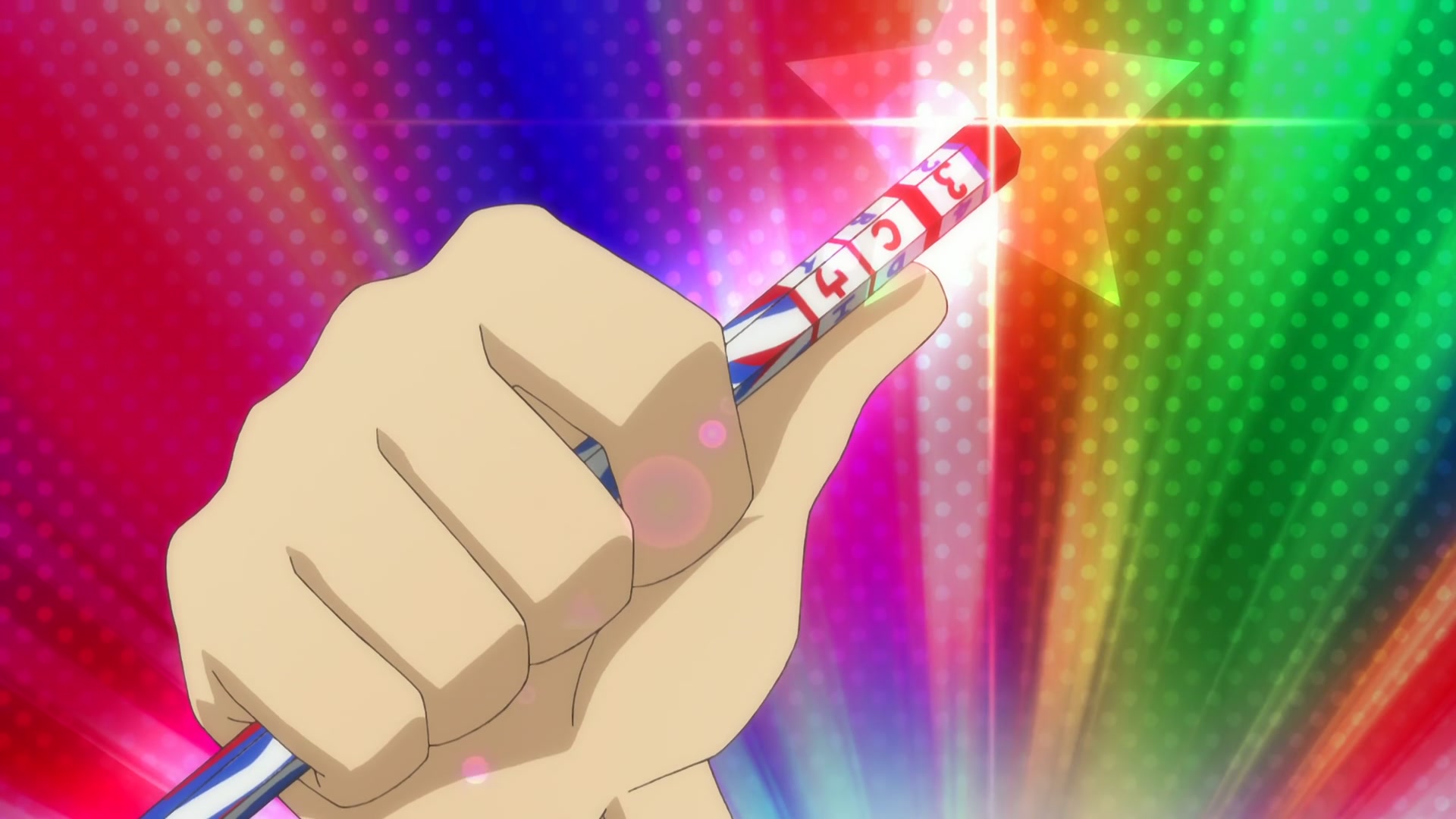
Yoshii Akihisa is, by any conventional metric of protagonism, a disaster. He cannot remember the year of the Taika Reforms. He thought the “Monthly” sign in a parking lot was a company name. He is so stupid that a magical bracelet, the Black Golden Bracelet, which allows one to summon without teacher supervision, only functions when his academic performance is below a certain threshold. The smarter he gets, the weaker he becomes. This is the central paradox of his character and the series’ thesis statement. Akihisa’s value lies precisely in what the school cannot measure: his loyalty, his willingness to absorb punishment for others, his inability to lie about his feelings. He is the idiot saint, and the show’s affection for him is absolute.
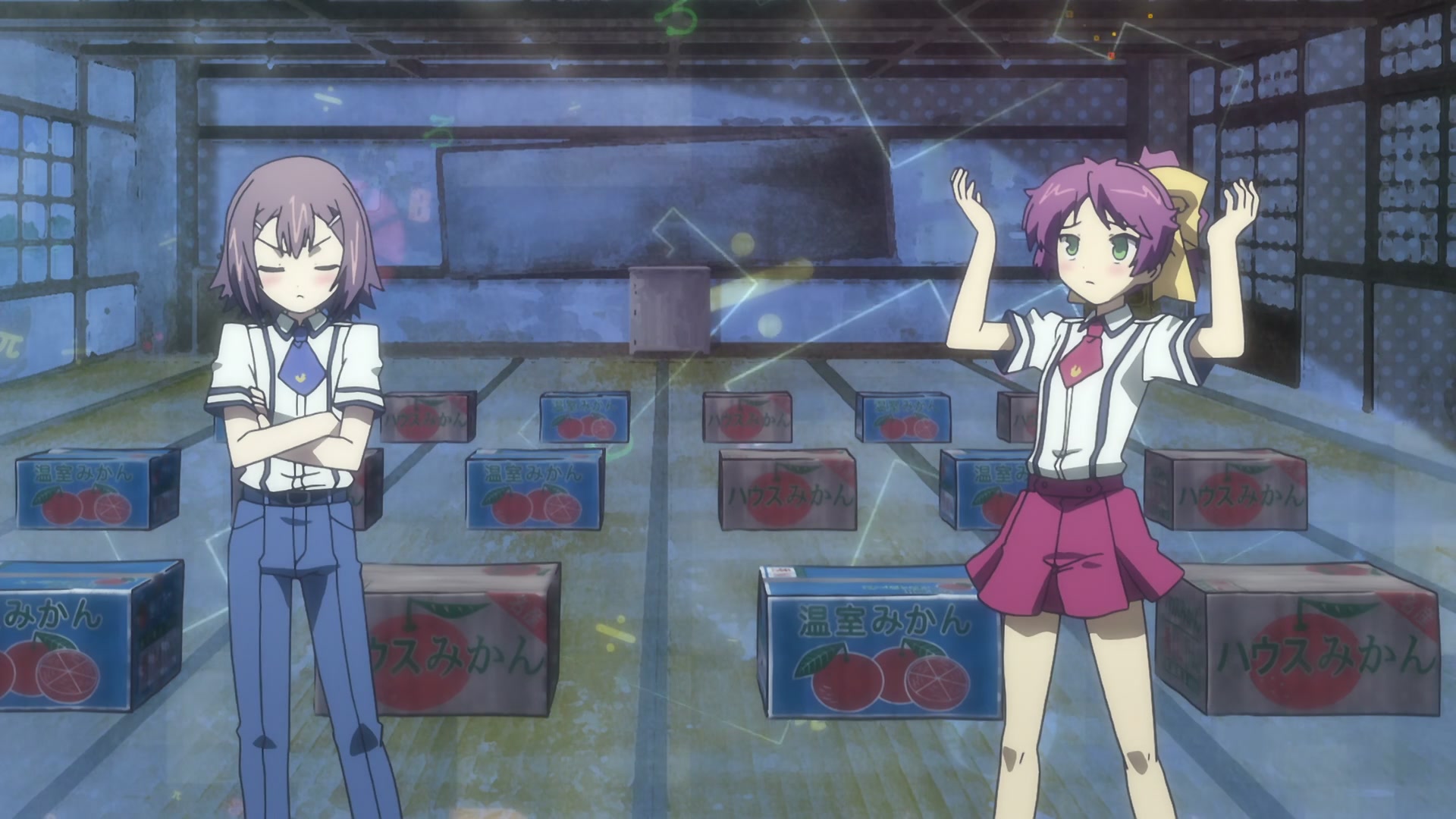
His differential treatment of the two girls in his orbit is the engine of the romantic plot. With Himeji Mizuki, he is gentle, almost courtly. He calls her “Himeji-san,” refuses to use her given name out of a shyness that he cannot articulate, and treats her with the careful reverence one might give a princess. This gentleness, however, creates a barrier. Mizuki herself points out the distance he maintains, the way his politeness prevents real closeness. With Shimada Minami, Akihisa is utterly unguarded. He teases her about her flat chest without a shred of gallantry. He wrestles with her. He talks to her like a sibling. He does not treat her like a princess because he does not feel the need to perform anything around her. This difference in treatment is not cruelty, but it is a kind of blindness, and the series explicitly calls him out on it. When Shimizu Miharu accuses him of treating Minami “like one of the guys” and failing to see her as a girl, she is right, and the observation stings because Akihisa, for all his other virtues, has not noticed what he is doing.
Himeji Mizuki is a more complex figure than her initial “ideal girl” presentation suggests. She is academically brilliant, kind, and possesses a lethal cooking ability that the series mines for endless comedy. Her food looks perfect and tastes like a near-death experience, and the running gag of friends collapsing after a single bite is never not funny. But Mizuki is also deeply insecure and surprisingly jealous. She is acutely aware that Minami has an ease with Akihisa that she lacks, and her determination to close that gap drives her character arc. Her big request—asking Akihisa to call her “Mizuki”—is a milestone in a culture where given-name usage signifies intimacy, and the way she blushes and stammers through it is both adorable and earned. Her decision to deliberately forget her name on the placement retest, choosing to stay in Class F rather than move to a class befitting her grades, is the ultimate declaration. She would rather be an idiot alongside Akihisa than a genius separated from him.
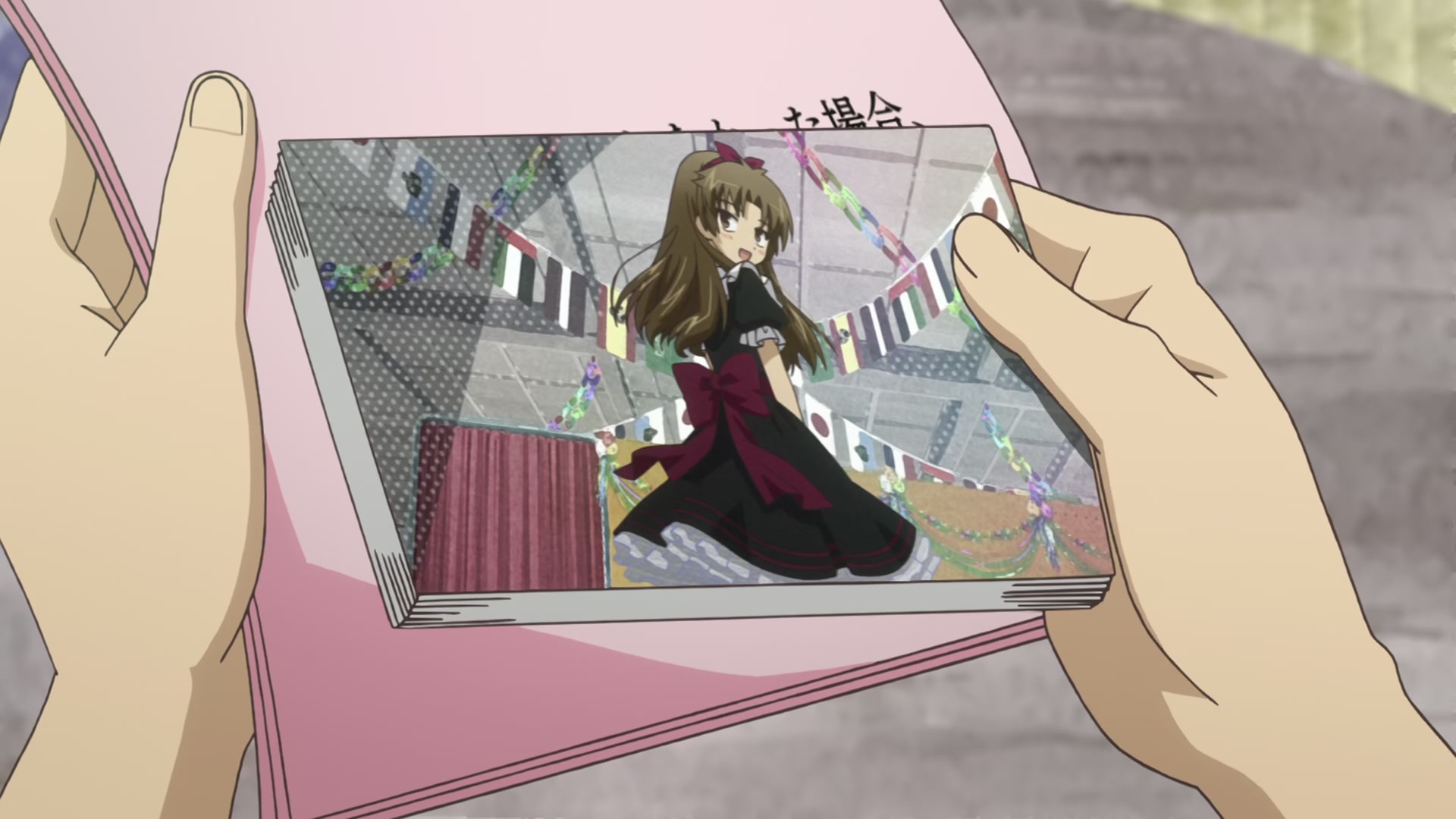
Shimada Minami’s backstory, delivered in a standalone flashback episode during the second season, is the most emotionally grounded material in the series. Arriving in Japan from Germany with shaky language skills, she was isolated and mocked. Her first day of school was an escalating nightmare of cultural misunderstanding. Then this loud, obnoxious idiot boy approached her and, in garbled French, asked “Tu ne voudrais pas devenir mon amie?” Would you like to become my friend? She initially thought he was mocking her. Later, alone with a dictionary, she translated his words and cried. Akihisa reached out when no one else did, and that act of unthinking kindness anchored her in a foreign world. This is the foundation of her love, and it explains everything about why she cannot say it. She has spent years building a tough, violent exterior as armor against isolation. She cannot now, even for the boy who saved her, dismantle that armor easily. Her arc is about learning to be vulnerable, and the moment when she admits to her little sister Hazuki that she “might have fallen really hard” is a quiet earthquake.
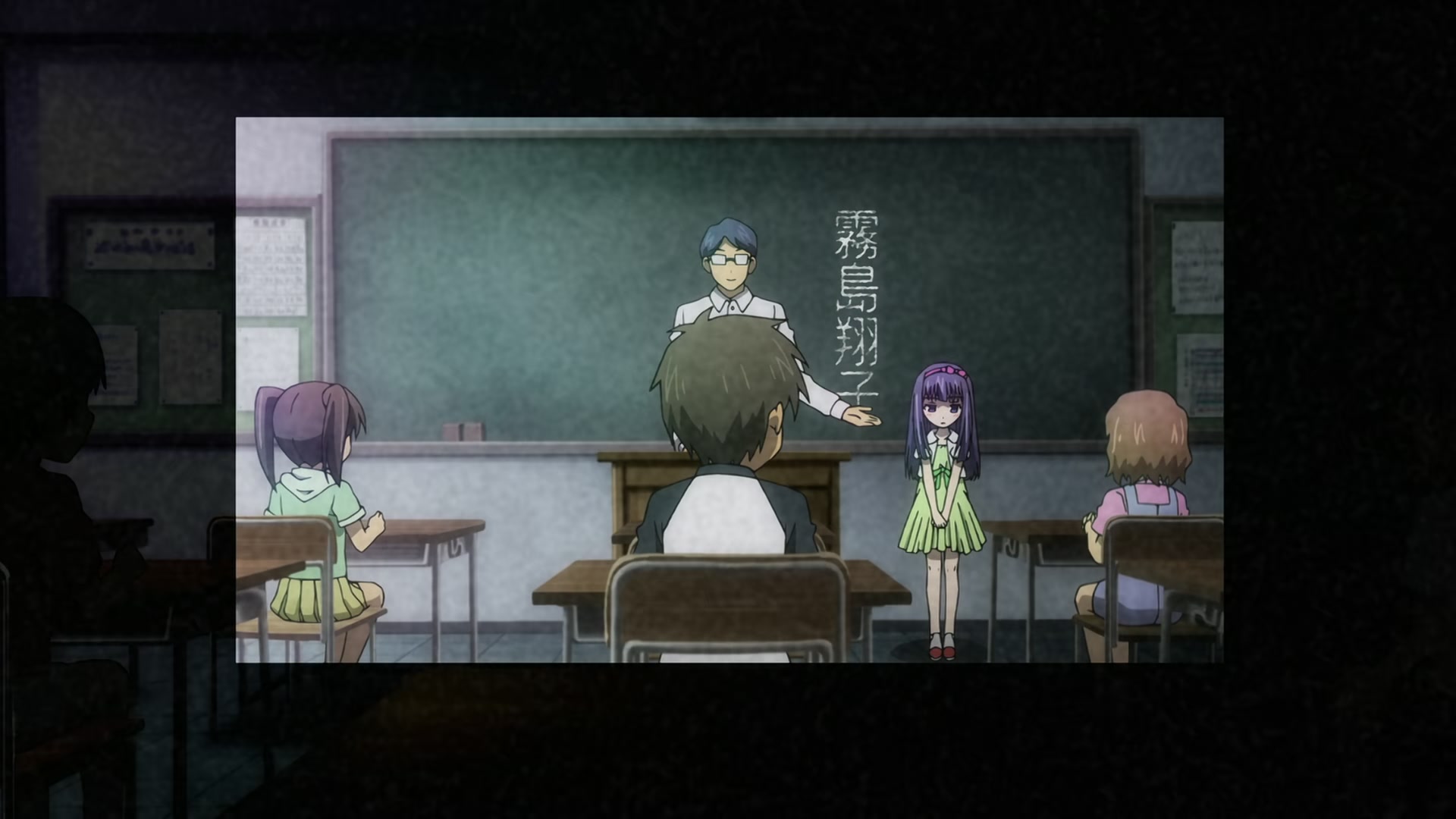
Sakamoto Yuuji is the show’s secret protagonist, the character with the most complex internal architecture. Once a child prodigy who looked down on everyone, he deliberately sabotaged his own academic career out of guilt and self-loathing. His backstory, revealed in the second season’s penultimate episode, is devastating in its simplicity. When bullies targeted him because of his arrogance, Shouko tried to protect his belongings. They turned on her. Yuuji, hiding and watching, understood that his intellectual superiority meant nothing. He was a coward, and she was getting hurt because of him. His intervention, trembling and outnumbered, was an act less of courage than of desperate self-reclamation. He told her to run. He stayed. He lost, badly. And that night, Shouko told his mother she would marry him.
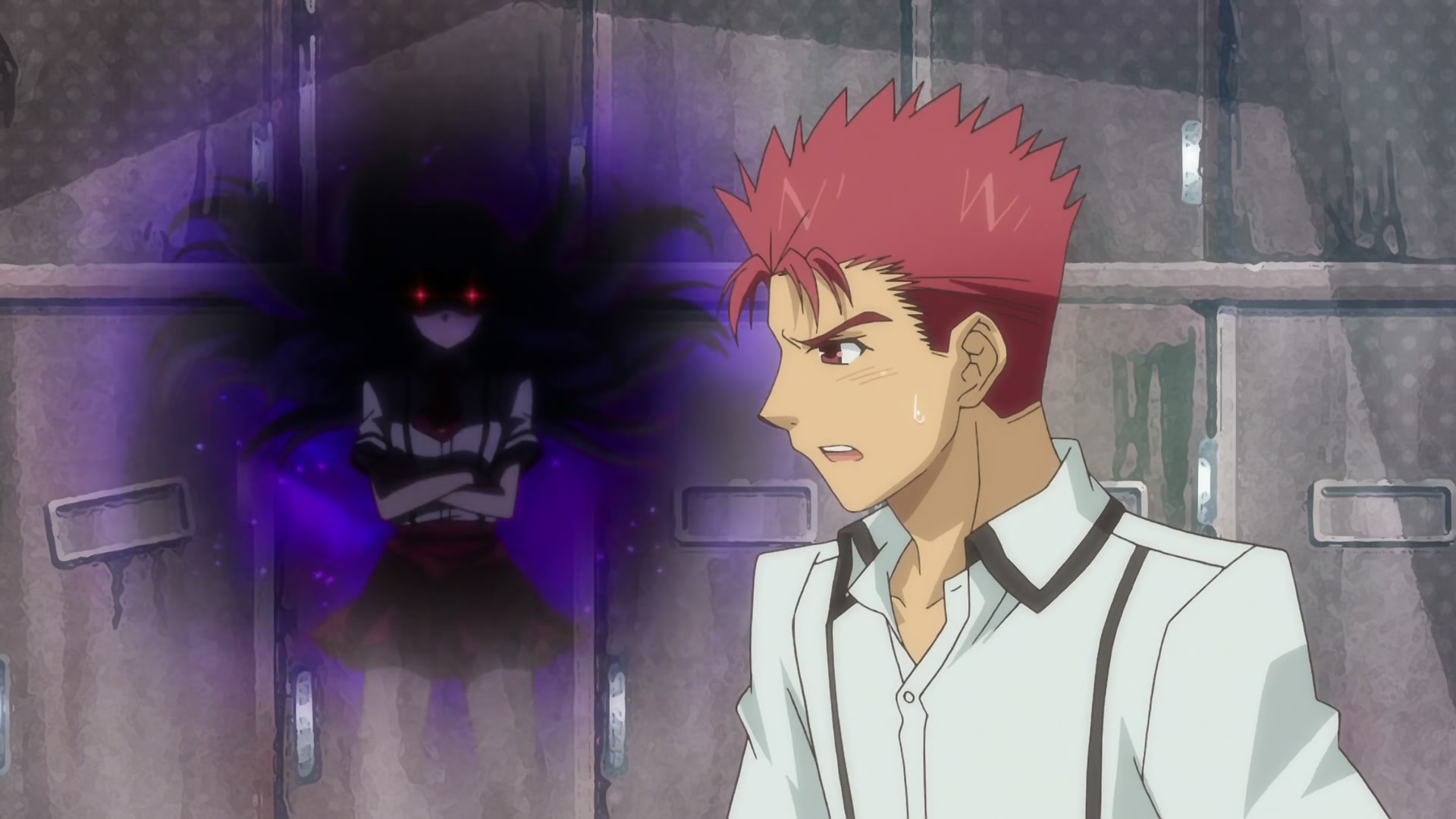
Kirishima Shouko’s love, expressed through stun guns and marriage registration forms, is easy to read as comedic yandere aggression, but the childhood flashback reframes it entirely. She is not pathologically obsessed. She is devoted to a person who, at the cost of a beating, proved that she was worth protecting. Her relentless pursuit of Yuuji is her way of repaying a debt she does not feel as debt. She is simply honoring a vow she made as a child, and her methods, while extreme, are never cruel. Her most romantic act is also her most subtle: deliberately writing the wrong year on the Taika Reforms question during Akihisa’s sudden-death duel. She throws the match, not out of pity, but because she “promised never to forget” what Yuuji taught her. He taught her wrong, and she treasures the wrongness. She loves the real, flawed, underachieving Yuuji, not the prodigy he once was.
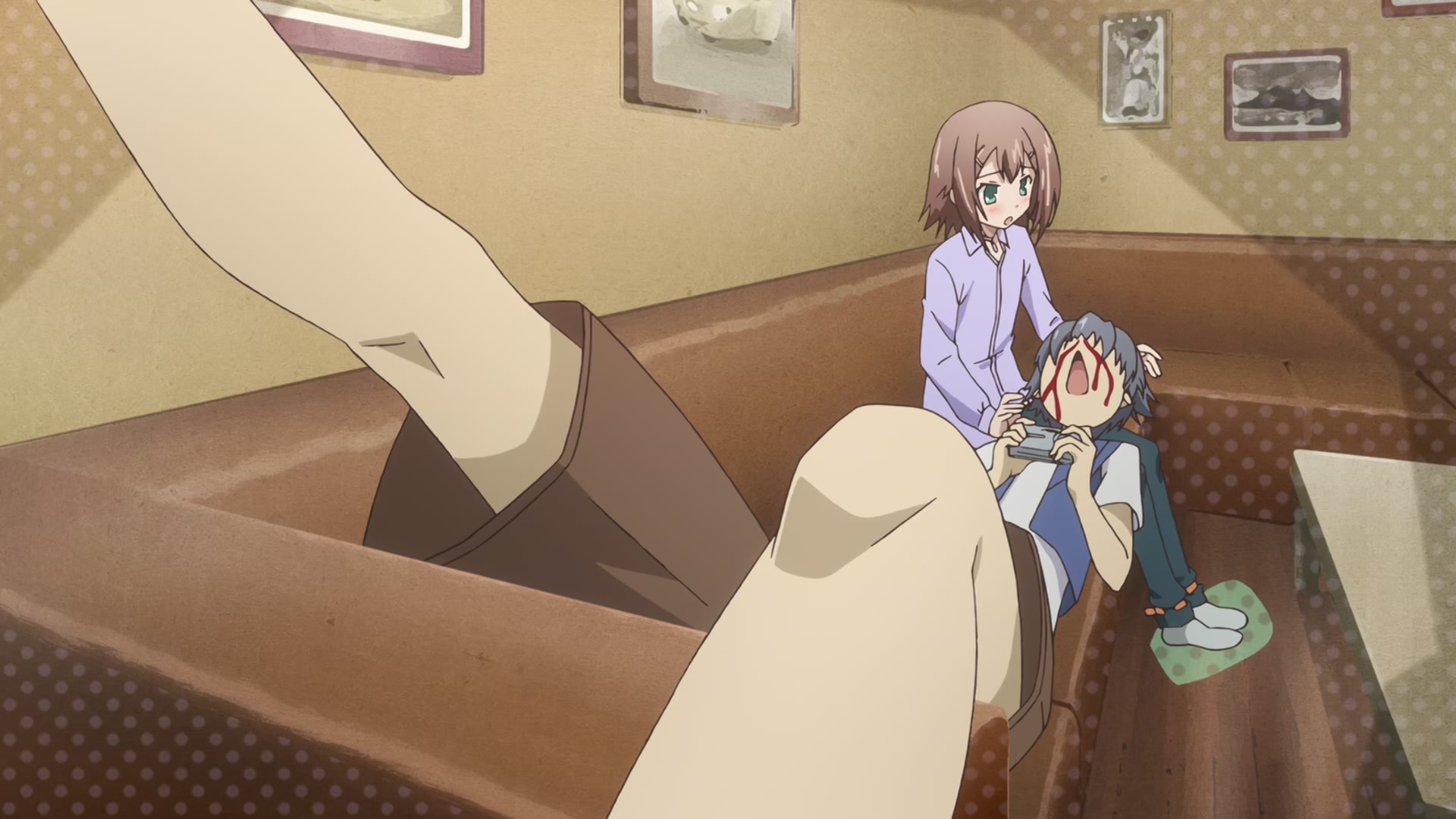
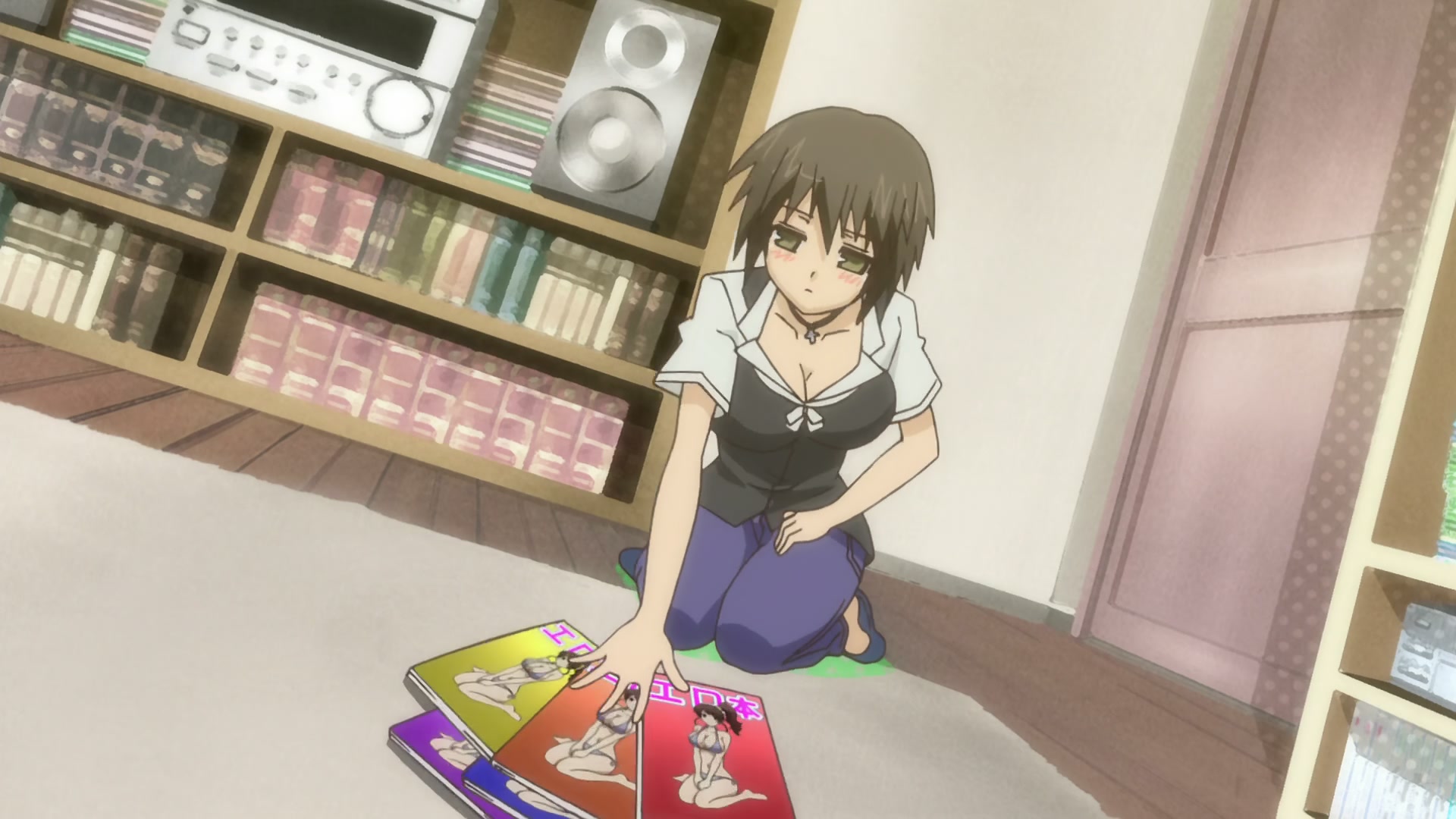
Tsuchiya Kouta, known universally as Muttsurini, is a silent voyeur whose nosebleeds are so violent they could be classified as a medical condition. He is a pervert, and the series never asks him to apologize for it. What it does instead is give him a code: he does not distribute his photos without consent, and he will only cross certain lines under specific conditions. His dynamic with Kudou Aiko, the Class A swim-club girl who teases him with deliberate flashes and then cruelly reveals she was wearing shorts, is one of the series’ stranger and more delightful relationships. She does not shame his perversion; she uses it as a weapon, turning him into a berserker unit whose nosebleed-induced frenzy can clear a room. Their partnership during the test-of-courage arc, where she strips to a leotard to activate his full power while he films enemy reactions for blackmail, is the purest expression of the show’s ethos: even the weirdest traits have value if you can find someone who understands how to wield them.
Kinoshita Hideyoshi is a boy so beautiful that the entire world—including the school administration—has collectively decided he is a separate gender. He gets his own bath. He gets his own changing room. Boys confess love to him in spontaneous poetry. He endures all of this with long-suffering exasperation, never once wavering in his assertion that he is male. The series treats Hideyoshi’s status not as a problem to be solved but as a fact of the universe, a running gag that is simultaneously absurd and, in its own weird way, progressive. He is the group’s voice of weary sanity, a competent fighter who specializes in history, and a loyal friend who puts up with Akihisa’s constant declarations of love with the patience of a saint.
The secondary cast is deep and well-utilized. Shimizu Miharu, Minami’s yandere stalker, functions as an emotional truth-teller, using her surveillance equipment to expose the dynamics that the main cast cannot or will not articulate. Kubo Toshimitsu, the second-year salutatorian in love with Akihisa, embodies dignified unrequited affection, his quiet support and refusal to pressure the object of his affection a poignant counterpoint to the heterosexual chaos around him. Principal Toudou Kaoru, the elderly “old hag” who runs the academy, is a trickster figure who delights in bending rules and handing out prototype devices that cause more problems than they solve. Nishimura-sensei, the iron-fisted supplementary lesson instructor known as Iron Man, is at once terrifying and weirdly paternal, his obsession with education manifesting as a kind of brutal tough-love.

Visuals and Animation
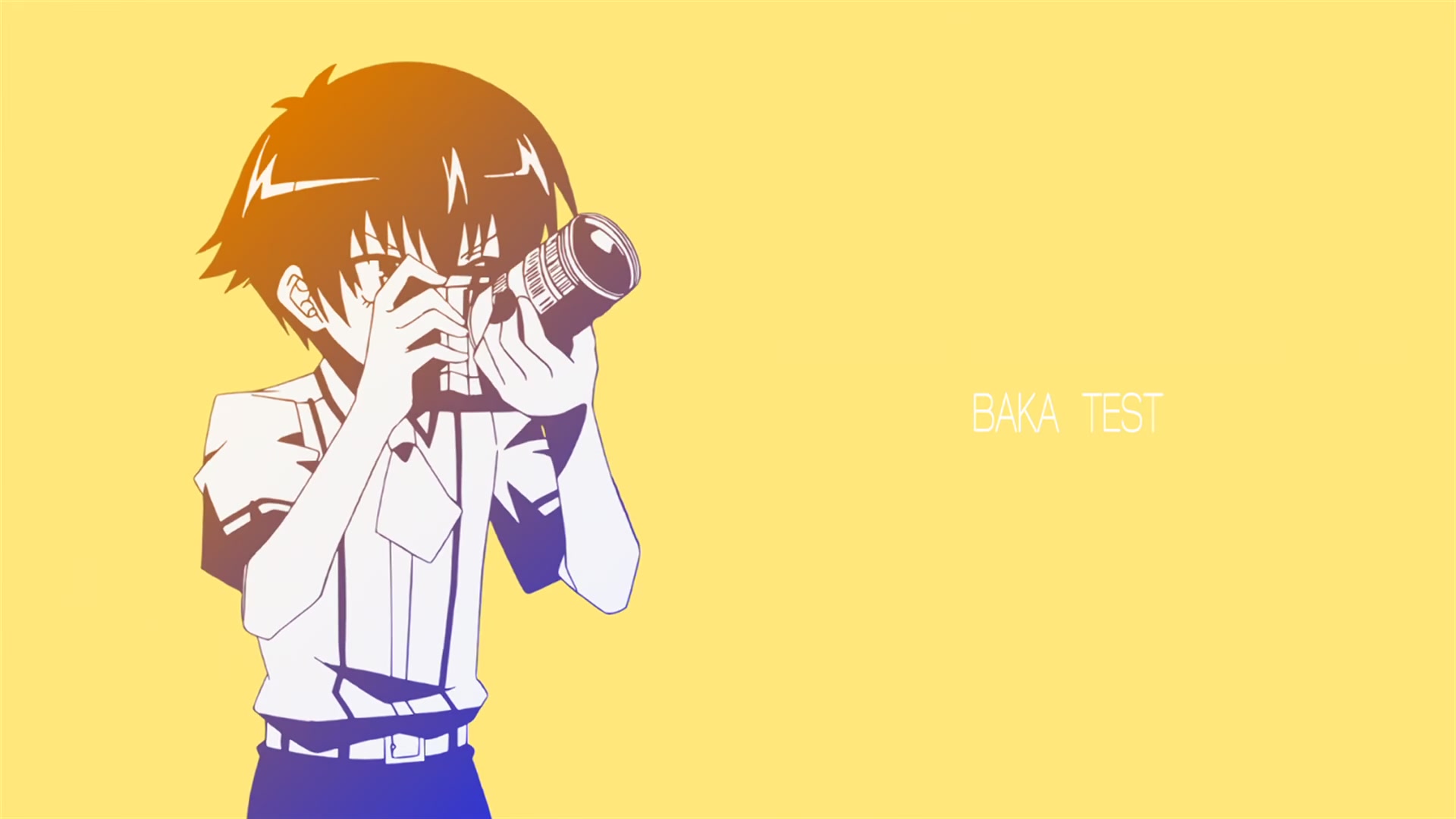
The visual identity of Baka to Test to Shoukanjuu is its greatest production asset. This is a show that understands exactly what it wants to look like and commits to that look with aggressive consistency. The aesthetic can best be described as digital pop art, a deliberate mashup of anime conventions, manga textures, and graphic design elements that treats the screen less as a window into a world than as a canvas for visual play.
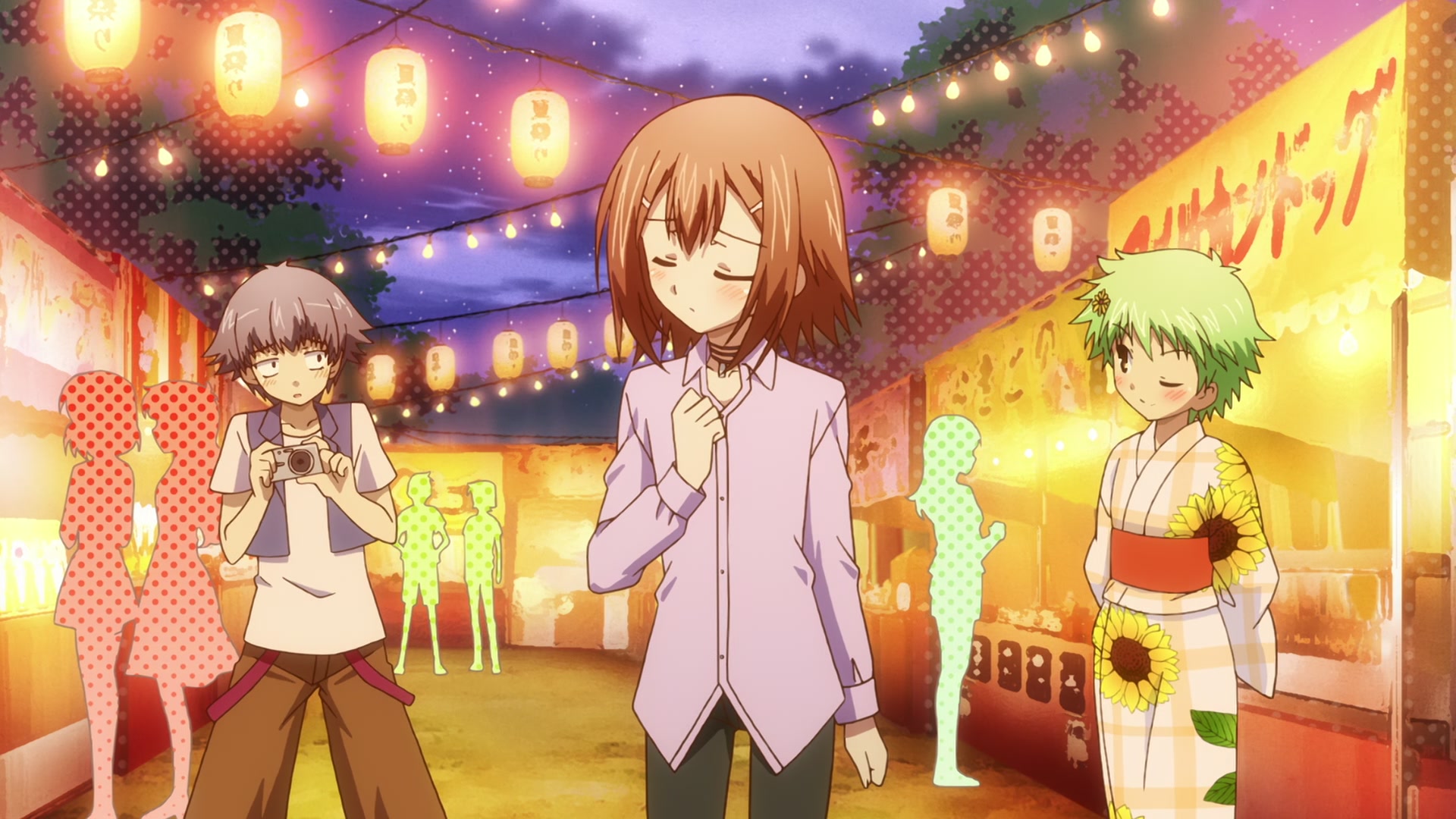
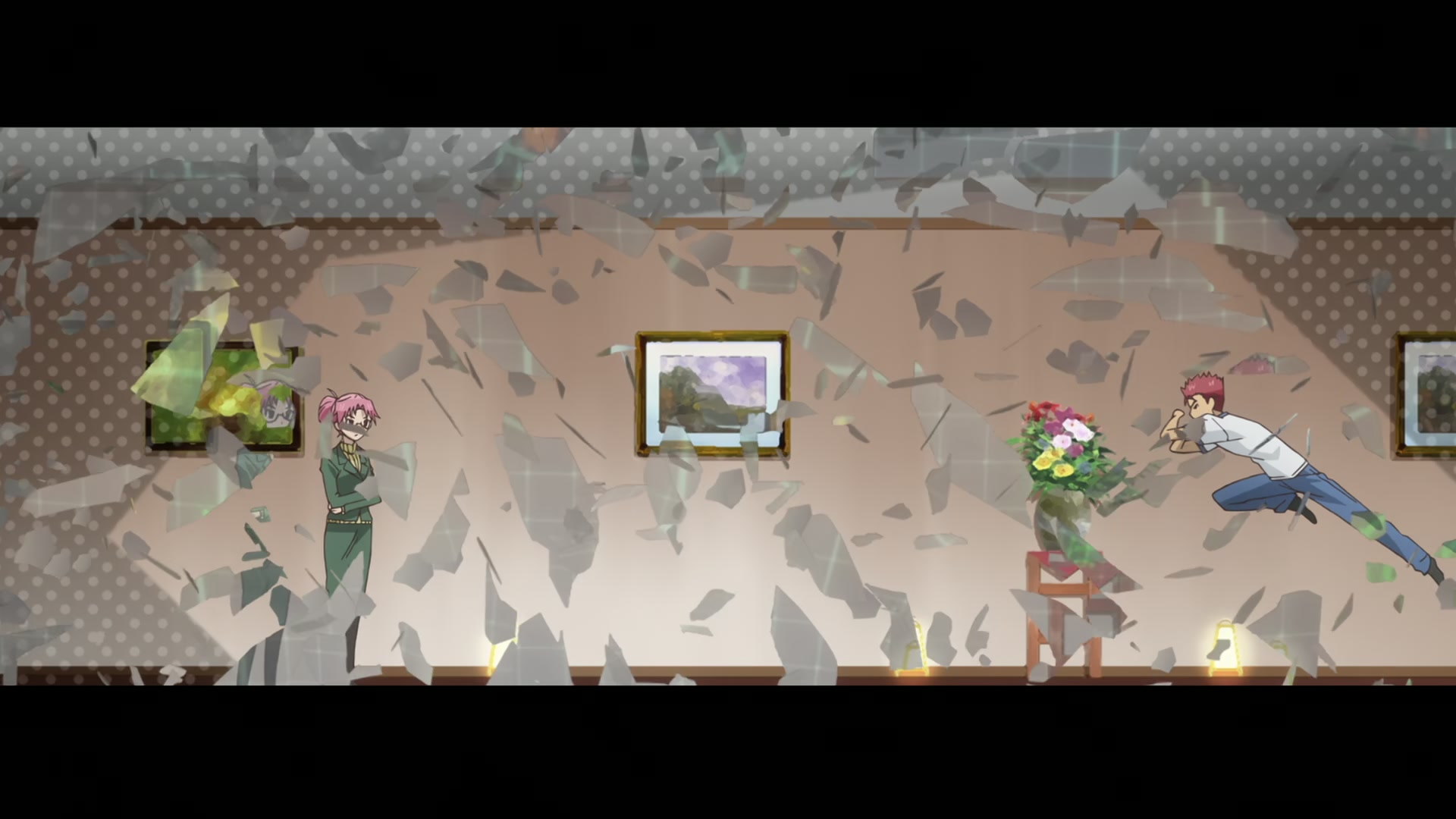
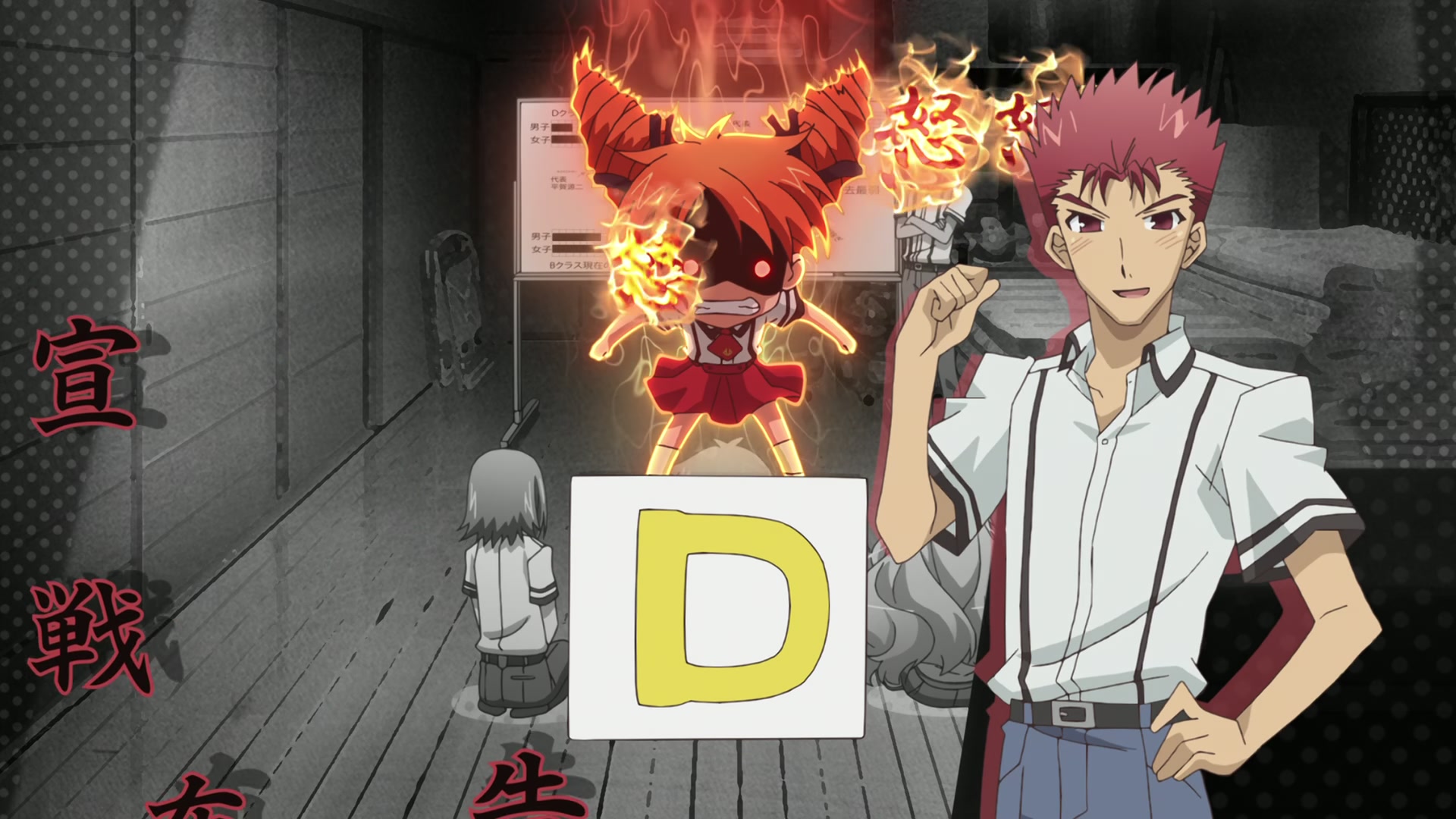
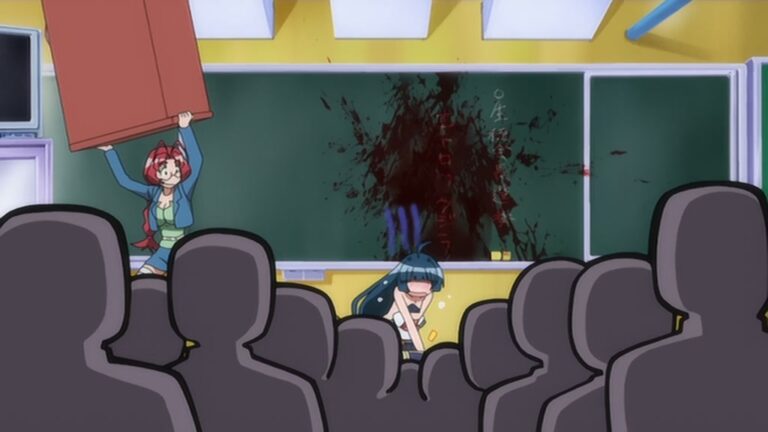
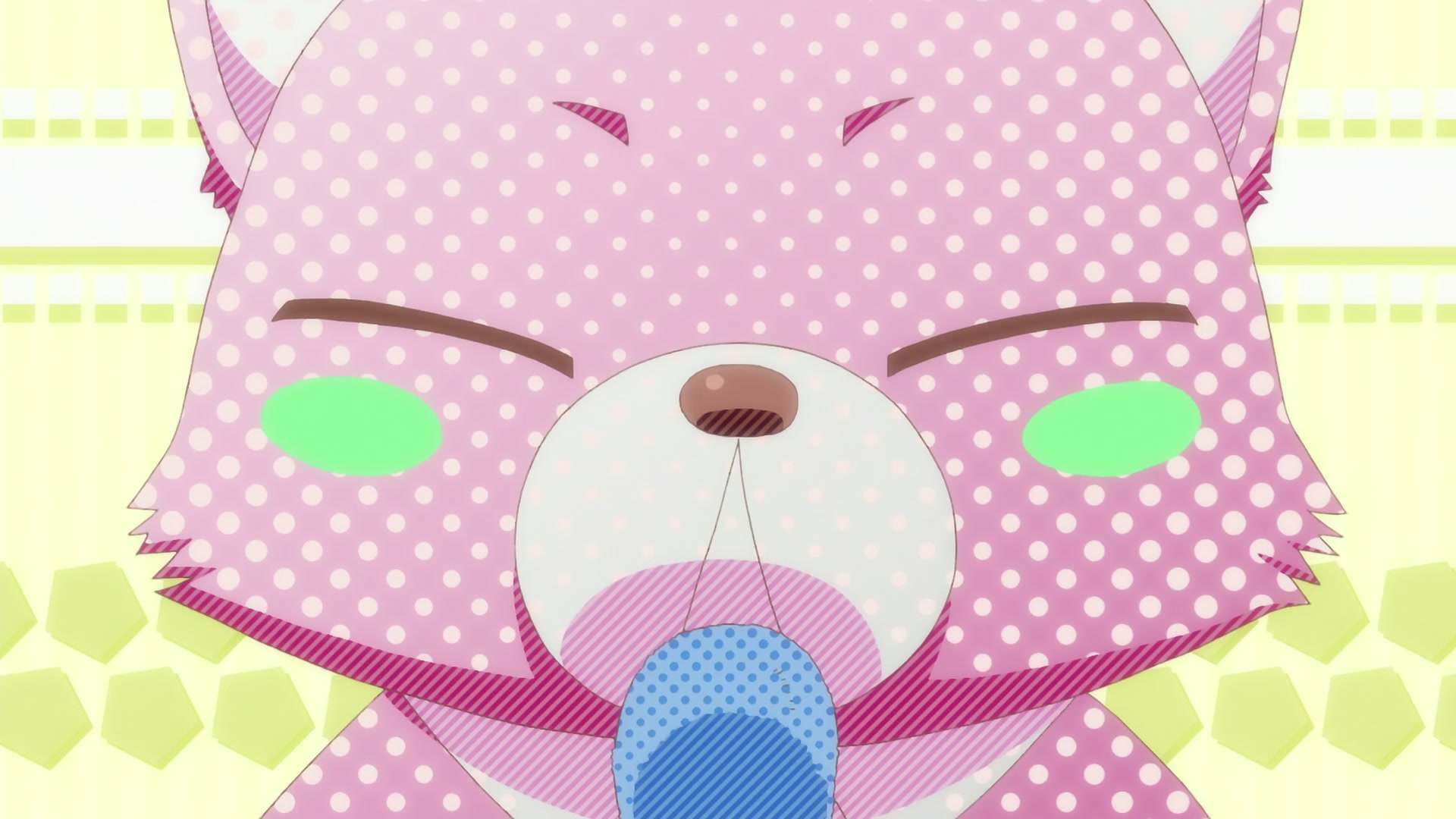
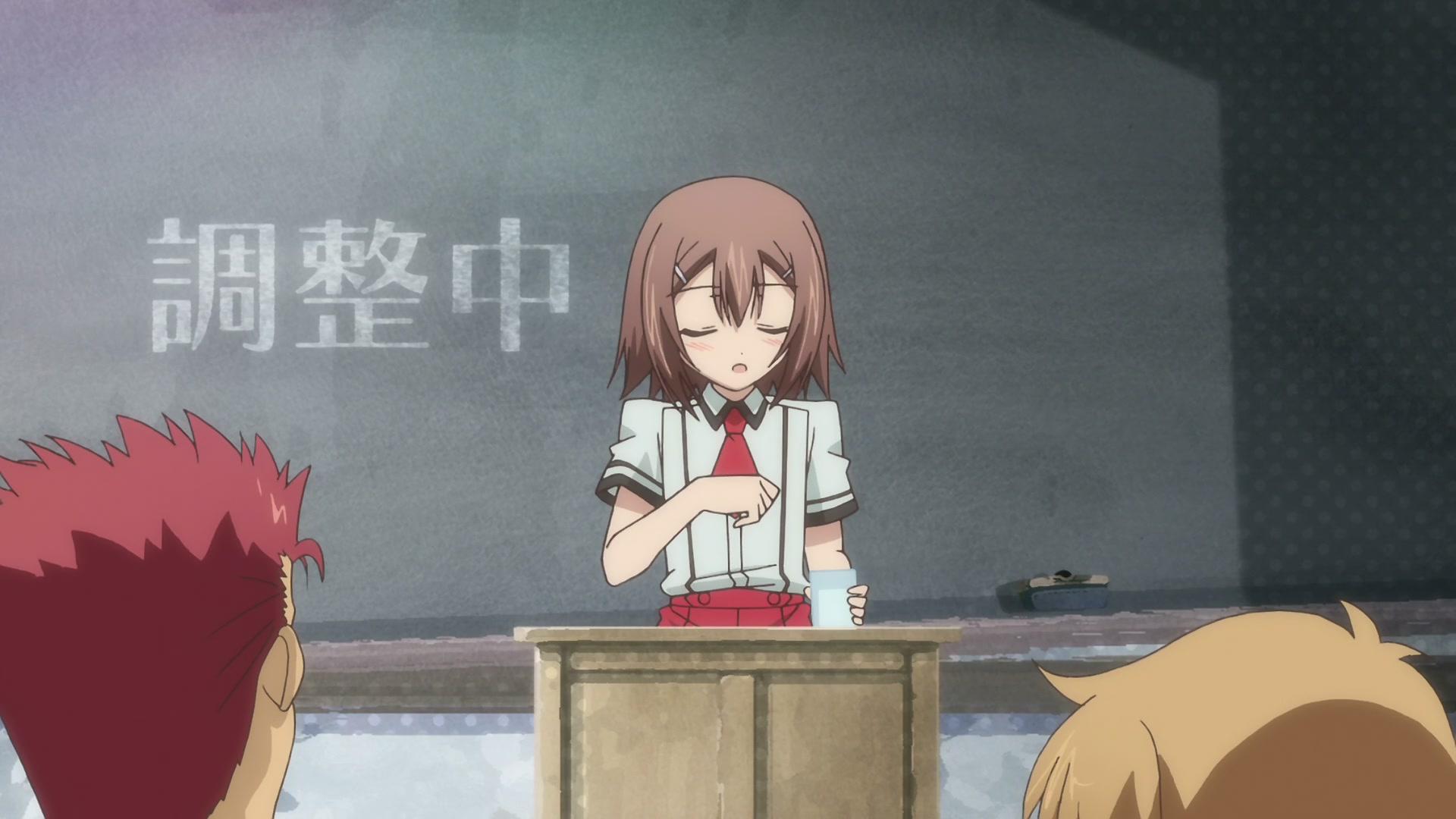
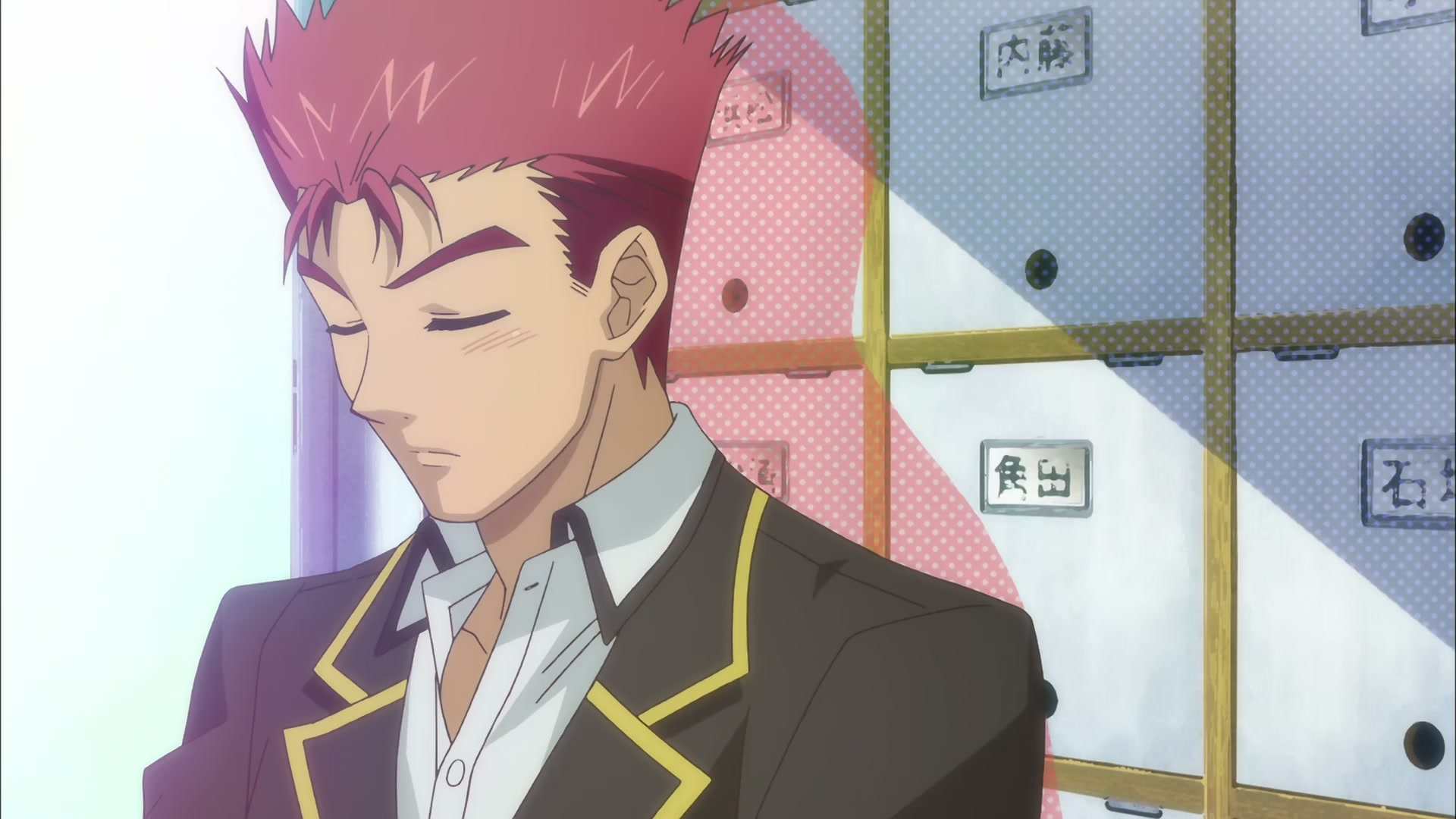
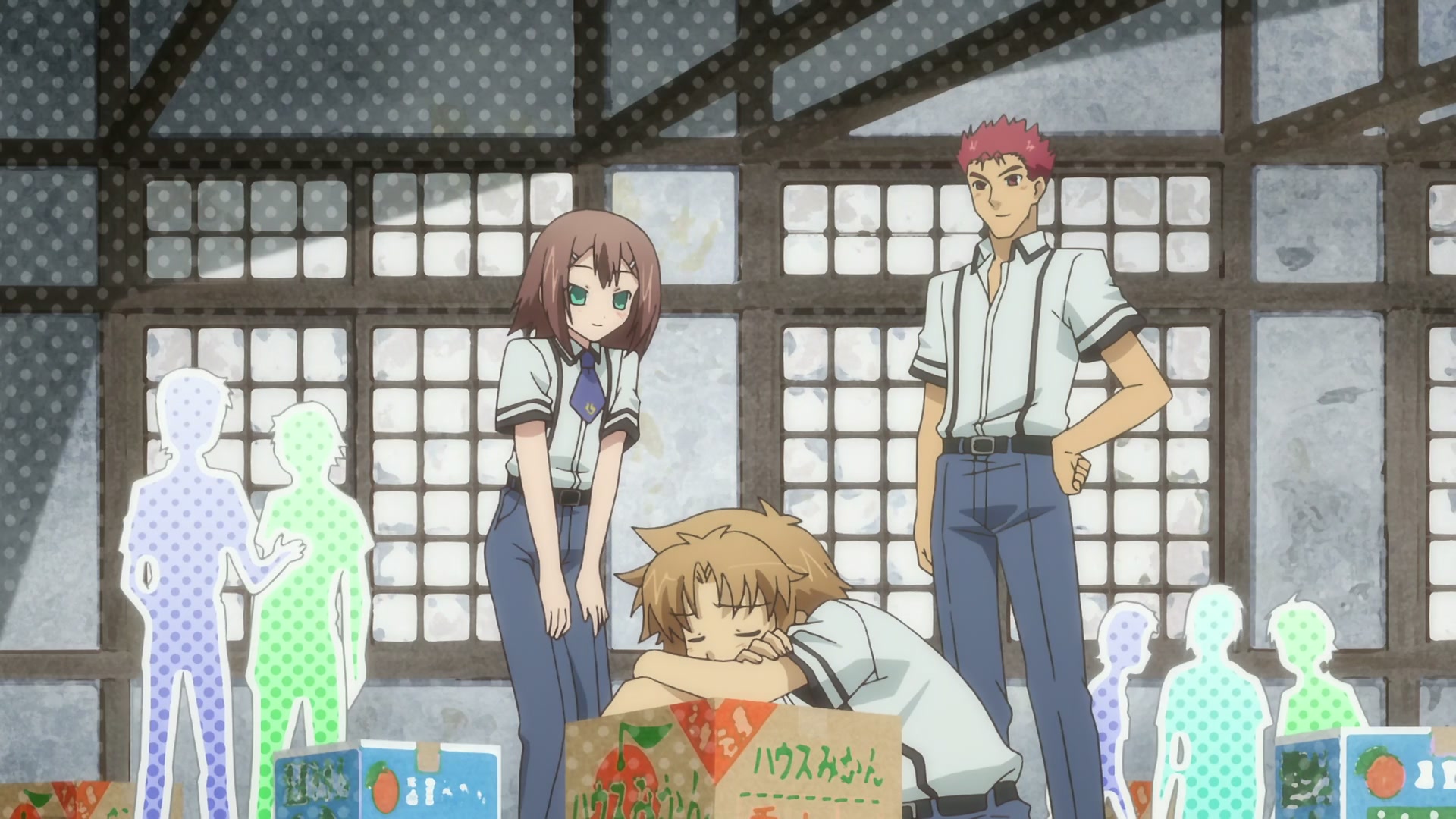
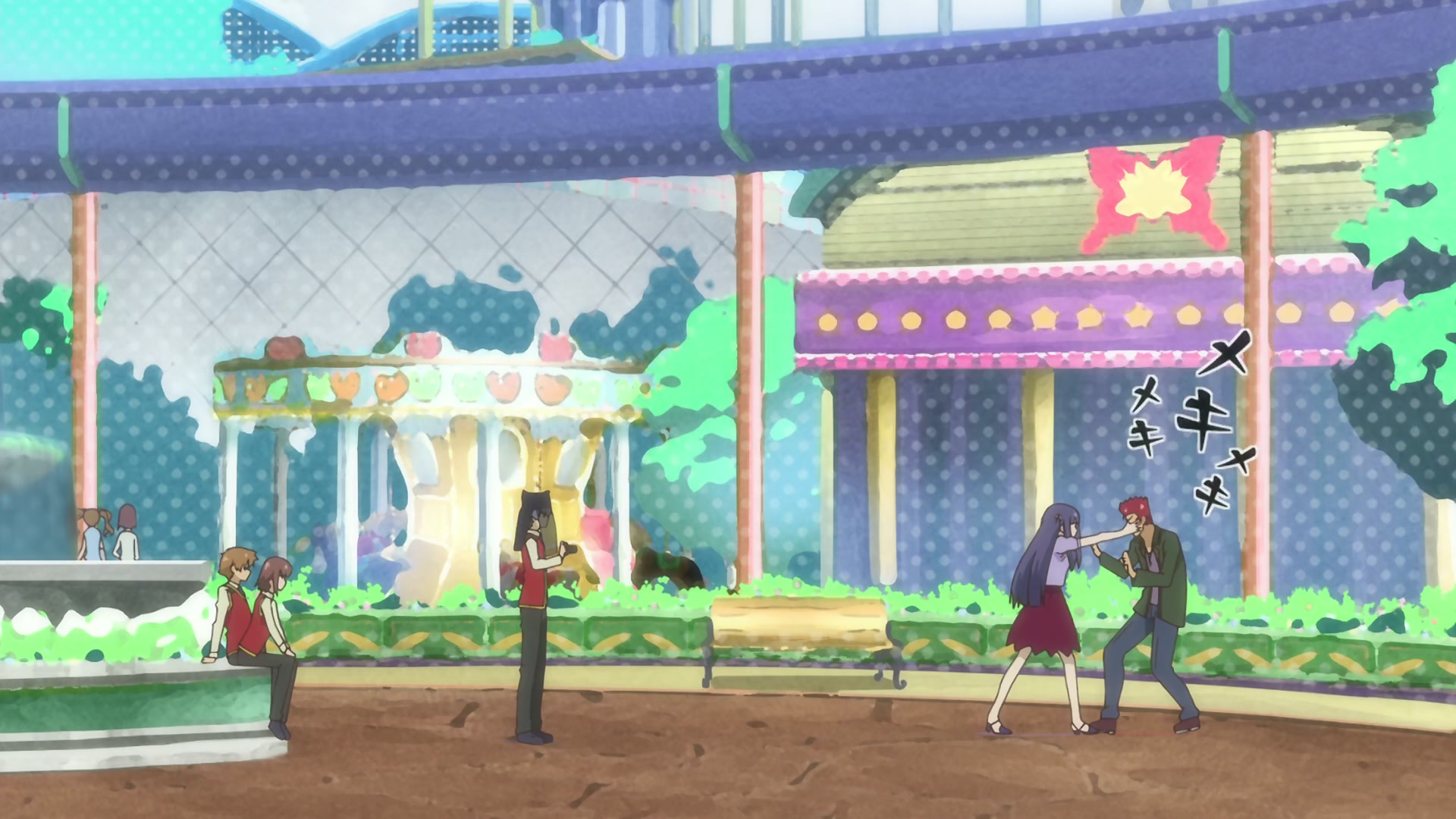
Compositing is where the magic happens. The series overlays halftone dot patterns, screentone textures, and graphic filters onto nearly every shot, giving the bright, clean digital animation a tactile, printed quality. Background extras are frequently rendered not as detailed figures but as flat, monochromatic silhouettes filled with polka dots or geometric stripes. This is a stylistic choice that functions both as a cost-saving measure and as a signature. It makes the world feel populated and energetic without requiring the animation team to draw detailed crowds, and it reinforces the show’s pop-art sensibility. The background characters are not individuals; they are part of the texture, the visual noise of a chaotic school environment.
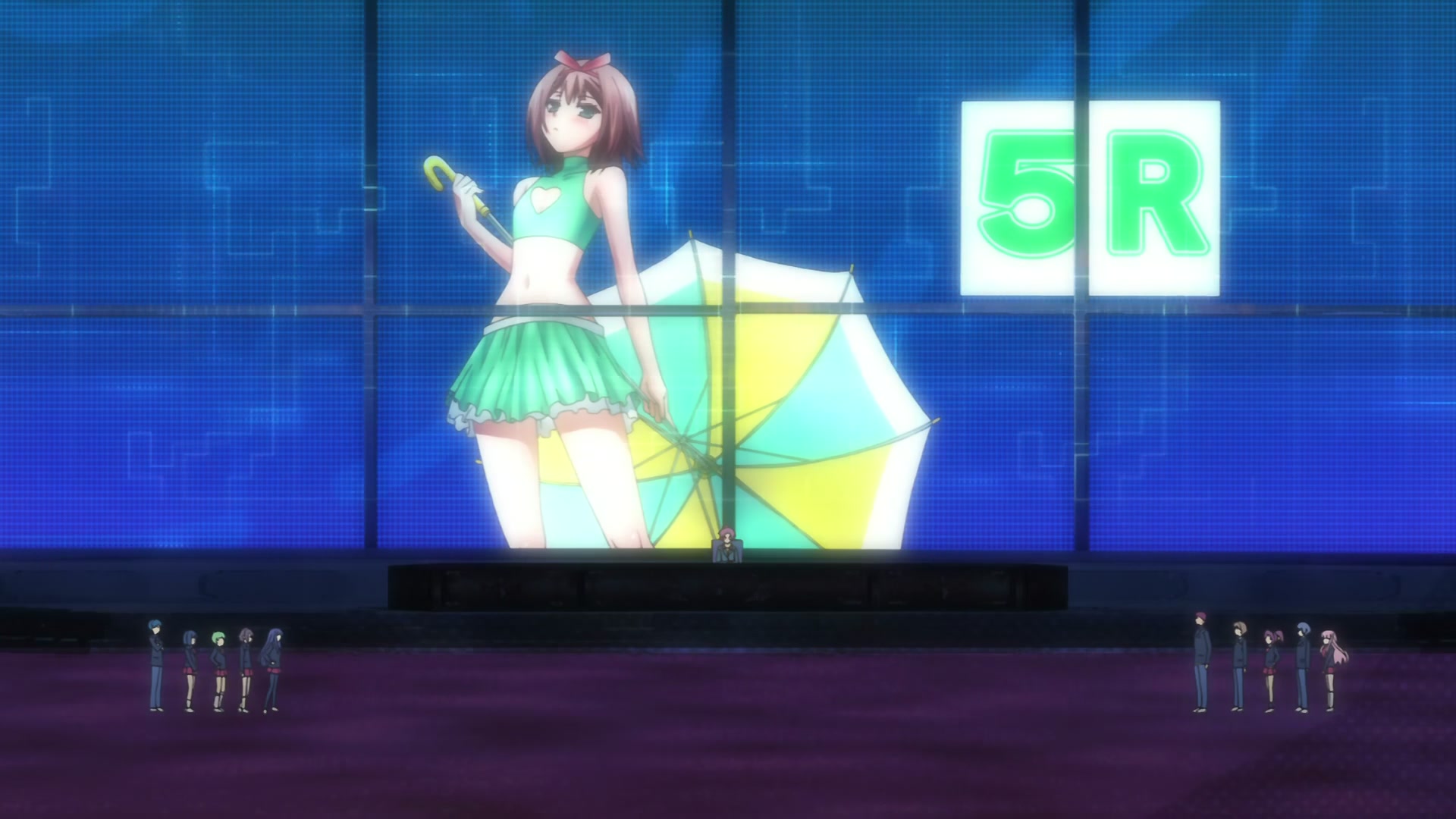
The integration of floating UI elements is similarly effective. During Exam Wars, the screen is littered with digital grids, mathematical symbols, glowing kanji, and interface readouts that gamify the action. This externalizes the series’ premise: these children are fighting with their test scores, and the battlefield knows it. The cold, digital aesthetic of the summoning fields contrasts intentionally with the warm, painterly backgrounds used for more intimate moments, like the school rooftop at sunset or the seaside training camp. The CG elements, while dated by contemporary standards, fit this aesthetic. The summoning fields are supposed to look like video game interfaces, and the slight disconnect between the 3D grids and the 2D characters actually reinforces the artificiality of the system they are trapped in.
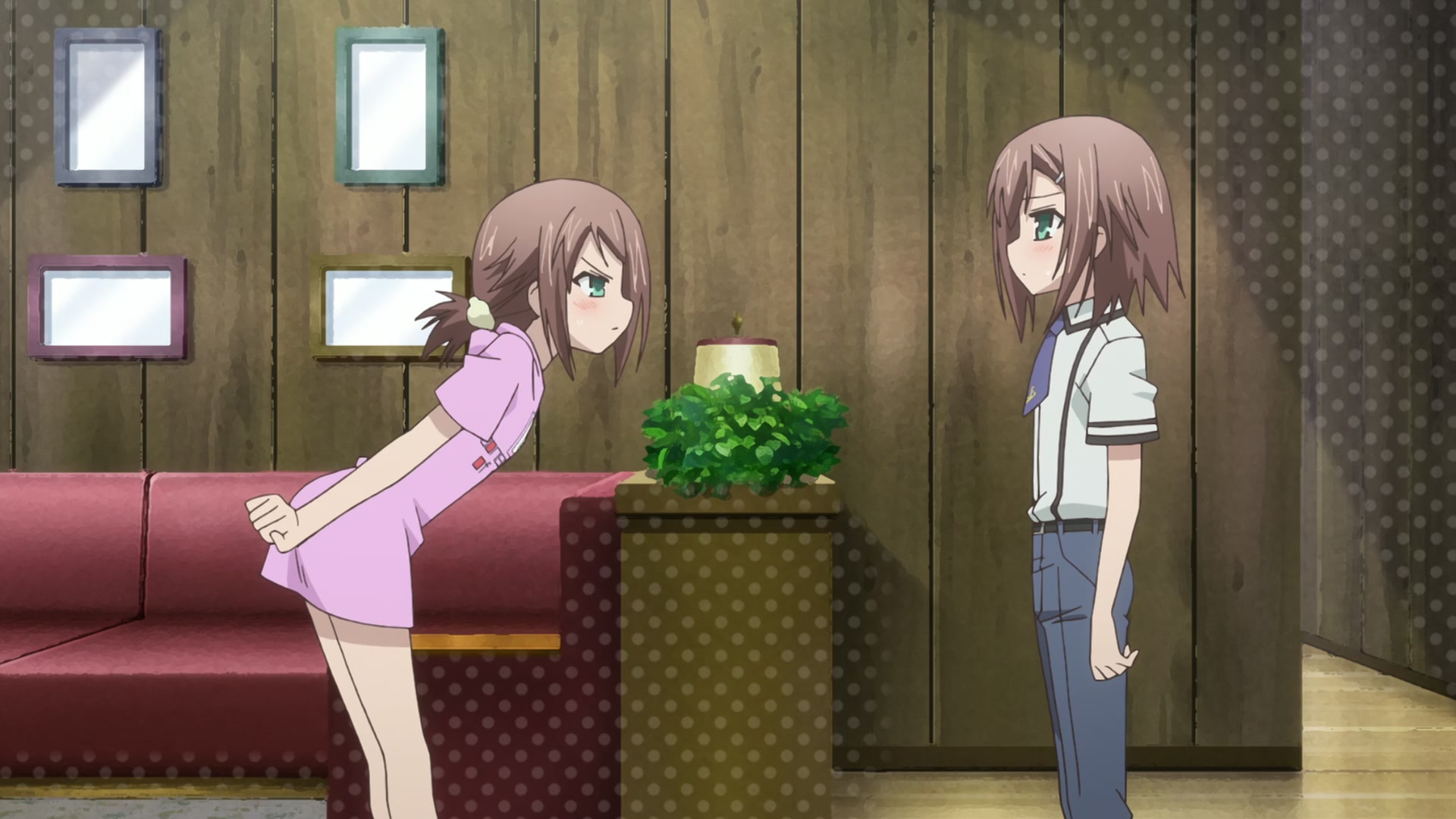
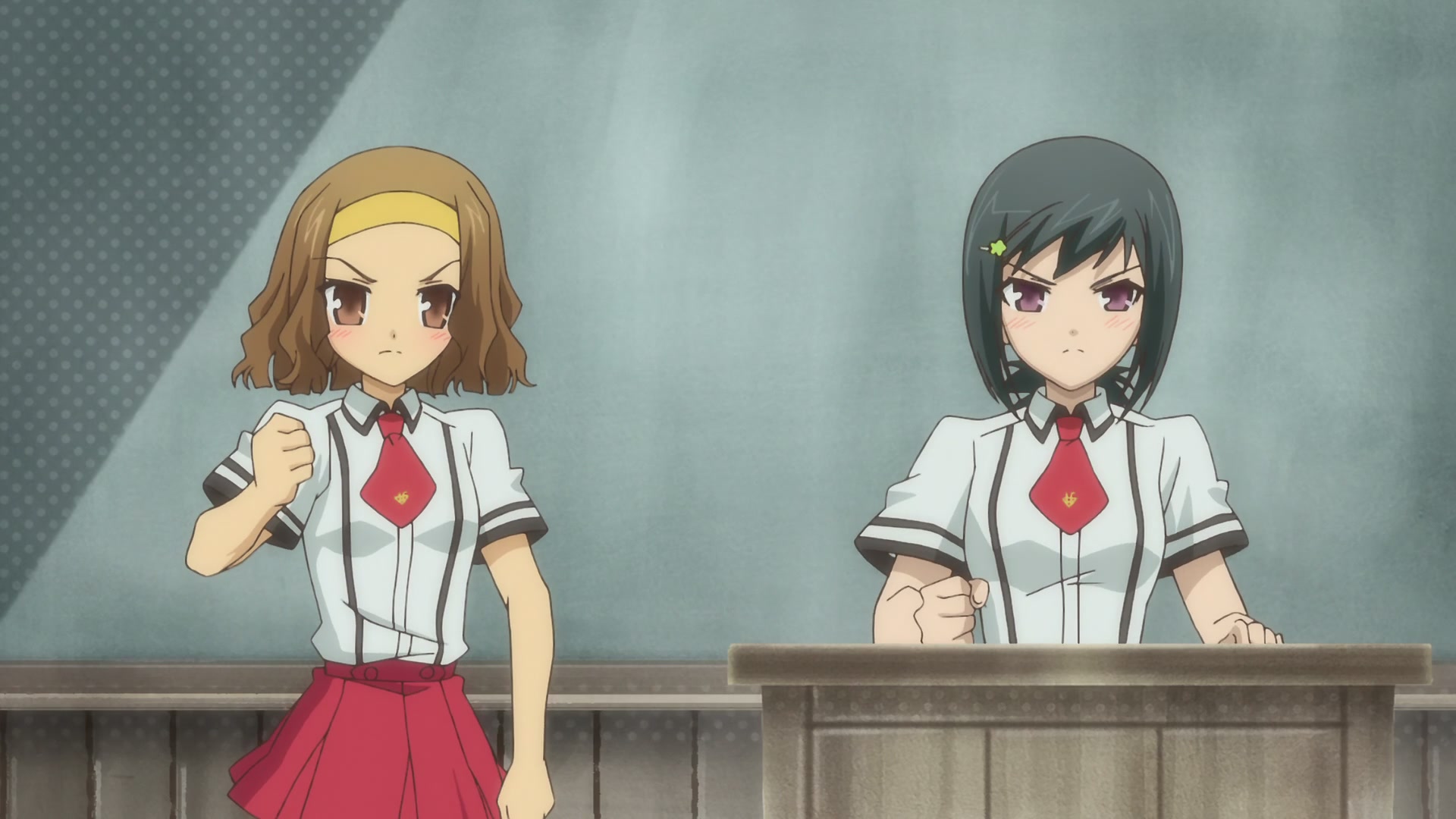
Character designs employ clean, thin linework with sharp silhouettes, particularly in hair shapes and eye construction. The core designs lean into a versatile moe aesthetic, but the cast is visually distinctive. Himeji’s flowing pink hair and soft features contrast with Minami’s sporty ponytail and sharper expressions. Hideyoshi occupies an ambiguous space where the design language signals beauty without explicitly gendering it. Muttsurini’s eyes are perpetually hidden, a choice that makes his rare moments of visible expression land harder. The Summoned Being chibi forms are simplified but expressive, each avatar a compact version of its summoner that can convey panic, determination, or exhaustion through minimal changes in posture and eye shape.
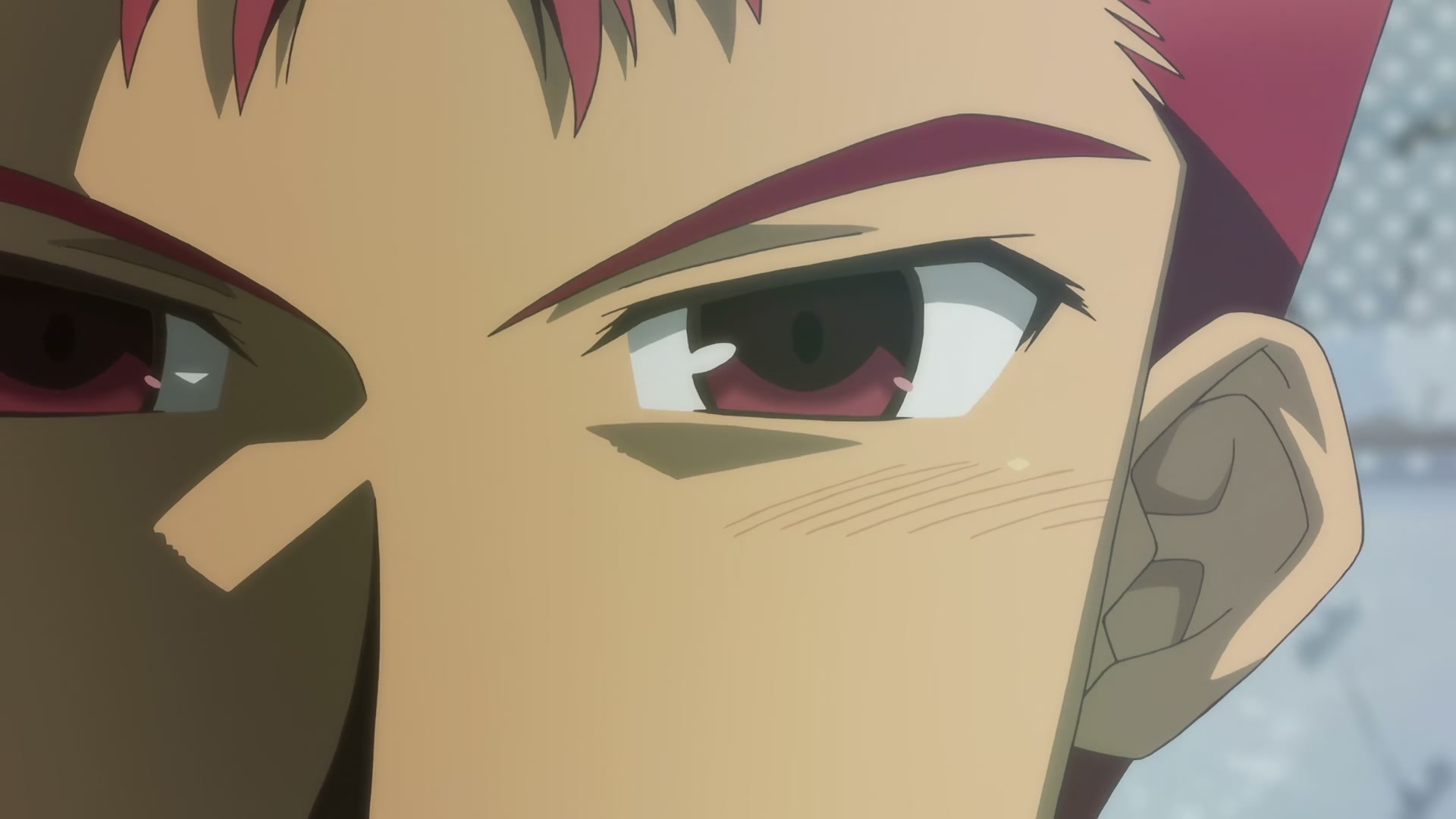
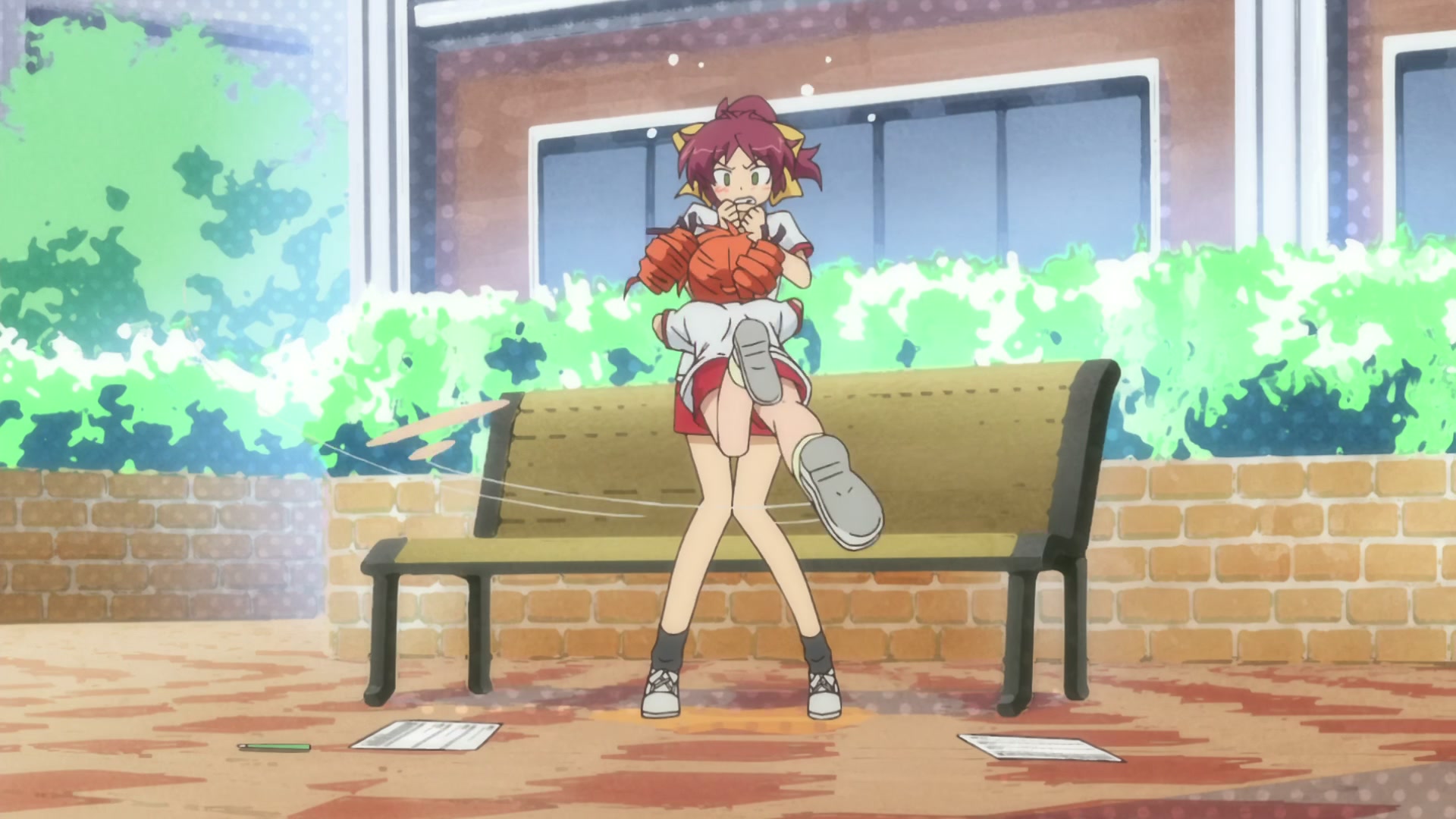
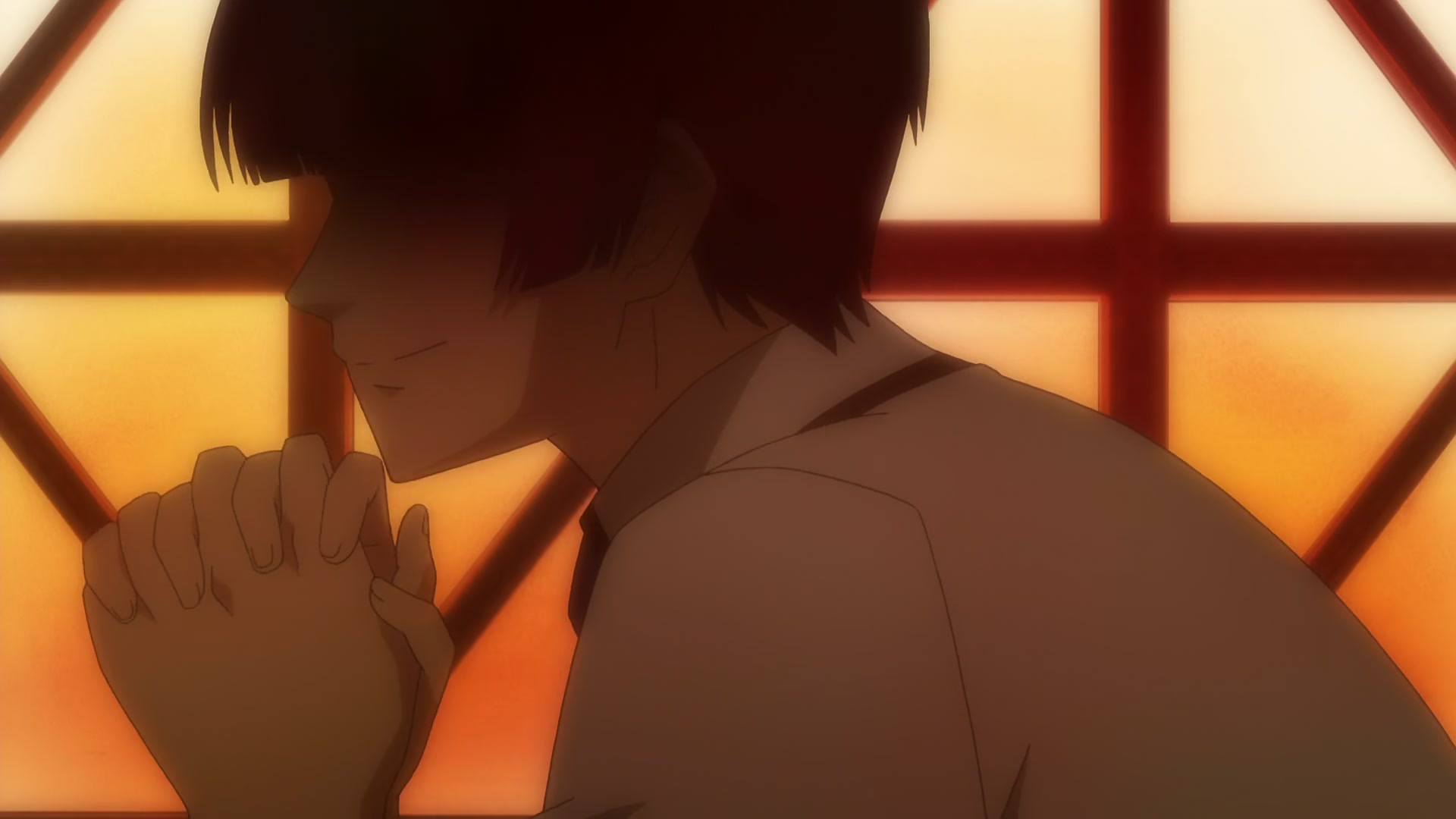
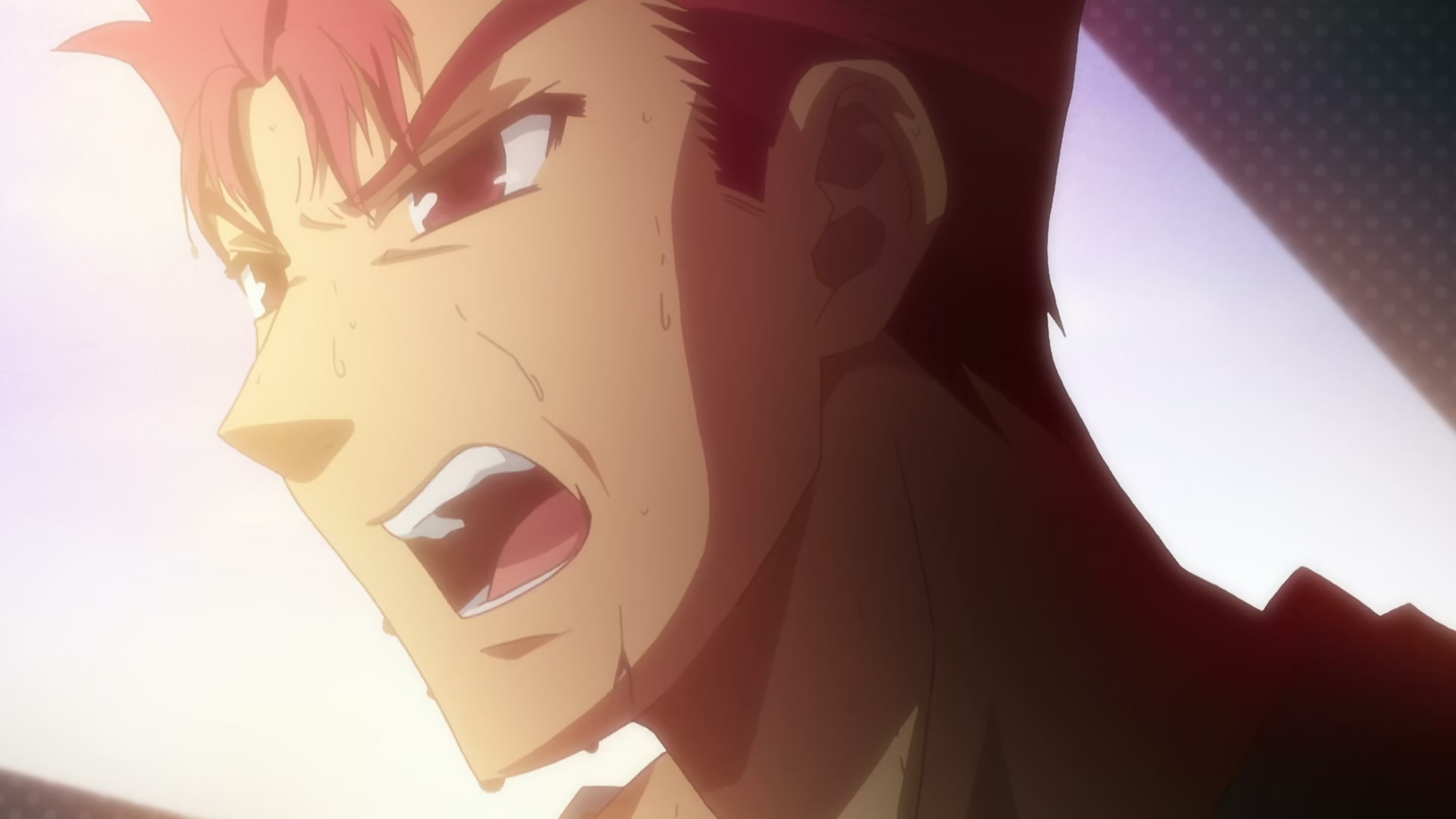
The series demonstrates genuine expressive versatility in its character acting, pivoting between three distinct modes. In standard comedy mode, the acting is fluid and trope-heavy, with exaggerated sweat drops, bulging vein marks, and the classic “dizzy eyes” of a character who has just been bludgeoned. The chibi mode shifts proportions into squat, simplified forms to punctuate physical gags or represent emotional vulnerability. These transitions happen so quickly and so frequently that they become part of the show’s visual rhythm. And then, in high-detail drama mode, the series pulls out intense close-ups with sharper linework, heavy hatching for blush and shadow, and dramatic hidden-eye compositions that sell emotional weight. These moments are deployed sparingly, which gives them impact when they arrive. The shift from broad comedy to an intimate close-up of Minami’s trembling expression or Mizuki’s downcast eyes is jarring in the best way, a signal that something real is happening beneath the noise.
Facial acting is a particular strength. The series uses vertical highlights in the eyes, a technique borrowed from visual novel and dating-sim aesthetics, to maintain readability even during chaotic wide shots or rapid comedy cuts. A character’s emotional state is always legible in their eyes, whether it is Akihisa’s vacant confusion, Yuuji’s calculating squint, or Shouko’s serene, faintly terrifying calm.
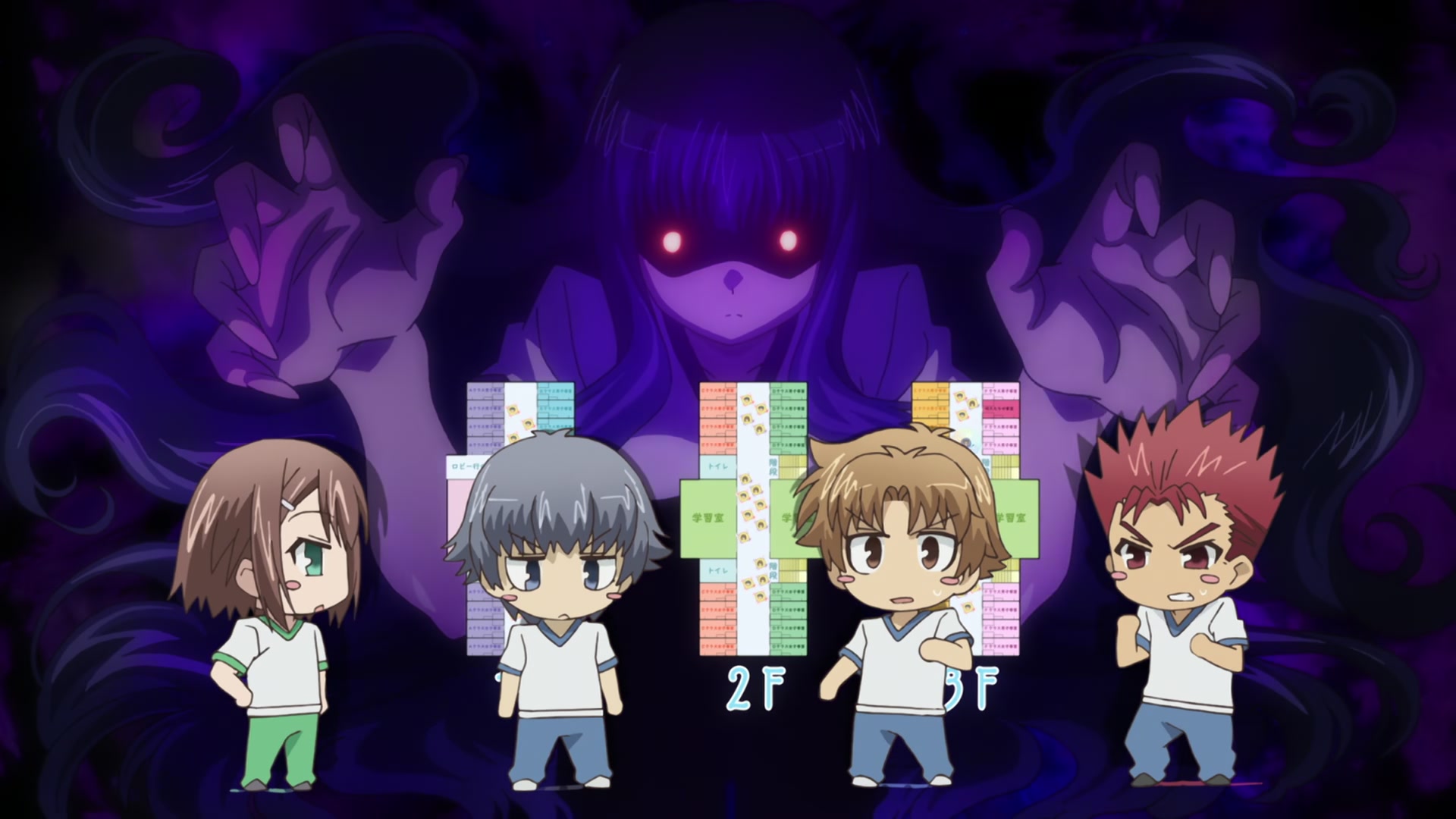
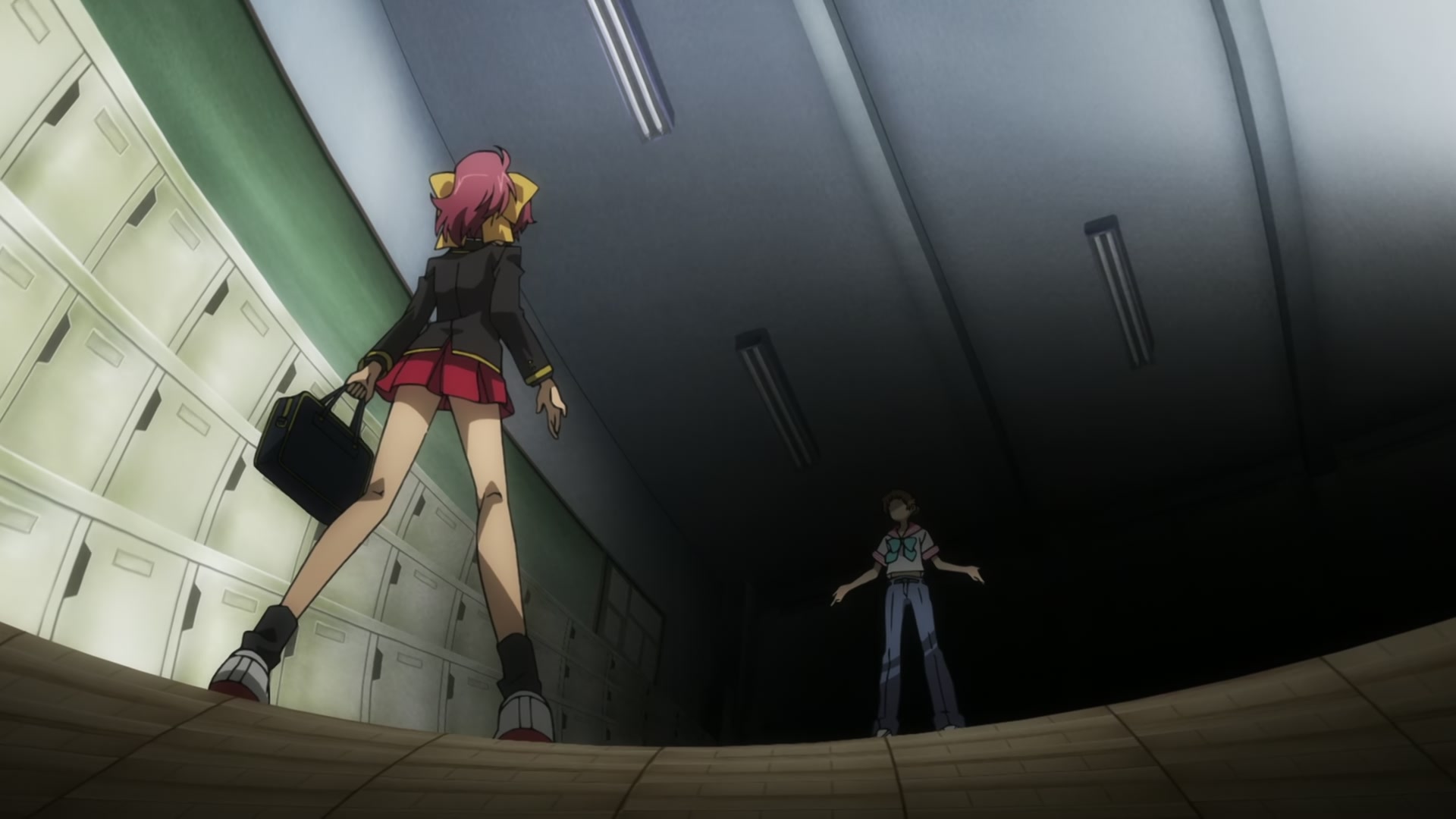
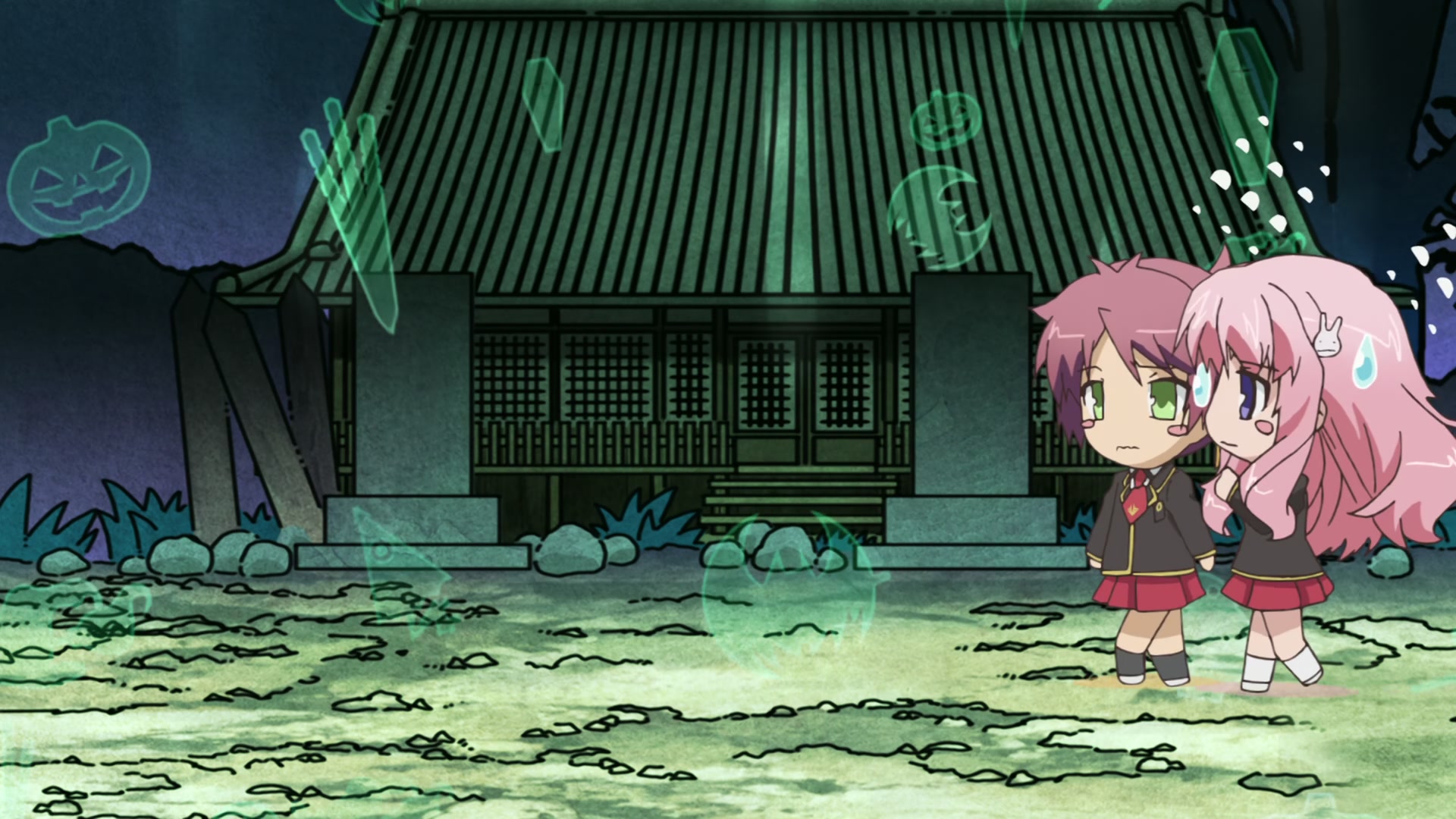
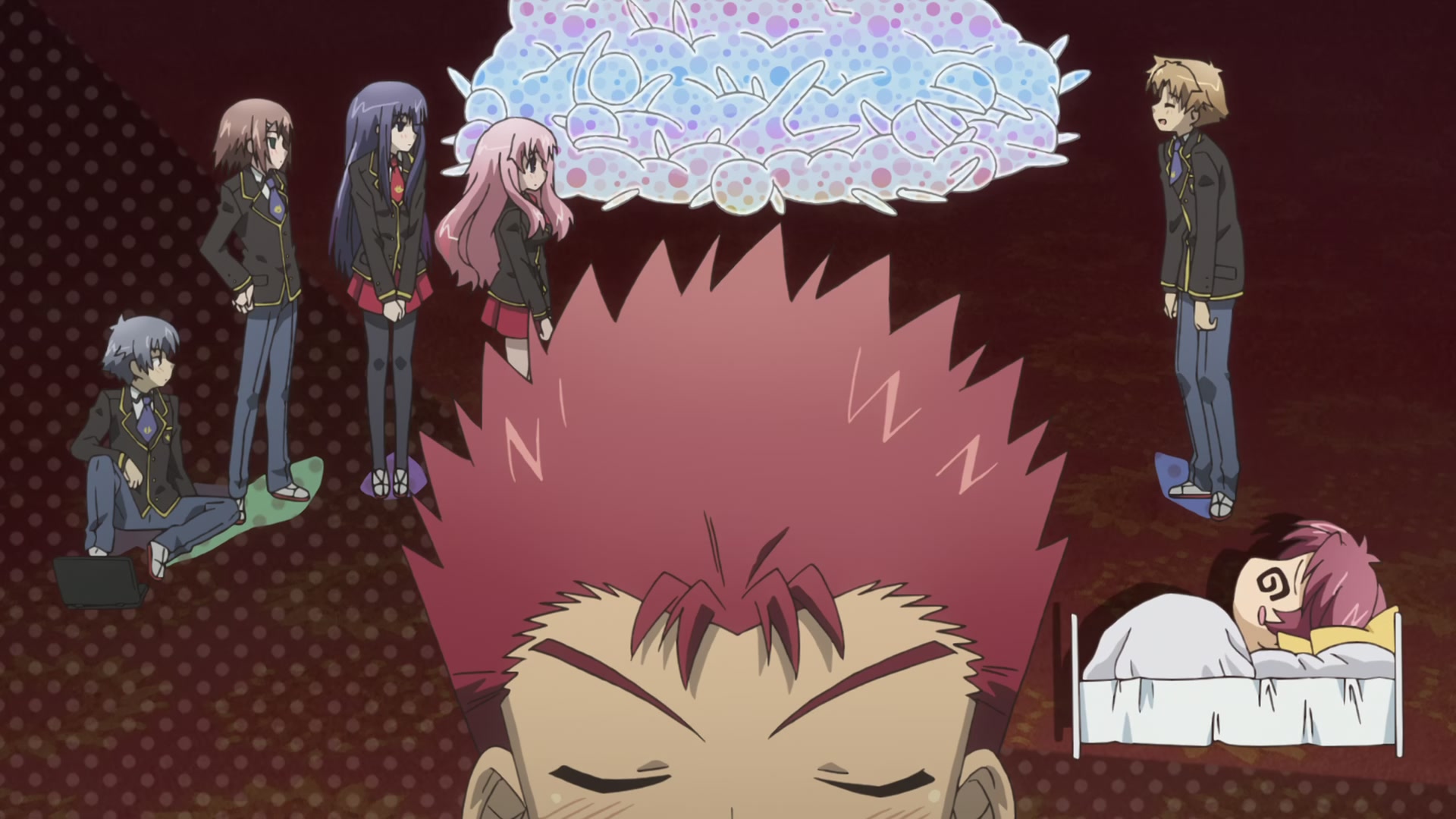
The direction is notably active. Extreme low-angle fish-eye shots and Dutch angles convey disorientation during Exam War chaos or the subjective terror of a haunted house. Depth-of-field is used expressively, with foreground objects placed deliberately out of focus to create intimacy or claustrophobia. And the series frequently abandons literal spatial logic in favor of montage framing, where characters in various states of action are scattered across abstract, patterned backgrounds. This is a creative choice that fits the show’s fourth-wall-breaking humor. The screen is not a room; it is a comic panel.
Now, a fair evaluation must acknowledge the budget limitations. This is a 2010 television anime produced on a late-night schedule, and it shows in the expected places. Running cycles are choppy and weightless. Crowd shots during large-scale Exam Wars reduce background fighters to nearly static sprites with looping low-frame animations. In some wide shots and rapid transitions, character faces simplify inconsistently, losing their distinctive features around the eyes. The series compensates brilliantly through its compositing and styling, and in many cases a static shot of characters scheming in a watercolor hallway is visually stronger than an underfunded animation sequence would have been. But viewers sensitive to low frame rates will notice the shortcuts, and acknowledging them is not a criticism so much as a recognition of the production context. The team allocated their resources well, prioritizing the comedy beats and the dramatic close-ups over transitional motion, and the result is a show that feels stylish and intentional rather than cheap.
Fanservice is present and unapologetic. Pool episodes, bath scenes, panty shots, and breast-size jokes are woven into the fabric of the comedy. The animation priorities reflect this: certain sequences, particularly those involving Kudou’s teasing or Himeji’s swimsuit, receive noticeably more fluid motion and detailed rendering than surrounding material. Whether this is a weakness depends entirely on viewer tolerance. For those comfortable with the idiom, the fanservice is diegetic and character-driven. Muttsurini’s nosebleeds are not external pandering; they are his personality. Kudou’s provocations are a deliberate strategy, not a passive camera leer. The series is perverted on purpose, and its perversion is, in its own bizarre way, honest.

Sound and Music
The voice acting in Baka to Test to Shoukanjuu is a key component of its identity. Shimono Hiro’s performance as Akihisa anchors the series with an elastic, constantly-shifting register that can pivot from vacant confusion to panicked screaming to unexpected sincerity without losing the character’s fundamental dopiness. His delivery of Akihisa’s more honest lines—the rooftop admission about Minami’s charm, the quiet “thank you” after Himeji’s cooking nearly kills him—carries a weight that the comedy surrounding it makes more striking.
Suzuki Tatsuhisa’s Yuuji is perfectly calibrated: a drawling, perpetually unimpressed baritone that makes his rare moments of anger or vulnerability feel like the mask slipping. His voice carries the exhaustion of someone who has been too smart for his own good since childhood and has settled into a permanent state of lazy manipulation as a coping mechanism. Harada Hitomi’s Himeji and Mizuhashi Kaori’s Minami form a complementary pair—Himeji’s softly wavering femininity contrasting with Minami’s sharper, more aggressive tone—and their scenes together, particularly during the love-triangle escalations, benefit from the chemistry between the two performances.
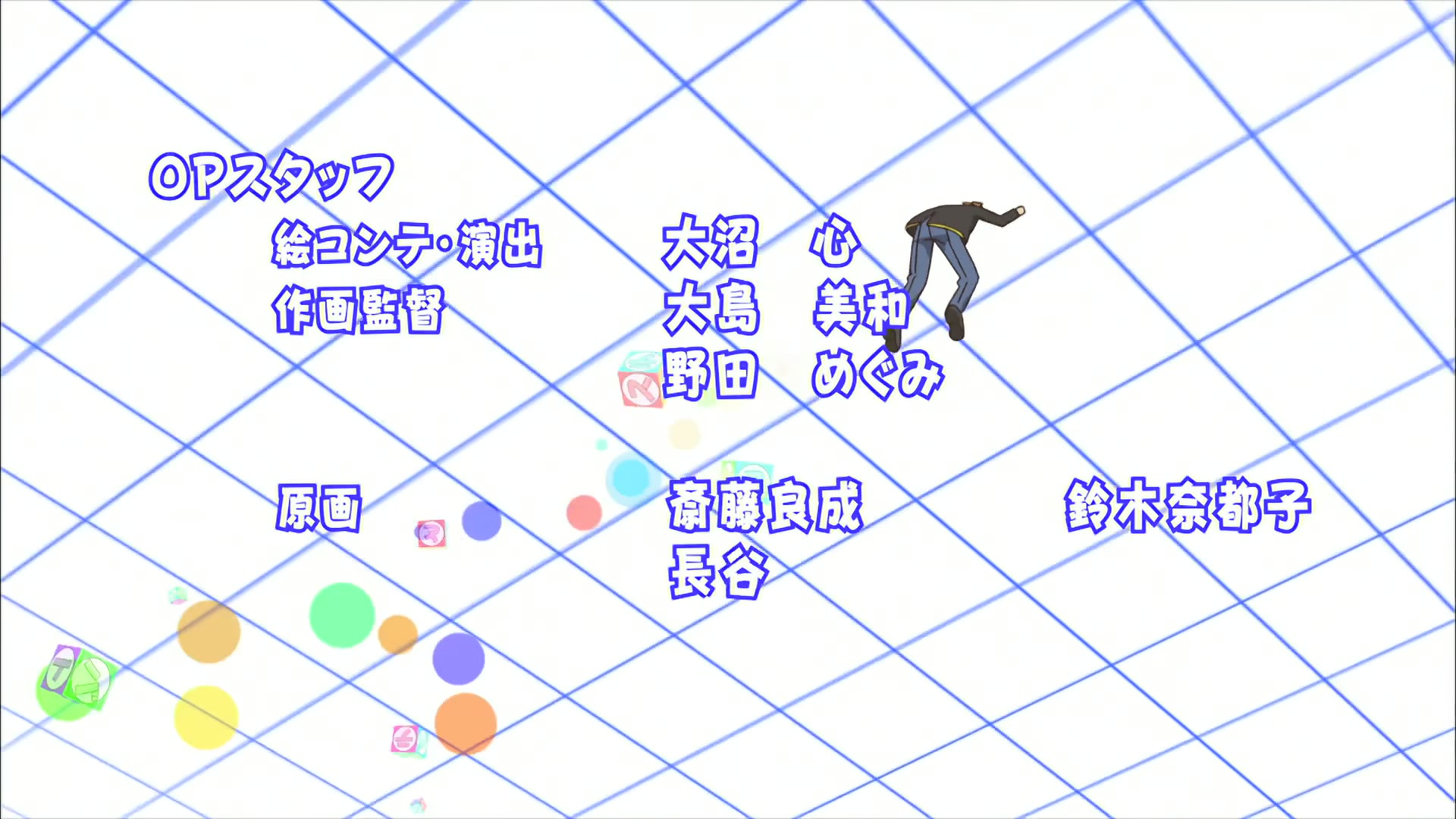
The opening and ending themes are energetic and tonally aligned with the series. The first season’s opening, “Perfect-area complete!” by Asou Natsuko, is a high-BPM electro-pop track that sets the chaotic energy of the Exam Wars to danceable beats. The second season’s opener, “Kimi + Nazo + Watashi de JUMP!!” by Larval Stage Planning, continues in a similar vein while the ending themes shift to a softer, more romantic register. The credit sequences themselves are well-produced, using stylized imagery and character showcases that reinforce the show’s visual identity.
Sound direction for comedy is notoriously demanding—timing is everything, and a misplaced sound effect can deflate a joke. Baka to Test handles this well. The Summoned Being summoning sequences have a satisfying digital chime and whoosh that makes each deployment feel like a game mechanic activating. The impact sounds during slapstick are appropriately cartoonish without becoming grating. Iron Man’s footsteps carry a heavy, metallic weight. And the use of silence during the show’s rare sincere moments, when the chaos suddenly cuts out and a character is left alone with their thoughts, is deployed with precision.
Overall Verdict
Baka to Test to Shoukanjuu is a series that knows exactly what it is and loves itself for it. It is a comedy about idiots that treats its idiots with genuine respect, a satire of academic meritocracy that never becomes cynical, and a romance that understands the courage required to say what you feel. It will not appeal to everyone. If the grammar of anime comedy—tsundere violence, pervert-guy nosebleeds, fourth-wall breaks, chibi transformations, and the specific cadence of a school-life ensemble piece—feels foreign or irritating, then the show’s frequency will be fundamentally unreadable. But for those who grew up with this idiom, who learned to parse the layers of irony and sincerity that coexist in this kind of storytelling, the series is a minor classic.
The animation budget is visibly limited, but the art direction, compositing, and stylistic confidence more than compensate. The pop-art halftones, the patterned silhouette crowds, the gamified UI overlays—these choices transform what could have been a cheap-looking production into something visually distinctive and memorable. The voice acting is strong across the board, with Shimono Hiro’s Akihisa standing out as a performance that manages to make terminal stupidity feel like a moral virtue.
Character writing is the show’s highest achievement. Akihisa, Yuuji, Mizuki, Minami, Shouko, Muttsurini, and Hideyoshi are not just archetypes. They are people whose specific wounds and longings are explored with patience and empathy. The love triangle is unresolved, and that is the correct choice. Minami’s inability to say what she feels and Mizuki’s determination to be recognized on her own terms are both ongoing struggles, and the series leaves them in progress, which is truer to life than a tidy resolution would have been. Shouko and Yuuji’s relationship, with its childhood foundation and adult complications, is the emotional anchor, and her deliberate error on the Taika Reforms question is one of the most elegantly constructed romantic gestures I have encountered in anime.
The Taika Reforms, really, are the key to everything. Yuuji taught the wrong year. The wrong year cost him a war. The wrong year nearly cost Akihisa his duel. And then Shouko wrote the wrong year on purpose, honoring a mistaken memory as a promise, and in doing so proved that the value of a fact is not its accuracy but its meaning to the person who holds it. A series about grades and test scores and the tyranny of correct answers culminated in an argument that some wrong things are worth keeping. That is not just good comedy. That is good writing.
I recommend Baka to Test to Shoukanjuu to anyone who has ever felt that they were defined by a number they did not choose, anyone who has ever bumbled through a conversation in a language they barely spoke and found a friend on the other side, and anyone who understands that the stupidest person in the room is sometimes the only one brave enough to tell the truth.


Gallery