






Introduction
There is a particular kind of magic that happens when a comedy understands that its characters are enough. No world-ending stakes, no romantic triangles engineered for maximum drama, no villain lurking in the shadows. Just a group of high school girls, their two deeply flawed teachers, and three years of ordinary life rendered extraordinary through the alchemy of good writing and genuine affection. Azumanga Daioh is that kind of magic. It premiered in 2002, adapted from Kiyohiko Azuma’s beloved four-panel manga, and it has never really left the conversation. For anyone who was watching anime in the early 2000s, this series is less a show and more a shared memory, a cultural touchstone that helped define what slice-of-life comedy could be.
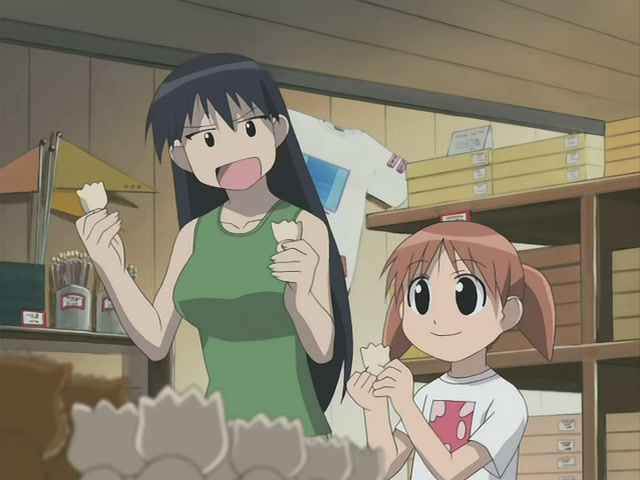
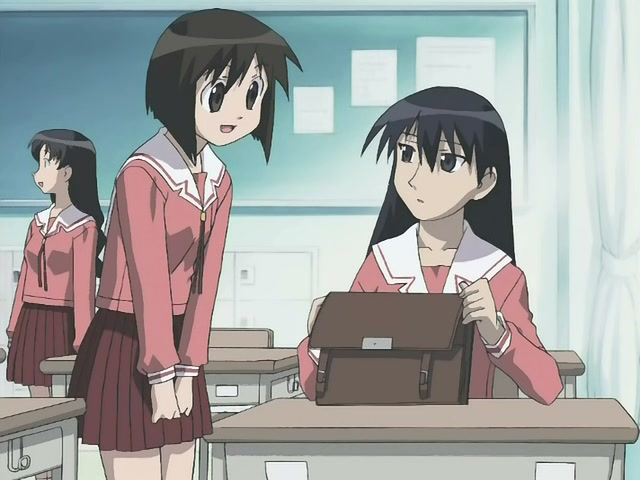
The premise is disarmingly simple. Mihama Chiyo, a ten-year-old prodigy, skips five grades to enter high school. On her first day, she meets her new classmates — the hyperactive Takino Tomo, the long-suffering straight-man Mizuhara Koyomi (called Yomi), and the tall, stoic, cat-obsessed Sakaki. Soon after, Kasuga Ayumu transfers in from Osaka. She is spacey, soft-spoken, and utterly unlike the loud Kansai stereotype her classmates expect. Tomo unilaterally dubs her “Osaka,” and the name sticks. In the second year, swim-team ace Kagura joins the class as a self-declared rival to Sakaki. Under the chaotic guidance of their English teacher Tanizaki Yukari — perpetually late, shamelessly lazy, and fiercely competitive with her best friend and colleague Kurosawa Minamo — these girls navigate Sports Festivals, Culture Festivals, summer vacations, entrance exams, and the slow, bittersweet countdown to graduation.
What makes Azumanga Daioh remarkable is not its premise but its execution. The series trusts its audience completely. Jokes are never explained. Cultural references are not footnoted. Emotional beats are allowed to sit without being underscored by swelling music or tearful speeches. It is a comedy built on rhythm, repetition, and the deep, almost unconscious understanding that develops between characters who have spent three years in the same classroom. I have loved this series for a long time, and returning to it now, the feeling is less like rewatching a show and more like visiting old friends.
Story and Themes
The Three-Year Arc as Structural Genius
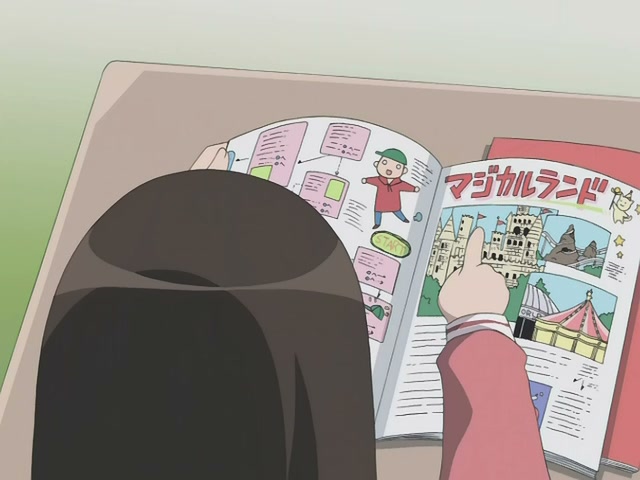
Most school-life anime exist in a kind of eternal present. First-years stay first-years forever. Summer vacation loops endlessly. Azumanga Daioh does something different. It covers the full three years of Japanese senior high school in a single, continuous timeline. The first episode begins on the first day of the new school year. The final episode ends with graduation and the group’s celebratory trip to Magical Land. Between these points, we watch the characters move from awkward fifteen-year-olds to young adults on the verge of university and careers.
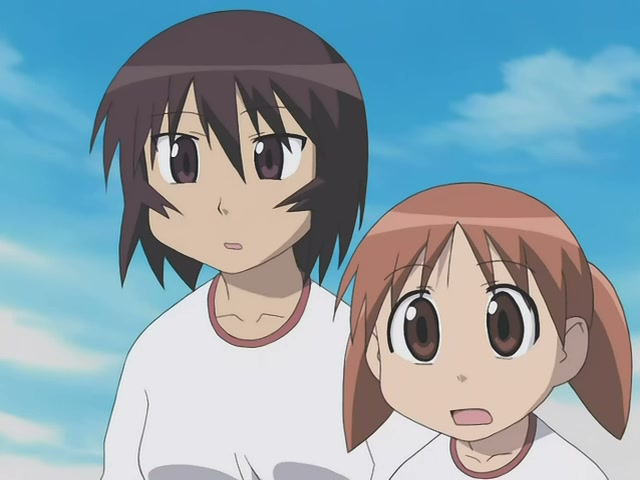
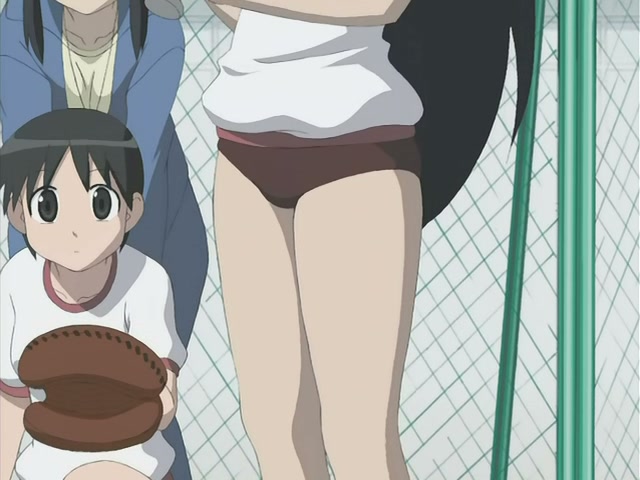
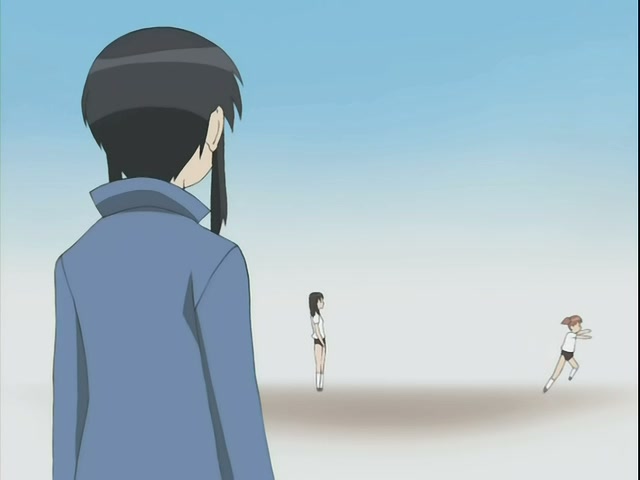
This structure gives the series a gentle but insistent forward momentum. Events recur annually — Sports Festivals, Culture Festivals, summer trips to Chiyo’s seaside home, New Year shrine visits, exam seasons — and each recurrence invites comparison. Chiyo is taller than she was last year (though still tiny). Sakaki’s bust measurement has increased (much to Tomo’s vocal frustration). Kagura’s tan is deeper. The stakes feel higher. By the third-year Sports Festival, the relay race carries emotional weight accumulated across two previous iterations. We have seen Chiyo feel like a burden before. We have watched her internalize that feeling and train in secret, running every night, determined not to let her friends down again. When she hands the baton to Sakaki without losing the lead, it matters because we remember the earlier races where she collapsed or despaired.
Time is the series’ true subject. It moves through everything quietly, inexorably, the way it does in life. And the series’ attitude toward this passage is the essence of mono no aware, the bittersweet awareness of impermanence that runs through so much Japanese art. Azumanga Daioh never names this concept. It doesn’t need to. The feeling is simply there, most explicitly in a brief conversation during Episode 19, when Kagura and Chiyo discuss cherry blossoms. Kagura says she loves them but hates watching them scatter. Chiyo’s response — that perhaps their beauty strikes the heart precisely because they bloom so brilliantly and then vanish — could be the series’ thesis statement. It is delivered casually, and then the show moves on. That restraint is everything.
Repetition, Ritual, and the Comfort of the Familiar
Slice-of-life comedy thrives on repetition, and Azumanga Daioh understands this at a structural level. Certain gags recur with the dependability of seasonal weather. Tomo challenges Sakaki to a contest she cannot win. Osaka falls asleep in class. Yukari is late. Yomi attempts and fails a new diet. Sakaki reaches for a cat and gets bitten. These repetitions are not laziness; they are the foundation of the series’ rhythm. Each iteration adds a small variation, a slight deepening of the joke or the character, until the gag itself becomes a kind of ritual.
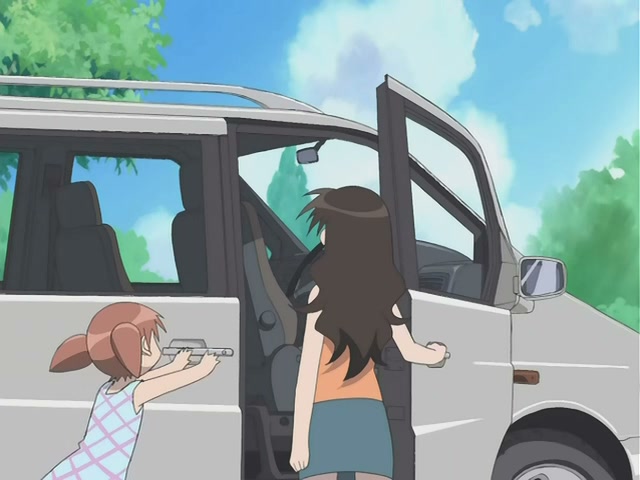
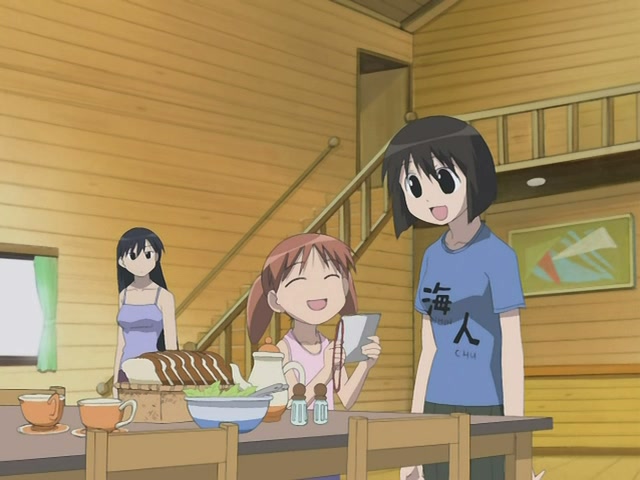
The summer trips to Chiyo’s beach house illustrate this perfectly. Year one: the Yukari-mobile traumatizes Chiyo so thoroughly that she develops what the subtitles wryly call “psychological scars.” Year two: Chiyo, now wiser, arranges for a rented van. Year three: newcomers Kagura and Kaorin must learn firsthand what the veterans already know. The watermelon-splitting gag evolves from a failed bat-swing (year one) to Sakaki karate-chopping the melon before anyone can even try (year two) to Kagura weeping over the destroyed tradition (year three). The series trusts us to remember, and that trust creates a sense of shared history that mirrors the characters’ own.
The same ritualistic quality infuses the Sports Festivals. Yukari bets against Nyamo every year, and the specific stakes — juice, steak, bragging rights — become a running negotiation. The “Steak Cup Relay Race” of episode four, where Yukari feigns a cramp and then claims moral victory despite losing, establishes a template that will be revisited and subverted twice more. By the third year, when Yukari takes the anchor leg and promptly destroys her class’s lead, the defeat feels almost ceremonial. It has to happen this way. The ritual demands it.
Cultural Embeddedness Without Exoticization
One of the quiet pleasures of Azumanga Daioh for a long-time anime fan is how thoroughly it assumes cultural fluency. The Japanese school year provides the narrative spine — first semester (April to July) with its cherry blossoms and rainy season, second semester (September to December) with the Culture Festival and Christmas, third semester (January to March) with the brutal exam period and graduation. The series never explains why the Sports Festival matters or what hatsumōde (the first shrine visit of the new year) signifies. It simply presents these things as givens, the way a show set in America might show Thanksgiving dinner without explaining the pilgrims. This is refreshing. It treats its own culture not as exotica to be displayed but as the water in which the characters swim.
The regional dynamics around Osaka are particularly well-observed, though some of the nuance is inevitably lost in translation. Kasuga Ayumu’s nickname is a compressed cultural joke. The Osaka stereotype in Japanese popular imagination runs toward the loud, the funny, the food-obsessed, the aggressively mercantile. Tomo greets the new transfer student by demanding to see her octopus-ball lunch and asking if she jaywalks. The punchline is that Ayumu embodies none of these traits. She is slow, dreamy, soft-voiced, and her Kansai dialect — rendered in the subtitles with a gentle rural lilt — is the opposite of the brash patter Tomo expects. The joke works cross-culturally because the tension between stereotype and reality is universal, but the specific texture of Kansai-versus-Tokyo tension adds a layer that rewards familiarity with Japan.
New Year shrine visits, exam-season good-luck charms, the practice of tying bad omikuji fortunes to trees, the adult drinking sessions that Yukari and Nyamo share — these are all presented as natural parts of the characters’ lives. When Tomo draws “bad luck” at the shrine and panics about whether to tie it (she has heard contradictory folk beliefs about what tying does), the comedy requires zero cultural translation. Superstition anxiety about test results is something any viewer can understand.
Adaptation Considerations
I should note that I cannot speak with authority about what was cut, compressed, or altered from the manga. Azumanga Daioh originated as a four-panel comic strip, and the anime’s episodic structure — short vignettes stitched into half-hour blocks — clearly reflects that origin. Some transitions between sketches are abrupt, but this feels less like a flaw and more like fidelity to the source material’s rhythm. The series sometimes breaks from this format to spend an entire episode on a single day (Chiyo’s day-in-the-life in Episode 12, the graduation in Episode 26), and these episodes demonstrate that the production team knew when to stretch and when to compress.
If anything was skipped, the final product does not show visible scars. The three-year arc feels complete. No character is left dangling. The pacing, while leisurely, never feels padded. For a 26-episode adaptation of a four-panel gag strip, this is a minor structural miracle.

Characters
Mihama Chiyo: The Prodigy Who Wants to Belong
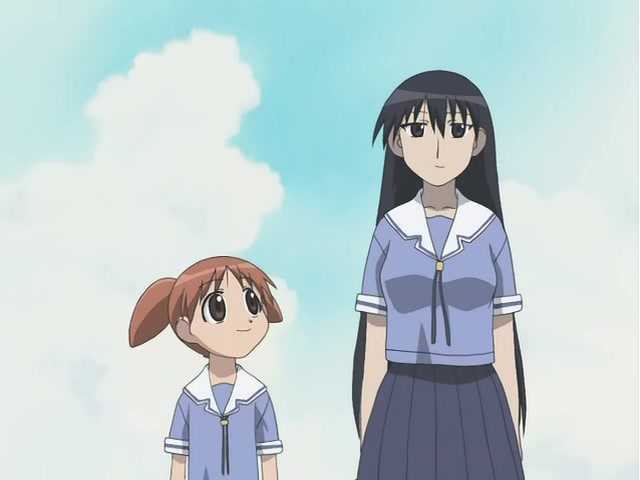
Chiyo is the series’ emotional center, and her central problem is almost painfully clear: she is ten years old in a sixteen-year-old’s world, and her intelligence, which should be an advantage, has instead isolated her. She skipped five grades. Her elementary-school friends are now in middle school, wearing sailor uniforms she will never wear, playing jump rope while she studies for entrance exams. Chiyo is unfailingly polite, hardworking, and generous — she shares her summer home without a trace of self-importance, she makes handmade good-luck charms for everyone’s exams, she cooks her own elaborate lunches — but she is also, visibly, a child. She believes in Santa Claus. She goes to bed early. She gets genuinely excited about amusement park rides and jump rope.
What Chiyo wants, more than anything, is to be taken seriously as a high-schooler. She hates being called cute, being patted on the head, being treated as a mascot. Her stern declaration to a first-year student — “It’s Mihama-senpai to you!” — is both funny and a little sad. She is a senpai by academic standing but not by any social measure, and she knows it. Yet Chiyo never becomes bitter. Her response to feeling like a burden is not to withdraw but to work harder. In the third-year Sports Festival, she has been practicing the relay every night, and her desperate run to hand the baton to Sakaki without losing the lead is one of the series’ most genuinely tense sequences. She doesn’t win. She just doesn’t lose quite as badly as before. For Chiyo, that is enough.
Her wealth — the mansion, the summer home, the enormous dog — could easily read as an alienating class marker. That it doesn’t is a testament to how the series frames her generosity. Chiyo offers what she has because she genuinely wants her friends to be happy. When she rents a van to spare everyone from the Yukari-mobile, it’s not a flex. It’s a survival strategy developed through trauma. The joke lands because Chiyo’s fear of Yukari’s driving is so pure and so justified.
Sakaki: The Distance Between Body and Soul
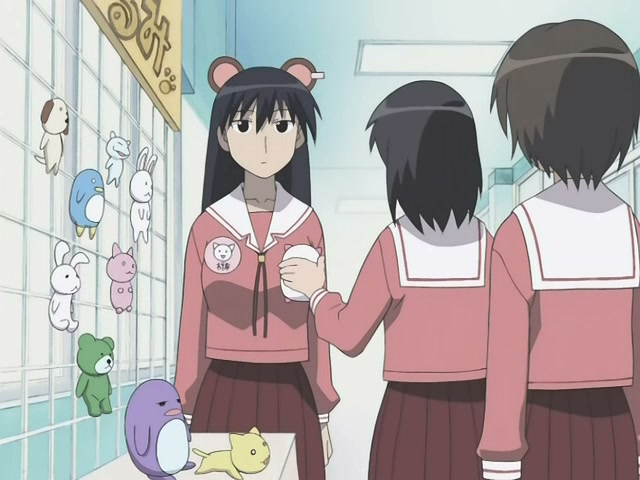
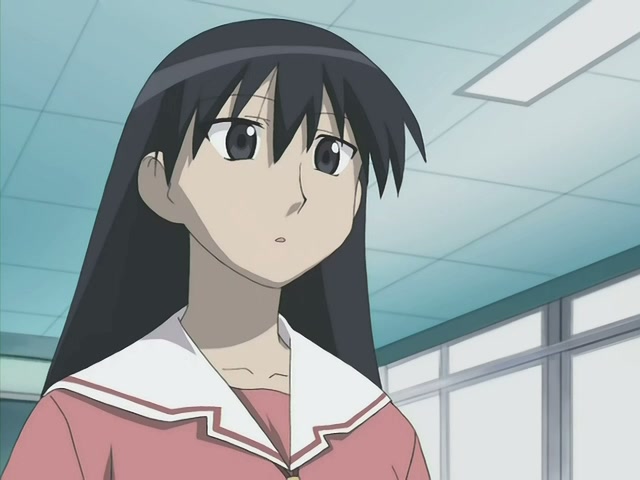
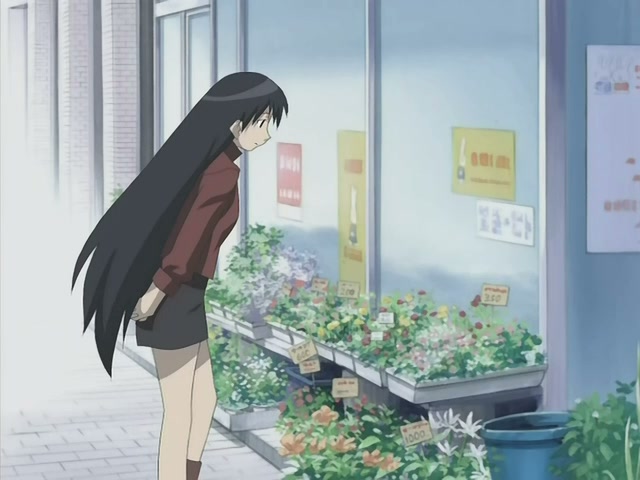
Sakaki is tall, athletic, stoic, and beautiful. Other students — especially Kaorin — regard her with a kind of worship. She excels at every sport without appearing to try. She speaks rarely and in short sentences. She is, by all external measures, cool. And she hates it. What Sakaki wants, what she has always wanted, is to be cute. To be soft. To hold small, warm things. Specifically, cats.
The cat-biting gag is the series’ longest-running joke and its most surprisingly emotional thread. For years, Sakaki cannot touch a cat without being scratched or bitten. She tries everything — approaching slowly, offering treats, staying still. Nothing works. The cats of the neighborhood seem to have formed a coalition against her, led by the malevolent, grinning Kamineko. This is played for comedy, but the accumulation of failures carries real weight. Sakaki’s bandaged hands are a visual record of repeated rejection. The thing she loves most, the thing that represents everything she wants to be (small, soft, unthreatening), will not accept her.
Her arc resolves in a way that feels almost mythic. On the Okinawa school trip, she encounters a wild Iriomote mountain cat kitten who does not bite her. It nuzzles her. It falls asleep on her. The moment is so quiet and so overwhelming that Sakaki can barely speak. Later, impossibly, the kitten — now named Mayaa — travels across Japan to find her, appearing at the exact moment when Kamineko and his swarm have her cornered. Mayaa drives the hostile cats away, collapses from exhaustion, and is nursed back to health. By the series’ end, Mayaa is living at Chiyo’s house, waiting for the day Sakaki can take him home.
The graduation-morning coda is the final grace note. On her way to the ceremony, Sakaki stops, reaches toward a random cat, and for the first time in three years, she is not bitten. The cat simply lets her touch it. It is a tiny moment, easily missed, and it is one of the most satisfying conclusions I have ever seen. The universe has finally, quietly, said yes.
Takino Tomo: Chaos Engine and Loyal Friend
Tomo is exhausting. She is loud, impulsive, competitive to the point of absurdity, and pathologically incapable of admitting fault or defeat. She challenges Sakaki to a 100-meter race and demands an 8-centimeter handicap to compensate for breast size. She copies homework shamelessly. She invents elaborate lies about Yomi’s moldy bread spawning sentient aliens. She forms a self-styled “Bonklers” trio with Osaka and Kagura, celebrating their shared academic incompetence as though it were a revolutionary identity. She is, by any reasonable standard, a nightmare to be around.
And she is also, unmistakably, the person who loves her friends the most fiercely. Tomo’s mockery of Yomi’s weight, her jealousy over Yomi’s Hokkaido crab feast, her constant needling — all of it is a defense mechanism, a way of expressing attachment that she cannot voice directly. When Yomi’s university applications are rejected twice, Tomo’s “encouragement” takes the form of aggressive optimism and jokes about consolation speeches. When Yomi finally gets in, Tomo is the one shouting congratulations loudest, the one proposing they hoist Yomi on their shoulders. She can’t say “I was worried about you.” She can say “You’re fat,” and mean “I’ve been paying attention to you since elementary school.”
The series reveals, late, that Tomo is smarter than she appears. She got into this academically demanding high school by cramming maniacally for a single year, motivated entirely by spite. Yomi told her it was impossible. Tomo proved her wrong. This backstory recontextualizes everything. Tomo’s laziness is not inability; it is choice. She could do the work. She simply prefers not to. The Bonklers are not a support group for the genuinely incapable; they are a club for people who have decided that effort is for suckers. That Tomo then faces the genuine possibility of failure during entrance exams is the first real threat her ego has encountered, and her panic is both satisfying and sympathetic.
Mizuhara Koyomi (Yomi): The Fear of Being Ordinary
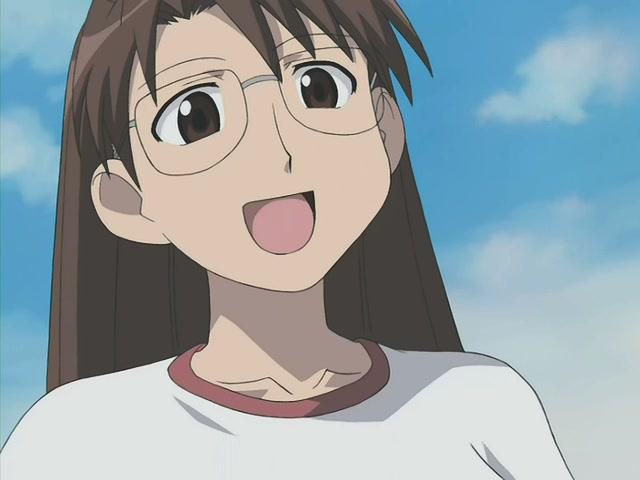
Yomi is the straight man, the responsible one, the person who sighs and delivers deadpan retorts while Tomo spirals into chaos. She wears glasses. She studies. She is good at sports and decent at academics. She is also deeply, quietly insecure about being nothing more than “good enough.” Her weight fluctuates. Her diets fail. Her singing voice is famously terrible. She sends anonymous postcards to a late-night radio show as “Little Tearful Diet Girl,” detailing her humiliating failures with the grainless diet, and then is mortified when Tomo hears it and laughs.
The exam arc is where Yomi’s character pays off everything that has been built across three years. She applies to multiple universities. She is rejected twice. Her pride makes her snarl at sympathy. She cannot bear to be pitied. When she finally sees her number on the acceptance board, she cries, and it is one of the most earned cries in anime comedy. Yomi has been the steady one for so long that watching her crack, and then watching her recover, feels like a genuine privilege.
Her relationship with Tomo is the series’ longest-standing friendship, a symbiotic arrangement that has persisted since elementary school. Tomo is the kite; Yomi is the string. Neither functions without the other. The violence between them — Yomi hitting Tomo over the head, Tomo’s verbal cruelty — would read as toxic in any other context, but here it reads as intimacy. They have been doing this dance for a decade. They know exactly where the lines are, and they never cross them.
Kasuga Ayumu (Osaka): Intelligence on a Different Axis
Osaka is the character most likely to be misunderstood as simply “the dumb one.” She is not dumb. She is, rather, operating on an entirely different cognitive frequency from everyone around her. Her mind makes connections that no one else would think to make. She wonders if snails are bugs, if stepping in dog excrement in America is a national crisis (since Americans wear shoes indoors), if Santa’s reindeer are real (the deer, not the flying). These are not stupid questions. They are, in their own oblique way, philosophical.
Osaka’s speech is slow and soft. Her Osakan dialect, rendered in the subs with a rural lilt, adds to the impression of someone who is always just slightly out of sync with the world around her. She falls asleep in class constantly. She forgets assignments. She cannot decide which flavor of bread to grab in the bread-eating contest and finishes last, clutching melon bread, completely unbothered. And yet, of all the characters, Osaka may be the one who grows most subtly over the course of the series.
Her decision to become a teacher, announced casually after Chiyo suggests she would be good at it, is a quietly radical moment. Osaka has spent three years being treated as gentle comic relief. No one expected her to have ambitions. And yet she does. She studies with Chiyo. She takes the entrance exams seriously. When she fails her safety school, she is disappointed but undeterred. She will try again. The yawn that everyone admires in Episode 19 — described as “magnificent,” the very picture of a yawn — is a joke about Osaka’s hidden talents. She is good at things that cannot be measured.
Kagura: The Body and the Self
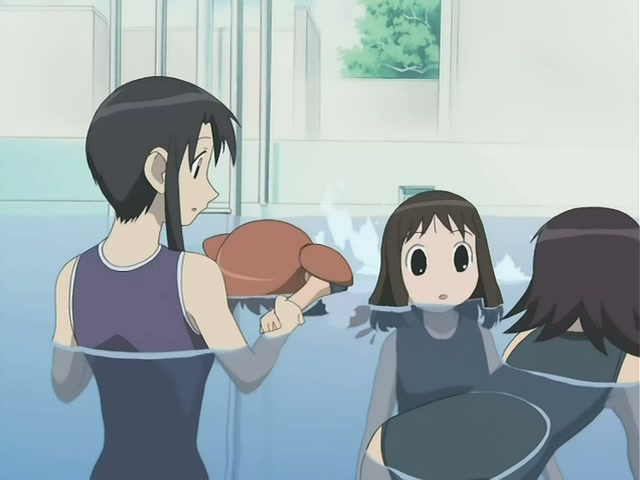
Kagura joins the main cast in the second year, and her introduction establishes her immediately as a rival to Sakaki. She is an athlete — a swimmer with national ambitions, good at every sport, competitive by nature. She challenges Sakaki constantly, and Sakaki barely notices. This dynamic could have remained a one-note gag, but the series gradually deepens Kagura by exploring what it means to define oneself entirely through physical achievement.
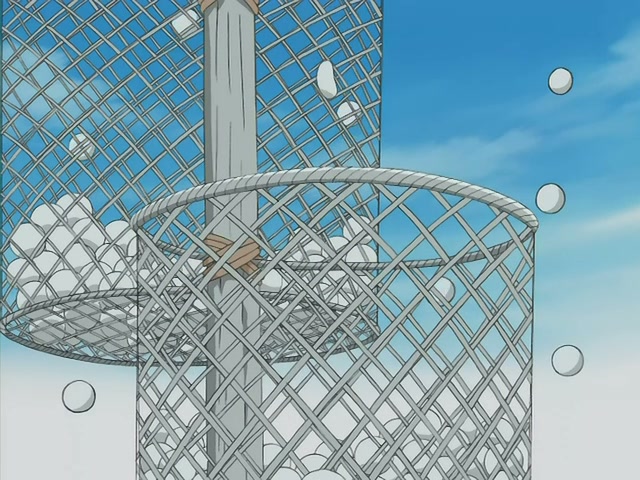
Kagura’s guilt over accidentally wrecking the Sports Festival tent reveals a fear of being “boorish,” of being nothing but a body that breaks things. Her late-night training runs, her uncertainty about life after swimming, her conversation with Chiyo about growing up — all of these suggest a young woman reaching for an identity that extends beyond the pool. Her acceptance to a sports university is a compromise: she keeps the athletic self but gains a future. And her place in the Bonklers, celebrating failure she doesn’t actually experience, is a kind of humility. She could distance herself from the group’s academic inadequacy. She chooses not to.
The Teachers: Adults in Progress
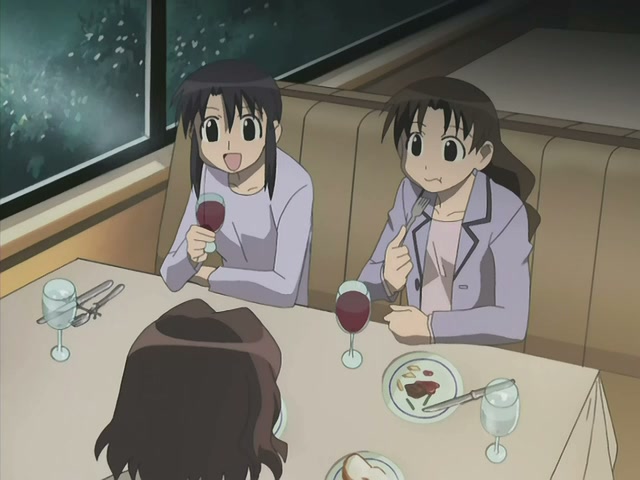
Yukari and Nyamo are the adult mirror of Tomo and Yomi, a boke-tsukkomi pair who have been locked in comic combat since their own school days. Yukari is a disaster — late, lazy, a terrible driver, an inveterate gambler on Sports Festival outcomes. She drinks too much and says mortifying things. She is also, in her own deeply flawed way, a good teacher. She fights to keep her favorite class together year after year. She is moved to tears when they give her a birthday present. Her aborted graduation speech — she begins sincerely, then panics and says “Well, everyone, goodbye” — is a perfect encapsulation of her emotional cowardice and her genuine affection.
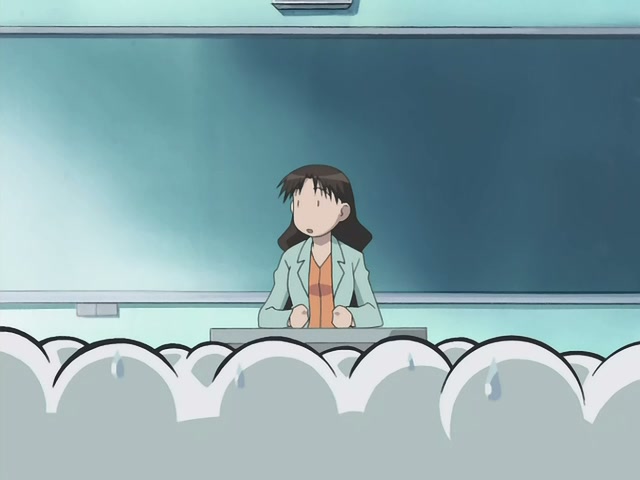
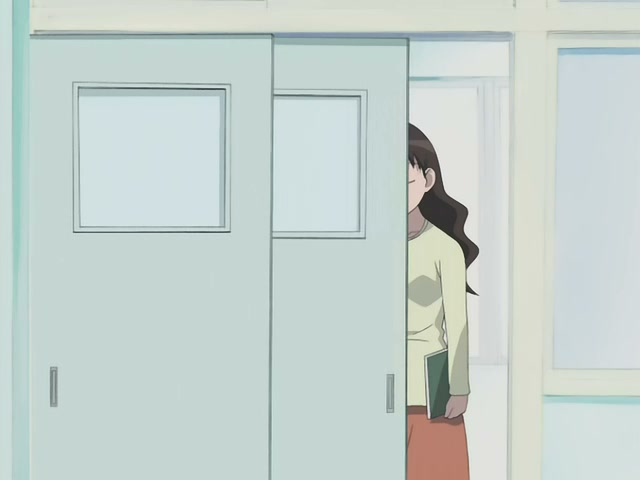
Nyamo is the responsible one, the P.E. teacher who runs efficient classes and endures Yukari’s impositions with weary patience. She is single, lonely in a way she rarely admits, and her romantic history is a sore spot that Yukari pokes at constantly. The episode where she is offered a corporate job at double her teaching salary, and refuses, is her defining moment. She has chosen this life — the chaotic students, the impossible best friend, the modest apartment with the expensive pillow. It is not what she imagined. It is, she realizes, what she wants.
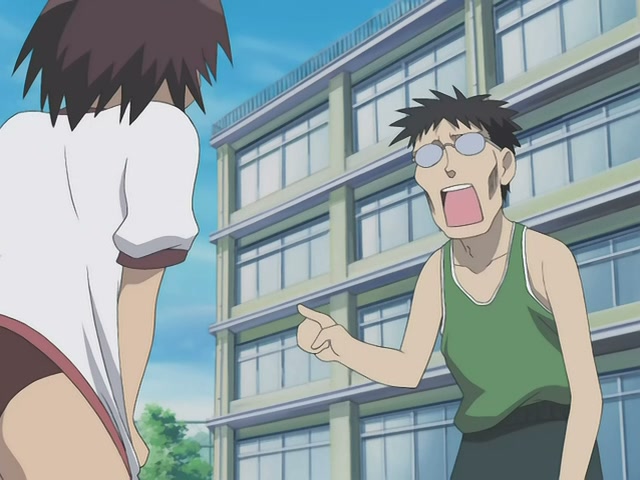
Kimura-sensei deserves mention as the series’ strangest creation — a male teacher who openly admits he likes high school girls, lurks around pools, drinks pool water, and designs frilly costumes for the Culture Festival. He should be irredeemable. The series complicates him by refusing to resolve him. His wife is beautiful, kind, and inexplicably devoted to him. He recycles. He donates money to charity. His daughter appears intelligent and normal. He sings “Happy Birthday” to himself, alone. The joke is not that he is a secret good person. The joke is that the universe does not explain itself, and some people are simply impossible to categorize.
Visuals and Animation
Art Direction and Design Philosophy
Azumanga Daioh arrived in 2002, during a transitional period in anime production when digital coloring and compositing had become standard but had not yet fully shed the aesthetic habits of the cel era. The series occupies a comfortable middle ground. Its linework is thin, clean, and consistent. Its color palette is muted and pastel-leaning — pale teals for school interiors, warm ambers for home scenes, soft blues for night sequences. The overall effect is gentle and approachable, a visual register that supports the comedy without overwhelming it.
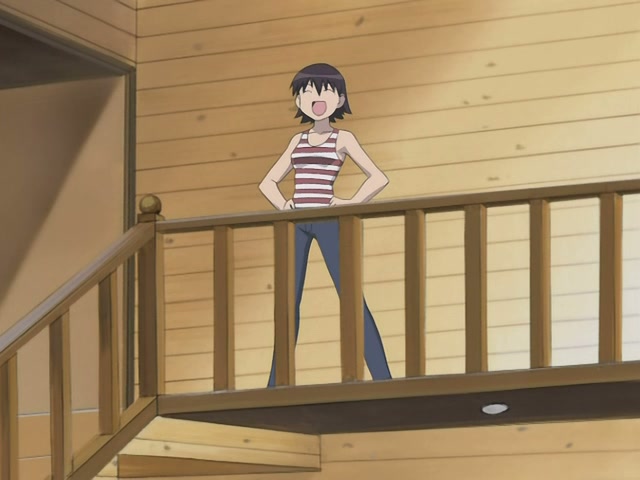
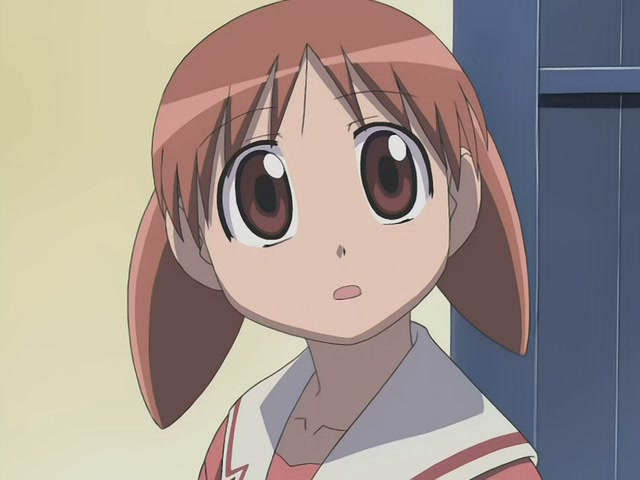
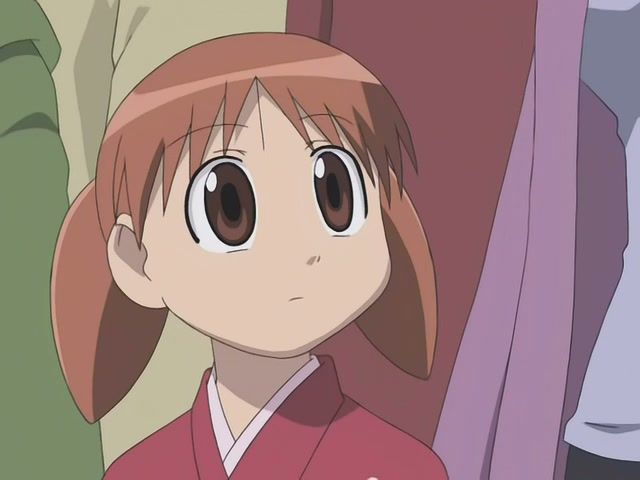
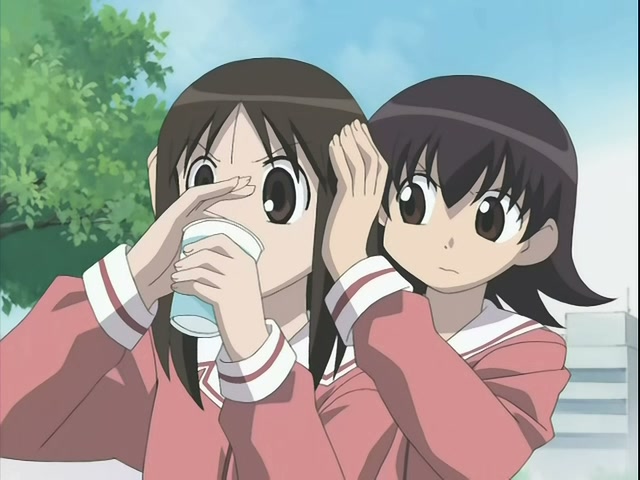
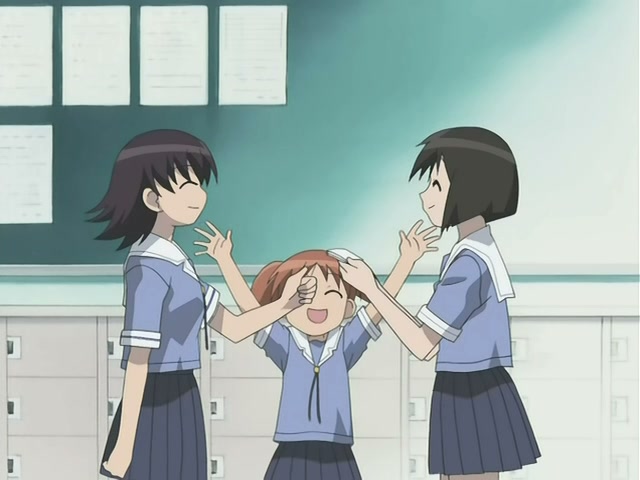
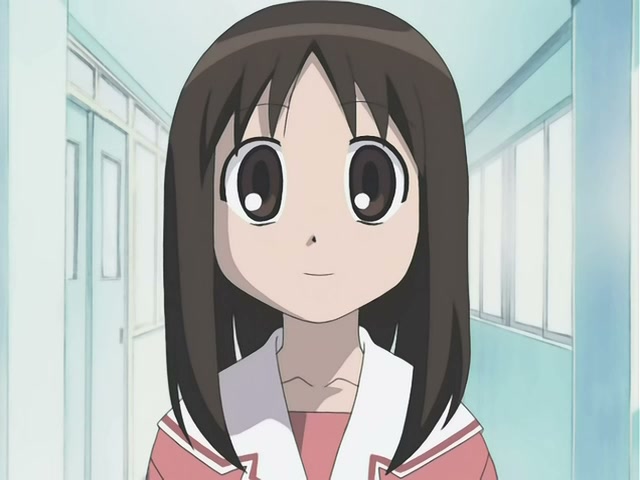
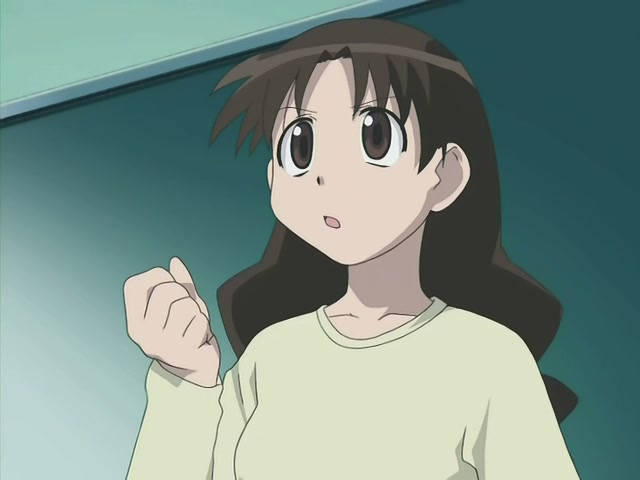
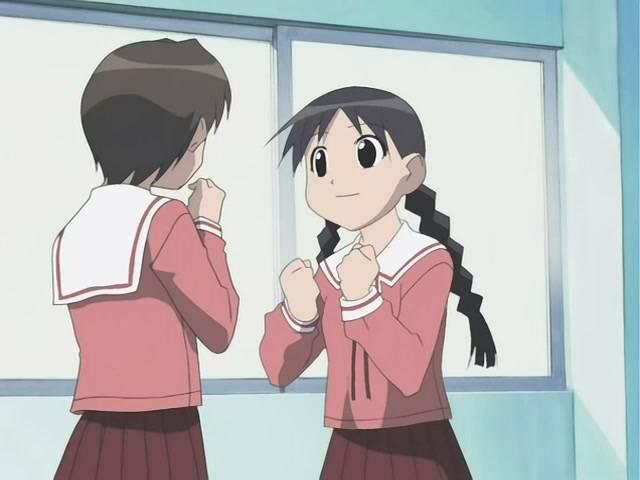
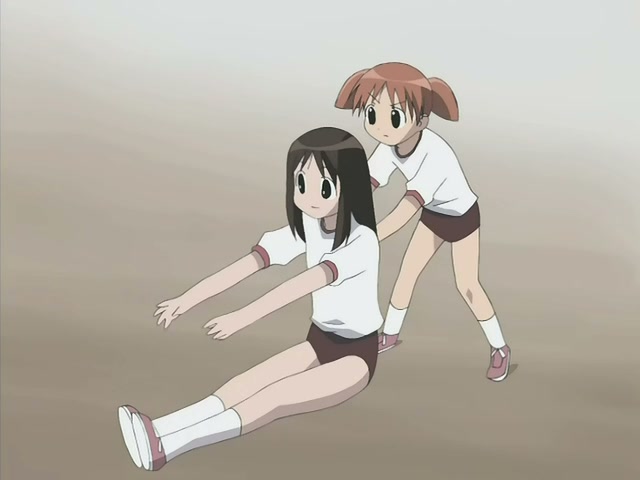
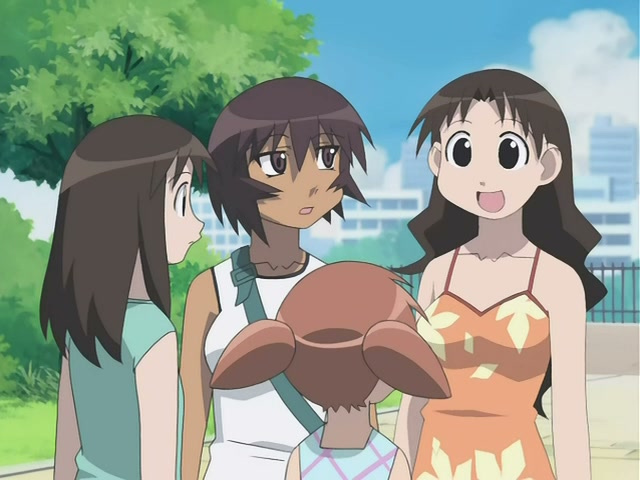
The character designs are deceptively simple. Each girl is defined by a clear silhouette and a few key visual markers. Chiyo’s twin pigtails. Sakaki’s long, straight hair and tall frame. Osaka’s short bob and perpetually half-lidded eyes. Tomo’s wild, untamed haircut. Yomi’s glasses and neat, controlled style. Kagura’s athletic build and deepening tan. These designs function as shorthand, allowing the animation to communicate character information instantly, which is essential for a comedy that relies on quick reaction shots and split-second timing.
The simplicity is a choice, not a limitation. When the series needs to, it can shift into a more painterly mode — the cherry blossoms against night sky, the sunset beach scenes at the summer home, the establishing shots of Okinawa. These moments of visual texture are deployed sparingly, which makes them land with greater impact when they appear.
The Elasticity of Expression
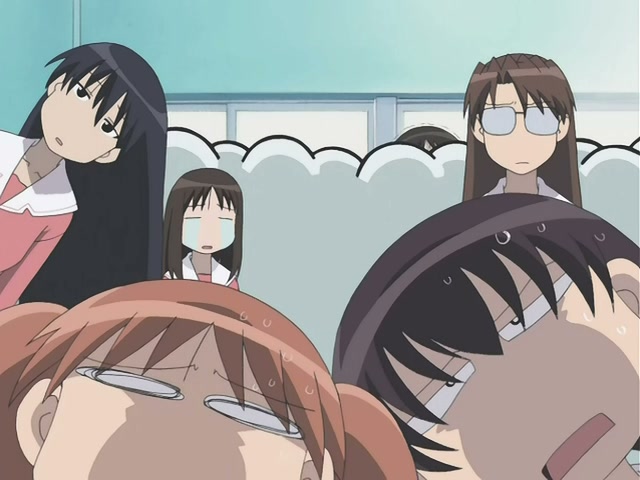
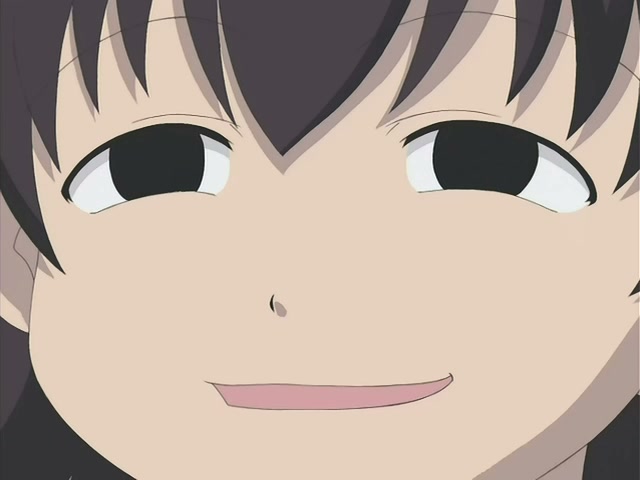
The series’ greatest visual strength is its willingness to deform its characters for comedy. Faces flatten into abstract planes. Eyes become white dots. Mouths stretch beyond anatomical possibility. Characters reduced to chibi proportions appear alongside their full-sized counterparts in the same frame. These deformations are not crude. They are precisely timed and perfectly integrated into the scene’s rhythm. When Tomo’s face collapses into a minimalist scrawl of shock after drawing “bad luck” at the shrine, the joke is in the contrast between the detailed background and the sudden abstraction of her features.
Sakaki’s expressiveness is a special case. Because her baseline is so stoic, any change registers as seismic. A slight blush, a tiny smile, a single tear — these micro-expressions carry the weight that a different character’s full-body meltdown might. Her reaction to Mayaa’s nuzzling, which is barely more than widened eyes and parted lips, is one of the series’ most powerful moments because the restraint is so total. The animators understood that Sakaki’s emotions are not absent; they are simply contained, and the containment itself is the performance.
Chiyo cycles between two modes — genuine child and miniature adult — and her face shifts accordingly. When she is excited about jump rope or believing in Santa, her eyes go wide and her mouth opens in an unguarded smile. When she is sternly correcting a first-year who called her cute, her expression tightens into something almost severe. The design supports both modes, and the transitions between them are seamless.
Backgrounds and Atmosphere
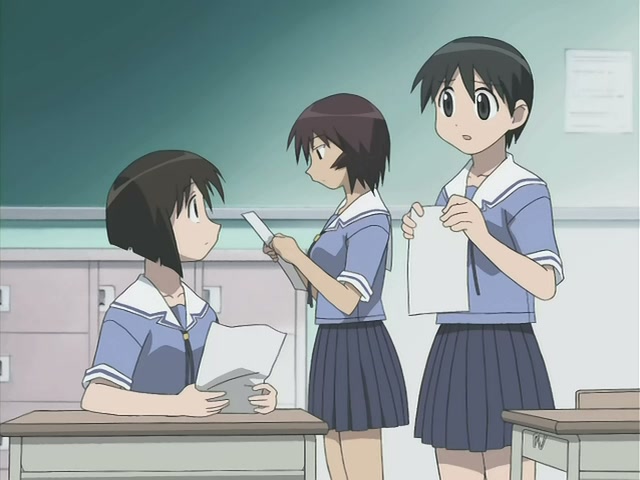
The background art in Azumanga Daioh splits between functional minimalism and occasional painterly ambition. School interiors are often sparse — single-color walls, geometric desks in neat rows, large areas of negative space. This minimalism focuses attention on the characters and creates a slight feeling of abstraction, as though the school exists less as a physical location and more as a stage on which the comedy plays out.
Exterior shots, particularly those establishing a change in season or location, show more care. The cherry blossom scenes carry genuine beauty. The Okinawa trip is filled with bright, saturated blues and greens that contrast with the muted palette of the school. The summer home, seen from a distance against the ocean, has the quality of a fond memory. These establishing shots are brief, but they do essential atmospheric work. They remind us that the characters exist in a world that is beautiful when they pause to notice it.
The night scenes deserve special mention. The series uses deep blue and teal washes for nighttime, punctuated by the warm amber of streetlamps and convenience store windows. The night walk that Kagura and Chiyo share in Episode 19, with cherry blossoms glowing against the dark sky, is one of the series’ most visually striking sequences. So is the graduation-morning scene where Sakaki finally pets a cat, the quiet street bathed in early light. These moments understand that beauty in this kind of show is not about spectacle. It is about mood, about the feeling of being young and awake at an hour when the world feels private and yours.
Animation: Strengths and Limitations
Azumanga Daioh is not a sakuga showcase. It is a dialogue-driven comedy, and most scenes consist of characters standing, talking, and reacting. The animation is functional rather than ambitious. Mouth flaps are basic. Walk cycles are minimal. Crowd scenes at the Sports Festival use static background figures. These are real limitations, and they would be more noticeable in a show that asked for more.
The key is that the series knows exactly what it is and never reaches beyond its means. The static framing functions like a theater stage. The “acting” is in the faces, the timing, the small shifts in posture and expression. When animation does ramp up — Tomo sprinting through the halls, Osaka’s surreal daydreams, the relay races with their speed lines and dynamic camera angles — the contrast with the baseline stillness makes these moments feel explosive. The budget was clearly allocated with intelligence. Money went where it would count.
The elastic gag faces, mentioned above, are the series’ real animation triumph. These deformations require split-second timing and a strong understanding of comic rhythm. A face that collapses into a white-eyed scrawl and then snaps back to normal in a single cut is doing complex work. It is signaling to the audience that a joke has landed, that a reaction has occurred, and that the scene is moving on. The consistency with which Azumanga Daioh nails these transitions across 26 episodes is a testament to strong direction and a clear, shared understanding of the material’s tone.
Sound and Music
Voice Acting as Character Foundation
The Japanese voice cast for Azumanga Daioh is, quite simply, definitive. Tomoko Kaneda’s Tomo is a force of nature — a high, sharp, relentless instrument that can pivot from manic enthusiasm to wounded indignation in a single breath. Her performance is exhausting in the best possible way. Rie Tanaka’s Sakaki is the opposite — low, quiet, almost monotone, yet capable of conveying immense warmth when she chooses. The contrast between these two performances mirrors the contrast between the characters themselves.
Yuki Matsuoka’s Osaka is a particular achievement. She speaks slowly, with a soft Kansai-ben that feels less like a dialect and more like a state of mind. Her lines drift out as though she is discovering them in real time. The timing of her delivery — the pauses, the sudden accelerations when an idea catches — creates the impression of a mind that works at its own pace and cannot be rushed. Tomoko Kawakami’s Chiyo navigates the character’s dual nature with precision, shifting from childlike openness to miniature-adult composure without ever breaking the character’s fundamental sweetness.
The adult cast is equally strong. Aya Hisakawa’s Nyamo is warm, grounded, and perpetually exasperated, while Akiko Hiramatsu’s Yukari is a perfect comic instrument — loud, brash, utterly un-self-conscious. The chemistry between these two performers captures decades of friendship in every bickering exchange.
Music and Atmosphere
The soundtrack, composed by Masaki Kurihara, operates in a register of gentle, character-appropriate themes. The opening theme, “Soramimi Cake” by Oranges & Lemons, is a bouncy, nonsensical earworm that perfectly captures the series’ mood of cheerful absurdity. The ending theme, “Raspberry Heaven,” is softer and more reflective, a wind-down piece that closes each episode on a note of quiet contentment.
Background music throughout the series is used sparingly. Many scenes play without any score at all, letting the dialogue and ambient sound carry the moment. When music does enter, it tends to be simple, melodic, and character-specific — a light piano line for Chiyo’s introspective moments, a jaunty woodwind for Tomo’s antics, a gentle guitar for Sakaki’s cat encounters. This restraint is characteristic of the series’ overall approach. Nothing is pushed. Nothing is underlined twice. If the audience is paying attention, they will feel what needs to be felt.
Overall Verdict
Azumanga Daioh is not a series that demands to be called a masterpiece. It is too modest, too content with its own small scale, too uninterested in the kinds of dramatic setpieces that typically generate that kind of acclaim. What it is, instead, is a near-perfect execution of a deceptively simple goal. It wants you to spend time with these characters until they feel like people you know. And then it wants you to watch them graduate and realize, with a small pang, that you will miss them.
The humor is gentle but genuinely funny. The emotional beats are earned through accumulation, never manipulation. The series trusts its audience to notice small things — the way Chiyo’s voice wavers when she insists she is a second-year student, the way Sakaki’s hands tremble slightly when Mayaa nuzzles her, the way Yomi’s pride makes her turn away from comfort she desperately needs. It does not explain these moments. It simply presents them and moves on.
This is a show for people who love character-driven comedy. For people who appreciate cultural specificity. For anyone nostalgic for an era of digital production that prioritized clarity and restraint over spectacle. It is not for action-seekers. It is not for viewers who need plot momentum or dramatic stakes. It is for people who understand that sometimes the most profound thing a story can do is show a group of friends walking home together, talking about nothing in particular, while the seasons change around them.
The graduation episode ends not with tears but with Chiyo’s simple, sincere benediction: “It was really and truly fun.” She is right. It was. And the series’ final image — Chiyo running toward her friends, toward Magical Land, toward whatever comes next — is the only ending that makes sense. Not an ending at all, really. Just a pause. A promise that the walk home will continue, even if we are not there to see it.


Gallery