


Introduction
Some anime reach you through spectacle. They dazzle with sakuga sequences, earworm openings, or a plot hook so sharp it snags the entire community in a single season. Other anime wait in the shadows, patient and unassuming, trusting that the right viewer will find them when the time is right. Mouryou no Hako belongs firmly to this second category. It is a work that demands attention, respects intelligence, and rewards patience with one of the most psychologically dense mysteries the medium has ever produced.
Set in 1952, the story begins with a schoolgirl falling onto train tracks and expands outward into a labyrinth of serial murder, spiritual fraud, wartime atrocities, and the quiet devastation of family secrets. A suspended detective, a diffident novelist, a blunt private investigator, and an eccentric onmyouji-turned-bookseller converge around the case, each bringing their own perspective and their own baggage. The threads tangle and tighten until it becomes clear that every crime is connected, not by a single culprit, but by an idea. A philosophy. A way of seeing human beings that is itself the real monster.
This series is not for everyone. It moves slowly. It talks endlessly. It expects you to remember names, dates, and philosophical distinctions drawn from ancient Chinese texts and Heian-era ritual practices. If that sounds exhausting, it probably will be. If it sounds intriguing, you are exactly the kind of viewer Mouryou no Hako was made for.
Story and Themes
The Architecture of Mystery
The narrative structure of Mouryou no Hako is deliberately disorienting from its opening moments. The timeline jumps without warning. Perspectives shift mid-scene. Events are presented out of chronological order, forcing the viewer to actively assemble the puzzle rather than passively receive a solution. This is not confusion for its own sake. The fragmentation mimics the psychological state of the characters themselves, people whose memories and motivations are buried under layers of trauma and self-deception.
Kyougokudou, the central detective figure, explains his method as a process of reordering rather than discovery. He does not find new clues so much as take the information everyone already possesses and arrange it correctly. His deduction style is less Sherlock Holmes scanning for ash particles and more a historian piecing together fragments of a lost chronicle. The series mirrors this method in its own storytelling. By the final episodes, scenes from early in the run take on entirely new meaning once their proper context is established.
This structural complexity is paired with a pacing that can feel glacial. Characters sit in rooms and talk for extended stretches. Kyougokudou delivers lengthy lectures on folklore, etymology, and religious history that initially appear tangential. These digressions are the substance of the series. Without them, the resolution would feel cheap. With them, every revelation lands with the weight of inevitability.
The Box as Universe
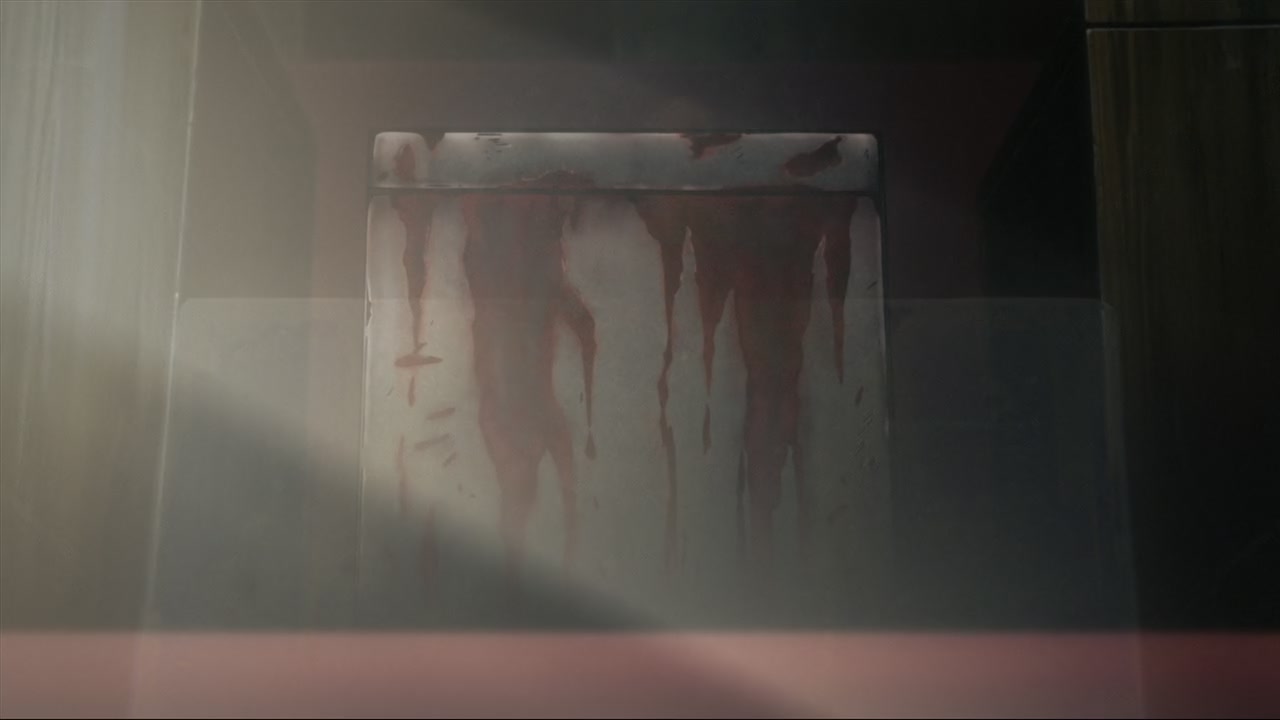
The central metaphor could not be more explicit, yet it never feels forced or one-dimensional. Boxes appear everywhere. The train station lockers. The paulownia containers holding dismembered limbs. The sealed doll cases. The massive windowless laboratory where the climactic confrontations take place. Each physical box corresponds to a psychological analogue. Characters trap themselves in grief. They seal away guilt. They construct elaborate containers for their obsessions and then mistake those containers for identity.
The most chilling articulation of this metaphor comes through the cult leader Onbako-sama, a former box-maker who builds a religion around literal boxes. His followers donate their money and their troubles, believing their spiritual impurities are being sealed away. The “box” of the faith becomes a dumping ground for psychological waste, growing more toxic as it fills. Kyougokudou identifies this process as mouryou, a term he unpacks across multiple episodes with academic rigor.
What Is a Mouryou
The title deserves careful attention. Mouryou is a Chinese and Japanese folkloric concept with no clean English equivalent. Kyougokudou traces its evolution through classical sources: water spirits in some texts, tree and stone spirits in others, corpse-eating demons in still others. His synthesis is brilliant. Mouryou are beings of the boundary, entities that exist in the margins between categories. They appear at gravesides, in wells, in the shadows cast by other shadows. They are not quite one thing or another, which makes them impossible to pin down and exorcise through conventional means.
Applied psychologically, mouryou become the half-formed obsessions and resentments that grow in the gaps of a person’s heart. They are what happens when love festers, when protection becomes possession, when scientific curiosity hardens into inhuman detachment. The serial killer Kubo is possessed by mouryou. So is the scientist Mimasaka. So are the grieving mother Kimie and the lovestruck detective Kiba. Each character hosts a different species of the same genus, and Kyougokudou’s task is to name each one so it can be expelled.
The Body and Its Discontents
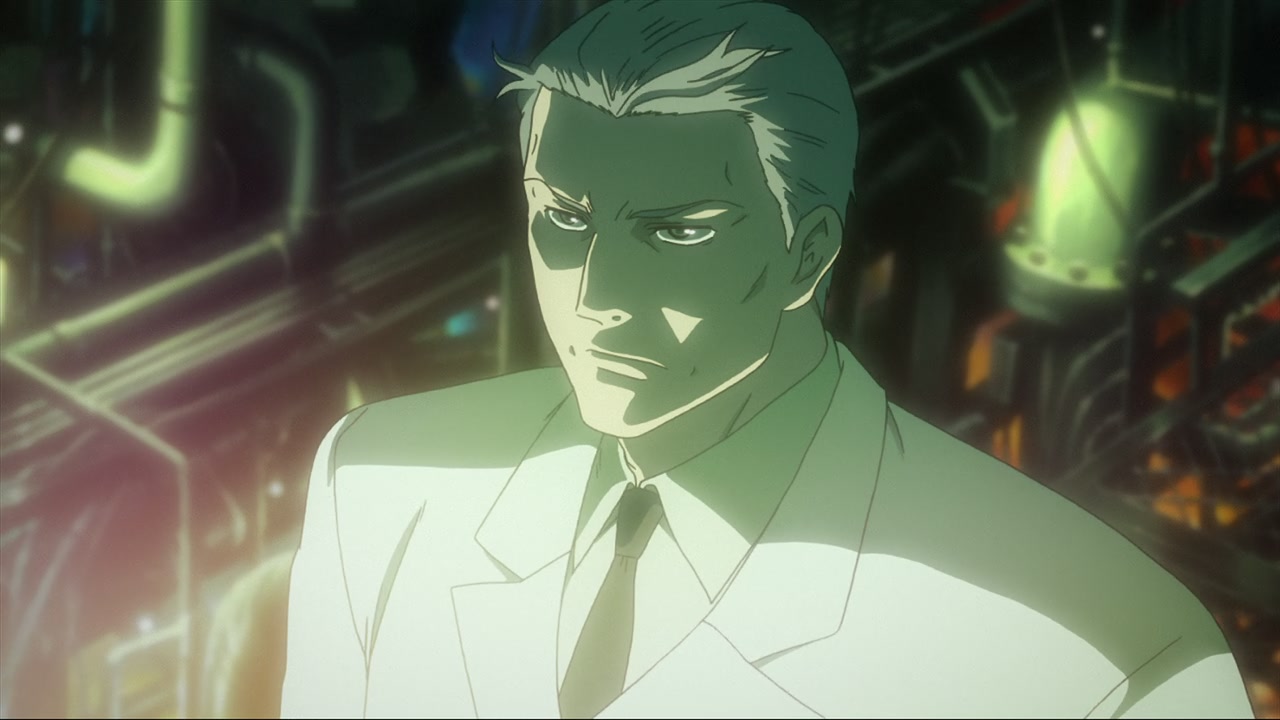
Running parallel to the folkloric framework is a scientific horror story rooted in historical fact. Mimasaka Koushirou, the director of the box-shaped laboratory, is a former army researcher whose work involved live experimentation on prisoners of war. His driving obsession is the separation of consciousness from the body. He views flesh as a decaying prison. The brain alone matters. Everything else can be replaced with machinery.
This ideology is not presented as cartoon villainy. The series grounds it in Mimasaka’s personal tragedy: his wife Kinuko suffered from myasthenia, a degenerative condition that slowly stripped her of physical control. Watching her body fail, Mimasaka grew to despise the organic entirely. His research into mechanical replacement parts and artificial life support was born from grief, but it curdled into something monstrous. By the time we meet him, he has become a machine himself, emotionless and absolute in his convictions.
The horror of his work is not that it produces Frankenstein monsters. It is that it succeeds. Kanako survives her injuries only by becoming a brain in a box, her body replaced by the laboratory’s machinery. Kubo, seeking to replicate this state in his victims, fails repeatedly because he lacks Mimasaka’s scientific apparatus. The serial killings are not about death. They are failed attempts at creation.
Historical Soil
The historical texture of Mouryou no Hako enriches every dimension of the story. The series draws clear lines between Mimasaka’s research and the real atrocities committed by Unit 731 and the Noborito Research Institute during World War II. Prisoners were experimented on. Chemical weapons were developed. The post-war American occupation allowed many war criminals to escape prosecution in exchange for their research data. Mimasaka is a product of this moral vacuum, a man whose genius was cultivated by an empire that valued results over ethics.
The clairvoyance experiments of the early 20th century provide another historical layer. Professor Fukurai’s attempts to prove the existence of psychic powers using sealed boxes ended in tragedy when the mediums involved were publicly discredited. Mifune Chizuko committed suicide. Nagao Ikuko died of pneumonia shortly after. These real events parallel the main narrative’s concern with what happens when people are sealed inside rigid frameworks of scrutiny and judgment. Science can be as cruel as superstition when it refuses to treat its subjects as human beings.
The post-war setting itself functions as a larger cultural box. Japan in 1952 is occupied, rebuilding, uncertain of its identity. Traditional woodworking trades like Hyouei’s box-making are giving way to industrial manufacturing. The cluttered Western-style offices and cafes sit uneasily alongside tatami rooms and Shinto shrines. Characters navigate a society in transition, haunted by the past and anxious about the future.
Adaptation Fidelity
I have not read Natsuhiko Kyogoku’s original novels, so I cannot speak to what was cut or compressed. What I can say is that the anime stands confidently on its own. The themes are fully realized. The plotting is meticulous. The climactic revelations recontextualize everything that came before without feeling rushed or incomplete. If any subplots were trimmed, their absence is not a wound. The narrative presented here is satisfyingly whole.
The decision to preserve Kyougokudou’s lengthy monologues rather than cutting them for pacing is a statement of faith in the audience. A less confident adaptation would have trimmed the lectures on Onmyoudou ritual or simplified the taxonomy of espers, mediums, diviners, and priests. This version trusts that viewers who need that density will appreciate it, and viewers who do not were never the intended audience in the first place.
Characters
Kusumoto Yoriko and the Weight of Adoration
Yoriko is the first voice we hear and the last person we fully understand. Her obsessive friendship with Yuzuki Kanako drives the entire plot into motion. She does not simply admire Kanako. She worships her. Kanako is beautiful where Yoriko feels plain. Kanako is cultured where Yoriko feels provincial. To compensate for her own perceived inadequacy, Yoriko constructs an elaborate cosmology in which she and Kanako are reincarnations of one another, bound eternally across lifetimes.
This fantasy shatters the moment Yoriko sees a pimple on Kanako’s neck. The goddess has a blemish. The perfect being is merely human. Yoriko’s response is not disappointment. It is violent rejection. In a moment of pure unconscious impulse, she pushes Kanako onto the tracks, eliminating the evidence of imperfection and preserving the idol in her mind.
The series never excuses this act. It also never reduces Yoriko to a monster. Her subsequent behavior, fabricating a witness account of a man in black, retreating into delusions of Kanako’s angelic ascension, is the desperate coping mechanism of a child whose emotional foundation has collapsed. When Enokizu, the blunt private detective, treats her with direct honesty rather than condescension, we see the healthy person she might have been under different circumstances.
Yuzuki Kanako as Absence
Kanako is the narrative’s gravitational center, yet she is barely present as a person. By the end of the first episode, she has been reduced to a brain in a box. Her personality is reconstructed through flashbacks and the impressions of others, but these impressions are all incomplete. Yoriko sees her as a goddess. Amemiya sees her as a daughter. Kubo sees her as an aesthetic ideal. Youko sees her as both daughter and penance.
Kanako’s own interiority is elusive. She reads forbidden literature. She speaks of Tennin Gosui, the five signs of a goddess’s decay. She binds Yoriko to her with a bracelet she calls the charm of fate. These are not the actions of a shallow girl playing at profundity. They are the self-mythologizing rituals of someone who senses she is the product of something shameful and is trying to construct a transcendent identity to escape it. Her tragedy is that everyone who loves her loves a fiction of her. No one ever reaches the real Kanako because she herself does not know who that is.
Detective Kiba Shuutarou and the Limits of Action
Kiba enters the story suspended from duty, aimless, filling time. He leaves it shattered, a man whose entire worldview has been dismantled by forces he cannot punch or arrest. His arc is a slow-burn romantic tragedy. The moment he sees Youko in the hospital corridor, something clicks into place. “An empty part of my heart was filled with something,” he reflects. “I now have someone to protect and an enemy to face.”
That clarity is an illusion. The enemy is not a person he can apprehend. The person to protect is complicit in most of the crimes he is investigating. Kiba’s straightforward morality, his belief that good people deserve protection and bad people deserve punishment, cannot survive contact with the incestuous, guilt-ridden reality of the Yuzuki family. His final charge to the laboratory with a drawn pistol is both heroic and pathetic. He means to rescue the woman he loves, but she does not want rescuing. She belongs to a story he can never be part of.
His suffering is largely silent. The series does not give him a breakdown scene or a cathartic outburst. He absorbs the truth and carries it away, a man who discovered too late that some monsters answer to no warrant.
Yuzuki Youko and the Inheritance of Guilt
Youko’s confession in the final act is seismic. She is not Kanako’s sister. She is Kanako’s mother. And Kanako’s father is Mimasaka Koushirou, Youko’s own father. The child of that union is the product of adolescent seduction born from a desperate need to replace a dying mother.
The psychology is horrifying but coherent. Youko watched her mother Kinuko’s body deteriorate from myasthenia. She watched her father pour his genius into finding a cure. She internalized a worldview in which female worth is physical and fading beauty equals death. Her seduction of her father was not lust. It was competition. She wanted to be the woman her father loved, and since her mother was failing, she decided to replace her entirely.
The subsequent decades of her life are a penance. She protects Kanako at all costs because Kanako is not just her child but proof of her unforgivable sin. She refuses the Shibata inheritance for years because accepting it would mean profiting from the lie. When she finally agrees to claim it, it is only because Mimasaka’s laboratory requires astronomical funding to keep Kanako alive. Every choice she makes is an installment on a debt she can never repay.
What saves Youko from being monstrous is the series’ refusal to condemn her. The confession is treated not as villainous unmasking but as a public purgation. She has carried this secret for fourteen years. Letting it out destroys her, but also frees her. Her final act is to follow her father onto the rooftop, choosing blood over the detective who loves her. It is a tragedy, not a defeat.
Kyougokudou and the Art of Exorcism
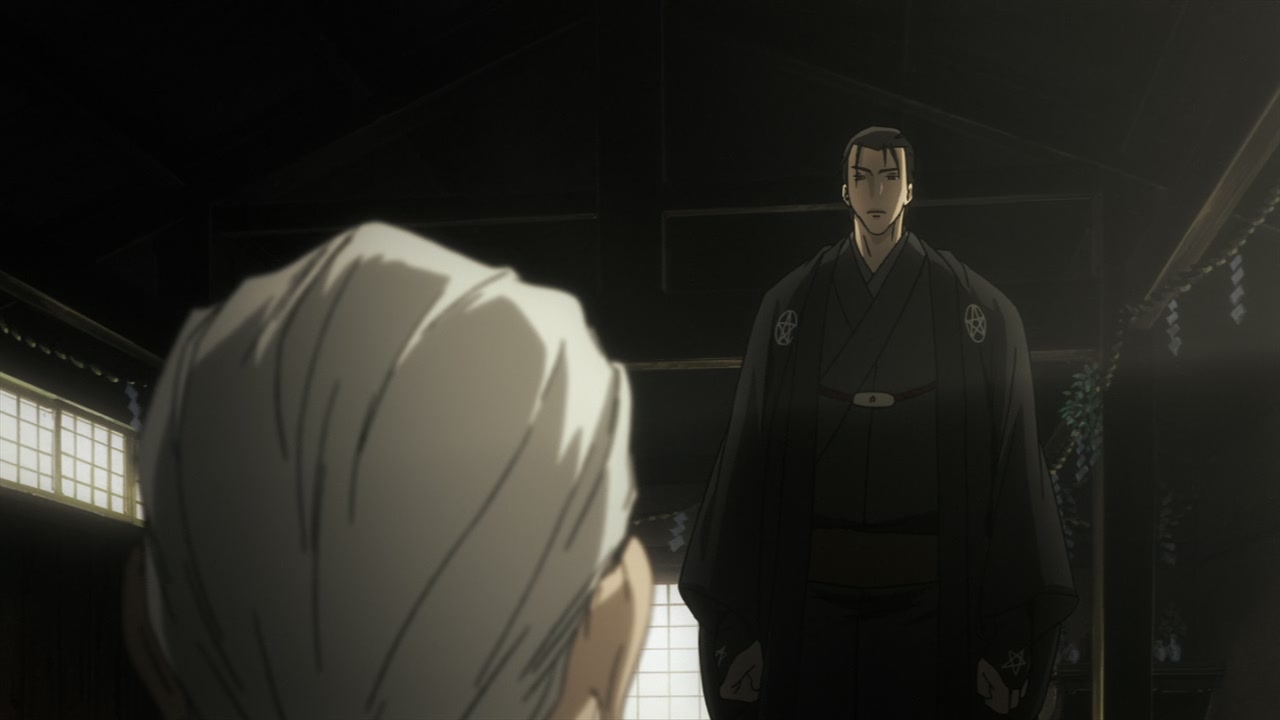
Kyougokudou Chuuzenji Akihiko is one of the most unusual detective figures in anime. He is a used bookseller by trade and an onmyouji by lineage, a gaunt figure who resembles a withered tree and speaks in dense academic paragraphs. He does not investigate crime scenes. He does not interrogate suspects. He receives information from his network of contacts, then sits in his study and thinks until the pattern reveals itself.
His philosophy is that nothing supernatural exists. Ghosts are not real. Curses are not real. Clairvoyance is not real. What people call the occult is always a manifestation of psychology, a product of unexamined emotion and unspoken desire. His method is to identify the mouryou in each person’s heart, name it, and thereby dissolve it.
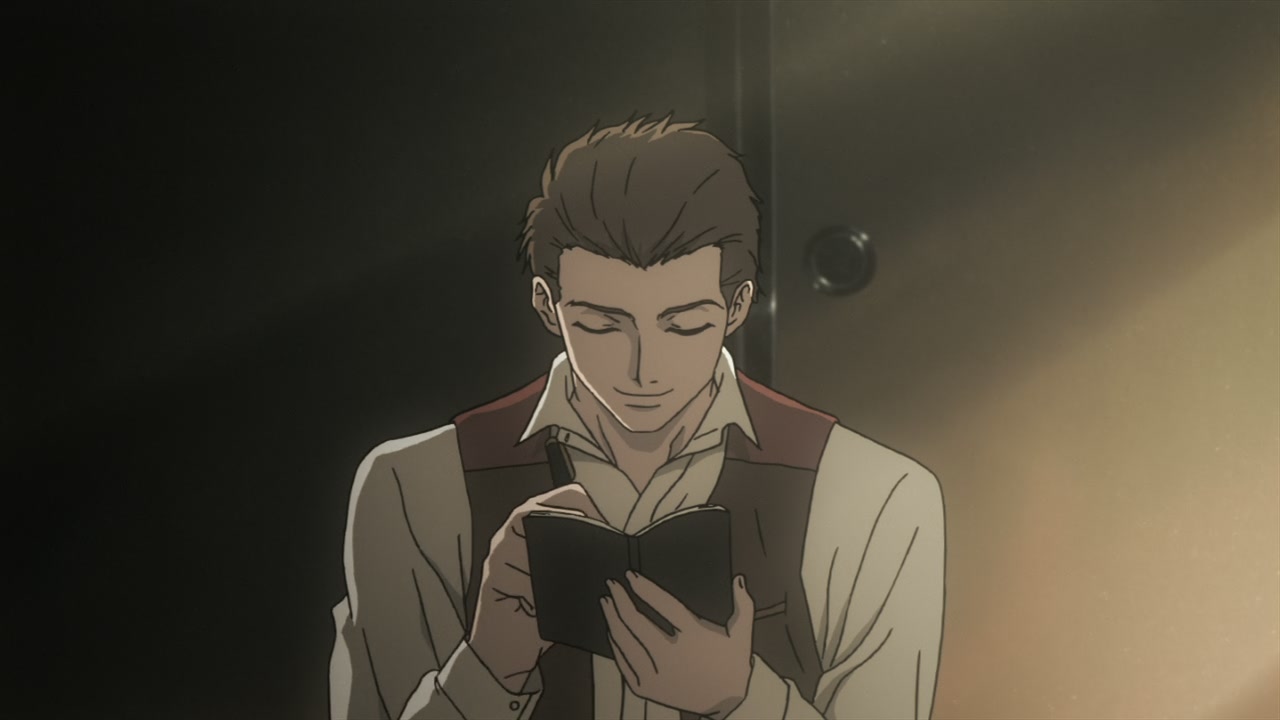
This makes him a kind of therapist as much as a detective. His confrontation with Terada Hyouei, the false cult leader, is not an interrogation but an exorcism. He dismantles Hyouei’s belief system piece by piece, revealing that the sacred box was a clairvoyance test prop and the holy incantations were plagiarized from an obscure chronicle. He does not punish Hyouei. He liberates him. The man who thought he was a prophet discovers he was merely a puppet, and the truth, however painful, is a release.
Kyougokudou’s past complicates his objectivity. He worked with Mimasaka during the war. He knew the scientist’s wife. He understands, better than anyone, the psychological wound that spawned the obsession with mechanical immortality. His final confrontation with Mimasaka is a duel of ideologies, science versus psychology, and he wins by turning Mimasaka’s own logic against him. If consciousness is generated by the brain alone, he argues, then a brain connected to a machine will merely reflect machine-consciousness. The scientist hesitates. The curse takes hold. The mouryou is exorcised.
Enokizu, Sekiguchi, and the Supporting Web
Enokizu Reijirou provides a necessary counterweight to the story’s oppressive seriousness. A private detective who claims to be one of Japan’s great mediums, he is blunt, eccentric, and completely unafraid of social consequences. He steals cars. He barges into houses. He accuses strangers of crimes just to see how they react. His methods look chaotic but are carefully calibrated to provoke truth from people who have spent years hiding it.
His partnership with Sekiguchi Tatsumi, the anxious novelist who narrates portions of the story, is a small gem of comic relief. He nicknames Sekiguchi “Turtle-kun” and drags him into situations the writer would never approach voluntarily. Beneath the teasing is genuine respect. Sekiguchi’s memory and observational skills are formidable, and Enokizu recognizes a useful ally when he sees one.
The supporting cast is uniformly strong. Toriguchi, the young editor, represents healthy curiosity in contrast to Kubo’s pathological obsession. Masuoka, the lawyer, embodies institutional rationality colliding with irrational human truth. Satomura, the medical examiner, is a comedic foil for Kiba whose forensic findings (the victims were cut while alive) prove essential to understanding the killer’s true motive. Kusumoto Kimie, Yoriko’s mother, is a study in how poverty and desperation can curdle maternal love into something indistinguishable from hatred.
Amemiya and Kubo: Two Ways to Love a Box
These two characters function as dark mirrors of each other, and their contrast illuminates the series’ moral center. Both encounter Kanako in her reduced state. Both are transformed by the sight. Their responses could not be more different.
Kubo sees Kanako’s limbless, living torso and experiences aesthetic rapture. This is beauty. This is perfection. He wants to create more of it. His subsequent murders are not sadistic. He does not enjoy killing. What he enjoys is the attempt to replicate what he saw, to manufacture his own girls in boxes. Each failed attempt drives him back to the source, until he finally offers himself to Mimasaka as experimental material, becoming the living consciousness that animates the laboratory.
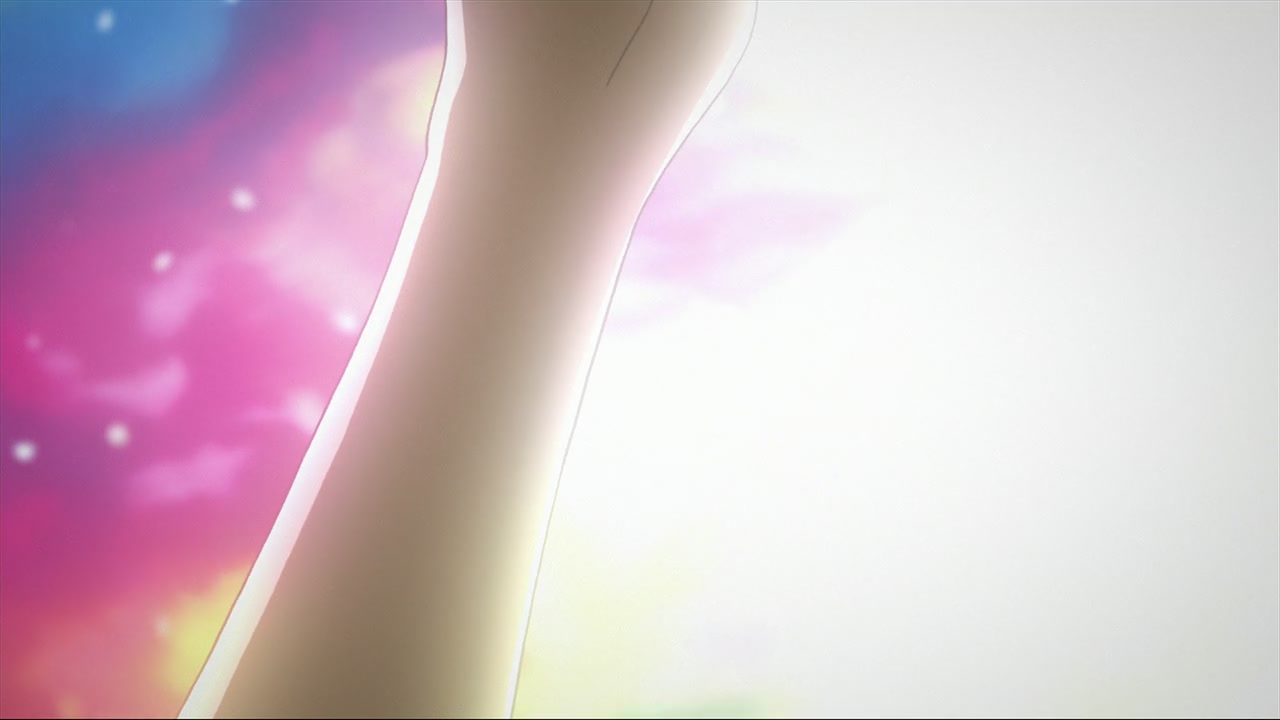
Amemiya sees the same state and experiences not rapture but devotion. He has loved Kanako as a daughter for fourteen years. Her physical form is irrelevant. When her limbs must be disposed of, he scatters them in Sagami Lake, fulfilling her wish to visit the lake she never reached. When her arm remains alive in the incinerator, he visits it secretly, preserving that fragment of her with a reverence that borders on worship. His final appearance in the epilogue, a wandering pilgrim speaking happily to the box containing her mummified arm, is deeply disturbing and strangely beautiful. He has given up being a person, Kyougokudou observes. And in that surrender, he has found perfect happiness.
Both men are possessed by mouryou. Kubo’s mouryou drives him to destroy. Amemiya’s drives him to preserve. The series judges neither with simple moralism. It presents both as inevitable outcomes of encountering something that human psychology was never equipped to process.
Visuals and Animation
The Mastery of Atmosphere
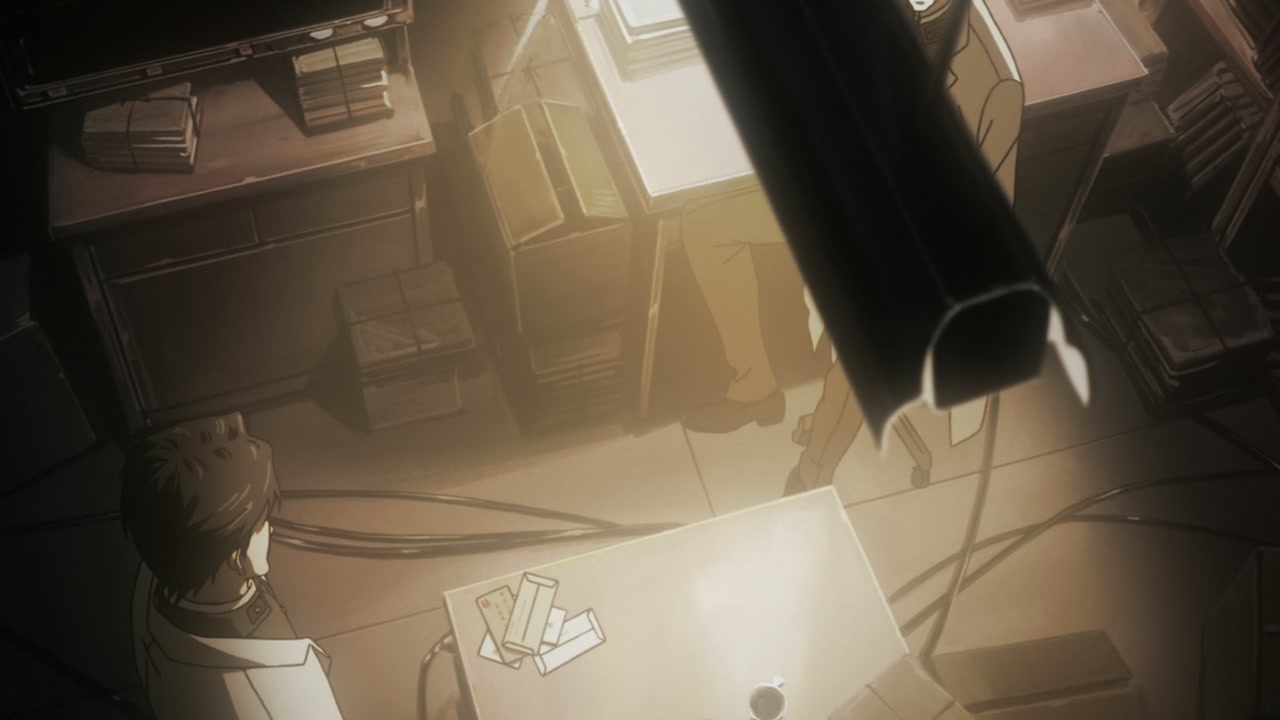
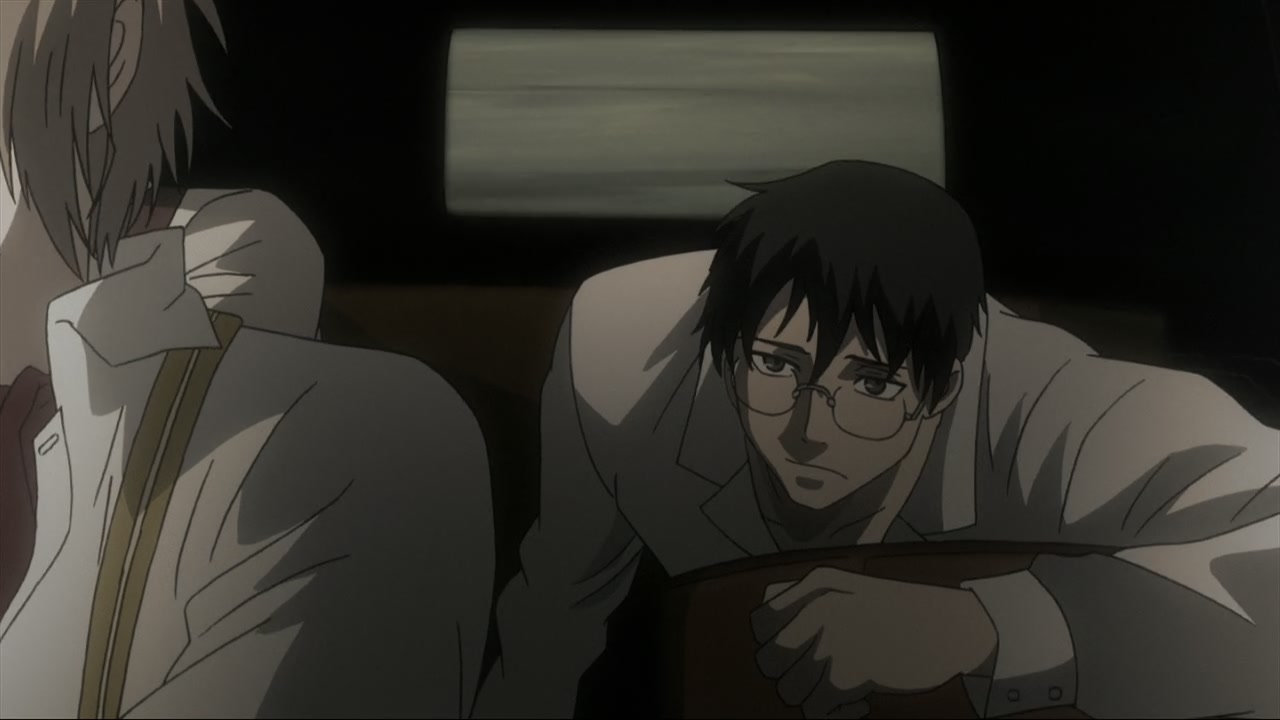
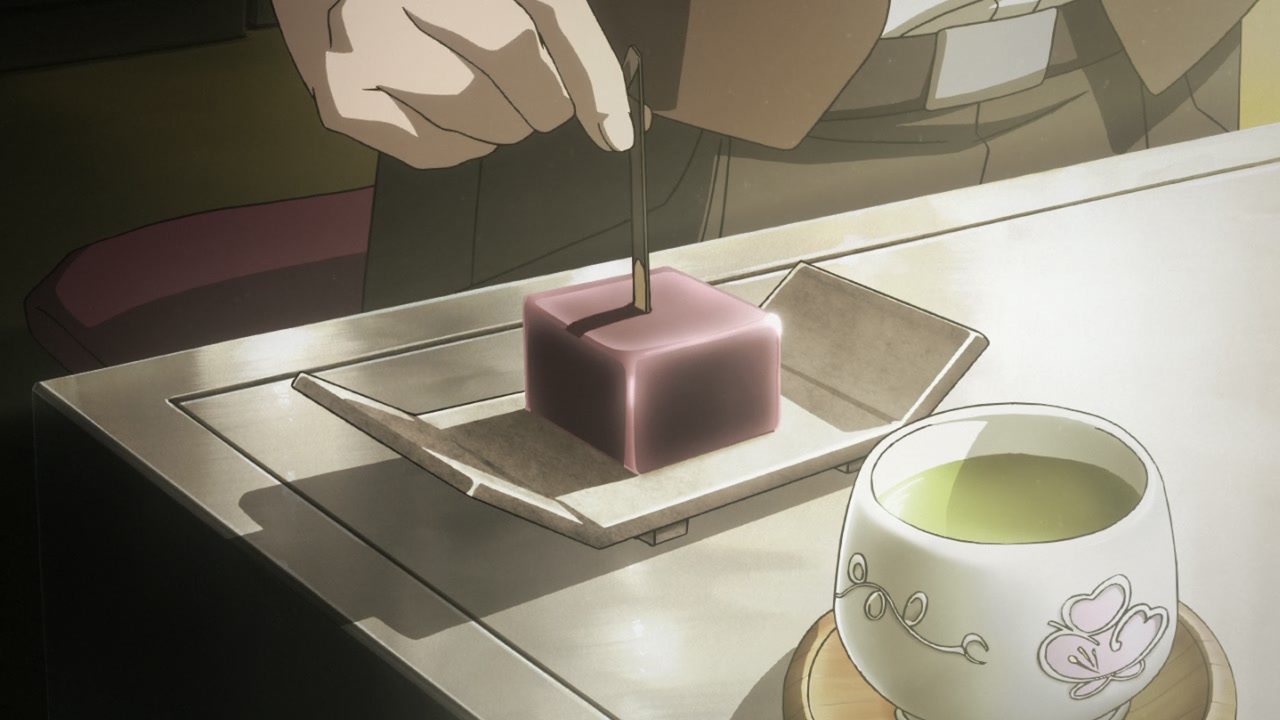
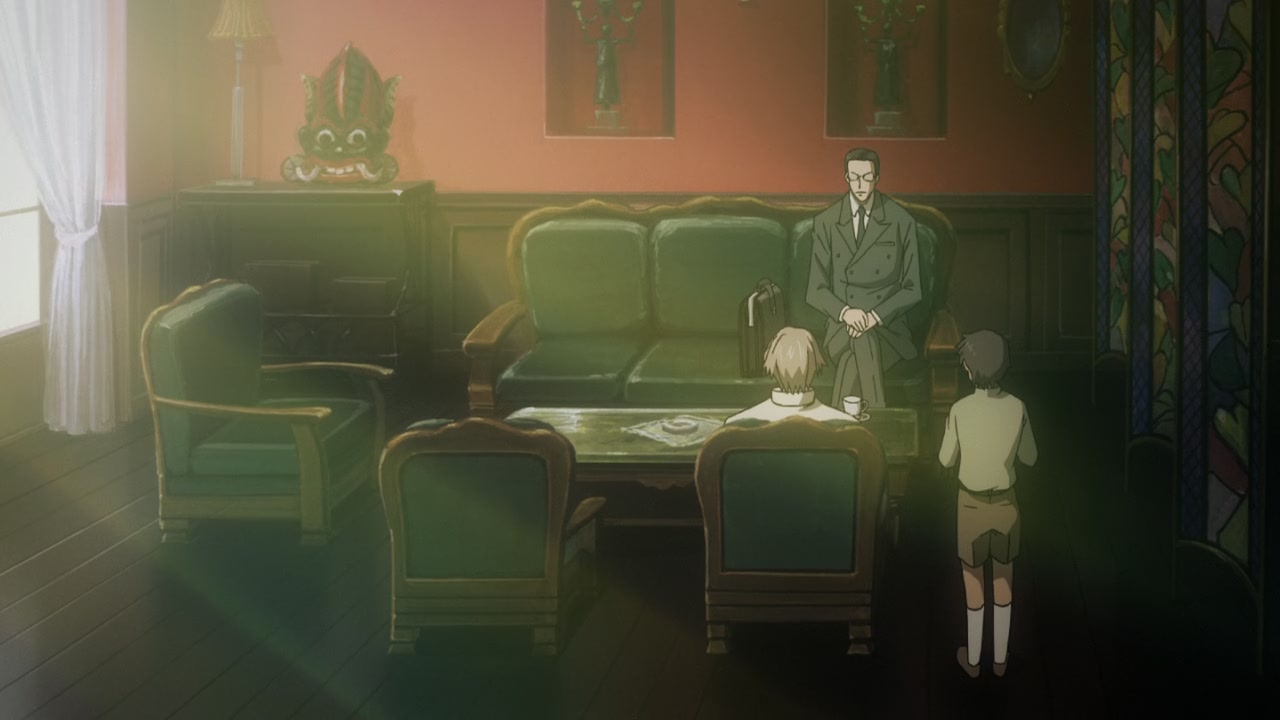
Mouryou no Hako is a masterclass in mood. The production team clearly understood that a story about psychological decay and post-war guilt needed to feel heavy, textured, and lived-in. Their solution was an aggressive approach to lighting and compositing that gives the entire series a distinctive, almost tactile quality.
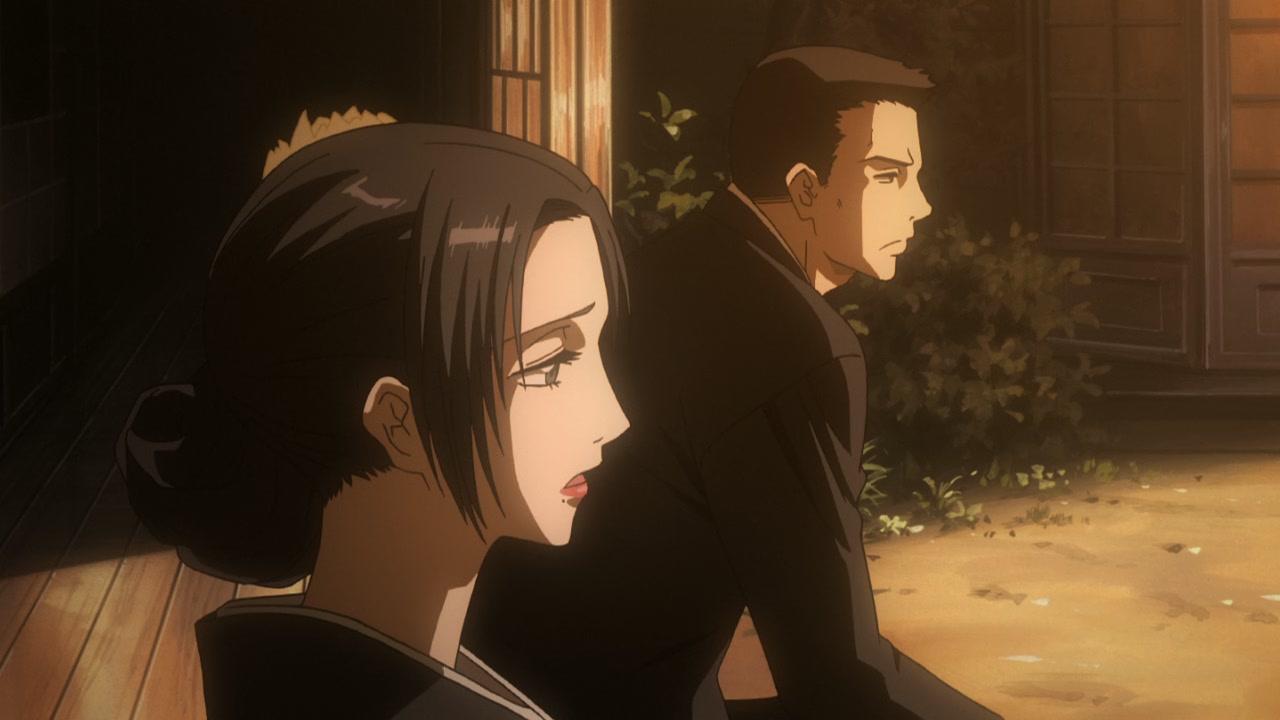
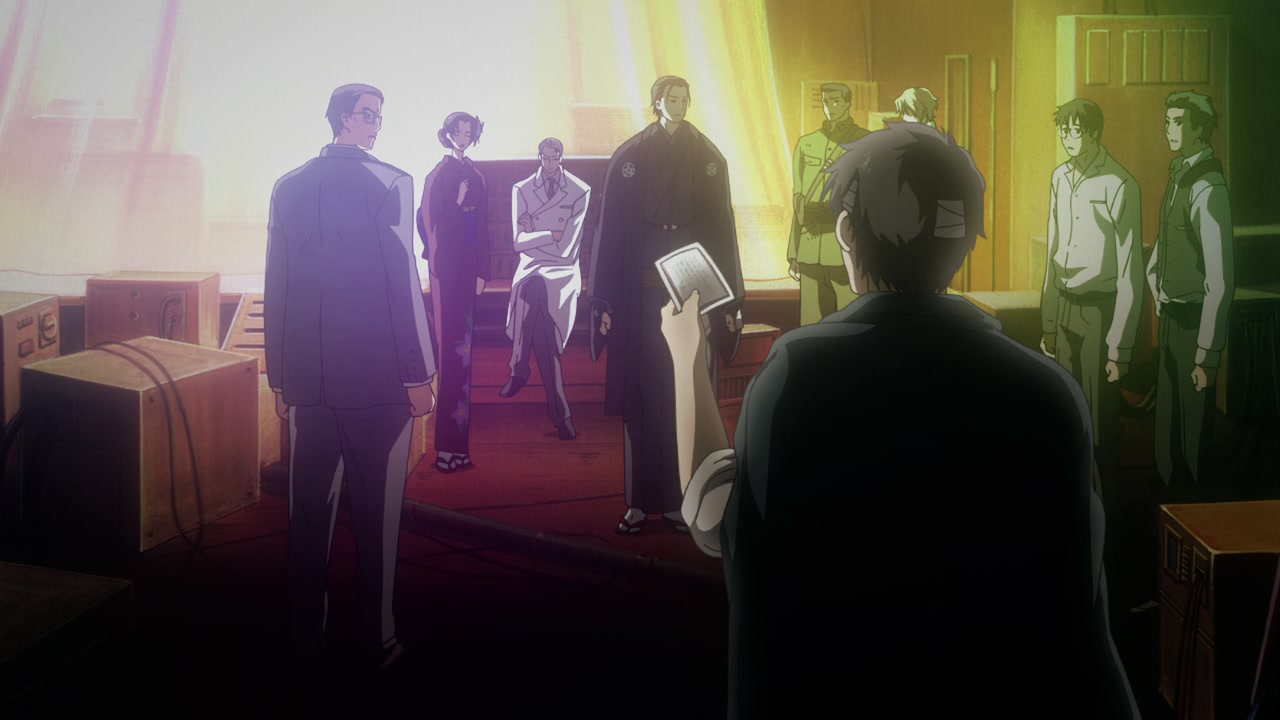
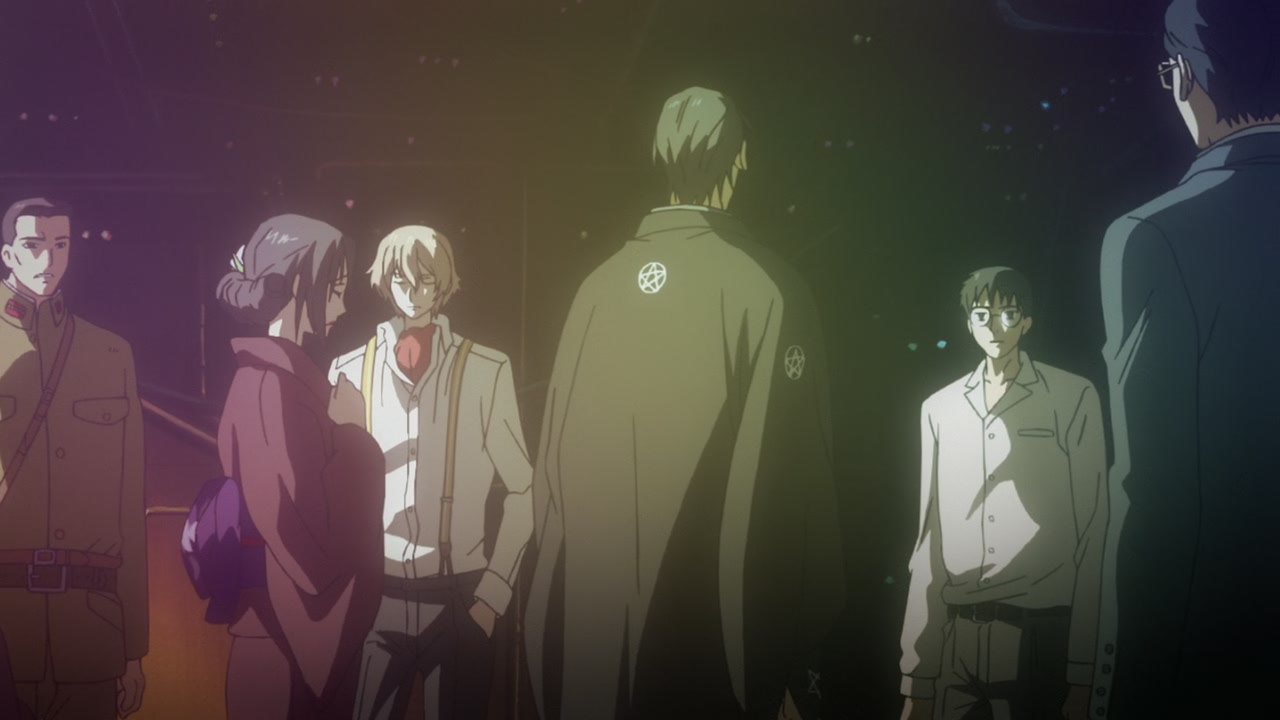
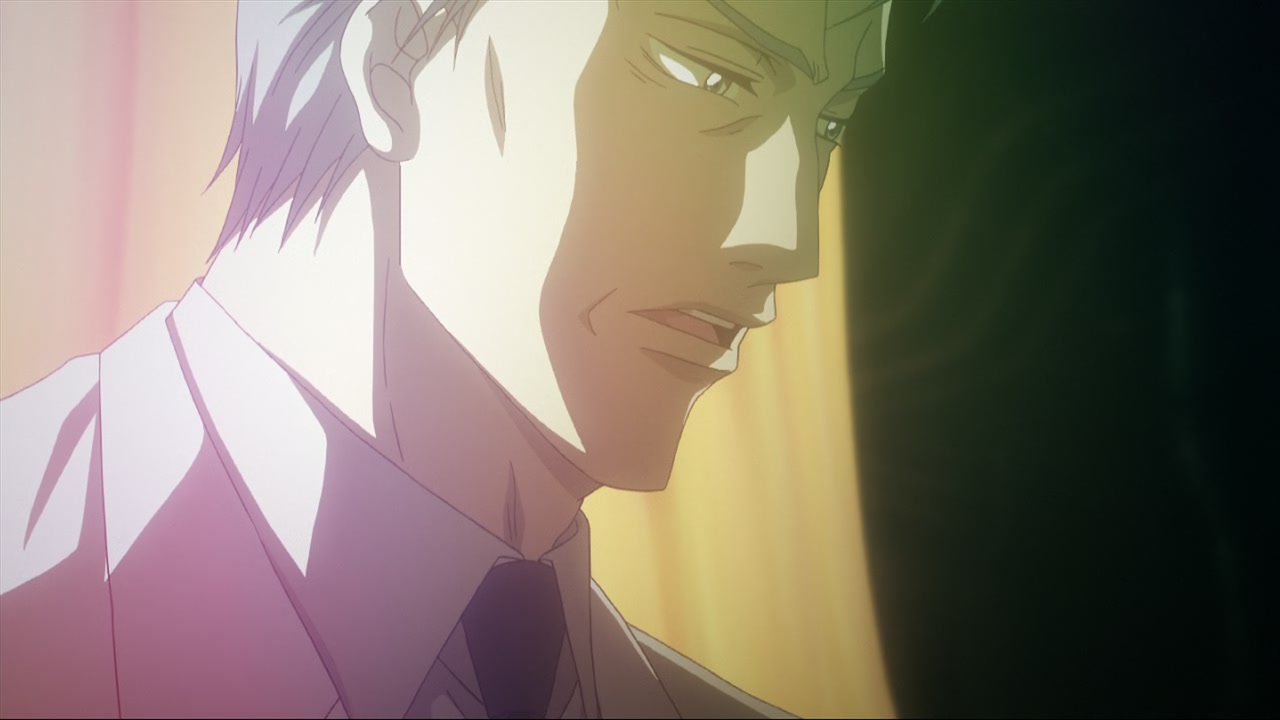
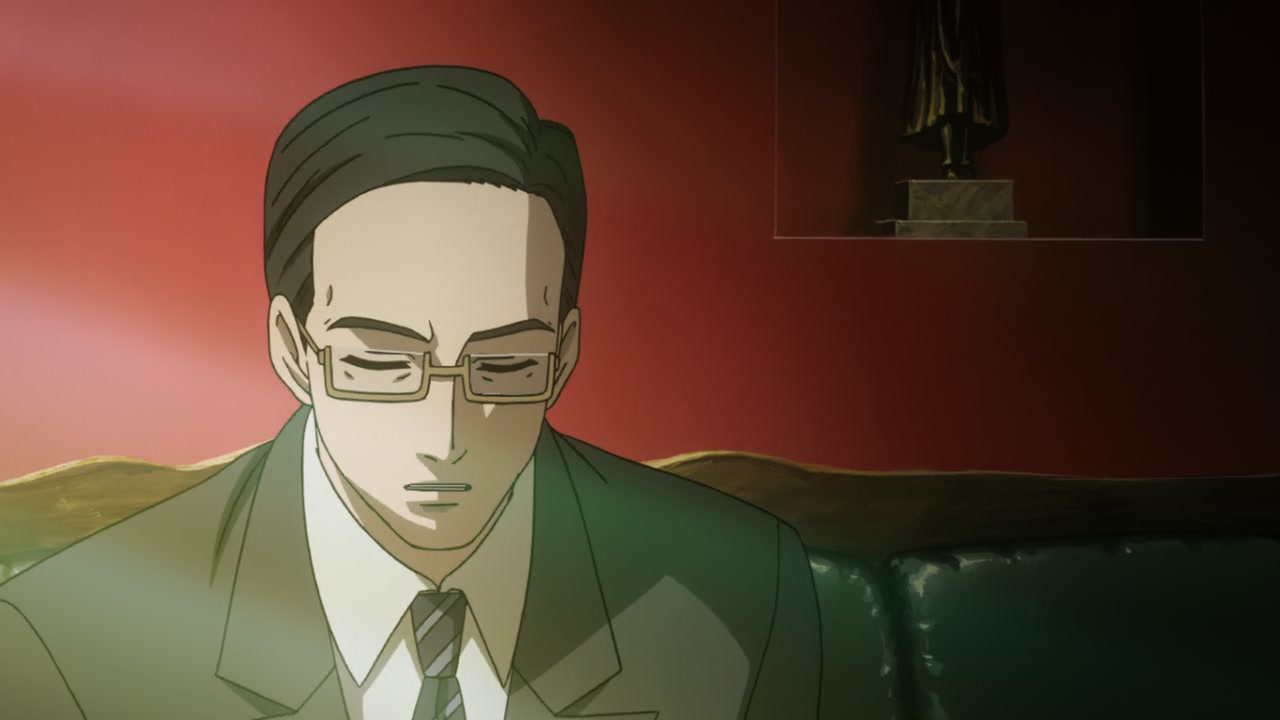
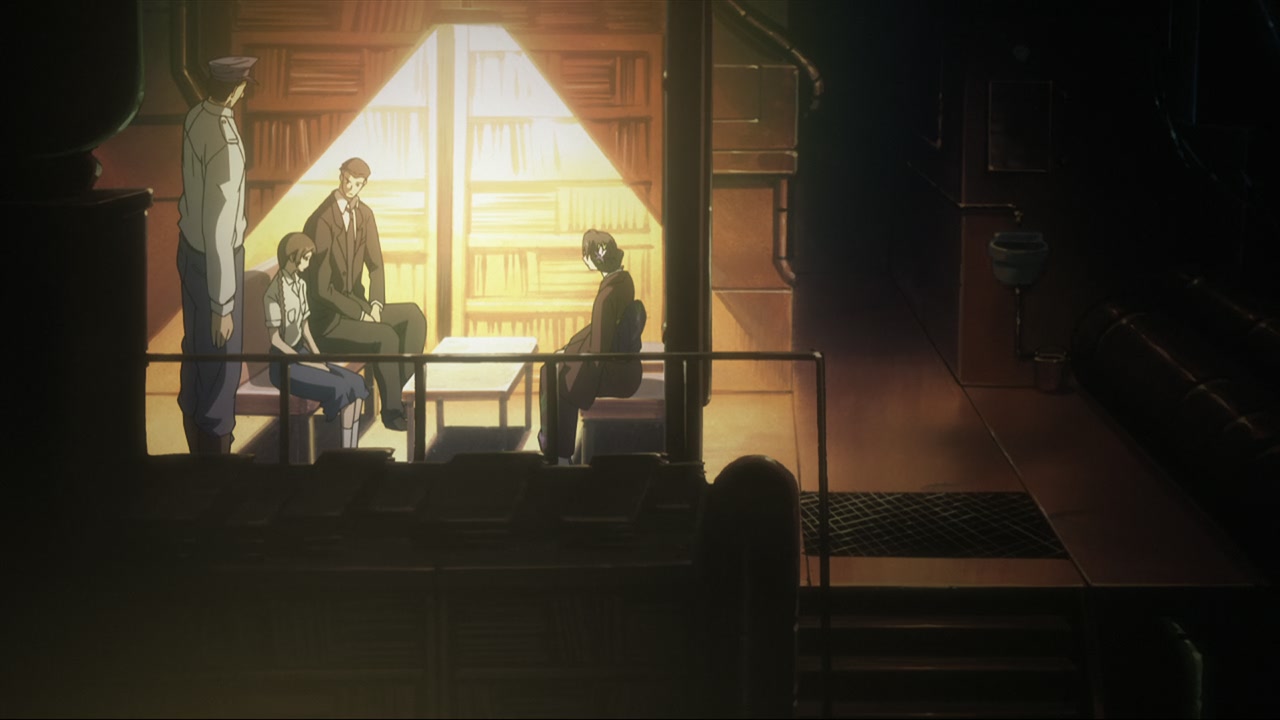
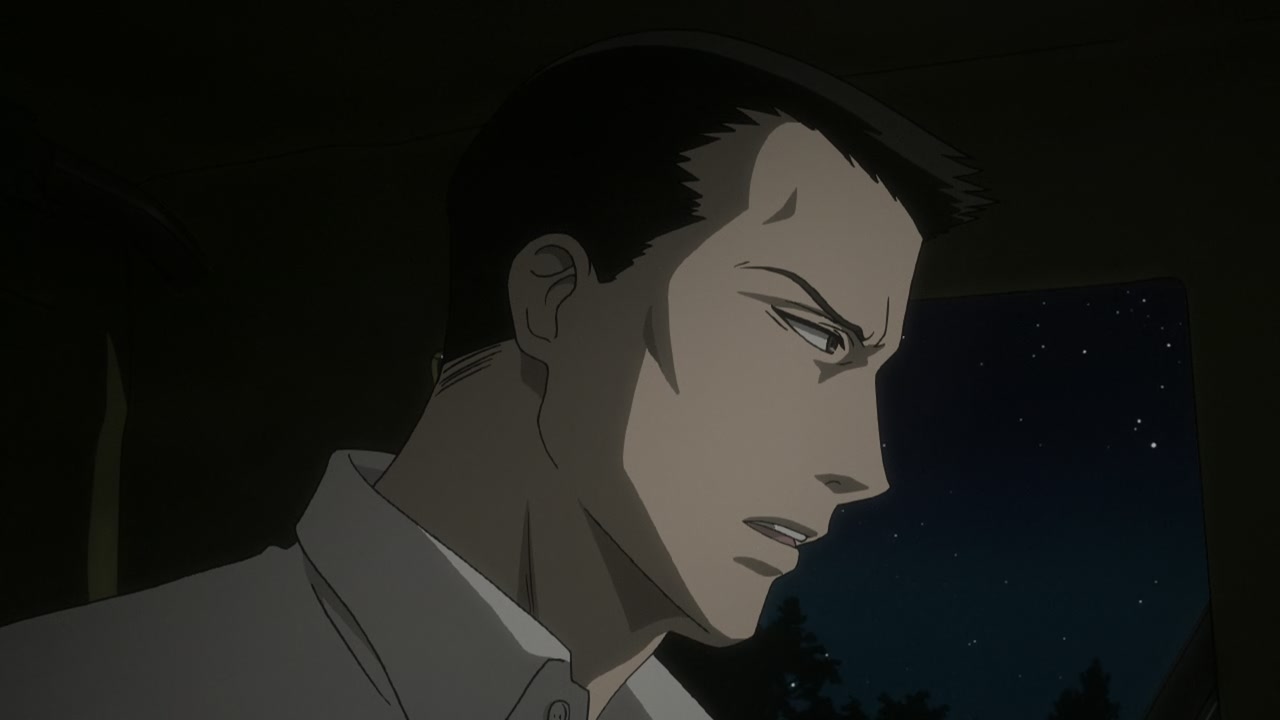
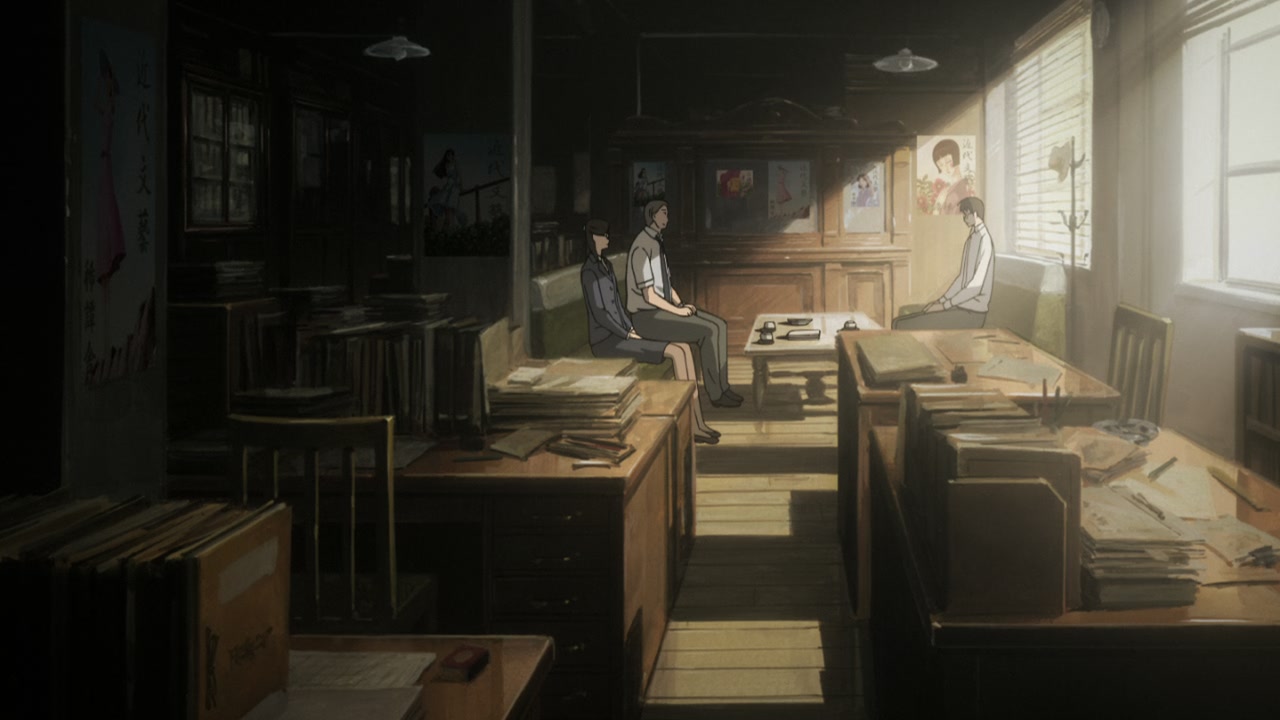
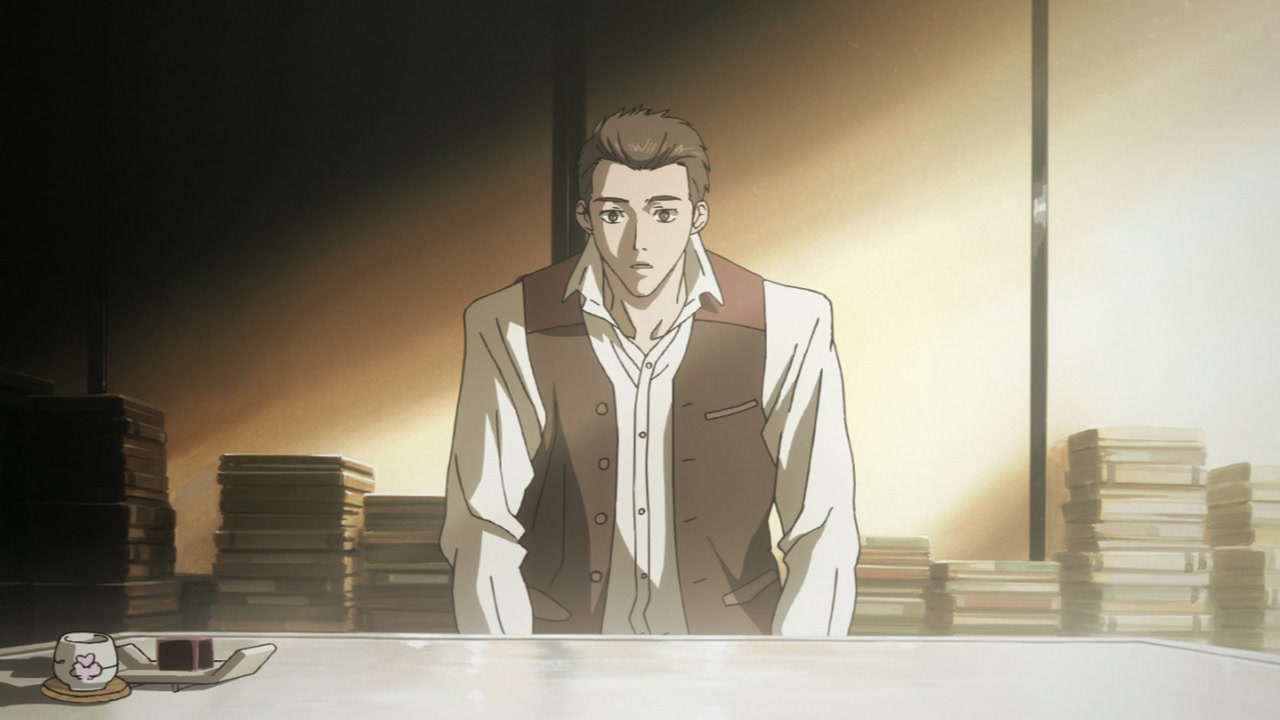
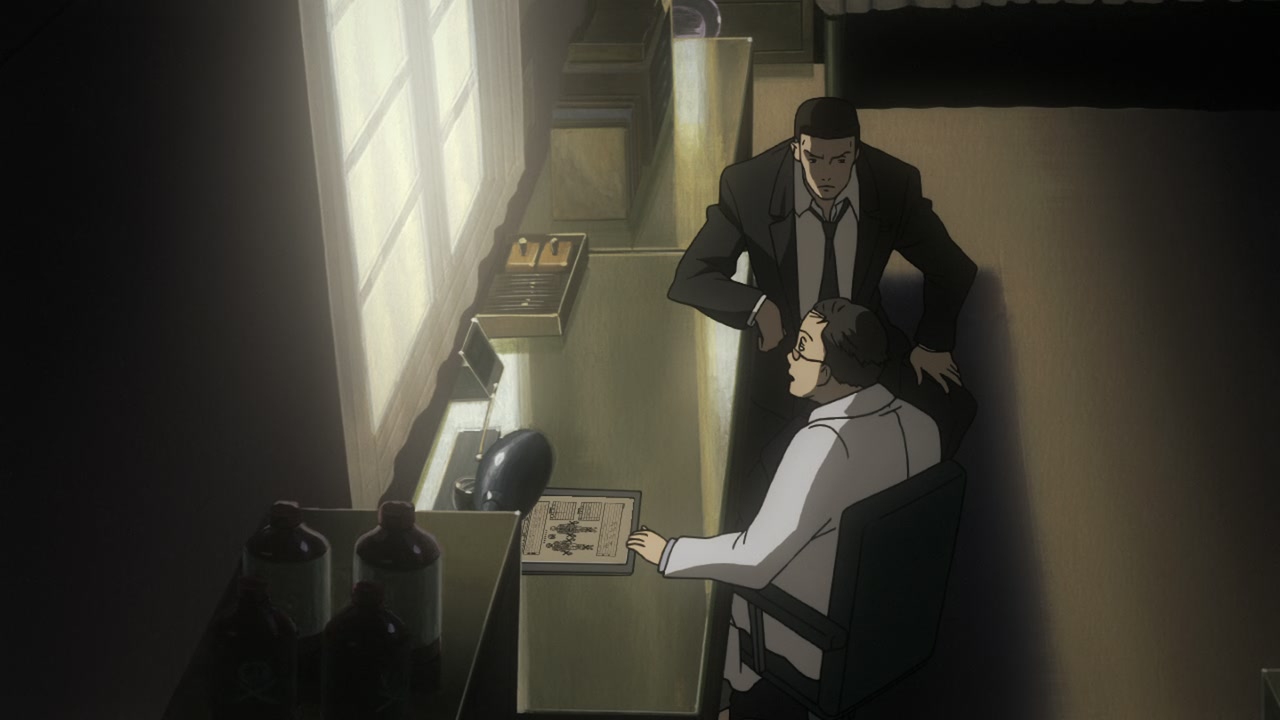
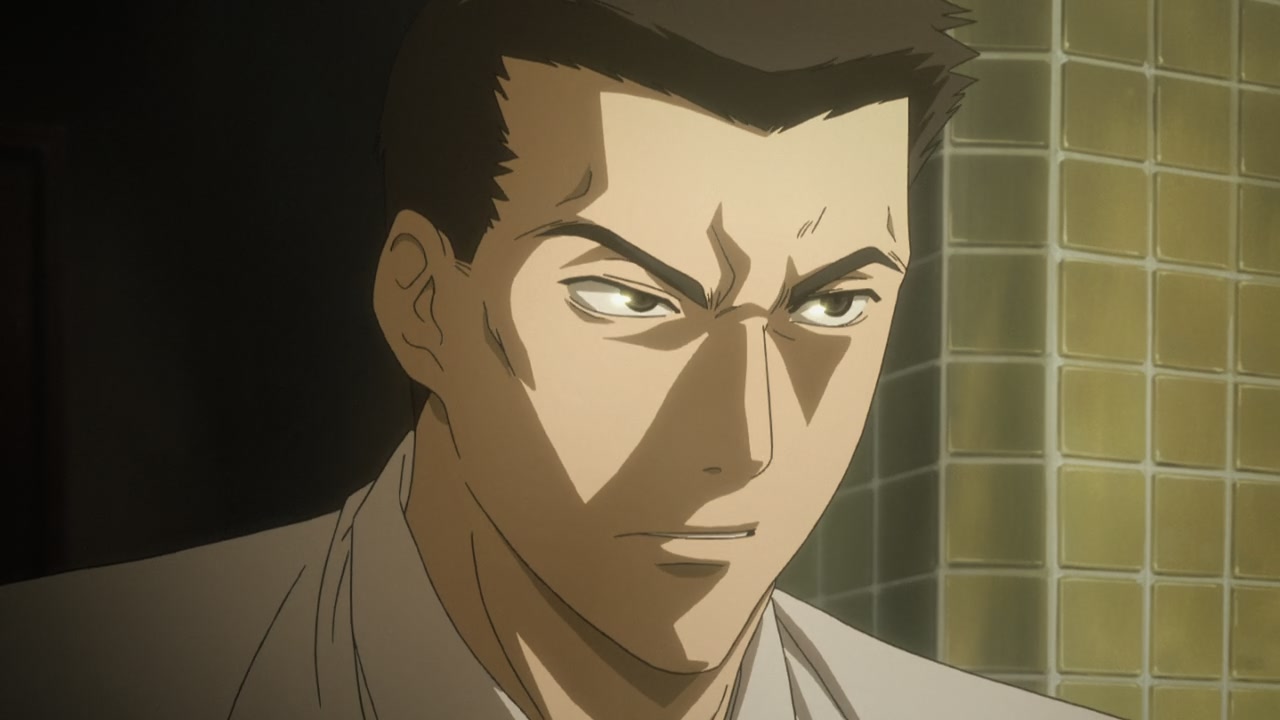
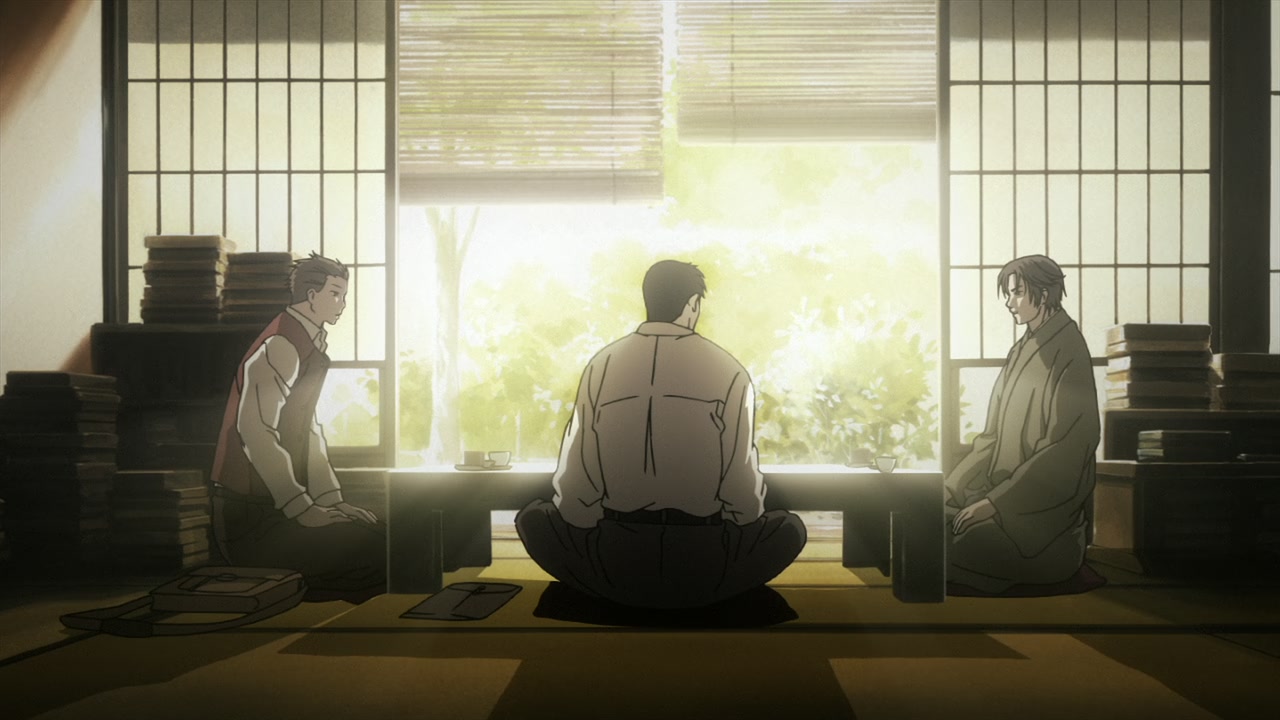
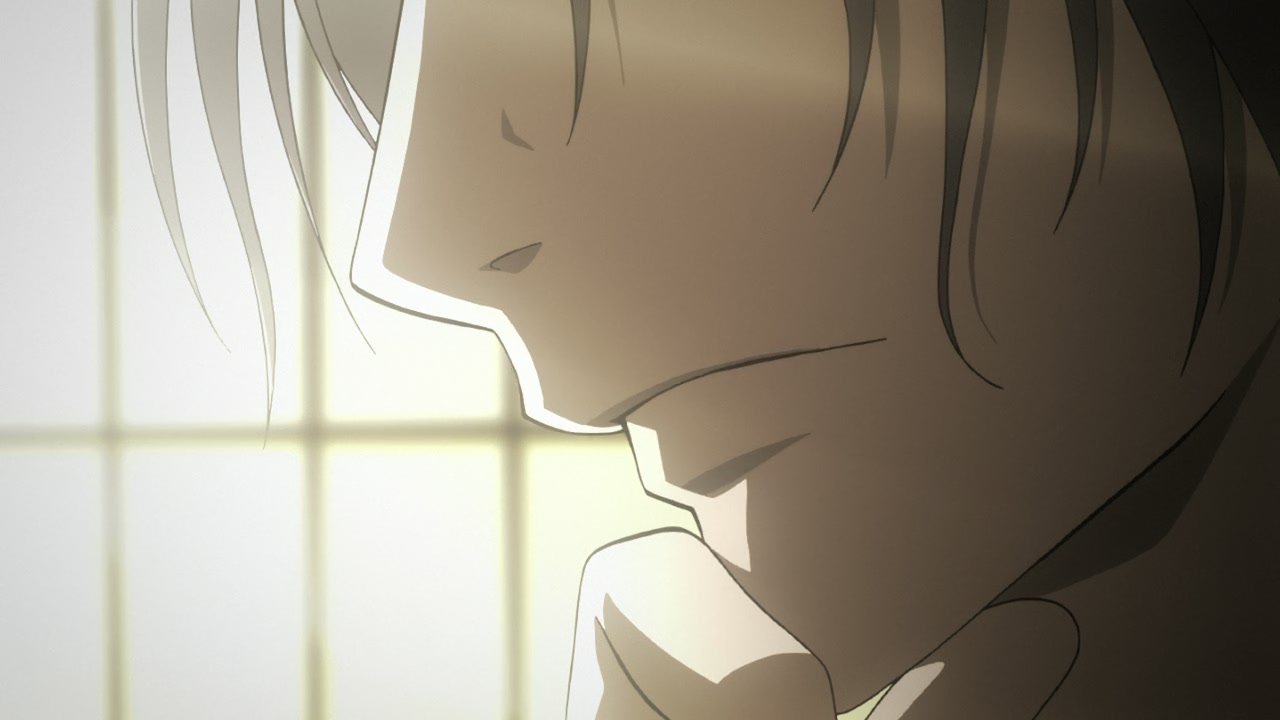
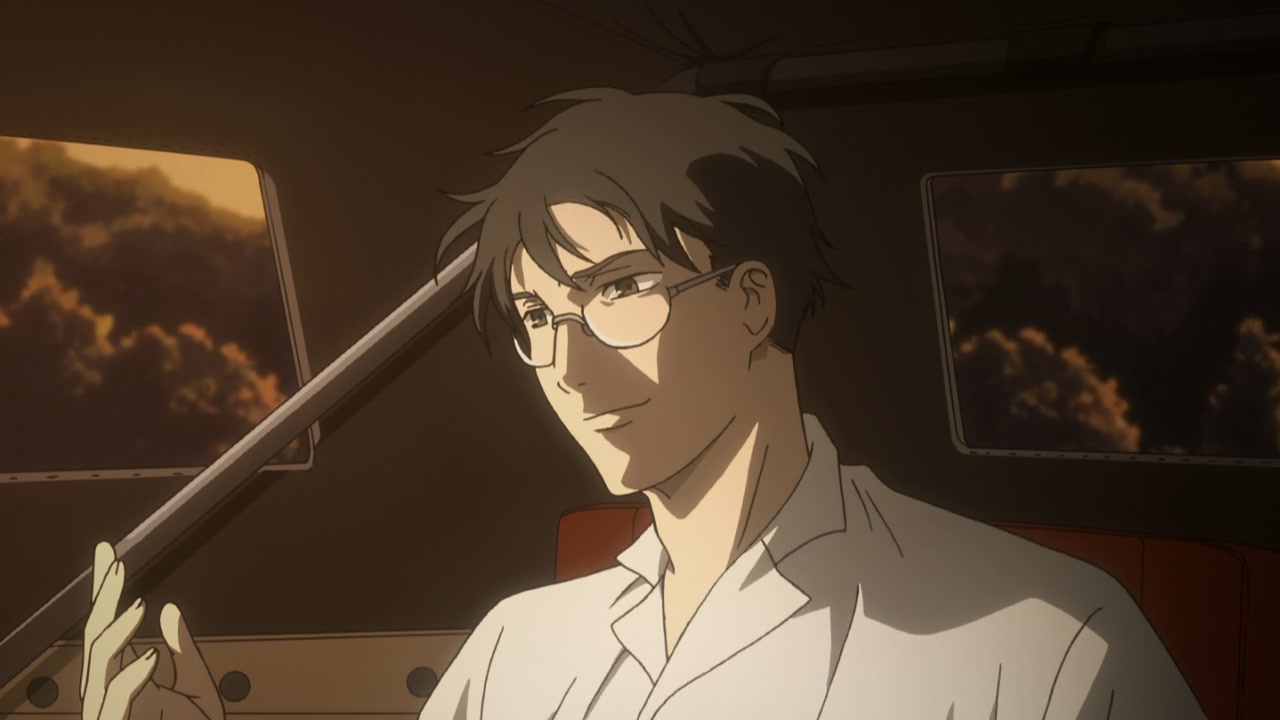
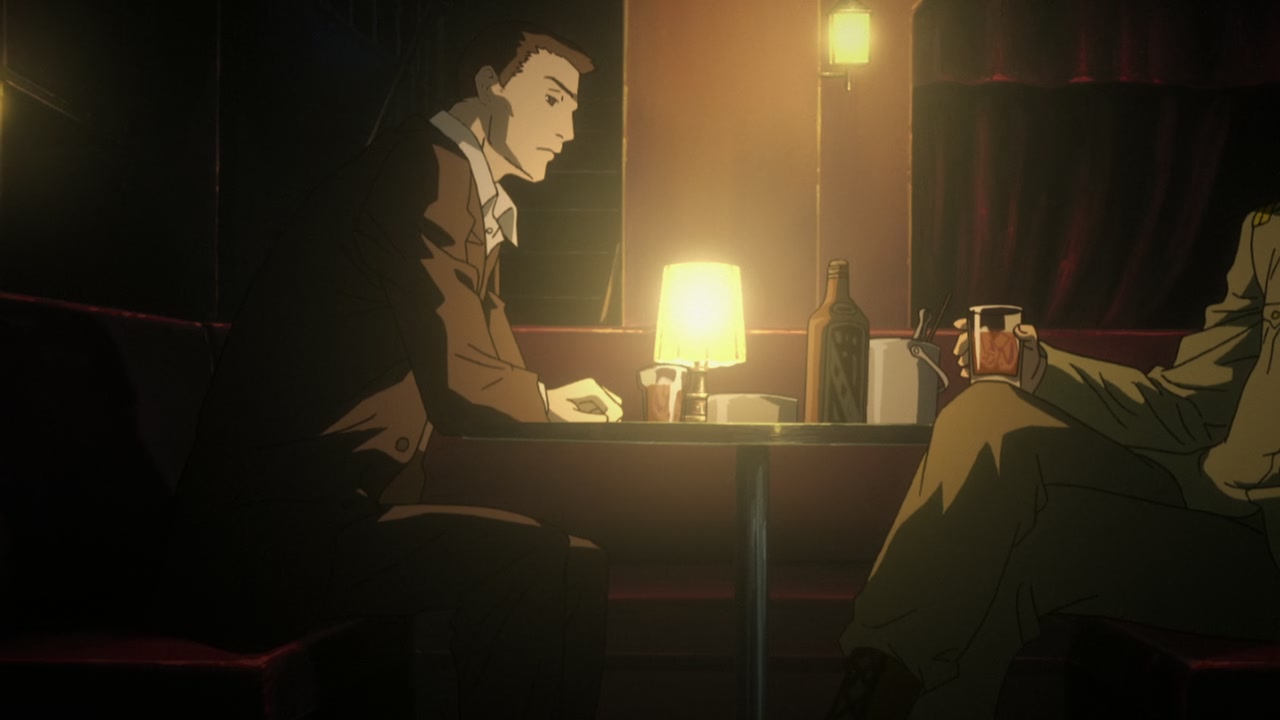
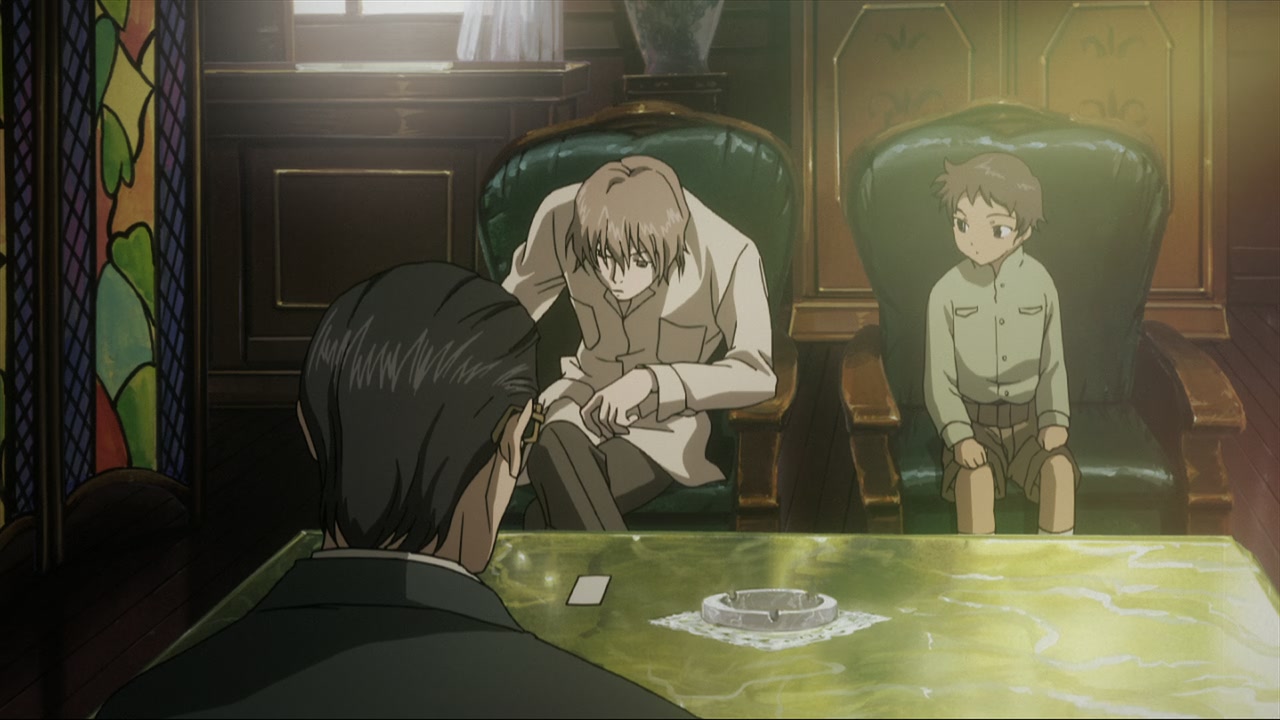
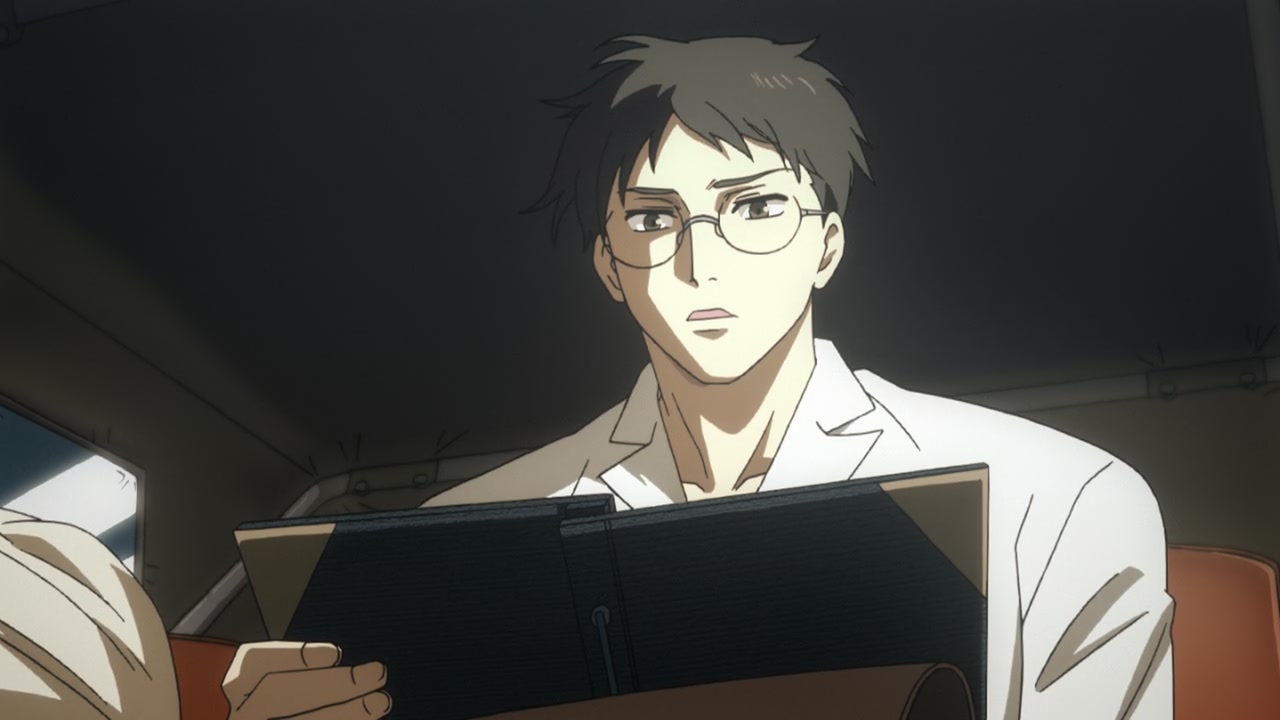
Light is treated as a physical substance. It floods through shoji screens in visible shafts, catching dust motes and bleeding gently over the edges of characters. Industrial lamps in the laboratory cast harsh pools of illumination while leaving the surrounding space in deep shadow. The frequent use of split lighting, with characters half-lit and half-consumed by darkness, visually reinforces the theme of partial knowledge and hidden selves.
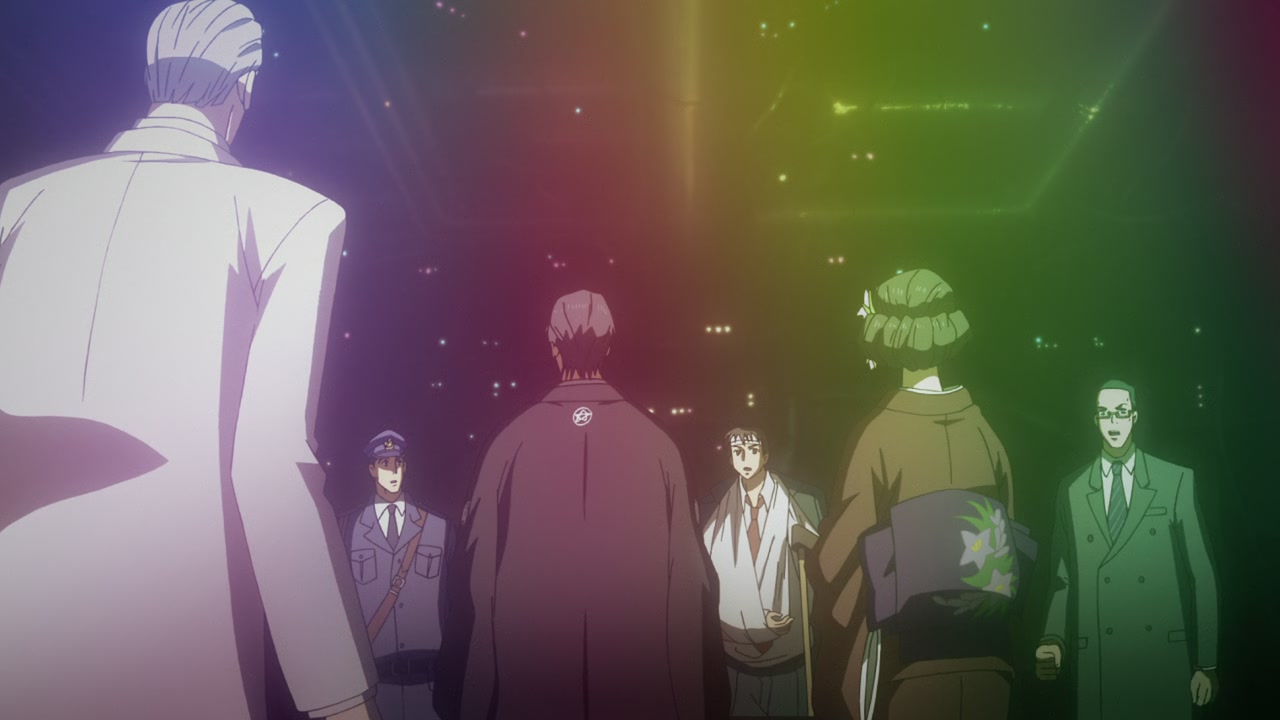
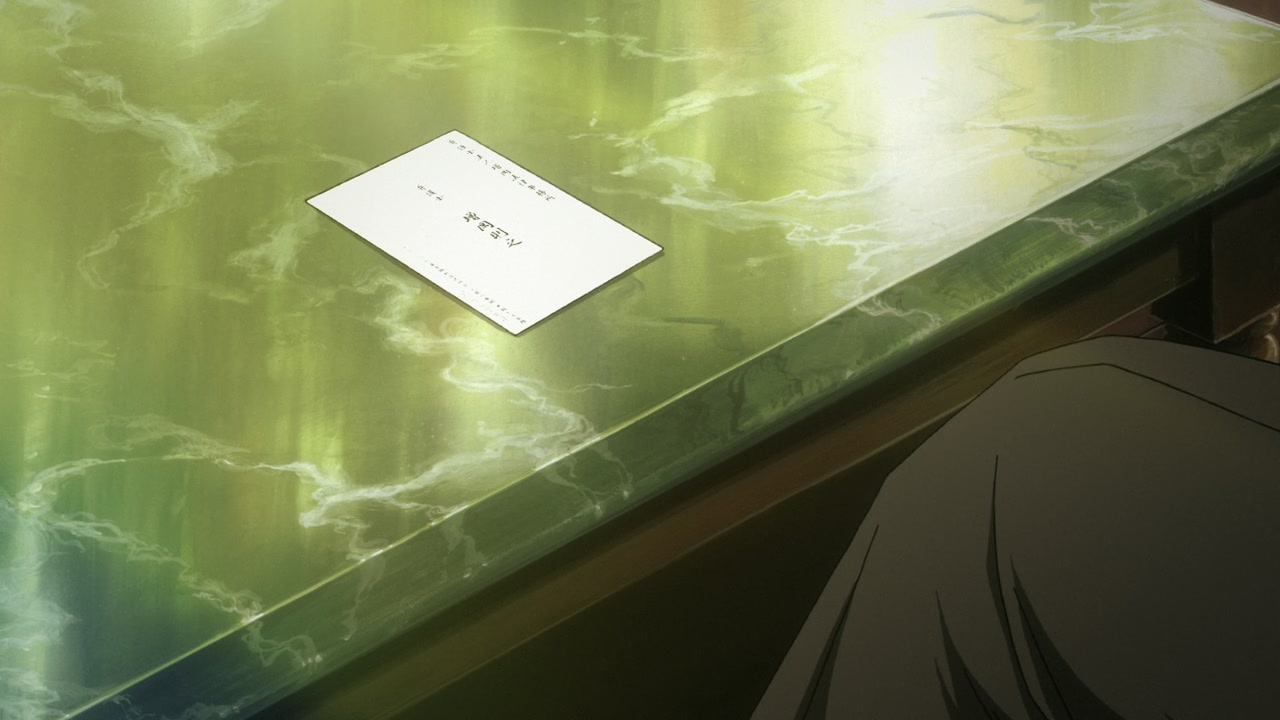
The color palette is restrained and earthy. Olive drabs, sepias, charcoal grays, and deep browns dominate. When color does appear in concentrated form, it carries symbolic weight. The crimson of a Buddhist altar. The sickly green-yellow of a corrupting environment. The deep wine-reds of an evening lounge where secrets are traded. The transitions between these palettes track the emotional register of each scene with precision.
Chromatic aberration appears in certain heightened moments, a subtle prism effect around the edges of the frame that suggests psychological instability or memory distortion. It is never overused. When it appears, it means something.
Character Design and Acting
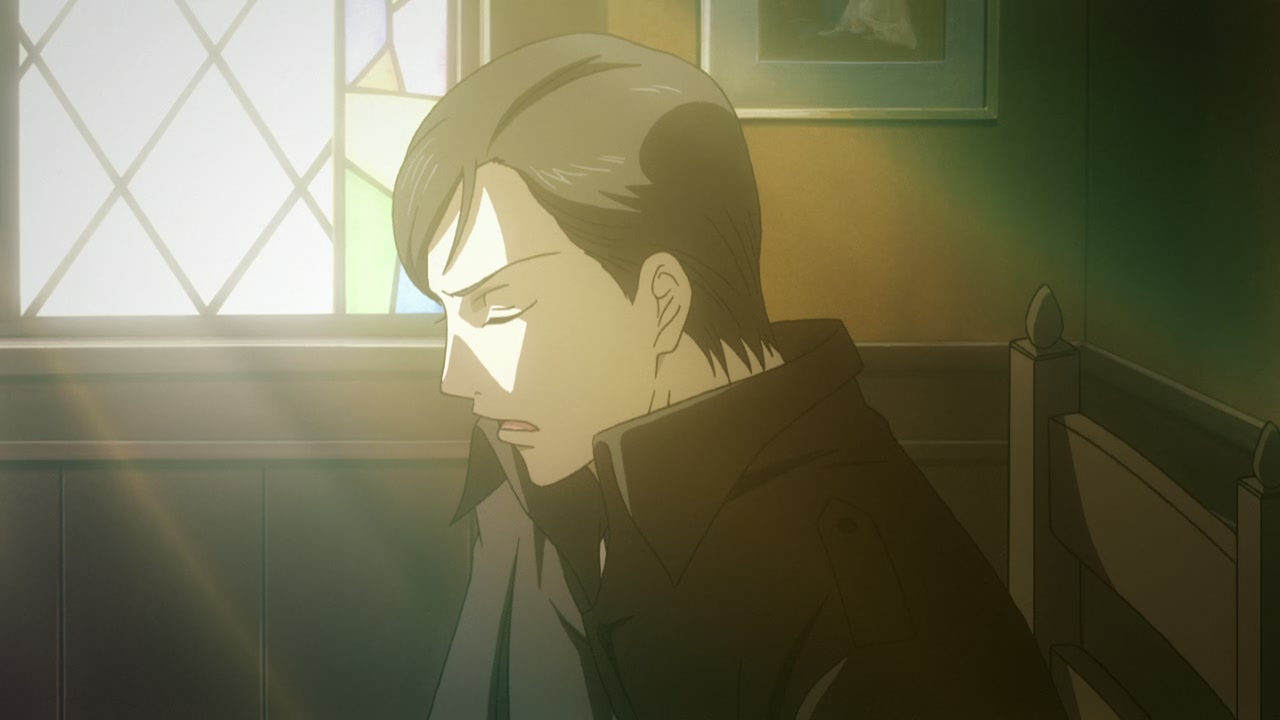
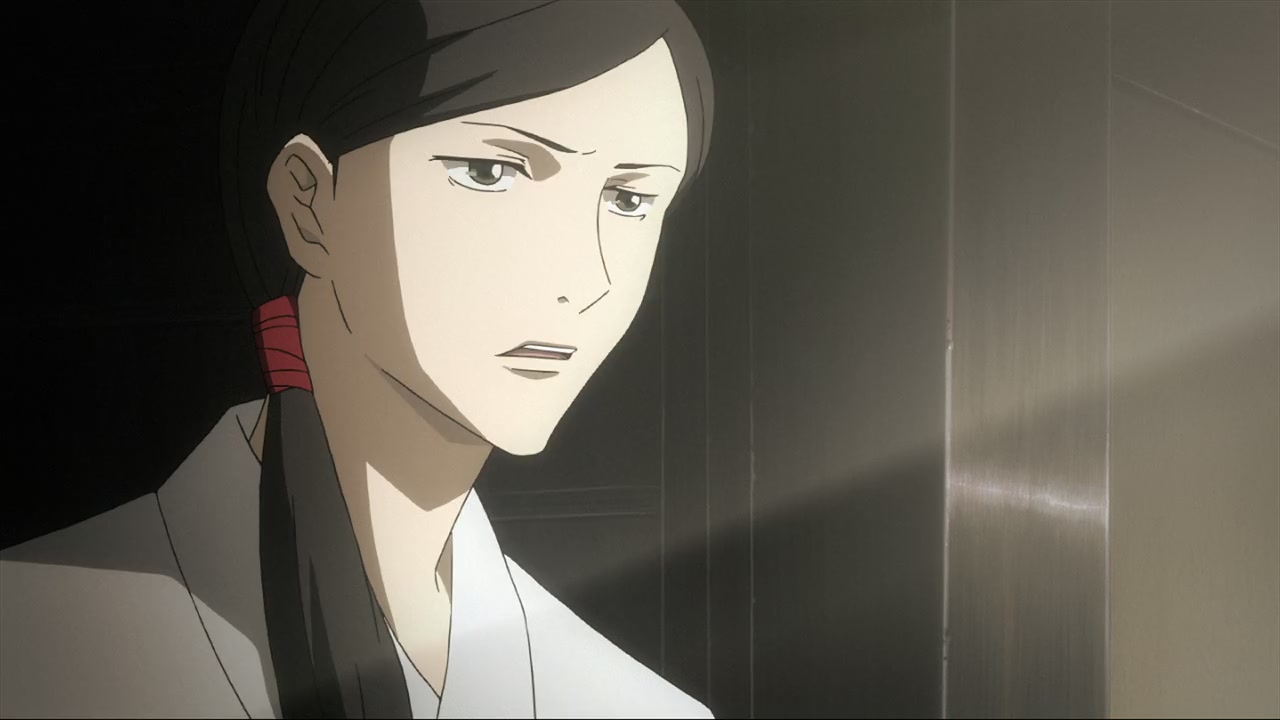
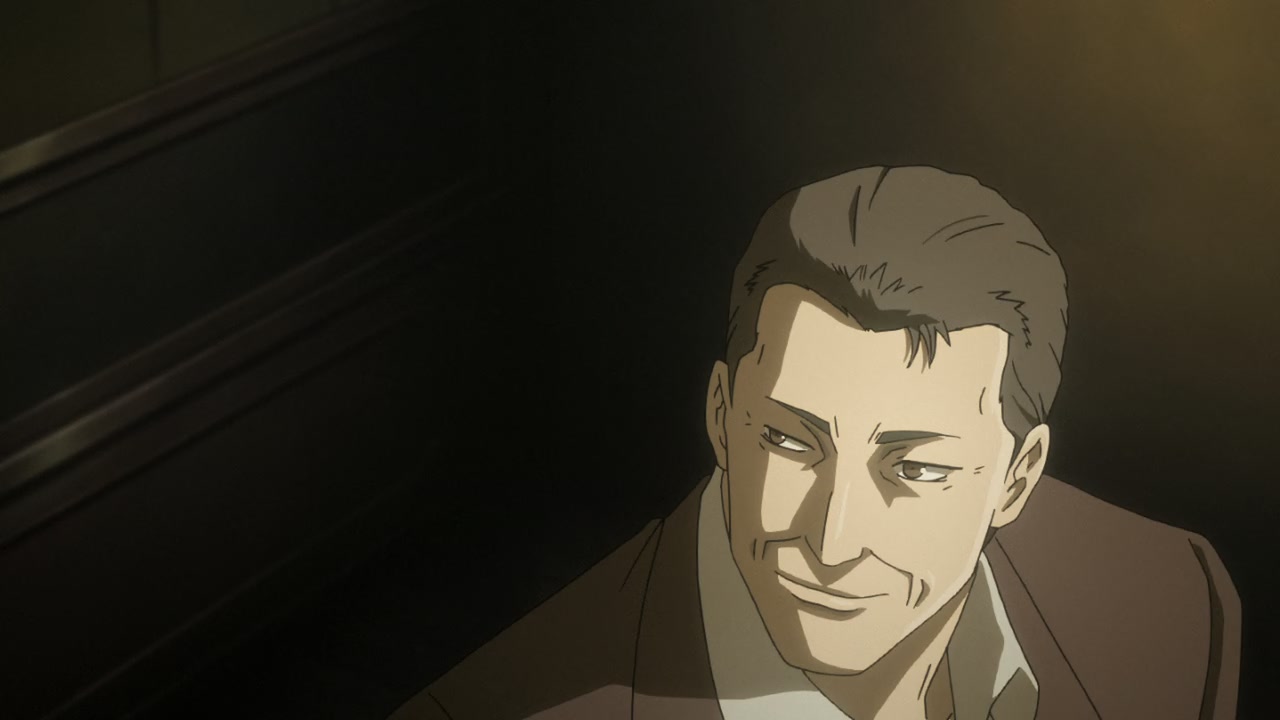
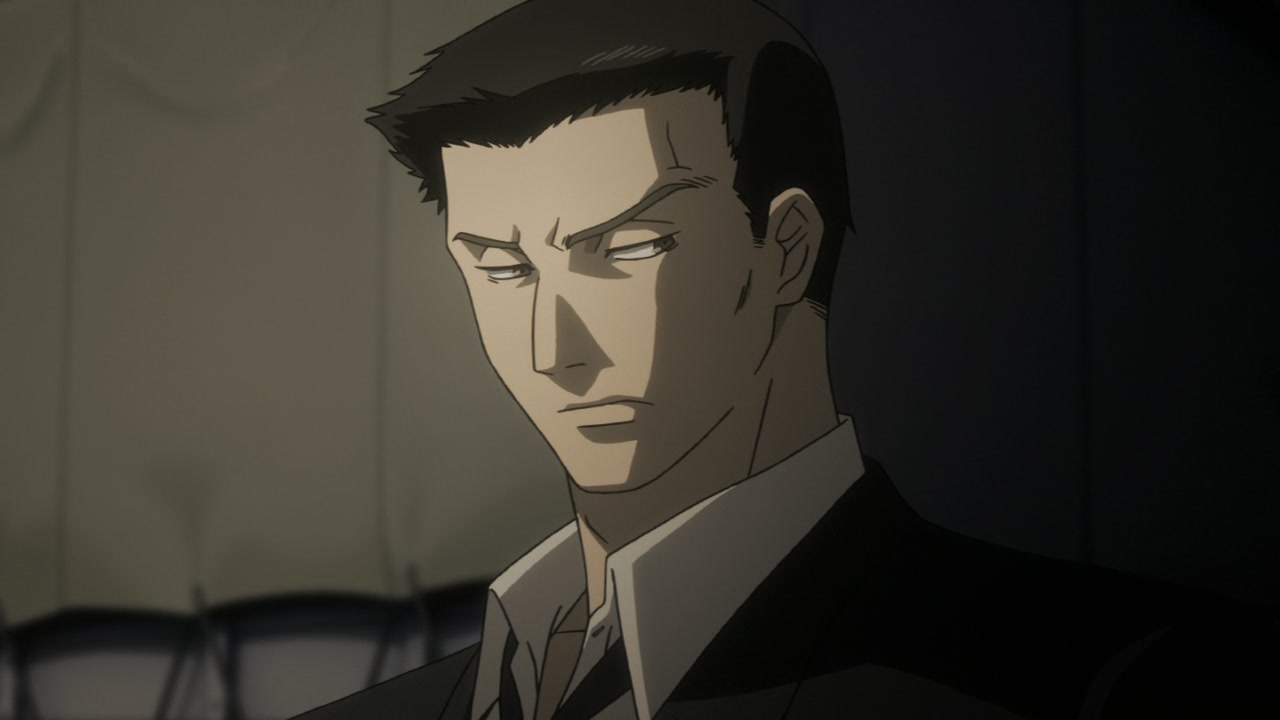
The character designs reject anime convention in favor of mature realism. Proportions are natural. Linework is thin and disciplined. Facial details that most anime gloss over (nasolabial folds, slight crows-feet, heavy eyelids) are rendered with care, giving each character a sense of age and accumulated experience. Kyougokudou’s gaunt frame and angular features make him look like he stepped out of a Meiji-era woodblock print. Kiba’s heavy brow and permanent scowl communicate his entire personality before he speaks a word.
The animation prioritizes “acting” over movement. This is a dialogue-driven story. Characters spend most of their screen time sitting, standing, and talking. Rather than try to inject false kinetic energy, the animation focuses on micro-expressions. A tightening of the jaw. A subtle shift in gaze. A slight tremor in the hand. These small details carry enormous weight when the emotional stakes are high.
There are moments where the limitations become apparent. Brief physical struggles and the rare bursts of violence lack the fluidity of a higher-budget production. Key frames are spaced apart, and transitions between poses can feel stiff. Whether this is a budget limitation or a deliberate stylistic choice to prioritize composition over motion is debatable. What is clear is that the series never relies on dynamic action to make its point. The real combat is verbal, and the static, tableau-like staging serves that material perfectly.
Environment and Framing
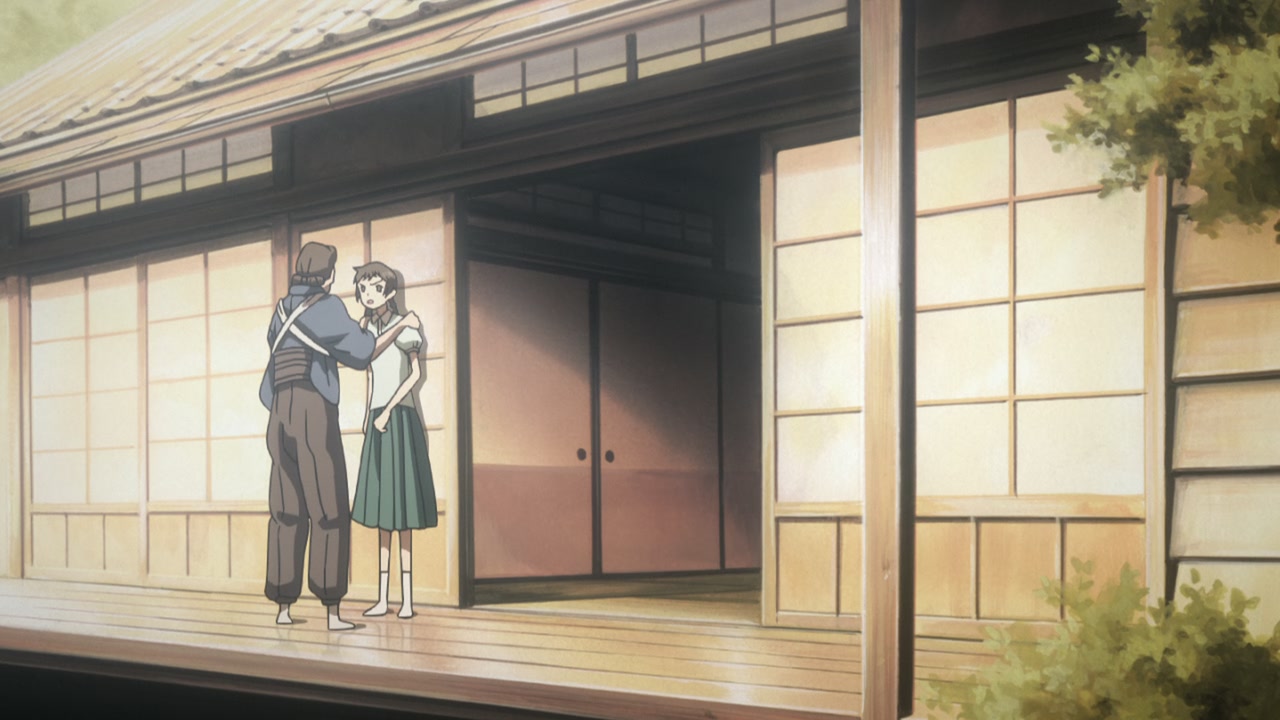
The background art is exceptional. The contrast between architectural styles is not just period-accurate. It is thematically charged. Traditional Japanese interiors (Kyougokudou’s study with its precarious stacks of books, the Kusumoto household with its nail-shut entrance) feel airy and organic despite their clutter. Western-style offices and cafes feel dense and claustrophobic. The laboratory is a steel labyrinth of pipes and dials, cold and inhuman.
Internal framing is used extensively. Characters are viewed through doorways, windows, and architectural pillars that “box” them within the composition. This visual motif reinforces the central metaphor without calling attention to itself. The viewer feels the confinement even when it is not being discussed.
The compositing is noteworthy for its success in integrating characters into their environments. Many modern anime suffer from a flatness that makes characters feel like stickers placed on top of backgrounds. This production avoids that trap through careful lighting matching and atmospheric effects that sell the illusion of a cohesive world.

Sound and Music
Voice Acting and Tone
The seiyuu cast delivers uniformly strong performances that align with the series’ grounded, mature tone. Hirakawa Daisuke brings an otherworldly calm to Kyougokudou, maintaining an even cadence through his lengthy lectures without ever becoming monotonous. His voice carries authority without aggression, the perfect instrument for a man who dissects souls through conversation.
Kiba’s gravelly baritone communicates volumes of suppressed emotion. The character says little about his own feelings, but his voice quivers with barely contained frustration during key exchanges with Youko. It is a performance built on restraint, and the moments where that restraint cracks are all the more powerful for it.
The female cast navigates complex emotional terrain. Yoriko’s voice work must oscillate between childlike adoration, delusional dissociation, and genuine terror. Youko’s performance combines aristocratic composure with an undercurrent of desperation. Both succeed in making characters who could feel melodramatic feel genuinely tragic instead.
Sound Design and Atmosphere
The audio landscape is as carefully constructed as the visual one. Train station announcements echo distantly. Rain patters against windows. Footsteps on wooden floors carry the specific resonance of post-war construction. The laboratory hums with the low drone of machinery, a constant reminder that the building is alive in ways the characters do not yet understand.
Silence is used strategically. Pauses between lines of dialogue are allowed to breathe. The absence of a musical score in certain scenes creates an uncomfortable intimacy, forcing the viewer to sit with the characters’ discomfort rather than being guided toward a prescribed emotional response.
The opening theme evokes the melancholic mystery of the era without resorting to pop energy. The ending theme provides a gentler comedown that suits the reflective tone of each episode’s closing moments. Neither is the kind of earworm that escapes the context of the show, but both serve their function admirably.
Overall Verdict
Mouryou no Hako is a dense, demanding, deeply rewarding work for viewers who crave psychological complexity and cultural depth from their mysteries. It asks a great deal. It moves slowly. It expects you to pay attention to mythological distinctions and historical references that most series would gloss over in a line of dialogue. It offers no cathartic violence, no clear moral victory, no happy ending for any of its principal characters.
What it offers instead is something rarer. A genuinely mature story about how people become monsters, not through supernatural possession or cartoonish villainy, but through grief that hardens into dogma, love that curdles into control, and guilt that calcifies into identity. The mouryou are us. The boxes are the compartments we build in our hearts to avoid facing what we have done. The exorcism is not comfort but clarity, a painful illumination that leaves the room emptier than it found it.
This series belongs in the company of anime like Monster and Shinsekai Yori, works that trust their audience to handle ambiguity and moral complexity without flinching. Viewers who need pace, action, or clear resolutions should look elsewhere. Viewers who appreciate being treated like adults capable of following a difficult conversation wherever it leads will find one of the most intellectually satisfying experiences the medium has to offer.
The final image haunts me. A man wandering distant roads, speaking happily to a box containing something dried and black. He has lost everything, and he is perfectly content. There is a kind of peace in that, I think. A terrible peace, but a real one. The peace of a mouryou that has found its perfect container.
Gallery