



Bringing the Pure and Earnest World to Life: An Interview with Taiyou yori mo Mabushii Hoshi Director Kobayashi Sayaka
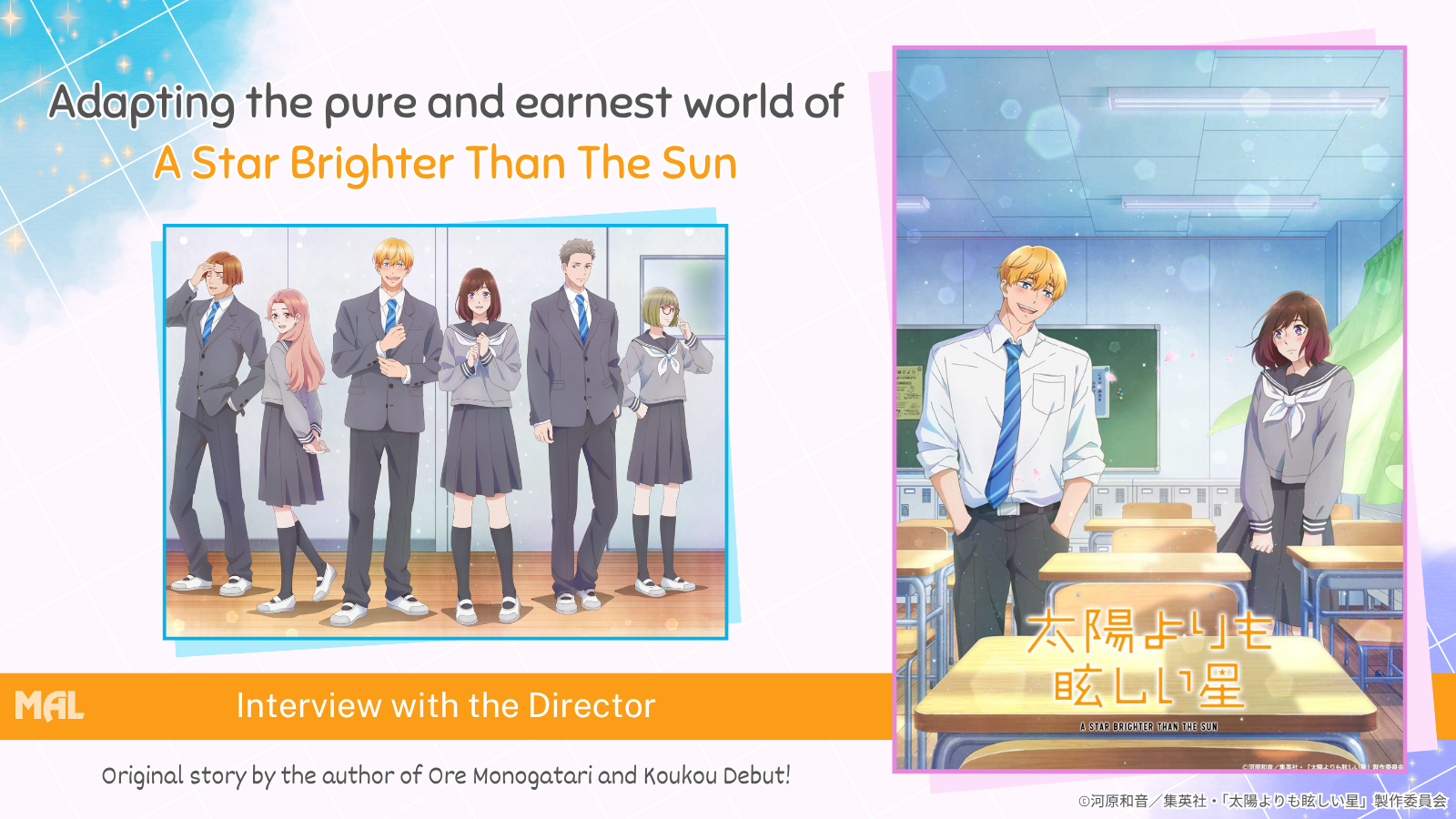
Get ready to dive into a world of youthful romance and deep emotions this Fall season! The highly anticipated anime adaptation of Taiyou yori mo Mabushii Hoshi (also known as *A Star Brighter Than the Sun*, and often shortened to *Tamahoshi*), is here to capture your heart. This charming shoujo manga by the celebrated author Kawahara Kazune is brought to the screen by Studio KAI and produced by TBS Television, under the keen eye of director Kobayashi Sayaka. The anime promises to deliver all the warmth and sincerity that Kawahara-sensei’s works are known for, enhanced with vibrant animation.
We recently had a chat with Director Kobayashi Sayaka, who shared insights into the intricate process of visualizing a story so deeply rooted in characters’ inner feelings and reflections. From her initial encounter with the manga to the subtle techniques she uses to convey unspoken emotions through movement and expression, Kobayashi-san delves into how her team meticulously brought Kawahara-sensei’s pure and earnest world to animated life.
Meet the Visionaries Behind Taiyou yori mo Mabushii Hoshi
Here’s a look at some of the key staff bringing this beautiful story to your screens:
| Role | Name |
|---|---|
| Director | Kobayashi Sayaka |
| Original Author | Kawahara Kazune |
| Studio | Studio KAI |
| Producer | Shiraishi-san |
| Sound Director | Yoshida-san |
And introducing the talent breathing life into the main character:
| Character | Voice Actor |
|---|---|
| Sae | Fujidera-san |
From Freelancer to First-Time Director: Kobayashi Sayaka’s Journey
This anime marks Kobayashi Sayaka’s directorial debut, a significant milestone in her career. She revealed how she joined the project: “The story of how I got involved goes back to when Studio KAI produced *Captain Tsubasa: Junior Youth Arc*.” Having contributed to the previous season with David Productions, Kobayashi-san was working as a freelance director when the second season came around. Character designer Watanabe Hajime referred her, saying, “I would like you to lend your support to the second season as well.” This led her to direct and storyboard three episodes, and storyboard the final episode for *Captain Tsubasa: Junior Youth Arc*.
It appears her work on that series left a strong impression on Shueisha, the publisher of both *Captain Tsubasa* and *Taiyou yori mo Mabushii Hoshi*, making her an ideal candidate for this directorial role, even as a first-timer. Kobayashi-san chuckled, admitting, “I say ‘suspect’ because I never heard it directly from the producer, so this is my own interpretation of the events.” She reflected on her journey, stating that becoming a director was her goal since graduating, a path “full of difficulties” but ultimately rewarding. “I’ve also gained many things career-wise so I’m glad I saw it through,” she added.
Capturing Unspoken Feelings: The Manga’s Enduring Appeal
Upon first reading the original work, Kobayashi Sayaka was profoundly impacted by Kawahara Kazune-sensei’s storytelling prowess. “I was amazed at Kawahara-sensei’s power of expression, or rather, skill at handling very uncommon feelings (continuing to like someone for a long time after you first met) and turning them into situations that many people can empathize with.”

She particularly noted how Kawahara-sensei masterfully depicts complex emotions. “When the characters are happy but sad at the same time, or have emotions that cannot be expressed in a single word, their facial expressions are drawn exquisitely… Being able to portray the emotions of a diverse cast of characters made me think Kawahara-sensei’s power of expression is the biggest charm.” This deep understanding of human emotion was a guiding principle for the anime adaptation.
The Unique Power of Anime for Shoujo Stories
Shoujo manga often find their way into live-action adaptations, but Kobayashi Sayaka firmly believes anime offers distinct advantages. She highlighted how anime can convey emotional depth far beyond what words alone can achieve. “When words alone are insufficient, the emotional impact on the character can be conveyed much more in anime, and I feel that richness of expression is the strength.”
She provided a delightful example: “talking to your crush feels like your heart is soaring inside, but if the live-action replicates the manga’s depiction of a character’s heart soaring, it’ll become a superhuman expression (laughs).” In illustrated mediums like manga and anime, such imaginative expressions are more readily accepted. Drawing a parallel to art, she explained, “It may be similar to how a painting by Picasso or Chagall seems easier to understand when you’re actually looking at it, compared to reading the explanation text next to it.” This perspective drove her to portray Sae’s feelings in Taiyou yori mo Mabushii Hoshi as faithfully as possible to the original manga.
Visualizing the “Earnest and Pure World”
To truly capture the delicate and heartfelt essence of *Tamahoshi*, Kobayashi Sayaka and her team employed several creative techniques. When Sae reminisces about Kamishiro in her “special memories,” they crafted a mental flashback effect that exudes a unique warmth, unlike anything seen before. Moreover, when Kamishiro appears through Sae’s adoring eyes, he literally sparkles, and the colors around him become more vivid. These visual cues are designed to deeply resonate with the audience, making Sae’s feelings palpable.


For the flashbacks to Sae and Kamishiro’s childhood, they rigorously tested various approaches to achieve a warm line style and textures reminiscent of a classic children’s picture book. To ensure everyone on the staff shared her vision, Kobayashi-san even added color and special effects directly to the storyboards, providing a clear image of the final footage.
Crafting the Opening Episode and Memorable Moments
The first episode of Taiyou yori mo Mabushii Hoshi presented a unique challenge: it features a lengthy monologue from Sae. The director’s primary focus was how to effectively convey Sae’s underlying frustration. Kawahara-sensei had specifically requested a faithful adaptation of episode one, so Kobayashi-san drew the storyboard with this in mind. However, while Sae’s feelings were conveyed through text in the manga, the anime required a strong visual narrative, which demanded considerable creative effort.
Kobayashi-san observed that early in the story, Sae displays a subtle sense of resignation, viewing her own life from a somewhat detached, “bird’s-eye view.” To express this visually, she aimed to create scenes where Sae watches her past unfold as if on a screen, mirroring the original story’s intent. During the dubbing process, she instructed the lead actress, Fujidera-san, to portray this particular scene with a calm demeanor, embodying that observational perspective.


One scene that personally resonated with Kobayashi-san appears towards the end of the first half: Sae, out of Kamishiro’s sight, grasps her cheeks tightly after going to get a thick marker. “In any episode, original depictions are put into the anime without going against the character’s interpretation, and I think this scene more clearly conveys Sae’s tension and elation to the audience,” she explained, hoping viewers will enjoy spotting these nuanced depictions throughout the series.

The “Sae Filter”: Portraying Kamishiro Through Adoring Eyes
Given that the manga largely centers on Sae’s inner thoughts, Kamishiro can often seem out of reach, almost an idealized figure. Kobayashi Sayaka addressed this in the adaptation by consistently showing Kamishiro through Sae’s perspective. “As you pointed out, the Kamishiro that Sae sees is a ‘perfect prince’,” she noted. Consequently, many visual compositions are from Sae’s viewpoint, presenting Kamishiro with a sparkling, vibrantly colored image.

The team even developed a specific “Sae Filter” for the sparkling effect seen around Kamishiro. This effect was designed with careful consideration of the original manga’s style, and also by referencing popular sparkle effects found on social media. Naming it the “Sae Filter” helped ensure all staff members were aligned on its consistent application.
The Nuances of Kamishiro’s Character
While many readers might initially perceive Kamishiro as an idealized prince, the story subtly reveals that he’s not quite as perfect as Sae sees him. Kobayashi Sayaka considered making him a more universally princely character during adaptation. However, Kawahara-sensei offered a crucial piece of advice: “Kamishiro is mentally around the second-year of junior high school (14 years old), so I hope you’ll think about the character with that in mind.”
This insight solidified the decision to maintain Kamishiro’s original character. Despite some scenes where he might appear “immature,” Sae’s feelings for him remain steadfast. Therefore, the direction focused on encouraging the audience to pay more attention to Sae and understand her deep emotions, rather than solely scrutinizing Kamishiro’s perceived flaws.
Guiding the Voice Cast: From Monologues to Balance
Kobayashi Sayaka placed particular emphasis on the voice acting, especially for the pivotal first episode. She described episode one as “the real battle,” especially for Sae’s actress, Fujidera-san. For the lengthy monologue where Sae reflects on her life, which was deeply infused with the director’s vision, Kobayashi-san asked Fujidera-san to perform with a sense of “looking down on her own life from a bird’s eye view.”

Beyond Sae, a general instruction was given to all cast members (with the exception of the character Izawa) to ensure their characters didn’t develop unpleasant personalities or become disliked by the audience. This crucial decision was made in consultation with producer Shiraishi-san and sound director Yoshida-san, highlighting the team’s commitment to maintaining a positive and engaging character dynamic.
Memorable Conversations with Kawahara Kazune-sensei
Kobayashi Sayaka recalled two particularly impactful discussions with the original author, Kawahara Kazune-sensei. The first occurred during their initial meeting, when Kawahara-sensei inquired about Kobayashi-san’s motivation for entering the anime industry. Sharing her childhood dream of becoming a film director and her early experiences with video left an impression, with Kawahara-sensei remarking, “It’s very interesting that Director Kobayashi has all kinds of stories to tell.”
The second memorable moment came during the recording for episode 7, when Kawahara-sensei visited the sound studio. After some time since their last meeting, Kawahara-sensei offered high praise: “It’s really great that you can show me so many different perspectives that I hadn’t thought of, I’d like to keep seeing more.” This compliment was incredibly validating for Kobayashi-san, who confessed to often being “overly skeptical” about her creative choices for the anime. “It was the greatest compliment I could receive,” she shared, adding that those words motivated her to push even harder through the latter half of the production.

Director Kobayashi (left) and Producer Shiraishi (right)
take a photo with the audience at Anime Expo 2025 in Los Angeles
Supporting Emerging Talent: From Film to Music
The interview touched upon Sae’s feelings for Kamishiro, comparing them to liking a pop star or an unknown manga before it achieves widespread fame. Kobayashi Sayaka shared her own experiences with supporting talent before they hit the big time. For film directors, she’s been a devoted fan of Director Pete Docter since *Monsters, Inc.*, which she first saw around age 10. She admires his innovative approach and his knack for developing stories that become unexpectedly emotional.
In the realm of music, Kobayashi-san pointed to Wanuka, the artist behind Taiyou yori mo Mabushii Hoshi‘s ending theme song. She praises Wanuka for their ability to craft catchy melodies and memorable lyrics, expressing a desire for more people to discover and enjoy their work.
Shoujo Manga Recommendations from the Director
For fellow shoujo manga enthusiasts, Kobayashi Sayaka offered some heartfelt recommendations. She highly commends all works by Ishida Takumi-san and Sato Zakuri-san, noting their exceptional talent in creating “characters who have their quirks, but you can’t hate them.”
Additionally, she suggests two historical “what if?” stories that are incredibly addictive: Hi ni Nagarete Hashi ni Iku by Hidaka Shoko-san and Palace Meidi by Kuze Banko-san, praising their engaging and interesting story developments.
A Message for Fans Around the World
To the international fans eagerly awaiting the anime, Kobayashi Sayaka extends a personal message. Echoing Kawahara-sensei’s sentiment, she emphasizes that “the feeling of falling in love with someone is very beautiful and precious.” She has poured her own interpretation of this truth into every aspect of the anime.
“While creating this work, I remembered my own bittersweet experiences from when I was a teenager,” she shared, expressing her hope that viewers will also be able to relive their own youthful memories while watching the series. “Please be sure to watch it.”
This interview was originally conducted in Japanese and has been translated into English.
Visit the Official Site: https://tamahoshi-anime.com/
Follow the Official X (Twitter): @tamahoshi_anime
Watch Taiyou yori mo Mabushii Hoshi on Prime Video: https://www.primevideo.com/detail/0FDNZG74Z3YIIIQ4HPWX966TO2