





Introduction
There is a particular kind of agony in being young and in love with your best friend. Every interaction becomes a negotiation between what you want to say and what you can safely say. Every glance carries weight you cannot acknowledge. Every casual touch is analyzed for hidden meaning. Most romance anime understand this tension, but few have found a mechanism as elegant for exploring it as the one at the center of Aishiteru Game wo Owarasetai.
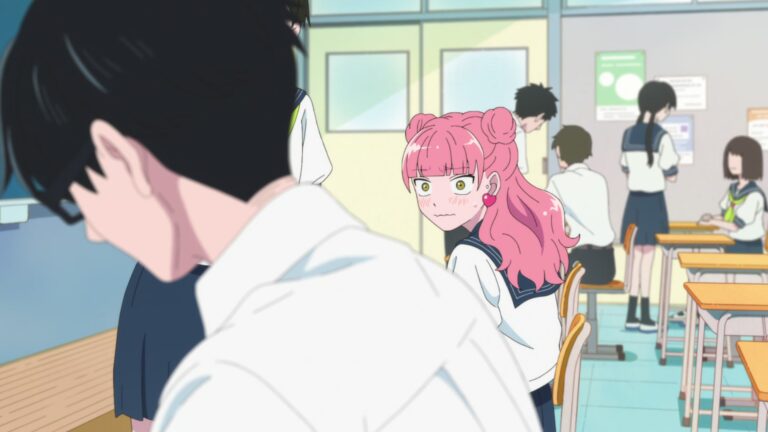
The premise is deceptively simple. Asagi Yukiya and Sakura Miku have been playing a game since the sixth grade. They take turns telling each other “I love you,” and the first one to blush or show a visible reaction loses. Four years later, as they enter high school, the game continues without a single winner. What began as a childish pastime has become something far more complicated, because both of them have developed genuine feelings that the game simultaneously expresses and conceals.
This is not a will-they-won’t-they in the traditional sense. They already say “I love you” constantly. The question is when they will mean it, or rather, when they will admit that they have meant it all along. The series takes this central paradox and builds an entire emotional architecture around it, one that rewards patience and attention to detail. If you have ever been young, stubborn, and completely incapable of saying what you actually felt, this series will resonate deeply.
Story and Themes
The Love Game as Emotional Architecture
The genius of the love game as a narrative device is that it functions on multiple levels simultaneously. On the surface, it is a competition, a battle of wills between two stubborn teenagers who refuse to lose. One level down, it is a safe container for genuine affection, a way to say the most vulnerable words imaginable without having to own them. Deeper still, it is a prison that prevents the very intimacy it enables.
Yukiya and Miku have said “I love you” to each other hundreds of times over four years. The words should be meaningless by now, worn smooth by repetition. Instead, they have become more charged, because both characters know that somewhere along the way, the game stopped being a game. Yukiya realized his feelings in the second year of middle school, when Miku’s voice suddenly “rang so sweet” during an otherwise ordinary exchange. Miku started the game specifically because she wanted Yukiya to see her as a girl, to acknowledge her as someone he could love. The game was never just a game for her.
This duality creates a unique emotional texture. Every “I love you” is simultaneously a move in a competition and a true confession. Every teasing remark is both a deflection and a test. The series understands something fundamental about adolescent communication: it is often easier to say the most important things indirectly, wrapped in layers of plausible deniability, than to say them plainly and risk everything.
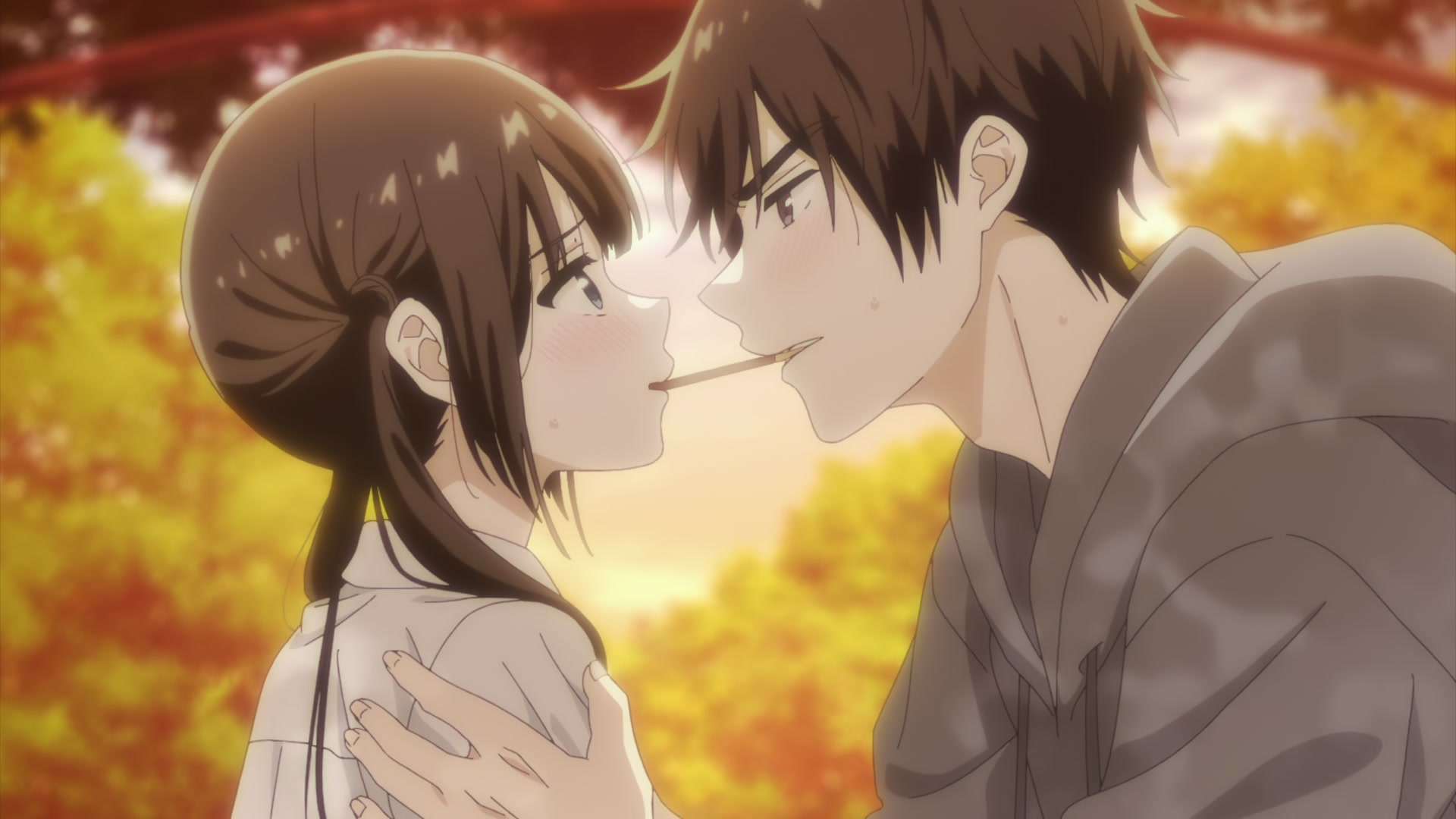
The escalation of the game’s rules mirrors the natural progression of their relationship. At some point in middle school, they agreed that “anything goes” in the pursuit of making the other person blush. This opens the door to physical intimacy that neither is fully prepared for. Hand-holding, hair-tying, sharing a futon, and eventually a kiss all become moves in the game, but physical intimacy cannot be contained within the game’s framework. It bleeds into genuine emotion, creating confusion and guilt that the characters must navigate.
Pride and the Terror of Vulnerability
Both leads are crippled by pride, but their pride has different sources and different stakes.
For Yukiya, admitting defeat would mean retroactively exposing years of teasing as defensive posturing. He has called Miku a “shrimp” and a “washboard” since childhood. If he now admits that he finds her beautiful, that he has been in love with her for years, every insult becomes evidence of his own cowardice. He imagines Miku’s gloating with vivid dread: “You’ve been acting so tough, but it turns out you thought I was cute the whole time.” This imagined scene is his personal nightmare, and he will go to extraordinary lengths to avoid it.
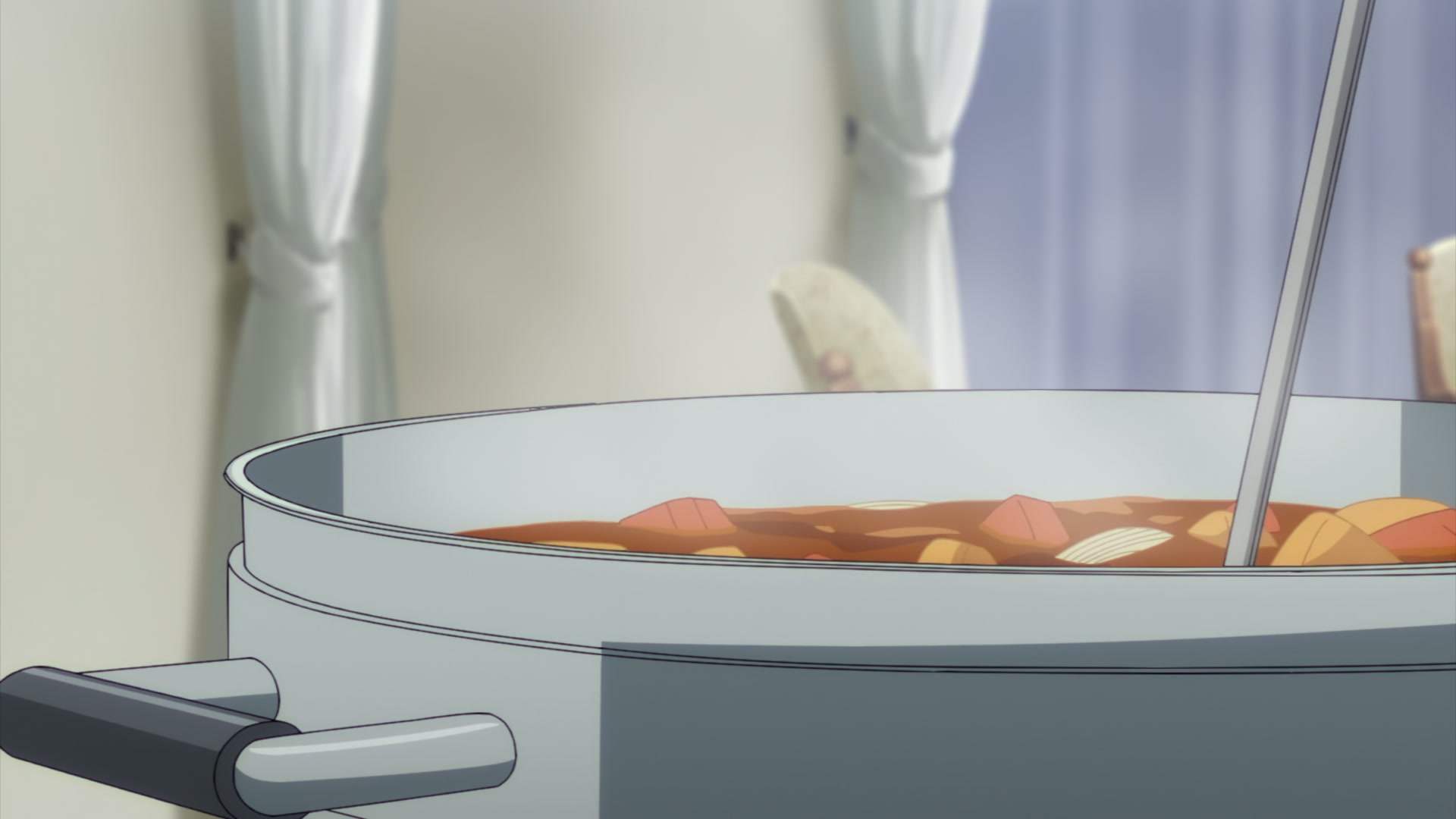
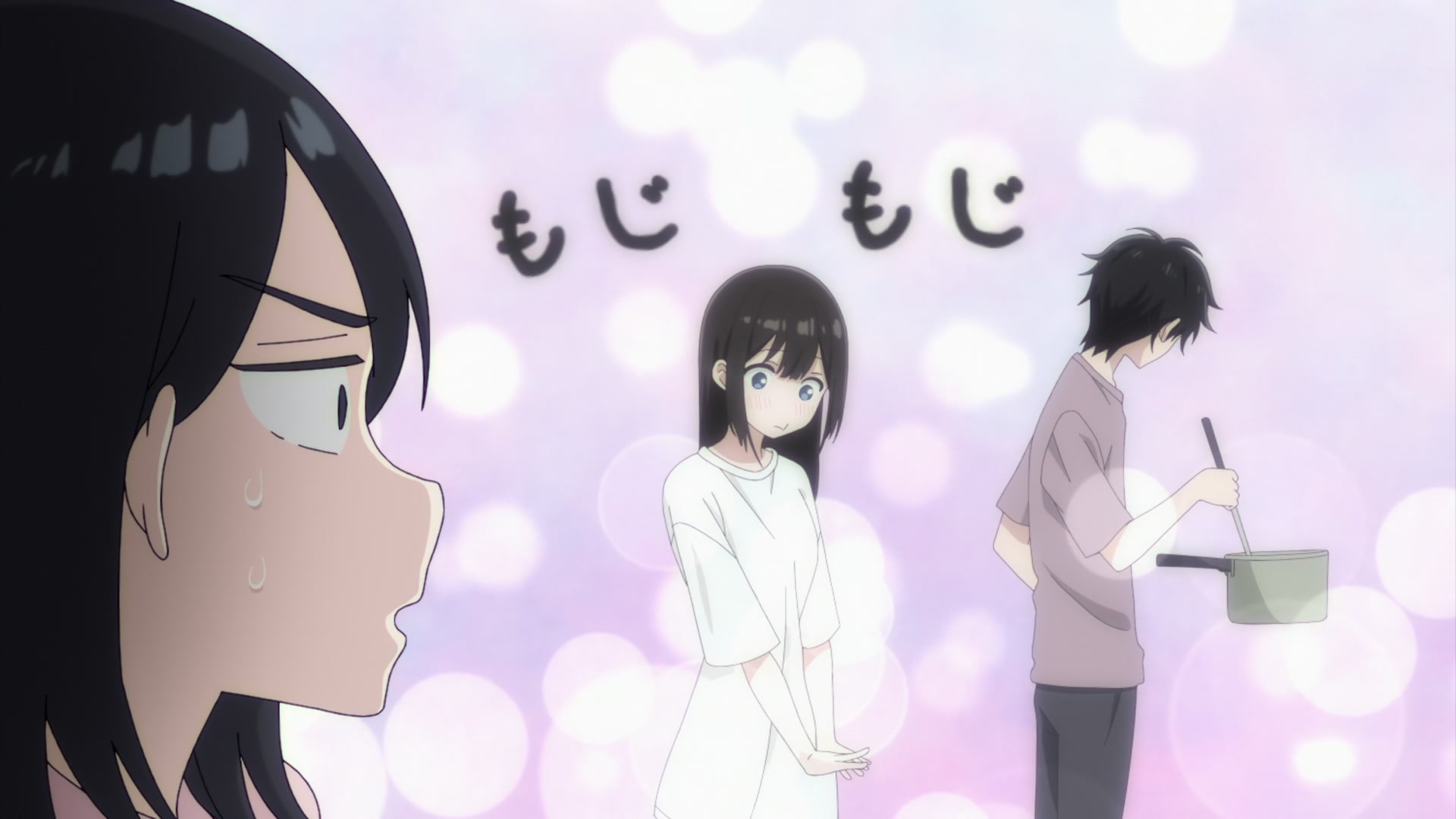
His pride is also intertwined with genuine self-loathing. Yukiya does not believe he deserves Miku. She is popular, cheerful, and surrounded by friends. He is a self-described “shut-in gloomer loner” who prefers video games to social interaction. The love game becomes a self-improvement project. He must become “an awesome man” before he can confess, because confessing while still inadequate would somehow cheapen the confession. He changes his hairstyle, studies shoujo manga for date ideas, learns to cook miso soup, and spends his savings on an elaborate amusement park date, all in pursuit of becoming someone worthy of her.
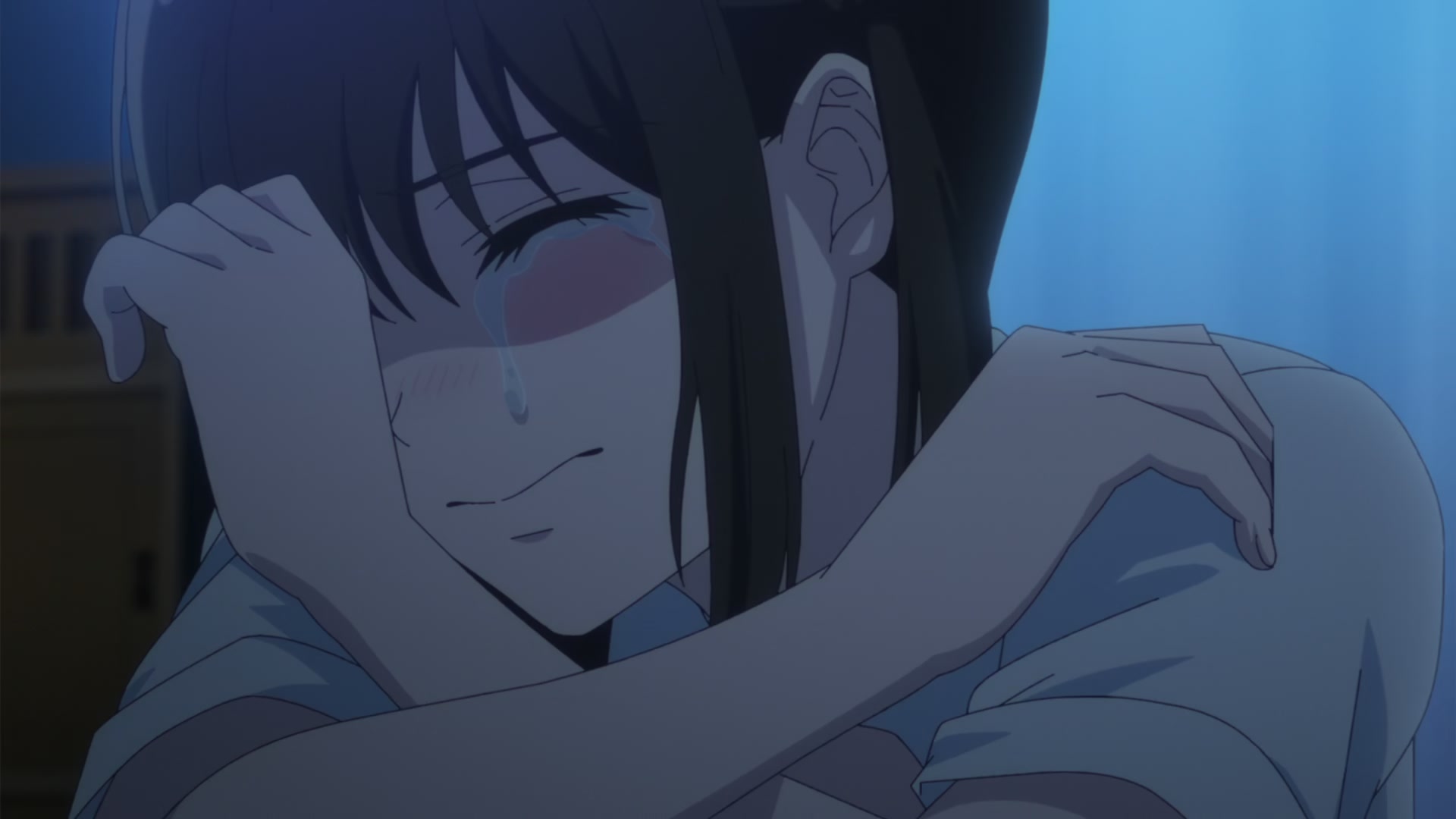
Miku’s pride is specifically gendered. She needs Yukiya to acknowledge her as a girl, as cute, as desirable. She spends hours on her appearance, carefully plans her outfits, and studies his reactions. But winning through trickery or manipulation would invalidate the victory. She wants to be chosen freely, not to force his hand. This is why the kiss in the later episodes becomes such a crisis for her. She initiated it out of jealousy and a desperate need for his attention, and afterward she is consumed by self-loathing, calling herself “low,” “trashy,” and “the worst kind of girl.” The kiss should have been a victory, but it felt like cheating, and cheating means nothing.
The series treats this pride with respect rather than mockery. These are not simply stubborn characters refusing to communicate. They are teenagers whose sense of self is still forming, and admitting romantic feelings feels like risking that fragile self entirely. The game protects them from this risk while also perpetuating it.
Self-Improvement and the Cost of Love
One of the series’ most interesting thematic threads is introduced by Hanaba Hinako, a university student who works at Miku’s uncle’s café. She explains to Yukiya that making someone happy requires “costs”—not just money, but time, thought, and effort. A generic gift bought online with good reviews will produce a generic response. A gift chosen with care, researched, and acquired with effort communicates something far more valuable: that the giver invested themselves in the recipient’s happiness.
This concept becomes a throughline for the entire series. Yukiya’s disastrous amusement park date is a direct application of this philosophy. He stays up nights researching, spends his limited savings, picks out a dress for Miku to wear, reserves a fancy restaurant, and plans a sequence of romantic gestures culminating in giving her a tiara in front of a castle. The date is awkward, cringe-inducing, and ends with him collapsing from exhaustion, but it is also deeply sincere. Miku finds his shoujo manga reference book filled with sticky notes and realizes the extent of his effort. The date fails on its own terms but succeeds as a demonstration of care.
Miku pays her own costs throughout the series. Her hours of preparation for the entrance ceremony, her carefully constructed bento with bite-sized portions tailored to Yukiya’s preferences, her study of his favorite flavors and interests—all of these are investments. The series suggests that love is not just a feeling but a practice, something demonstrated through consistent effort rather than declared in a single confession.
The parallel growth of both characters is one of the series’ quiet strengths. They are both trying to become “good enough” for the other, unaware that they are already more than enough. Their agreement not to end the game until they have achieved this worthiness is both a mutual promise and a shared delusion. It keeps them moving forward while preventing them from arriving.
The Performance of Gender
Both main characters are engaged in performances of gender that complicate their relationship. Miku performs cuteness while fearing she is not genuinely cute. Her cheerful exterior is both authentic and strategic, a conscious choice rooted in her grandmother’s dying request that she keep smiling. She wants Yukiya to see her as a girl, but she is never quite sure that she is succeeding, and the effort exhausts her.
Yukiya performs a cool, confident masculinity that does not come naturally to him. His kabedon attempt in the first episode is undercut by his loose button, which Miku fixes while teasing him. His expensive date plans are undermined by his obvious discomfort in adult spaces. His confident lines are delivered with visible tension. The series finds comedy in these failed performances but never cruelty. Yukiya’s genuine moments of care—tending to Miku when she is sick, worrying about his sister Wakana, quietly making miso soup—are where his true self emerges, and these moments are treated with warmth and respect.
The series gently suggests that authenticity is not a starting point but an achievement. Both characters are trying to become more authentic versions of themselves, and the love game, paradoxically, helps them practice. By forcing them to express affection within a structured framework, it gives them space to develop the skills they will need when they finally step outside that framework.
Cultural Context and Adaptation Notes
The series is deeply rooted in Japanese cultural patterns around indirect communication. The concept of “reading the atmosphere” (kuuki wo yomu) is central to how these characters interact. Direct confession is avoided not just out of personal fear but because it violates the unspoken rules of their relationship. The love game is a culturally legible way to express feelings without breaking these rules.
Food serves as a primary love language throughout the series, which is a well-established pattern in Japanese storytelling. Miku’s homemade bento, the shared parfaits, the daifuku mochi they make together in the final episode—all of these carry emotional weight that would be immediately recognizable to a Japanese audience. Cooking for someone, sharing food with them, and paying attention to their preferences are all ways of saying “I care about you” without saying the words.
The series also engages knowingly with shoujo manga conventions. Both Yukiya and Miku use shoujo manga as reference material for their love game strategies, which is both a nod to the genre’s influence and a gentle commentary on how media shapes romantic expectations. Wakana’s manga collection becomes the playbook for both sides, and the gap between manga romance and reality is a recurring source of comedy.
I experienced this series as an anime-only viewer and cannot speak to what may have been cut, compressed, or altered from any source material. The anime stands on its own as a complete, emotionally coherent narrative. The character arcs are clear, the themes are well-developed, and the ending, while open, feels intentional rather than truncated. If source readers have specific complaints about adaptation choices, I have no basis to evaluate them, but the anime as a standalone work is satisfying.
Characters
Asagi Yukiya: The Reluctant Romantic
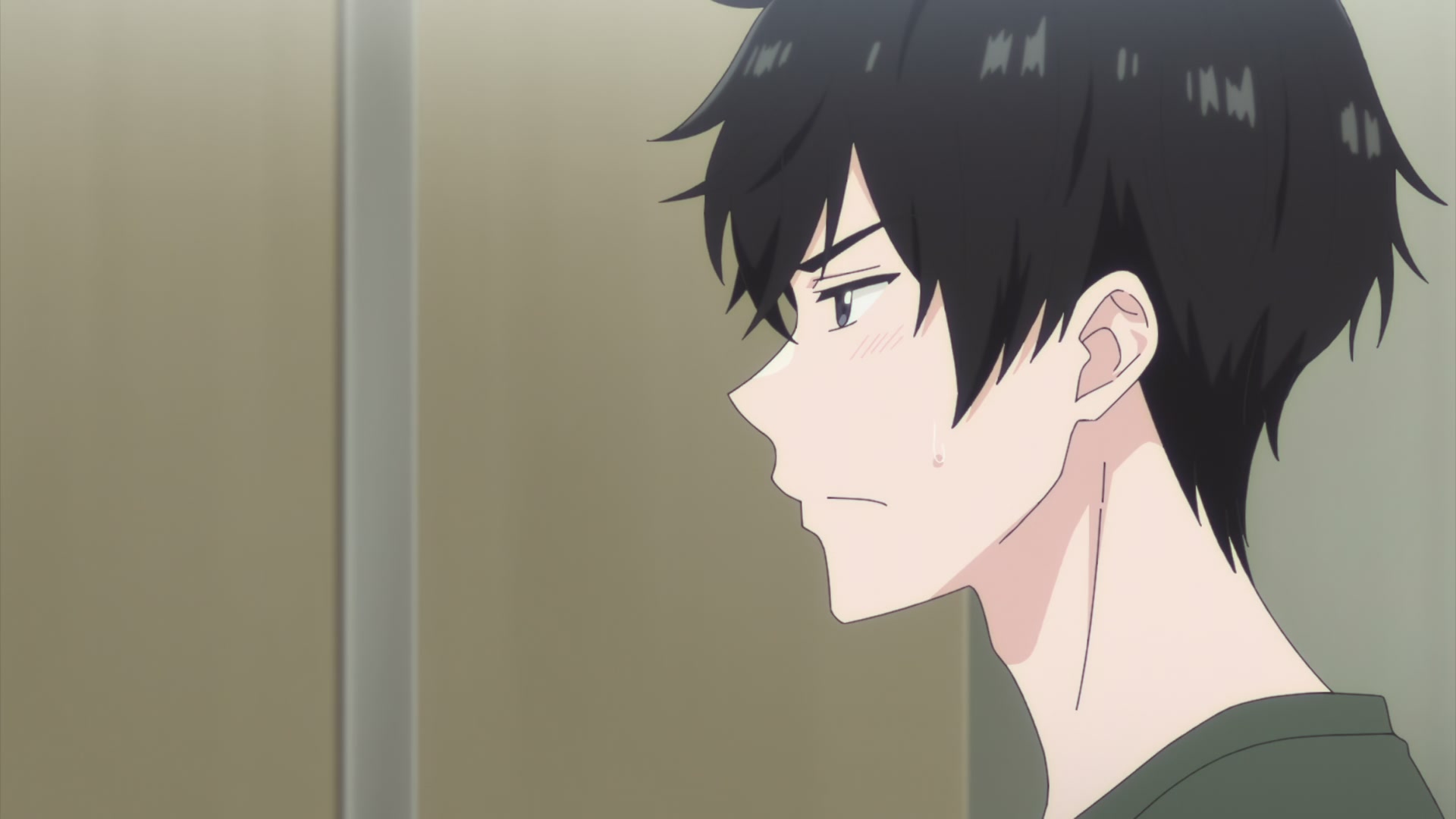
Yukiya is the kind of protagonist who grows on you gradually. On first impression, he seems like a standard aloof loner type—sarcastic, withdrawn, more comfortable with video games than people. But the series quickly reveals the rich inner life beneath this exterior. His internal monologues are where the character truly lives, and they paint a picture of someone completely, hopelessly in love, whose every sharp word to Miku is a desperate attempt to maintain cover.
What makes Yukiya compelling is the gap between his self-perception and reality. He calls himself a loner, but he has maintained a deep, complex relationship with Miku for years. He claims to prefer solitude, but he lights up when she is around. He insists he does not care about social media, but he installs Instagram specifically to create a shared album with her. His actions consistently betray his words, and the series trusts the audience to notice.
His growth across the twelve episodes is incremental but meaningful. He begins as someone who can only express care through the game’s framework. By the end, he is capable of sitting with Miku while she is sick, wiping her sweat, making her food, and telling her that he likes her flaws without needing to frame it as a game move. He still cannot say “I love you” directly, but he has learned to show it in ways that matter more.
His relationship with his sister Wakana adds another dimension. His overprotectiveness reveals a caring nature that he struggles to express with Miku. The scene where he tucks Wakana in after she has fallen asleep, a gesture she pretends not to notice, is a quiet moment that speaks volumes about who he is beneath the sarcasm.
Sakura Miku: The Insecure Genki Girl
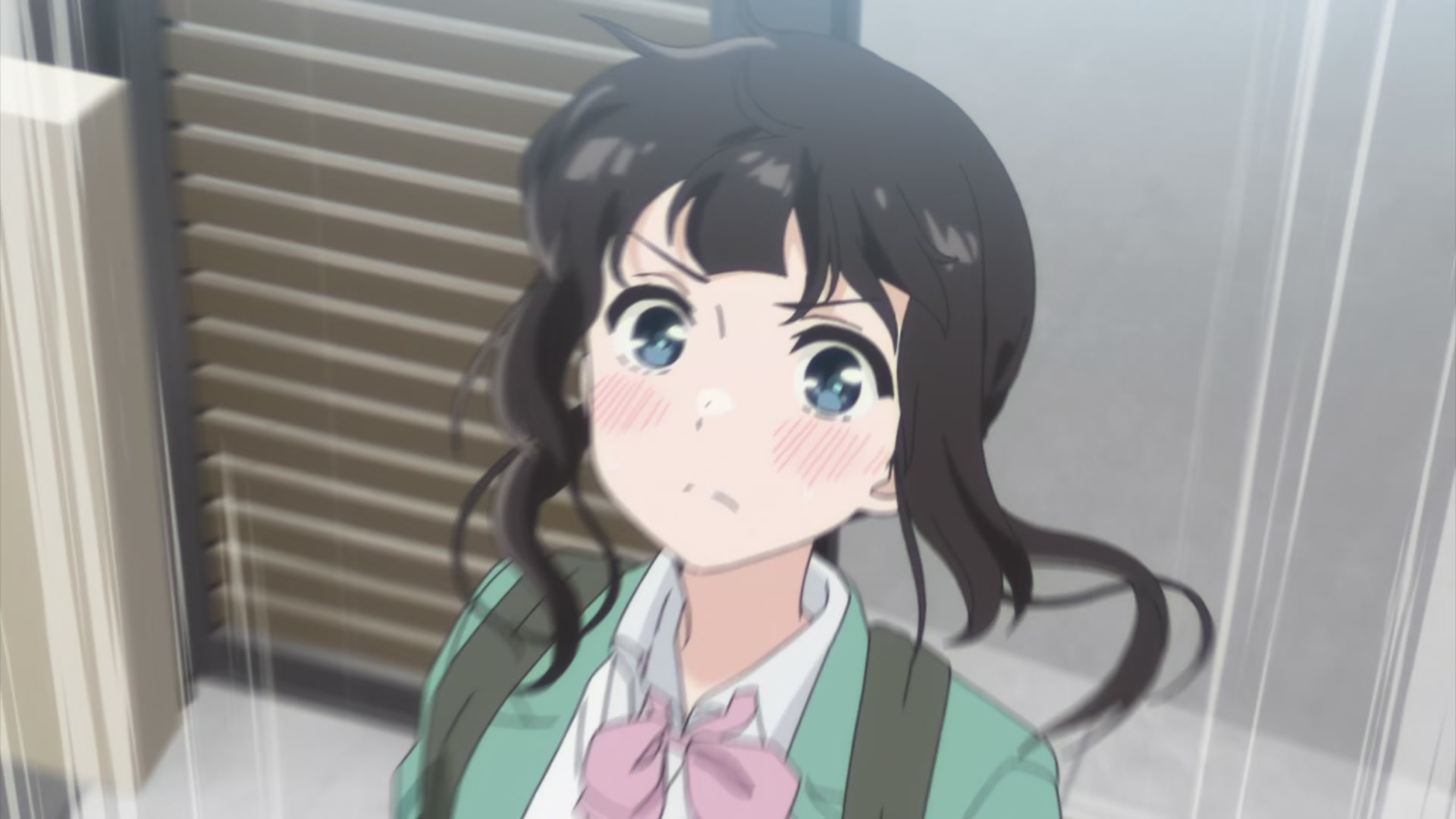
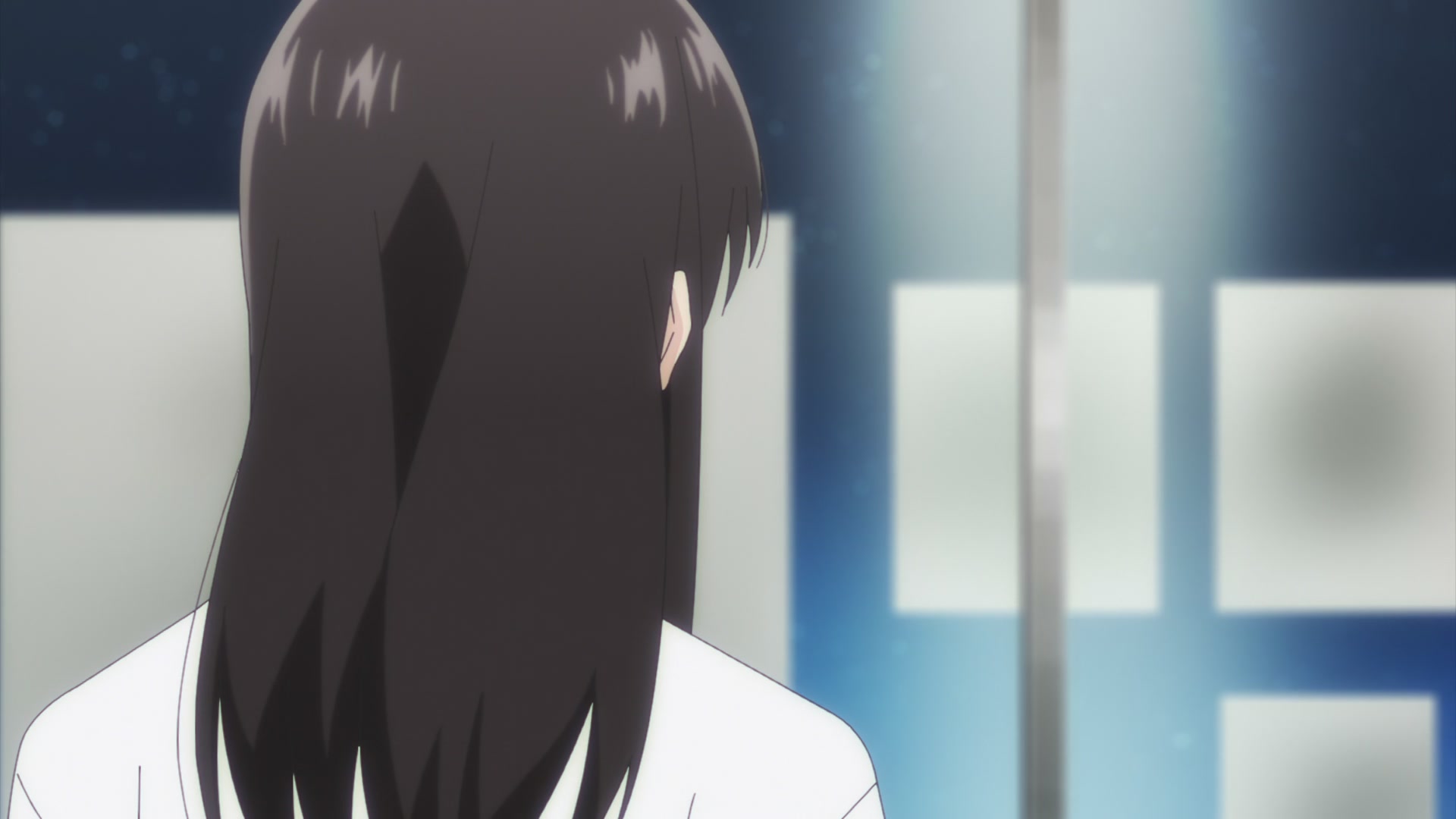
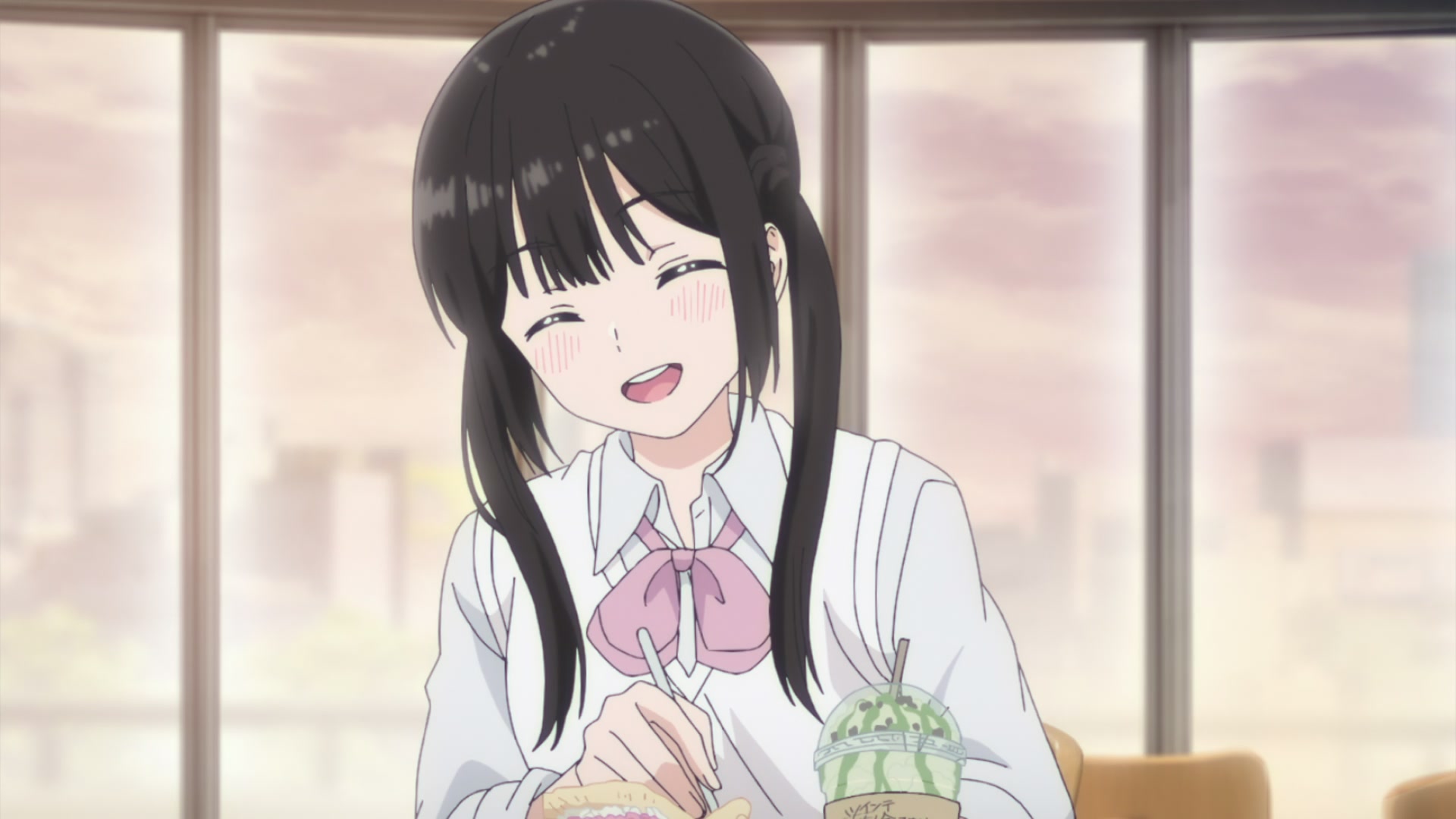
Miku initially presents as the classic cheerful, popular girl—surrounded by friends, active on social media, effortlessly sociable. But this exterior is both genuine and strategic. She is genuinely warm and friendly, but she also uses her social skills as armor, and her cheerfulness is a conscious choice rooted in her grandmother’s deathbed request that she keep smiling.
Her internal life is dominated by insecurity about how Yukiya sees her. She started the love game specifically to make him acknowledge her as a girl, and four years later, she still does not feel she has succeeded. Every interaction is analyzed for evidence of his feelings. When he compliments another girl’s lipstick as “super cute,” it devastates her—not because she thinks he is interested in the other girl, but because he used the word she has been desperate to hear, and he used it for someone else.
The kiss crisis in the later episodes is Miku’s most vulnerable moment. She initiated physical intimacy out of jealousy and a desperate need for validation, and afterward she is consumed by guilt. She believes she manipulated Yukiya, used his male desires against him, and proved herself unworthy of genuine affection. Yukiya’s reassurance—that he likes her flaws, that he admires her persistence, that she looks best when smiling—helps her begin to accept that she is loved even when she is not perfect.
Miku’s relationship with her deceased grandmother adds emotional depth. The origami flowers she makes for the grave, the regular visits where she talks through her problems, and the weight of the promise to smile all ground her character in something beyond the romance. She is not just a love interest. She is a young woman carrying grief and trying to honor a loved one’s memory while navigating her own desires.
The Supporting Cast
Wakana, Yukiya’s younger sister, serves as both audience surrogate and comic relief. Her exasperated reactions to her brother’s antics—the “Ew, Onii!” that punctuates several episodes—validate our own amusement at how ridiculous these two can be. But she is more than a Greek chorus. Her fight with Yukiya over his overprotectiveness shows her as a teenager navigating her own independence, and her quiet appreciation of his care reveals the warmth beneath their bickering.
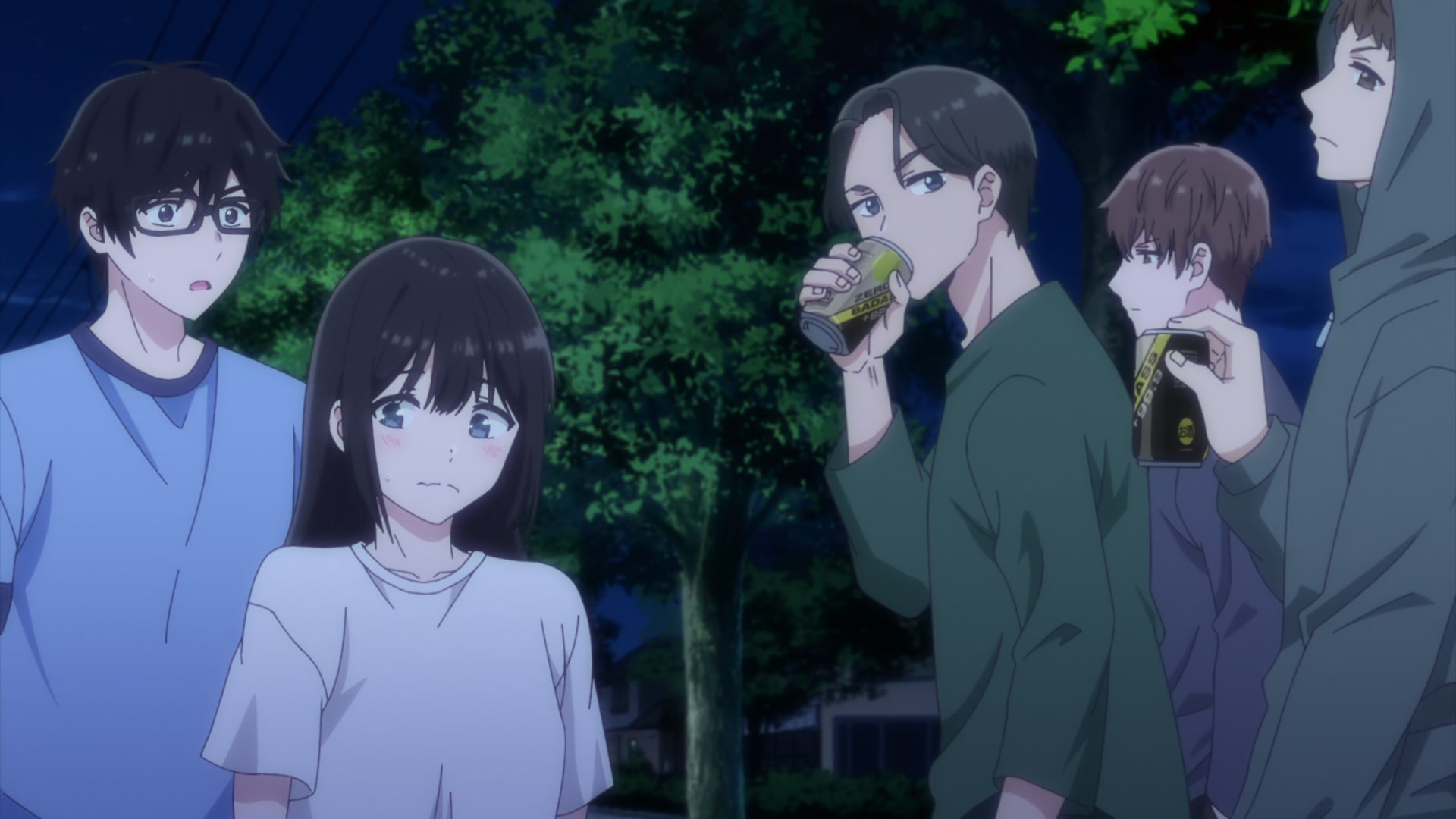
Shirayuri Kazane and Chigusa Kakeru, the student council president and her childhood friend, function as a parallel couple that highlights how much progress the main pair has actually made. Kazane is a more extreme tsundere whose feelings for Kakeru are expressed almost entirely through violence. She punches him, jabs him, and scolds him, and he remains completely oblivious, accepting her aggression with good-natured patience. Her request that Miku teach her the love game is both comic and poignant. She recognizes that her methods are not working and wants to learn a different way, but she is so uncomfortable with vulnerability that even role-playing a seductive line sends her into a spiral of scandalized denial.
Kazane’s reactions to Miku’s demonstrations—”Debauchery!” “Lewd!” “Obscene!”—are some of the series’ funniest moments, but they also reveal a deep discomfort with her own desires. She wants what Miku has but is terrified of the vulnerability it requires. Her small victory in the final episode, offering Kakeru a Pokitto snack, is a quiet triumph that suggests she is beginning to find her own path.
Hinako and Masaru, the adults at Café Kanade, provide perspective from outside the adolescent bubble. Hinako’s pragmatism about the “costs” of love and Masaru’s patient wisdom create a balanced adult presence. Masaru’s advice to Yukiya—”Setting aside what’s correct, what is it that you want?”—is the most philosophically significant line in the series, cutting through Yukiya’s overthinking to refocus him on his own desires.
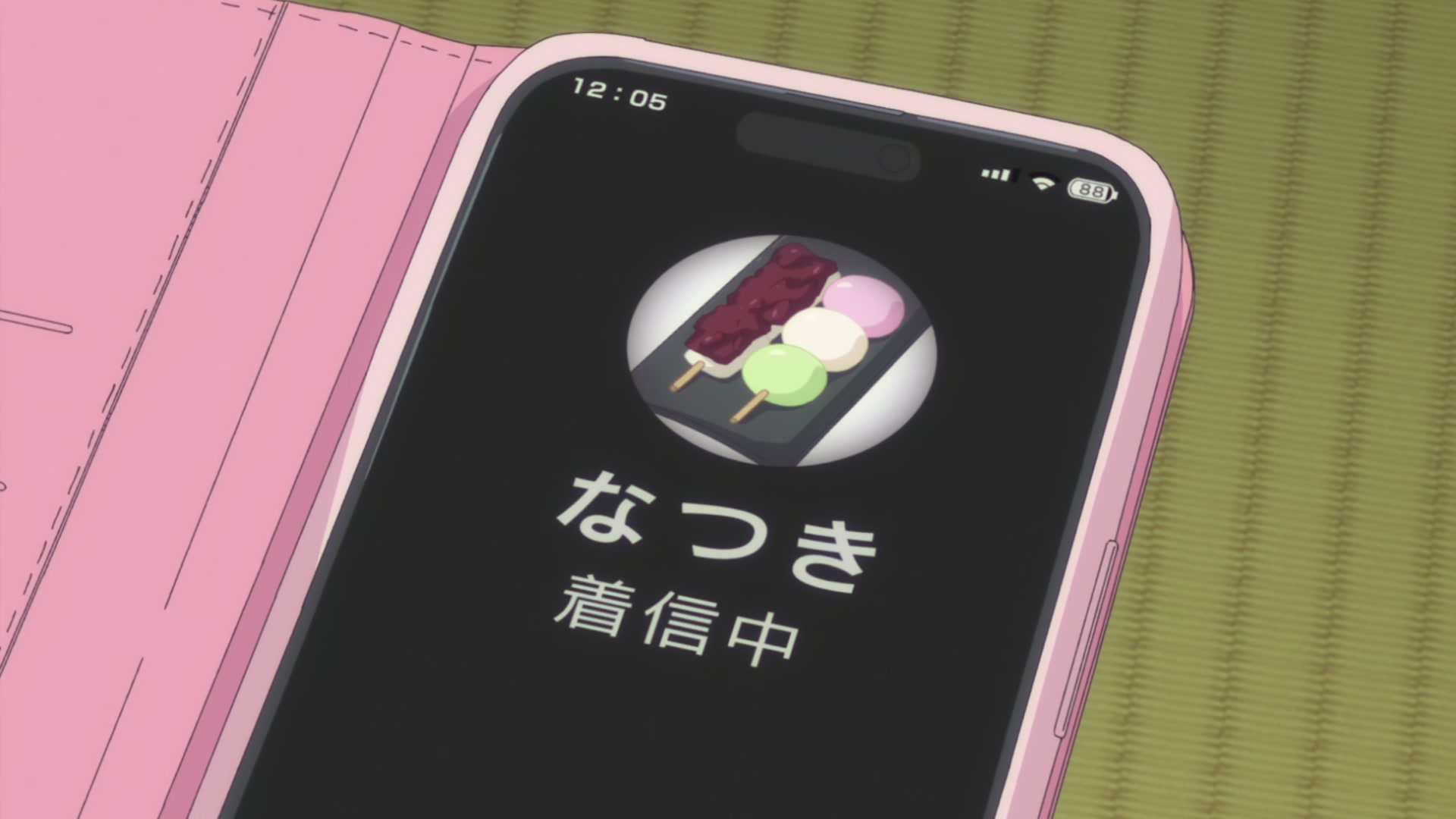
Akane and Natsuki, Miku’s friends, represent her social world outside of Yukiya. Akane’s easy confidence and unintentional triggering of Miku’s jealousy drive important plot developments, while Natsuki’s loyal enthusiasm provides emotional support. Neither character is deeply developed, but they serve their narrative functions well.


Visuals and Animation
Art Direction and Aesthetic Identity
The series employs a clean, polished digital aesthetic that prioritizes emotional legibility over realism. The default visual mode is bright and inviting—sunny classrooms, warm domestic spaces, soft lighting that makes the world feel safe and comfortable. This baseline makes the shifts into more heightened visual modes more effective. When the emotional temperature rises, the art direction follows.
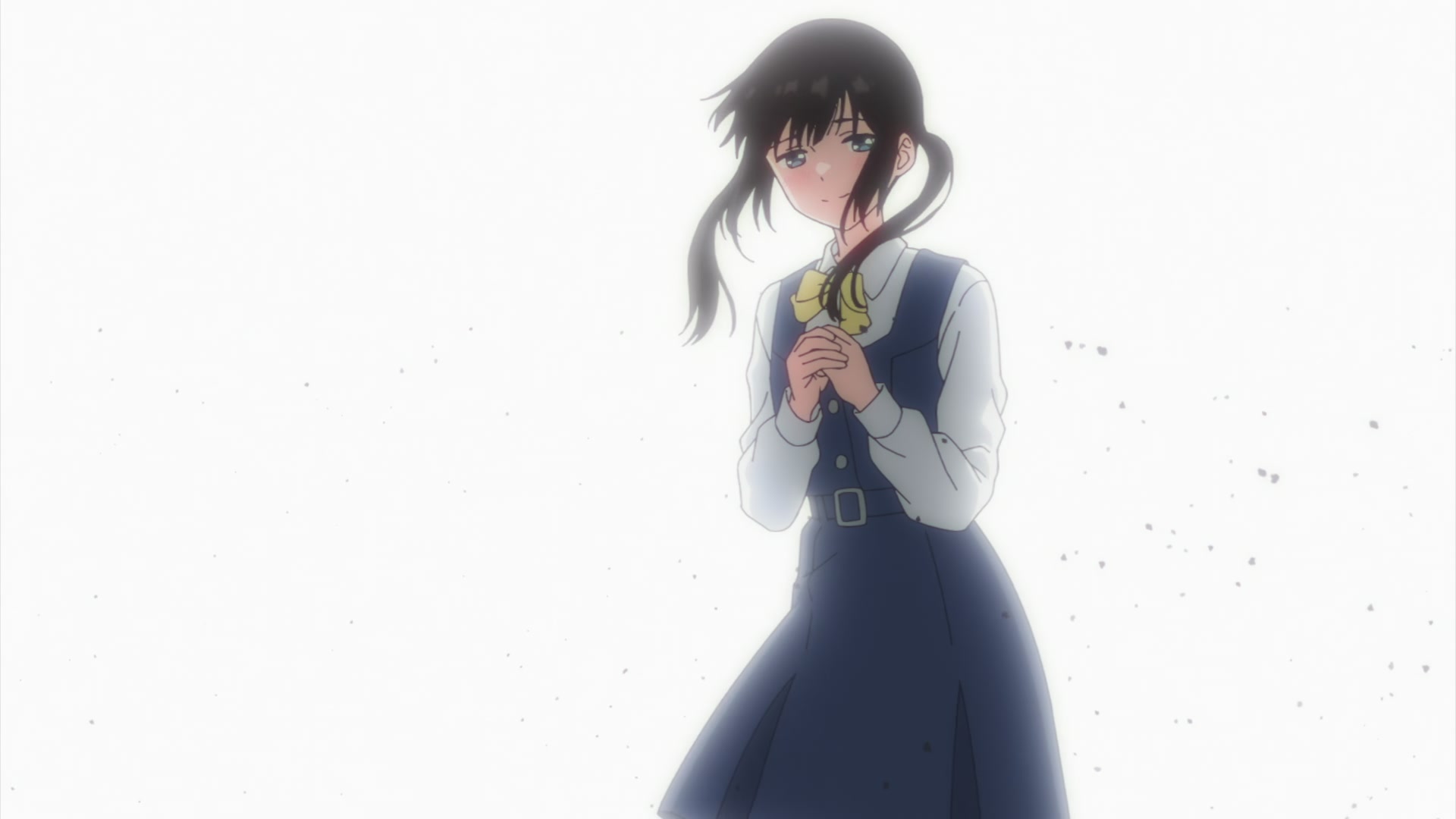
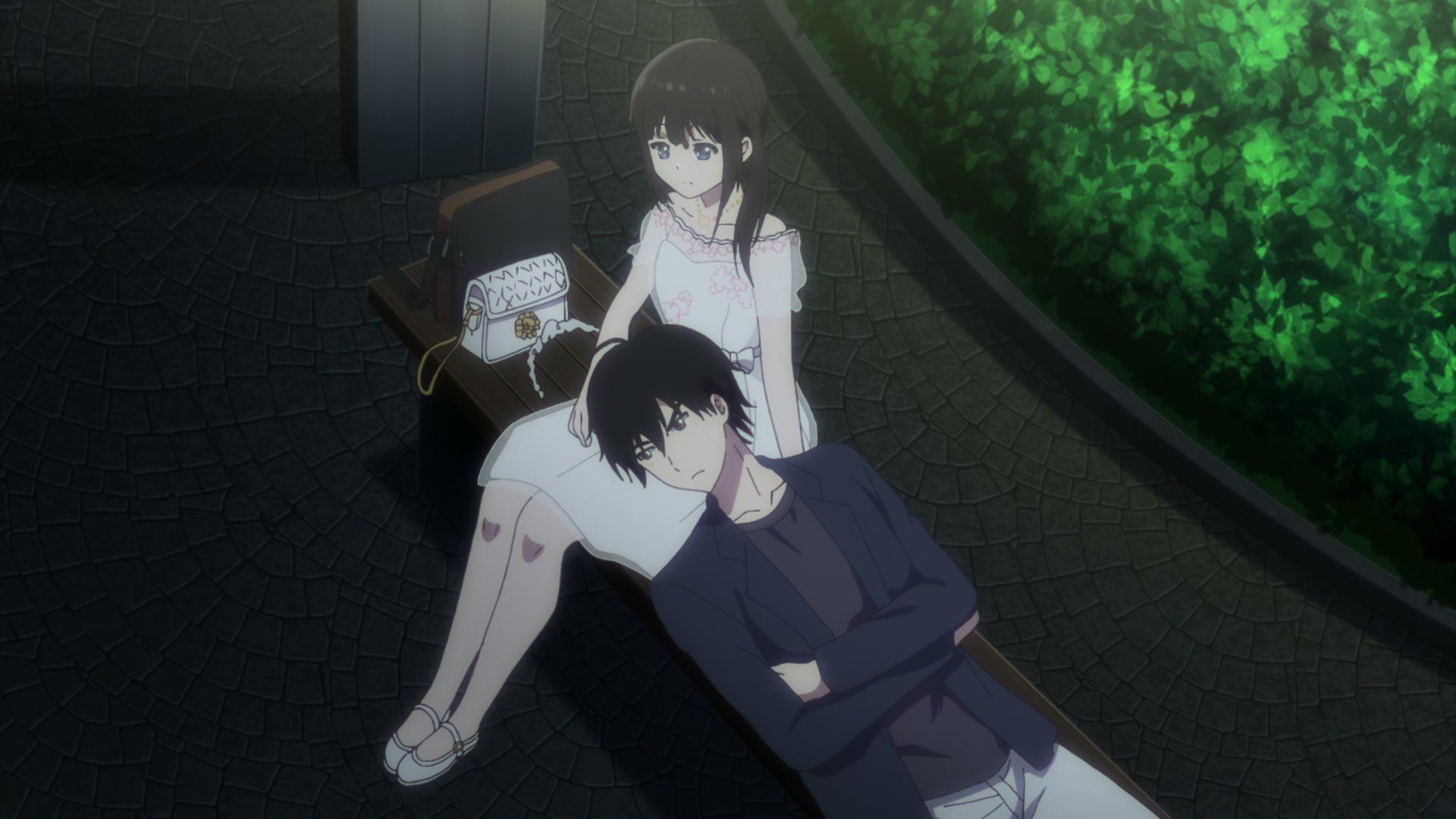
Romantic moments are bathed in warm golds and soft bloom effects. Intimate scenes between Yukiya and Miku often feature a dreamy, slightly idealized quality created by digital glow around hair and clothing. Melancholy or introspective sequences shift to cooler palettes—deep blues, sharp directional shadows, a sense of isolation created through lighting choices. The series is not afraid to use abstract, textured backgrounds during moments of psychological intensity, pulling away from literal representation to convey internal states.
This “mood-based” approach to art direction is one of the series’ strengths. It understands that the goal is not photographic accuracy but emotional truth, and it uses every tool in the digital compositing toolkit to achieve that truth.
Character Designs and Acting
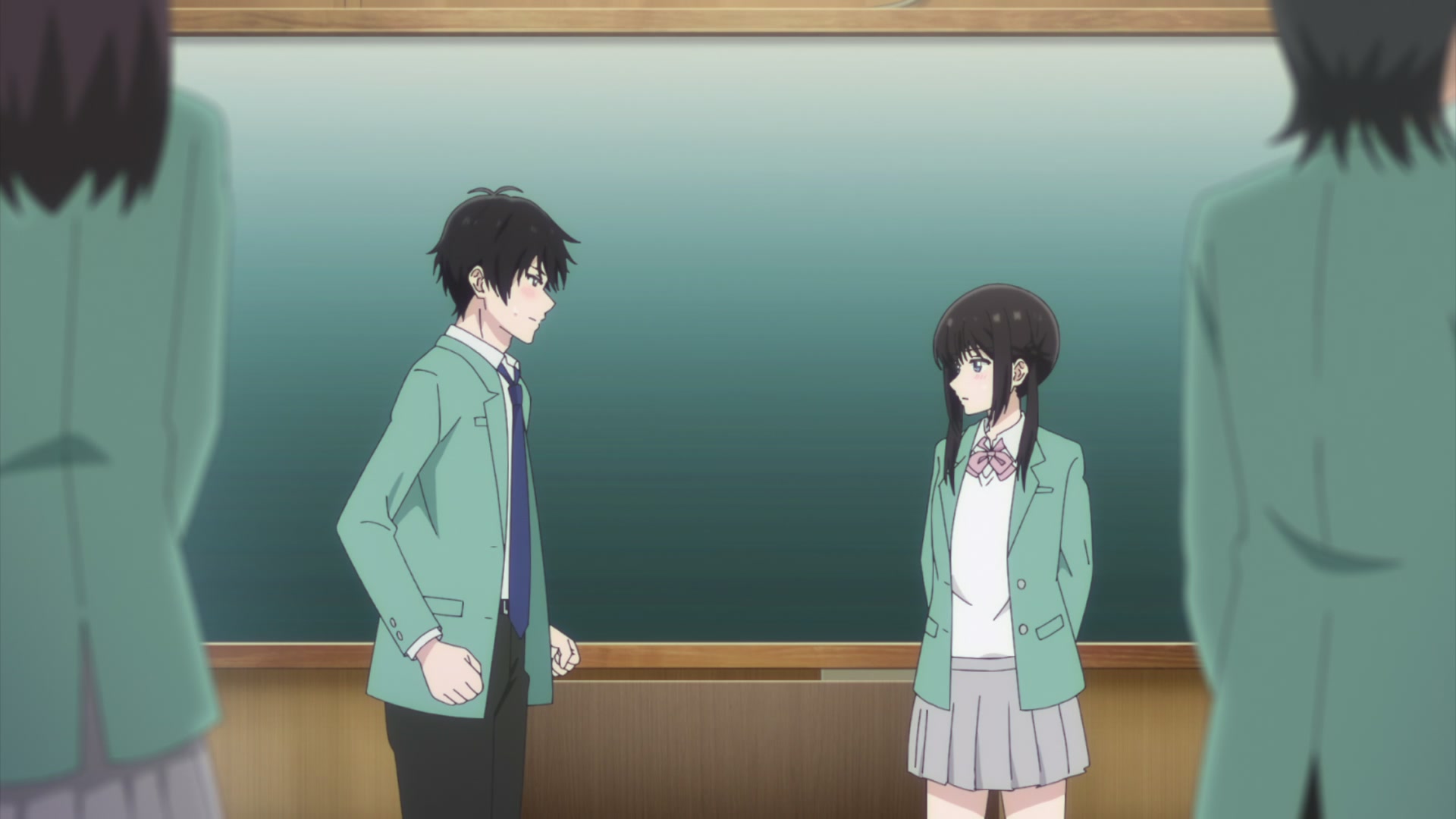
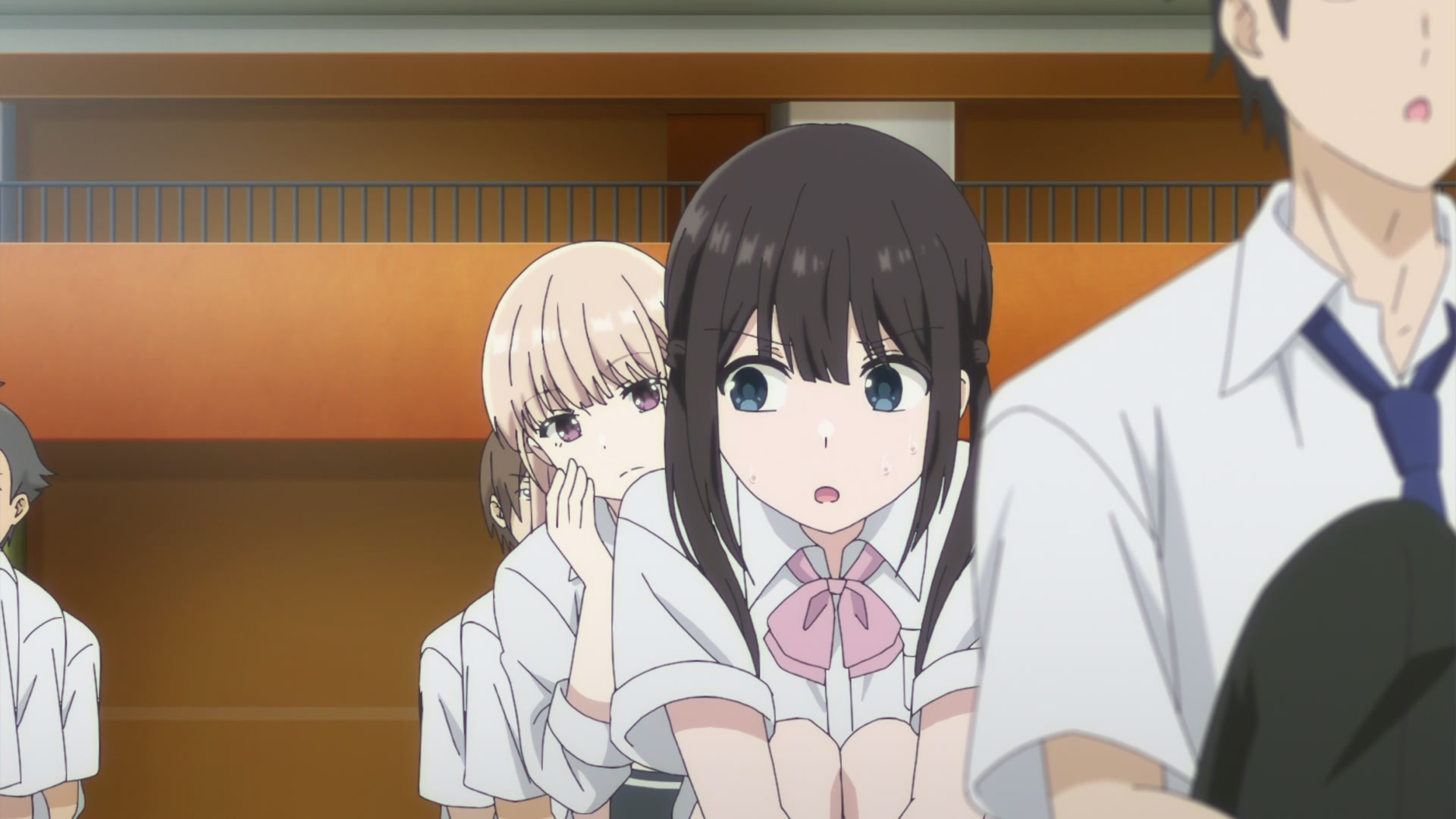
The character designs are grounded and contemporary. Thin, consistent linework holds up well in close-up, and the characters look like actual high school students rather than idealized fantasies. They are attractive without being extravagant, which suits the series’ tone.
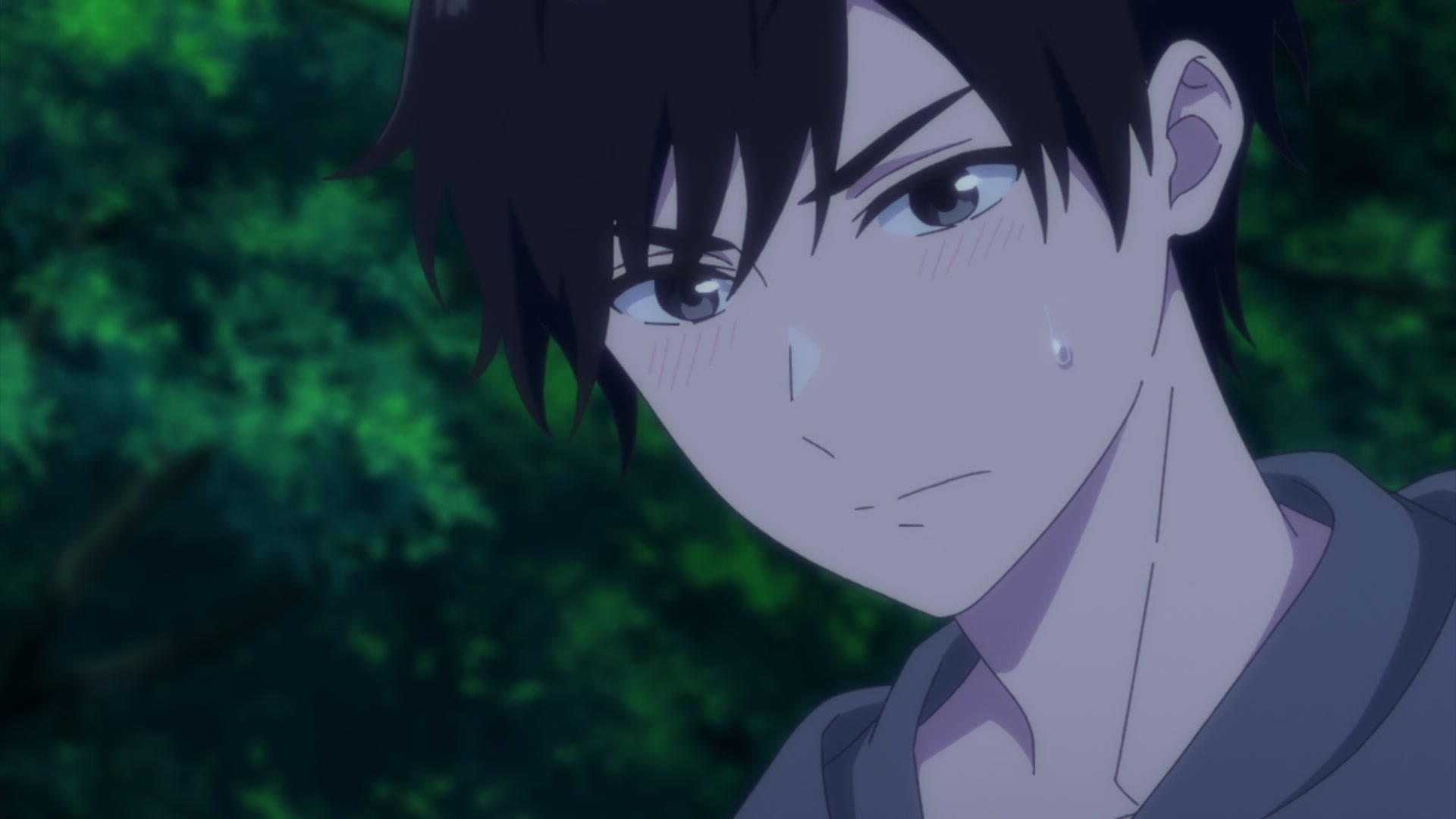
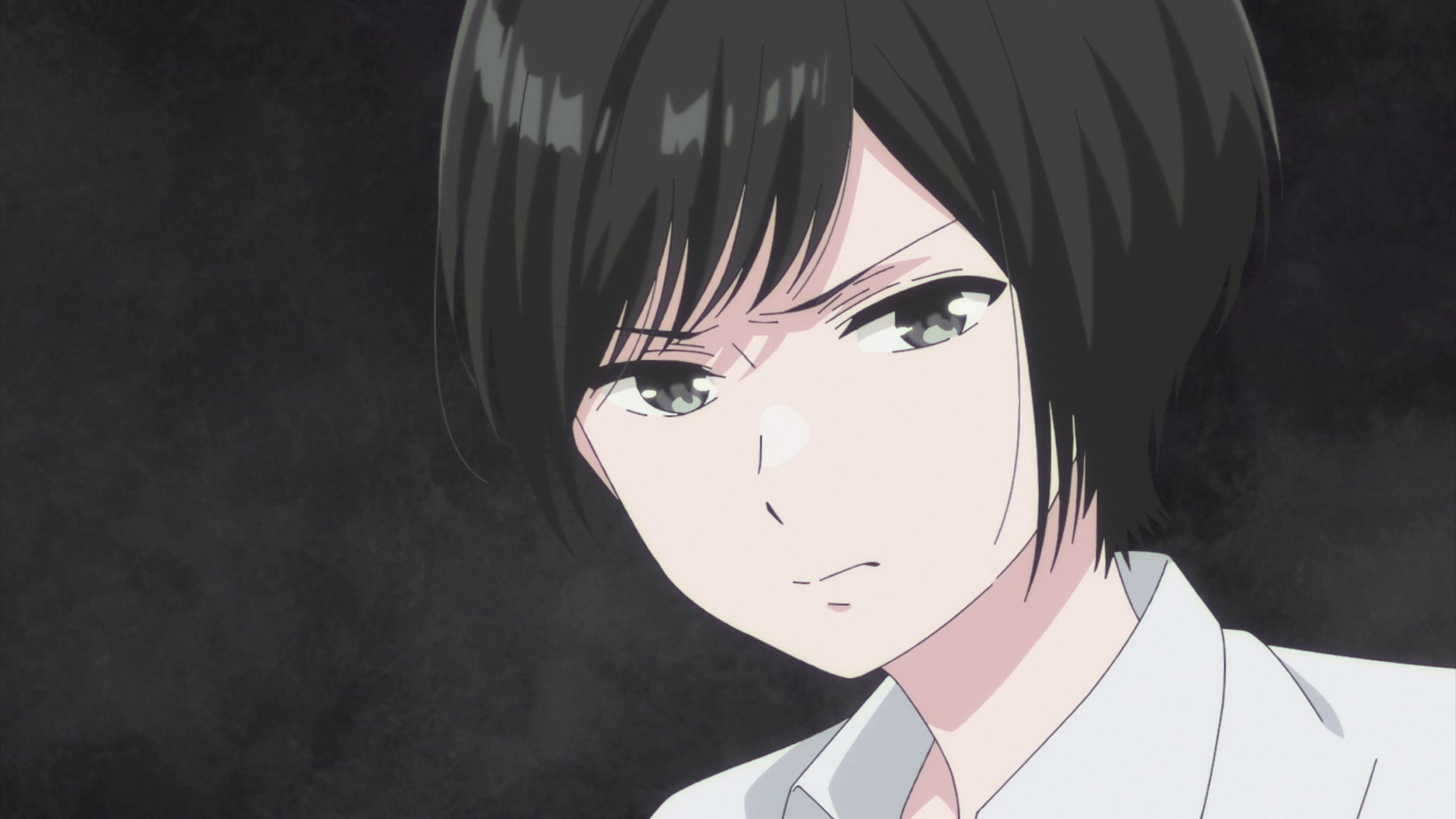
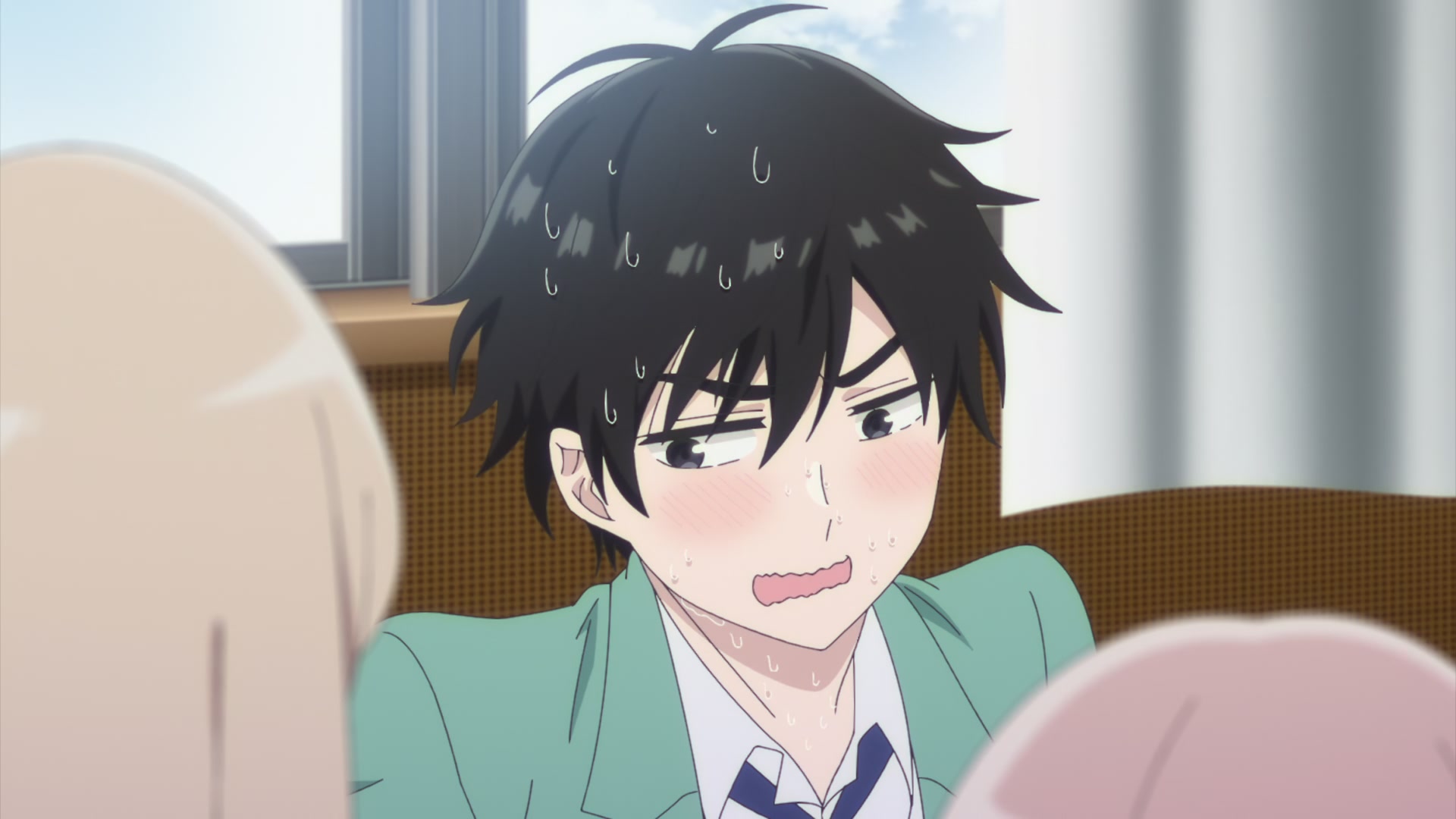
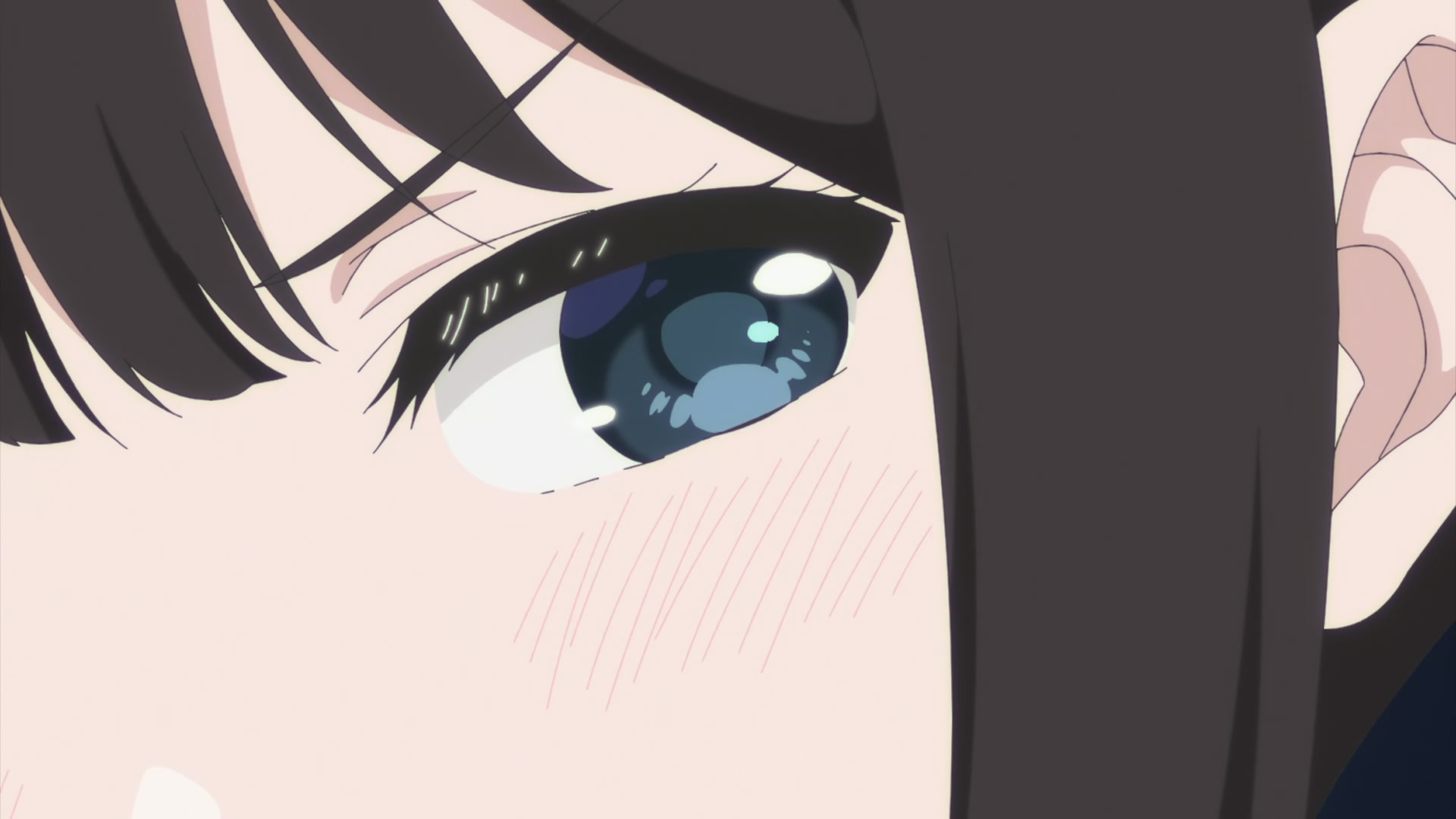
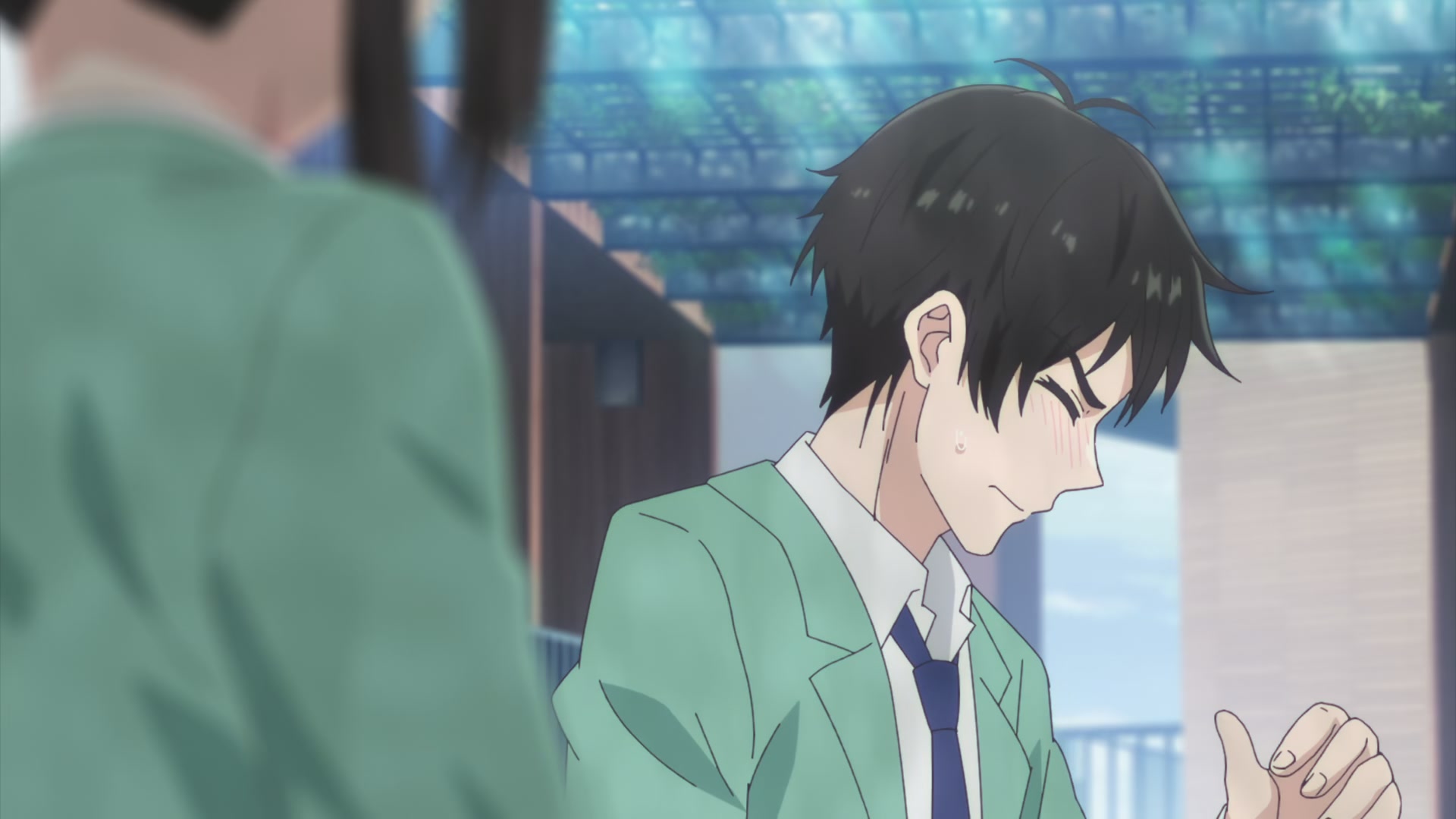
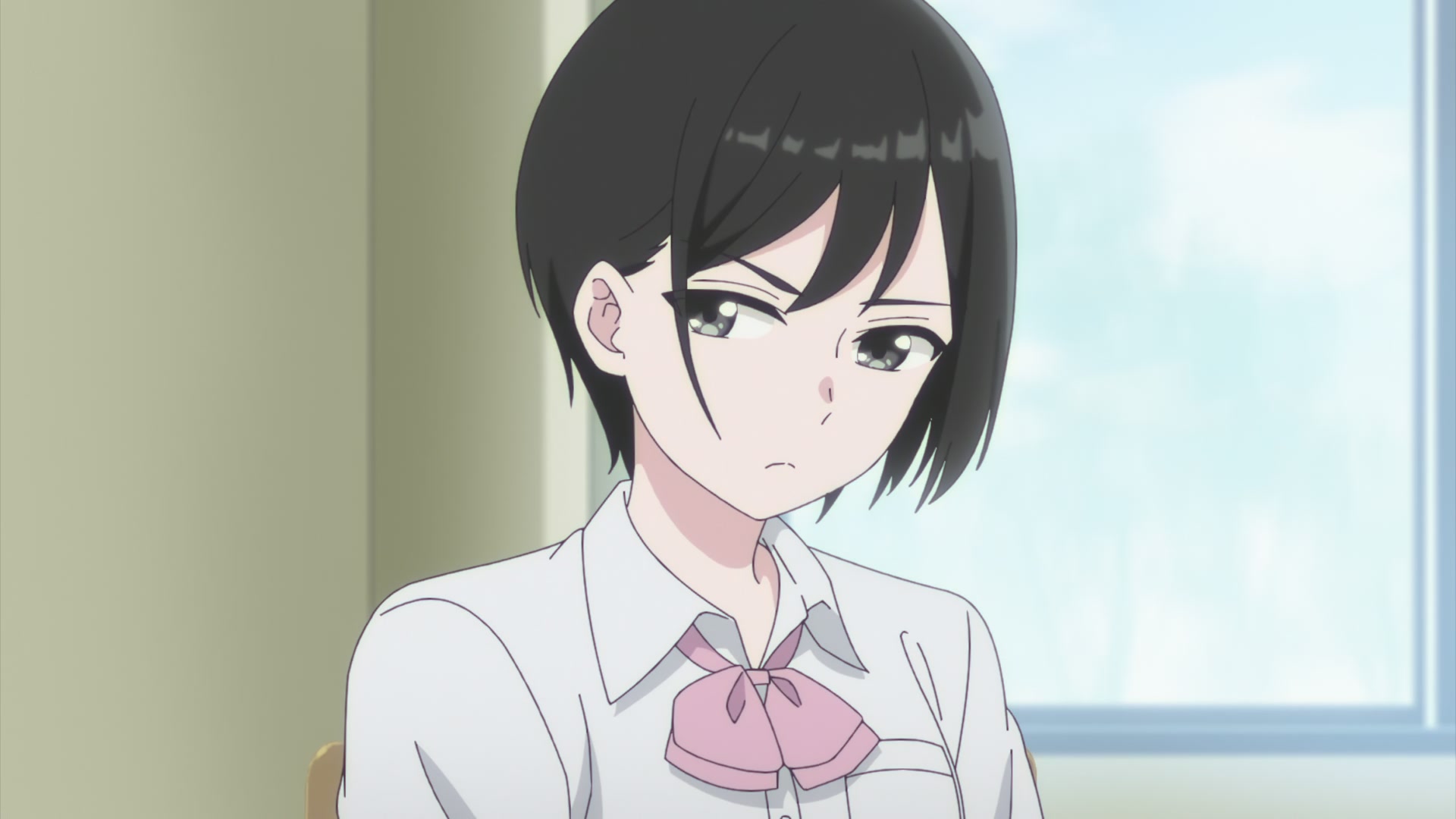
The facial animation is where the visual presentation truly excels. The series invests heavily in “eye-acting”—irises rendered with multiple highlight layers that create depth and emotional legibility. Subtle shifts in brow position, mouth shape, and blush intensity convey internal states without needing dialogue. The “micro-acting”—small hesitations, averted gazes, tightening expressions—is consistently excellent and carries much of the series’ emotional weight.
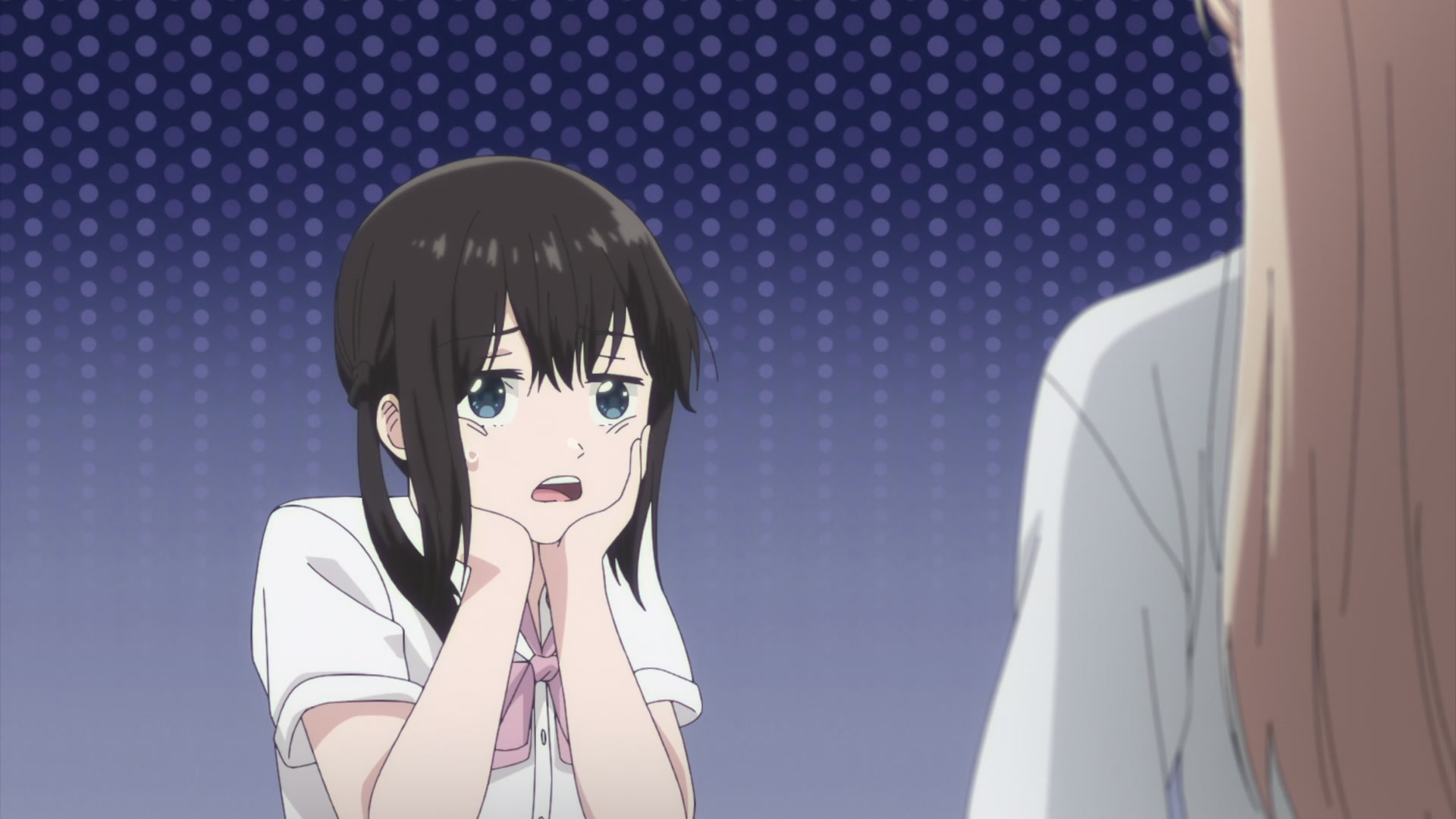
In moments of high comedy or extreme emotion, the art style shifts toward exaggeration. Linework becomes thicker or wobbly, facial features simplify, and background detail is often crushed or replaced with simple patterns to focus attention entirely on the character’s reaction. These shifts are well-deployed and never feel out of place. The contrast between realistic subtlety and comedic hyperbole is part of the series’ charm and reflects its dual identity as both romantic drama and comedy.
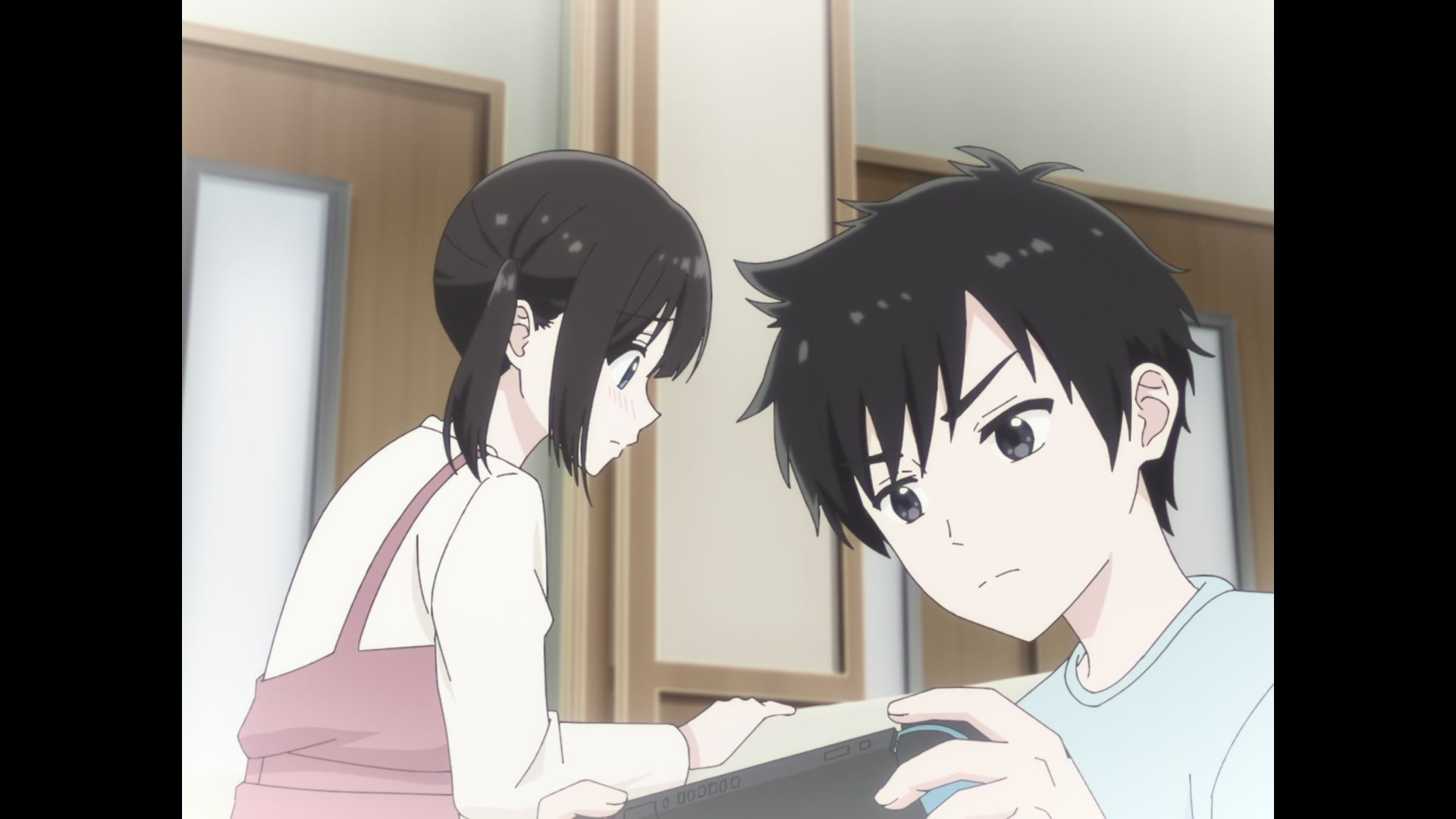
Physicality is handled with care. Characters feel grounded in their bodies, and intimate moments—hand-holding, hair-tying, sharing a futon—are staged with attention to physical proximity and body language. The “lived-in” quality of the character animation contributes significantly to the series’ warmth.
Background Art and Environments
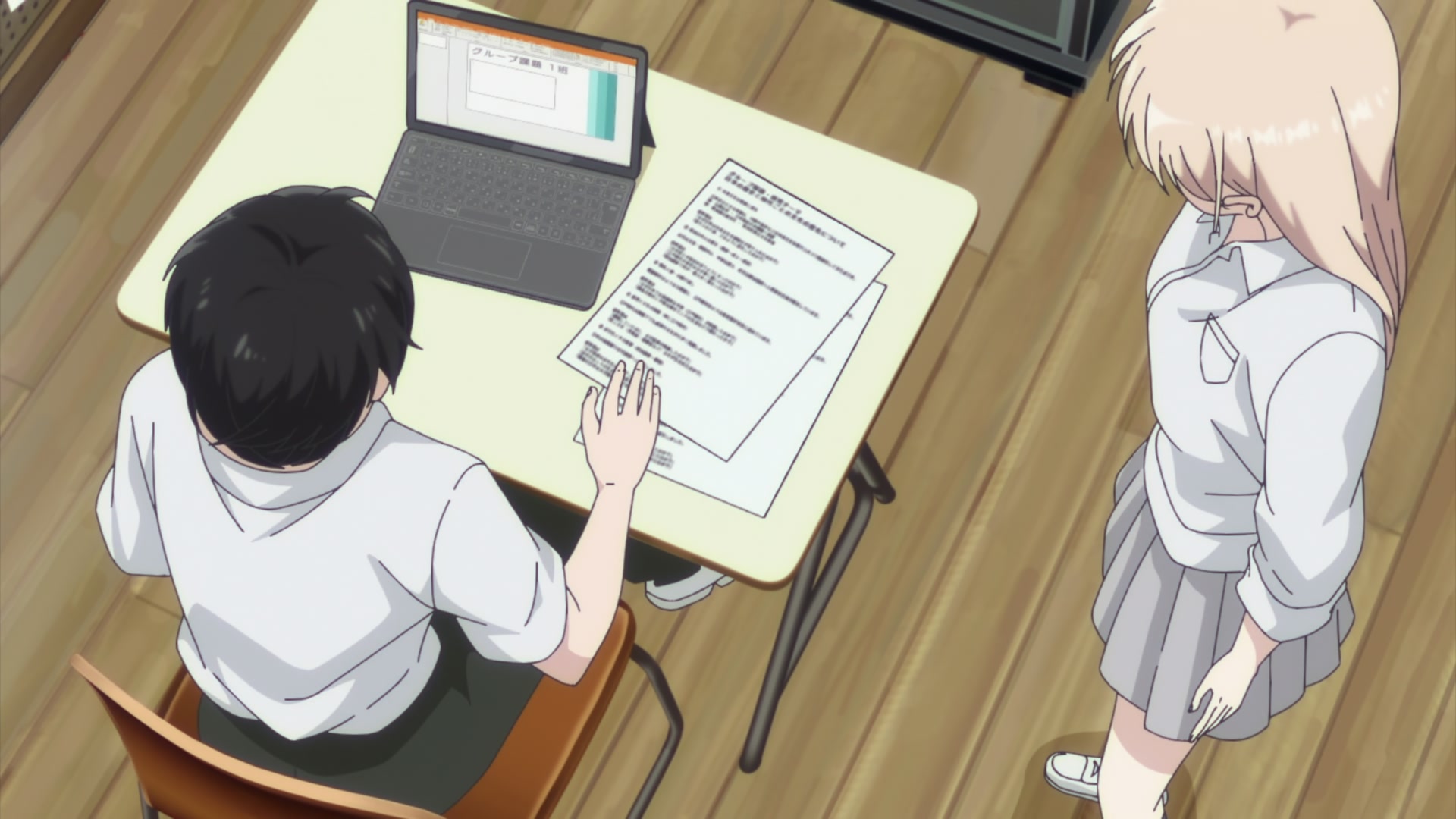
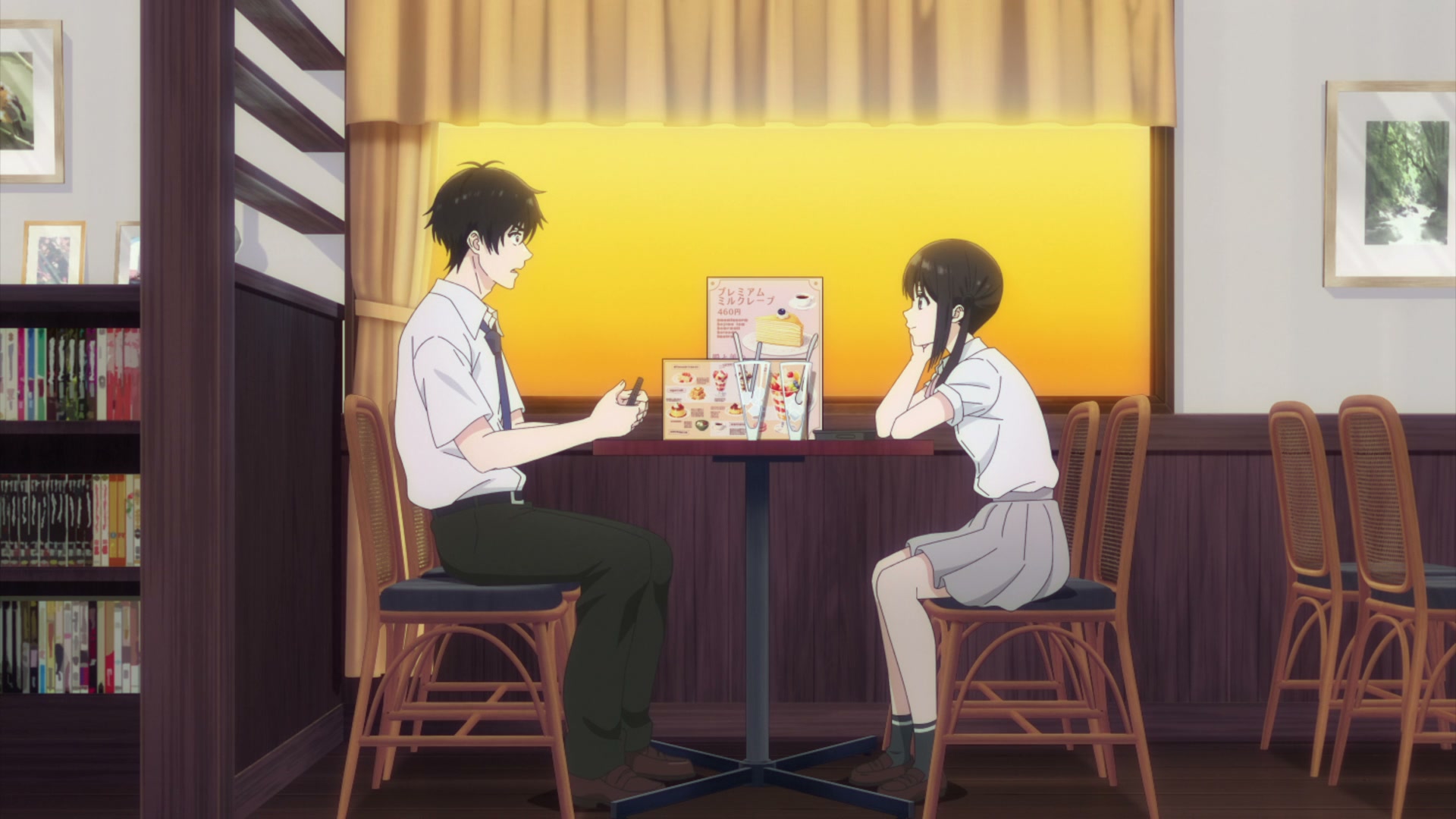
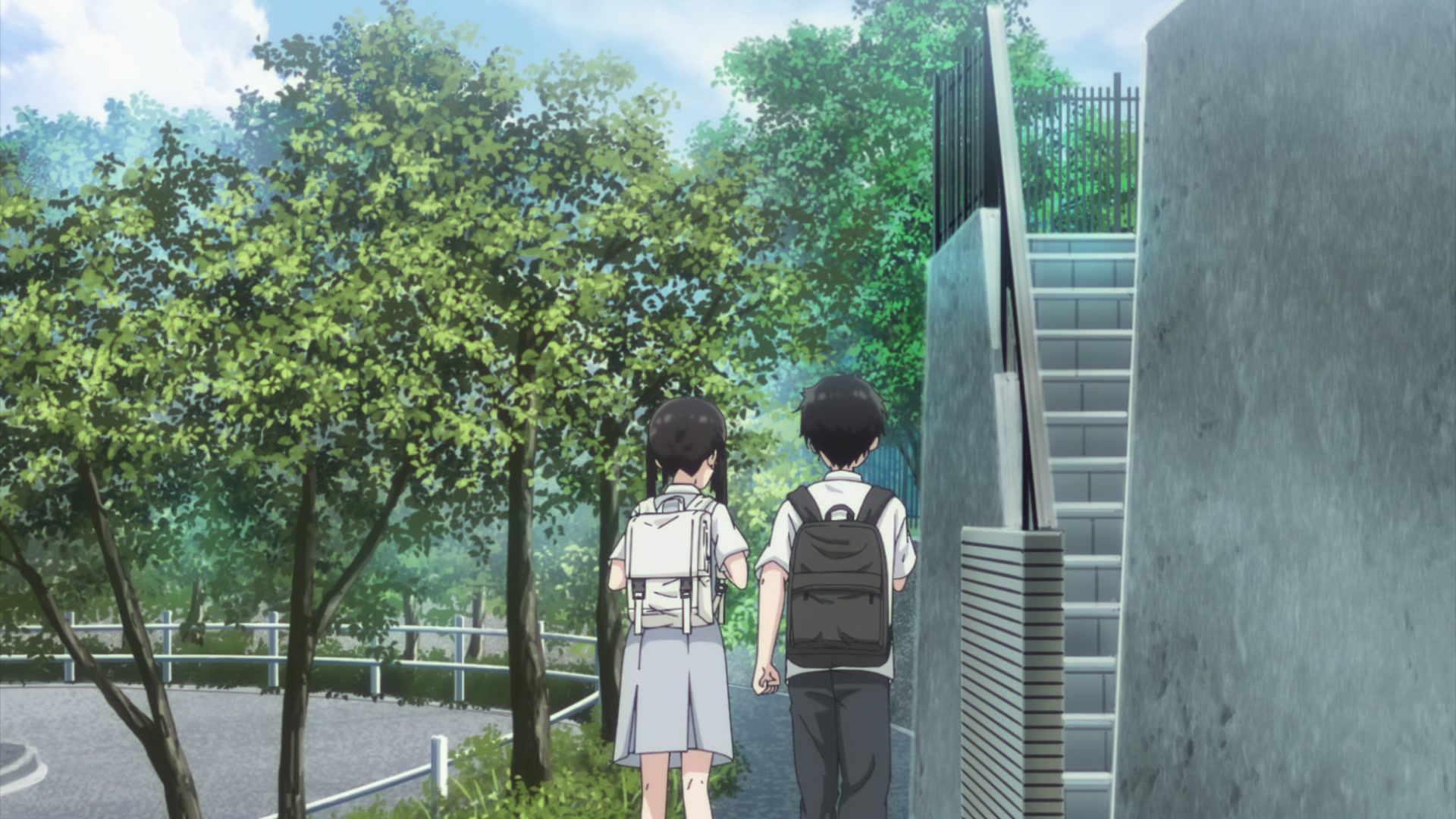
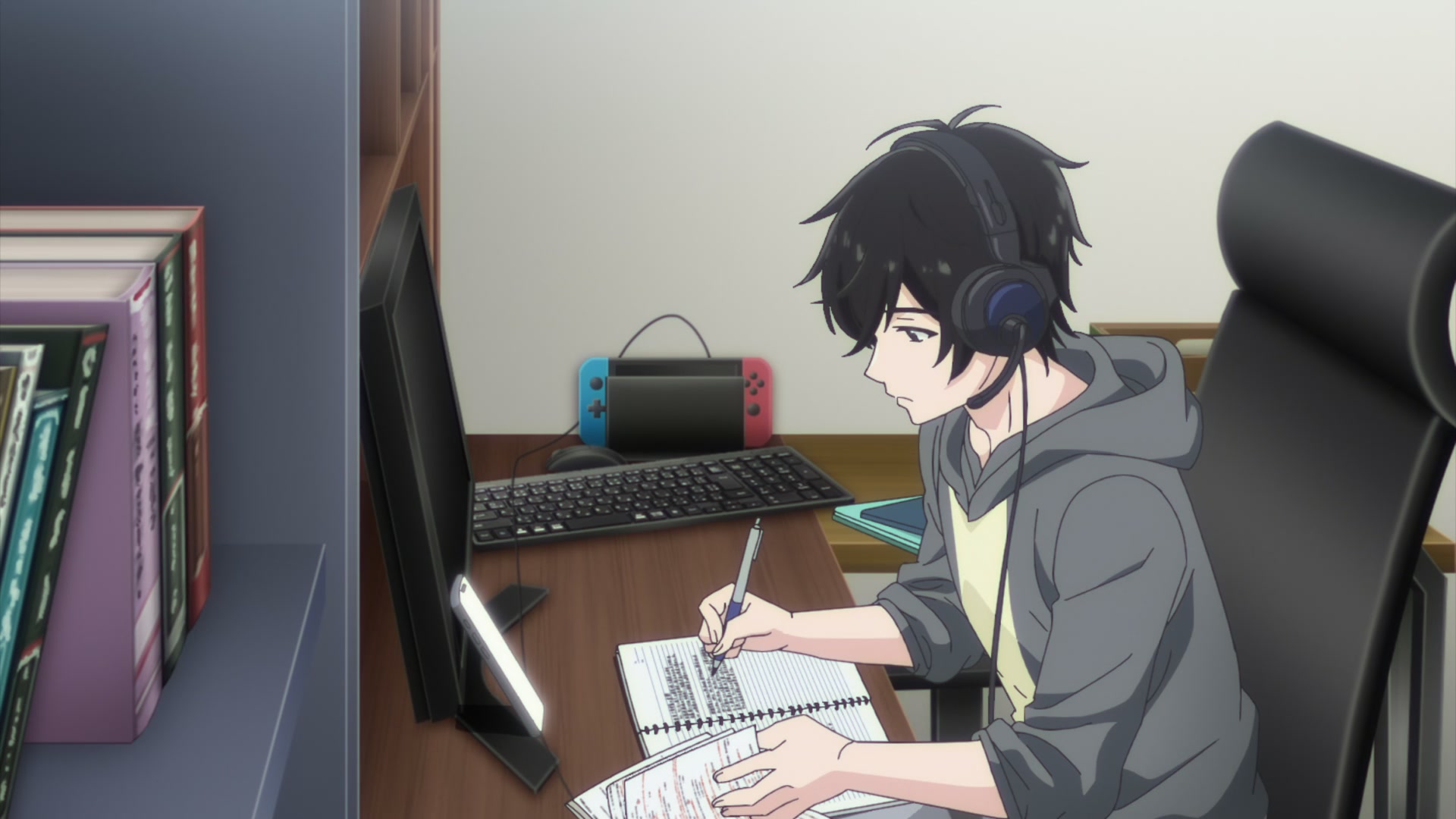
There is a noticeable variance in background art quality that is common in TV anime productions. Exterior scenes—parks, streets, the amusement park—feature painterly textures, dappled light, and atmospheric detail that create a strong sense of place. Key interior locations like Café Kanade and the characters’ bedrooms are densely propped with game consoles, book spines, smartphone interfaces, and kitchen implements that create authenticity. These spaces feel inhabited.
Standard school environments—hallways, classrooms, the library—can feel flatter and more functional by comparison. This is clearly a production that saves its visual budget for emotionally significant scenes, and the trade-off is generally well-managed. The environments that matter most look best.
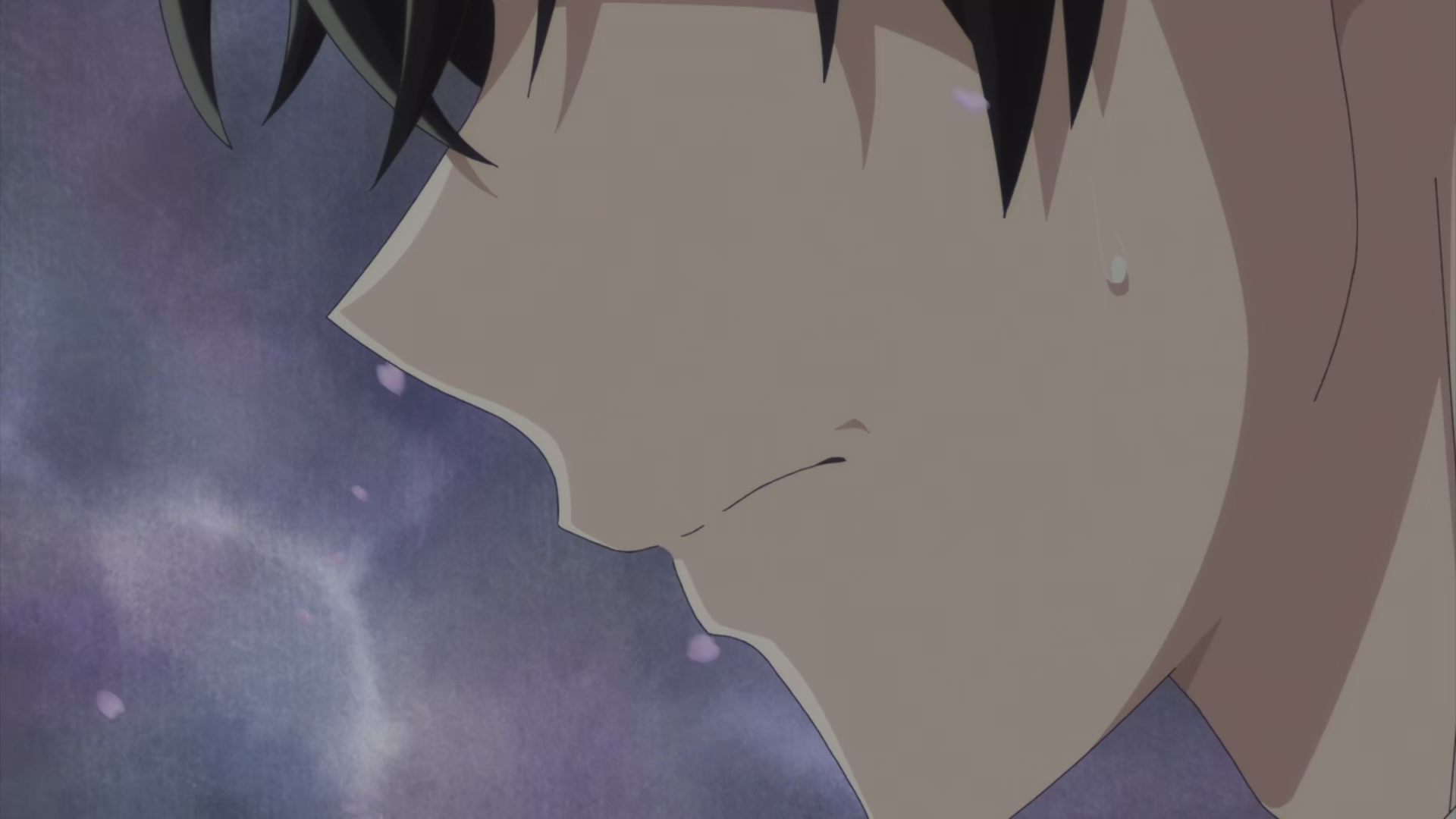
Atmospheric overlays appear in emotionally charged static shots. Floating petals, dust particles, and watercolor-like textures are pure mood-setting elements used judiciously to heighten the emotional register. They contribute to the series’ romantic, slightly nostalgic atmosphere without feeling excessive.
Cinematography and Compositing
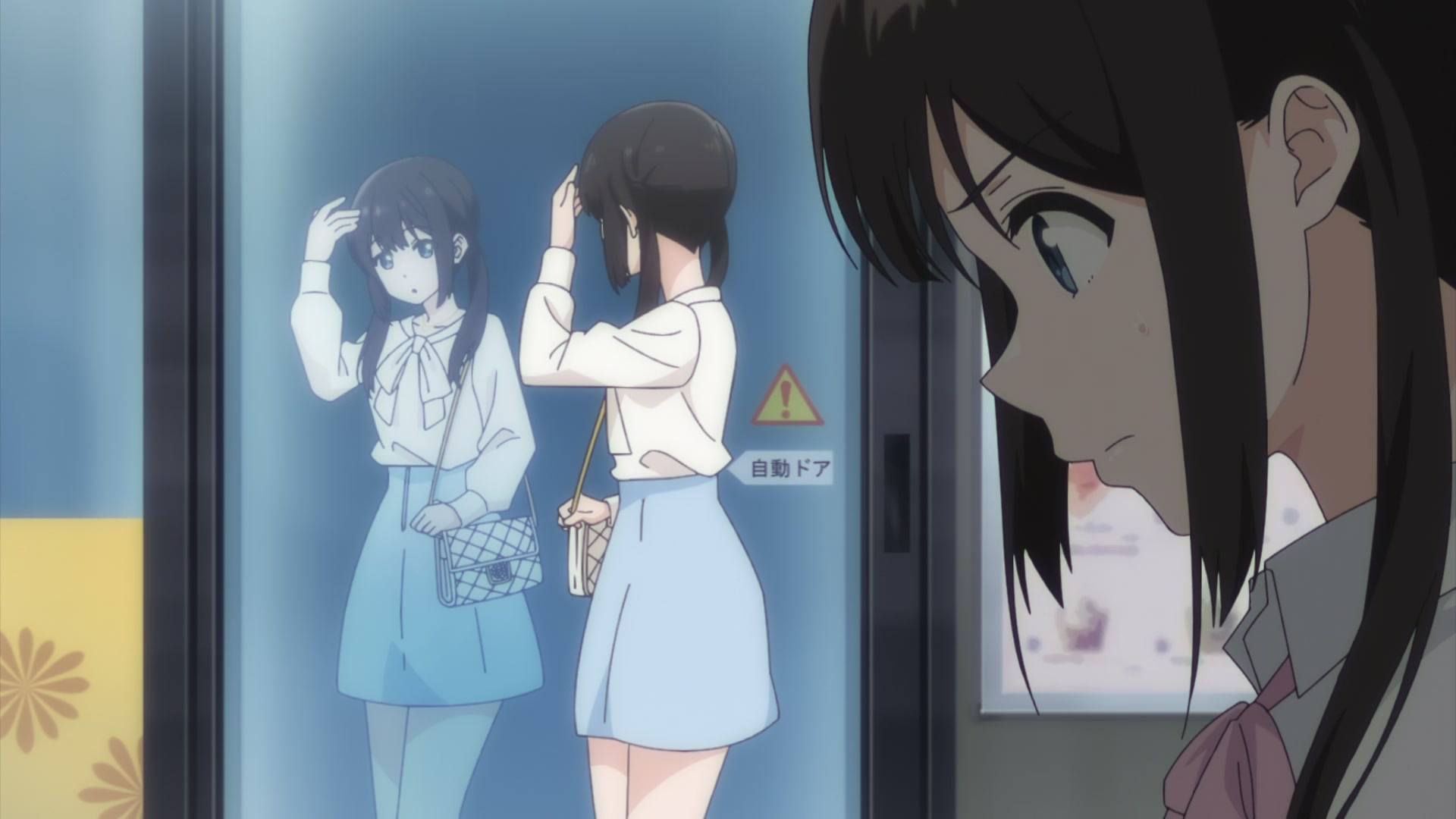
The series employs thoughtful composition to convey emotional states. Frame-within-a-frame shots through windows or doorways suggest characters feeling trapped or observed. Over-the-shoulder compositions create intimacy or scrutiny depending on context. Shallow depth of field with bokeh backgrounds is used frequently in emotional close-ups to direct attention to facial expressions.
The digital compositing is a particular strength. Bloom effects, soft glow around characters, and careful color grading create a cohesive visual atmosphere that supports the emotional goals of each scene. The series looks polished where it matters most, even if the animation itself is not especially ambitious in terms of movement.
Animation Quality Assessment
This is not an action series, and it does not need to be. The animation priorities are correctly placed on character acting in dialogue scenes, facial expressions, and intimate physical interactions. These are all handled well. Movement outside of these priorities can be minimal, and background characters are often static or simplified, but these limitations are typical for the genre and budget level.
It is worth distinguishing between static scenes that serve the tone and those that reflect production constraints. A quiet, still moment between Yukiya and Miku is intentional—the stillness conveys tension or comfort. A flat classroom wide shot with frozen background characters is more likely a budget necessity. The series generally uses stillness well, though there are moments where the seams show.
Overall, the visual presentation is above average for a TV romance anime. The strengths in facial animation, lighting, and compositing outweigh the weaknesses in background variance and limited motion. The series knows its priorities and allocates its resources accordingly.

Sound and Music
The opening and ending themes set the emotional tone effectively. The opening is upbeat and energetic, capturing the playful competition of the love game while hinting at the genuine feelings beneath. The ending theme is softer and more reflective, providing a gentle wind-down that suits the series’ quieter moments.
Voice acting is a particular strength. The two leads carry the series on their vocal performances, and both seiyuu navigate the difficult task of making characters sound like they are hiding their true feelings while simultaneously revealing them to the audience. Yukiya’s internal monologues require a different register than his spoken dialogue—softer, more vulnerable, often panicked—and the transition between these modes is handled smoothly. Miku’s voice work captures her cheerful exterior, her competitive edge, and her moments of genuine vulnerability with equal skill.
The supporting cast is well-served by their performers. Kazane’s scandalized outbursts are a vocal highlight, and Wakana’s deadpan delivery provides consistent comic relief. The adult characters sound appropriately grounded, creating a contrast with the more heightened emotions of the teenage cast.
Sound design is functional and supportive. Environmental audio—classroom chatter, café ambience, the quiet of a bedroom at night—creates a sense of place without drawing attention to itself. The series understands that its emotional moments are best served by restraint, and the audio mix reflects this understanding.
Overall Verdict
I Want to End This Love Game is a warm, emotionally intelligent romance that uses its central conceit with remarkable skill. The love game is not just a gimmick. It is a sophisticated metaphor for the ways young people protect themselves from vulnerability while simultaneously reaching for connection. Every “I love you” is both a lie and the truth, and the series never loses sight of this duality.
The characters are well-drawn and sympathetic. Yukiya and Miku are both frustrating and endearing in equal measure, and their mutual pining is balanced so that neither feels like the sole obstacle to happiness. They are both stuck, both trying, both growing. The supporting cast enhances the central relationship without distracting from it, and the parallel couple of Kazane and Kakeru provides both comedy and thematic reinforcement.
The visual presentation supports the emotional goals effectively. Facial animation, lighting, and compositing are particular strengths, and the series looks polished where it matters most. The animation is not ambitious in terms of movement, but it does not need to be. This is a story told through faces, through small gestures, through the space between what characters say and what they mean.
The open ending may frustrate viewers who want a definitive confession and resolution. The love game is not concluded, and the words “I love you” are still spoken within the game’s framework rather than as a free admission. But this feels intentional rather than cowardly. The series is about the journey toward honesty, not the moment of arrival, and ending with both characters more determined than ever to become worthy of each other is thematically appropriate.
This series is for fans of slow-burn childhood friend romance, for viewers who appreciate emotional nuance over plot momentum, and for anyone who remembers being young, in love, and completely unable to say so. It is not revolutionary, but it does not need to be. It is a well-crafted, deeply satisfying entry in its genre, and it deserves to find its audience.
If you have ever said “I love you” as a joke because saying it for real was too terrifying, this series will feel like home.

Gallery