




Introduction
Some anime ask you to meet them halfway. They present a premise that sounds like a joke, a collection of tropes that could easily collapse into self-parody, and then they ask you to trust that there is something genuine underneath. NEET Kunoichi to Nazeka Dousei Hajimemashita is exactly this kind of series. A shut-in gamer ninja moves in with an office worker she protects from extradimensional ghosts. She wears a tracksuit over her battle attire, begs for gacha money, and treats Youma extermination as a “newbie quest.” He cooks, cleans, does laundry, and quietly discovers that his previously colorless life has started to mean something.
If that description makes you smile rather than roll your eyes, this series is probably for you.
I came to this show as someone who has watched seasonal anime long enough to recognize the familiar rhythms, the stock character types, the visual shorthand that signals comedy or drama or action. I do not flinch at fanservice or tsundere archetypes or stylized exaggeration. These are tools. What matters is whether a series uses them with purpose. This one does. It is not a masterpiece. Its animation has real limitations, its compositing is inconsistent, and some of its comedy relies on repetition that will not work for everyone. But it has something that many more polished productions lack: a coherent emotional core and the willingness to take its characters’ unconventional values seriously.
Story and Themes
The Premise as Emotional Architecture
The series opens with a deliberate fake-out. Tsukasa Atsumi, an office worker with no prospects, narrates the cliché isekai setup: an ordinary person walking down the street, about to be hit by a truck. But the truck does not kill him. A kunoichi named Shizuri Ideura saves him from a falling steel beam and explains that the real threat was a Youma, a ghost from another world that targets those with “warrior’s blood.” She proposes a contract: protection in exchange for provision. He accepts. Within a week, she has established a routine of gaming, eating, sleeping, and leaving all domestic responsibilities to him.
The isekai fake-out is more than a joke. It signals that this series is interested in subverting expectations about what kind of story it is. Tsukasa does not die and reincarnate in a fantasy world. He remains in his ordinary life, but that life is transformed by the introduction of something extraordinary. The supernatural does not replace reality; it infiltrates it, revealing that reality was always stranger than it appeared.
The master-servant contract that structures their relationship is initially presented as transactional. Shizuri fights Youma; Tsukasa provides food, shelter, and gaming funds. But the series systematically dismantles this framing by revealing that both parties entered the arrangement believing themselves to be the burden. Tsukasa, prone to accidents and illness since childhood, internalized the belief that he causes trouble for everyone around him. His social isolation was not chosen solitude but a defensive adaptation to perceived worthlessness. Shizuri, despite her elite pedigree as a candidate for village leader, views herself as a mooch whose only value is combat. “I’m awful,” she tells him after failing to protect him. “I wouldn’t be upset if you said you wanted to replace me with another kunoichi.”
The contract becomes the mechanism through which each discovers their own value through being valued by the other. This is the series’ central emotional insight, and it is developed with patience across the full season.
The NEET as Valid Identity
The series’ most distinctive thematic position is its refusal to pathologize Shizuri’s NEET lifestyle. In a cultural context where hikikomori and NEET phenomena are typically framed as social crises requiring intervention, the show instead argues that a shut-in gaming existence can coexist with responsibility, purpose, and genuine human connection.
This is not presented as a joke that the series eventually undercuts with “character growth” toward normalcy. When Shizuri attempts to reform herself, getting a part-time job, taking over all housework, and locking away her games, the series depicts this as psychologically destructive. She develops dark circles under her eyes. Her hair becomes disheveled. She enters a state of “nothingness” when the boredom becomes unbearable. She creates handmade flipbooks, frame-by-frame animations drawn by hand, to simulate the game she cannot play. This is not admirable self-improvement. It is a crisis of self-negation.
Tsukasa’s climactic request inverts the expected resolution. He does not ask her to become functional by societal standards. He asks her to remain exactly what she is: “For my sake, please continue being a NEET.” His happiness depends on her happiness in that identity. This is a quietly radical position for a commercial anime to take, and the series commits to it fully.
Mutual Salvation and the "True Contract"
The “power of the master,” called chimyakuko, is introduced as a supernatural ability that allows descendants of warriors to manipulate ley line energy and channel it through their contracted kunoichi, strengthening them in combat. But the series treats this power as a metaphor for emotional commitment. Tsukasa cannot access it until he fully commits to protecting Shizuri. The supernatural ability literalizes the transformative effect of genuine emotional investment.
His awakening occurs when Shizuri is about to sacrifice herself against the advanced-level Youma Killa. She confesses that her time with him, the first time anyone accepted her true self, made her genuinely happy, and she is willing to die to protect him. This declaration triggers his power. He manifests a barrier, begins healing her wounds, and enters the battle not as a passive protected party but as an active participant.
The “true contract” they subsequently form is not about exchanged services. It is about mutual fulfillment. Each sustains the other’s ability to live authentically. Tsukasa’s confession on the balcony makes this explicit: before meeting her, his life “felt the same as being dead.” Her presence, her smile, “made the faded colors of my life start to shine.” He loves her. She loves him. The contract has become the foundation of their mutual psychological survival.
Found Family and the Ronin Community
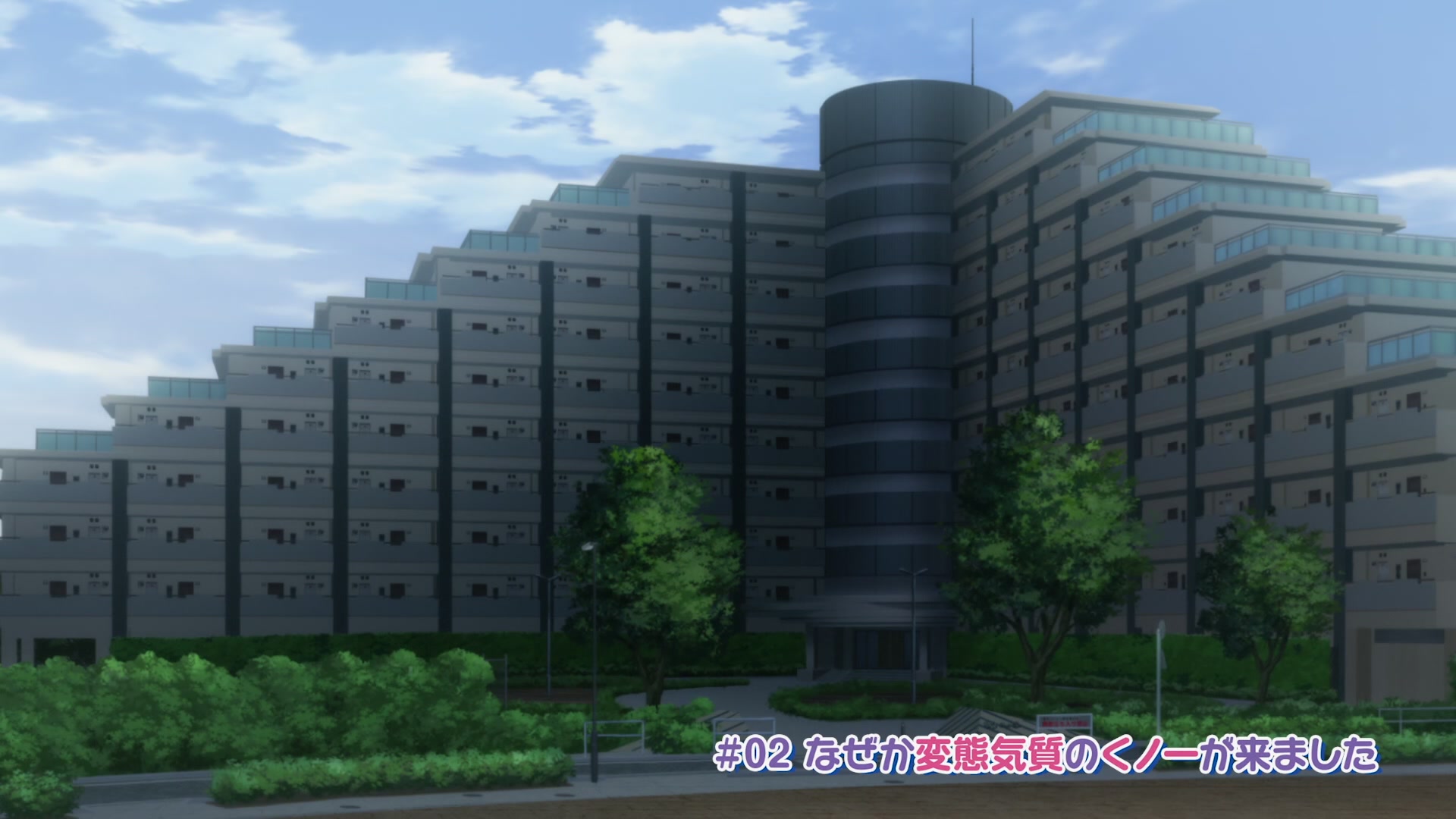
The apartment building where Tsukasa and Shizuri live becomes, under the deliberate design of landlady Hazuki Saya, a haven for those who have left or been rejected by their original communities. The term “ronin,” historically a masterless samurai, is repurposed here for warriors without clan affiliation. It captures the shared condition of the building’s inhabitants.
Shizuri abandoned her candidacy for village leadership. Hina Izumi violated the village taboo by falling in love with her master and fled rather than accept separation. Ayame Momochi hides her gender identity and her location from the village. Kanna Natsumi, while still a leader, spends increasing time in the ambiguous space of the Nin Nin Cafe. Killa and Clena are exiles from the Youma realm. Even Tsukasa, though not a runaway, has always felt disconnected from his adoptive family and from society generally.
The concentration of these characters creates a community of mutual understanding that replaces the clan structures they have left. The series does not idealize this. The characters bicker, invade each other’s privacy, cause explosions, and generally create chaos. Shizuri’s final lament, “Gimme back my NEET lifestyle,” acknowledges that community comes with costs. But the costs are accepted because the alternative, the isolation each character knew before, was worse. The series’ closing image is not of a couple alone but of a building full of interconnected lives.
The Deconstruction of Elite Identity
Shizuri is introduced through Ayame’s worshipful narration as a prodigy: “the most talented kunoichi of our clan,” “a genius that no one can compete with,” “the embodiment of perfection that leaves piles of Youma corpses in her wake.” Her actual presentation immediately subverts this. She wears a tracksuit over her ninja attire. She begs for in-app purchase money. She pulls all-nighters gaming and is “totally helpless in romantic situations.”
The series argues that competence in one domain does not necessitate competence in others, and that this inconsistency is not failure but human reality. Shizuri is genuinely elite in combat. She is genuinely incompetent at domestic life and emotional expression. Both are true, and neither negates the other.
This extends to the supporting cast. Kanna is a village leader and a tsundere maid cafe idol who secretly loves being number one. Ayame is a skilled intelligence operative and a pervert whose devotion manifests as masochism. Hina is catastrophically unlucky and genuinely powerful when she commits fully. The series refuses to resolve these contradictions, presenting them instead as the natural texture of personhood.
Cultural Context and the Shinobi Reimagining
The series draws on ninja mythology but recontextualizes it within a contemporary urban setting. The shinobi villages are not historical holdovers but parallel societies with their own hierarchies, taboos, and political structures. The “big three” villages (Ideura, Natsumi, and a third unnamed) suggest a formalized system that the runaway ninja have opted out of.
This allows the series to use ninja tropes, secret techniques, master-servant contracts, clan rivalries, while grounding the characters in recognizable modern life. The contrast between ancient shinobi decrees (“Thou shalt not consort with the opposite gender from age seven onwards”) and contemporary reality (maid cafes, smartphone gacha, Akihabara dates) generates both comedy and thematic resonance. Yuzu Natsumi, Kanna’s younger sister, arrives in the city speaking in archaic patterns and is horrified by everything she sees. Her shock at discovering Kanna in a maid outfit is both funny and genuinely poignant, a clash between the dignified older sister she remembers and the person Kanna has become, who is, in her essential qualities, unchanged.
The Akihabara date episode treats the district with the reverence of a pilgrimage. Shizuri’s reaction, “The holy land… Akihabara!” is played for comedy but reflects genuine otaku cultural practice. The sequence through figure shops, retro game stores, and kebab stands is a love letter to the district’s actual geography and subcultural significance. The series assumes its audience shares or can appreciate Shizuri’s value system, in which a limited edition figure or a rare gold cartridge is genuinely exciting.
Adaptation Considerations
I have not read the source material and cannot speak to adaptation fidelity. The provided context contains no specific complaints from manga readers. If such complaints exist in the broader fandom, about compressed arcs, skipped chapters, or altered characterization, I am not positioned to evaluate them.
What I can observe is that the anime functions coherently as a standalone work. Character arcs are complete and legible. Thematic throughlines are maintained across episodes. The tonal balance between comedy, romance, and action is consistent. If material was cut or compressed, the adaptation team did so with sufficient skill that the resulting structure does not feel broken. The OVA structure of Episode 13, which contains a beach episode and the Killa/Clena integration sequence, suggests some material may have been displaced from the main broadcast run, but whether this represents adaptation choices or source material structure, I cannot determine.
Characters
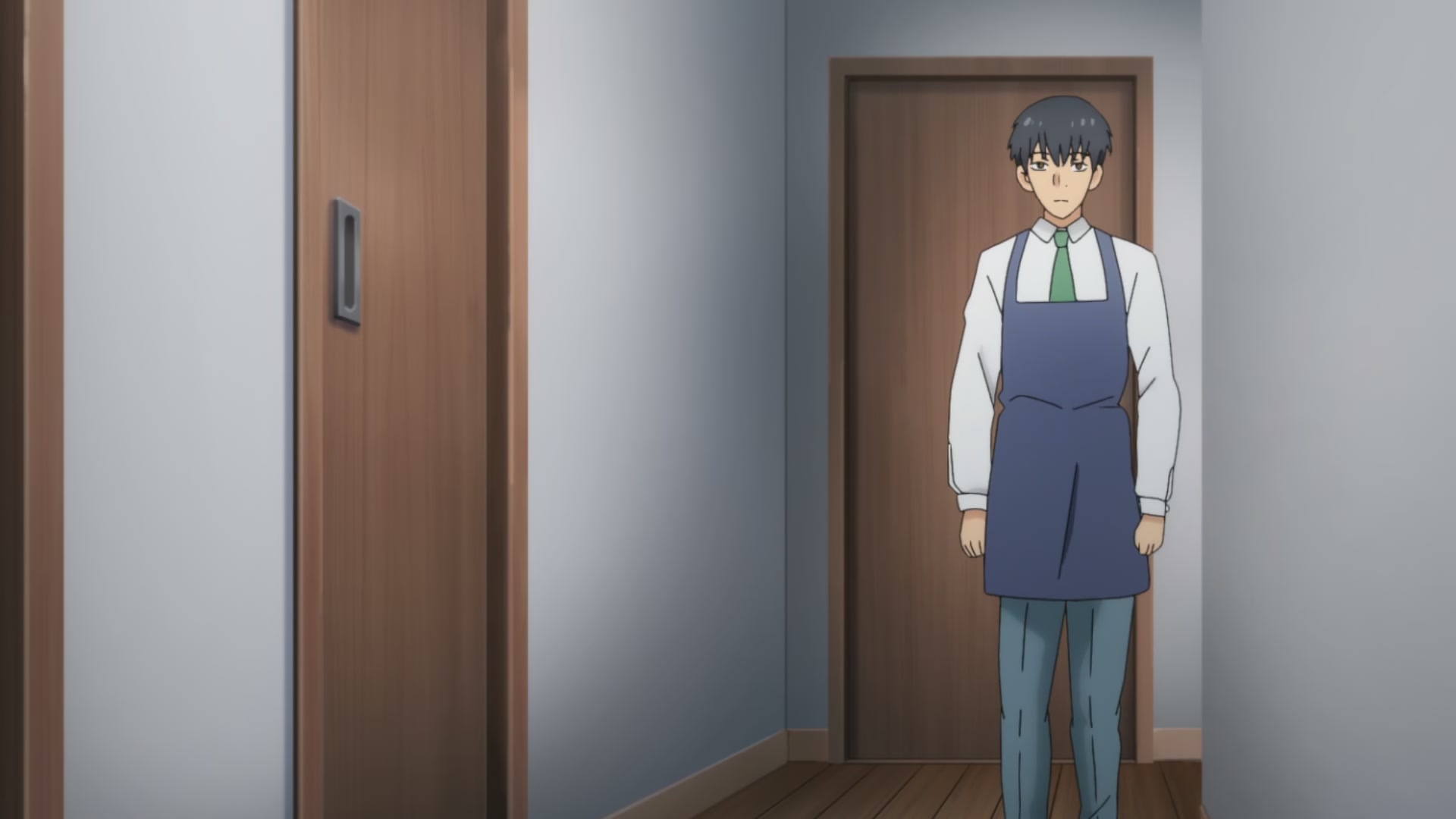
Tsukasa Atsumi: From Passivity to Agency
Tsukasa begins the series as someone who “just went with the flow” and believed his life had no value. His emotional flatness is not depression per se but a hollowing-out produced by years of isolation and a sense of being a burden. He describes his pre-Shizuri existence as “alive, but it felt the same as being dead.” He was not suffering acutely. He was simply not living.
His development is catalyzed by Shizuri’s presence but actualized through his own choices. The turning points are active: defending their relationship to his high school friend Masa-kun, who dismisses it as “basically a pet.” Standing between Shizuri and Saya when the landlady demands she leave. Requesting that Shizuri remain a NEET for his sake. Confessing his love on the balcony. Each represents a departure from his lifelong pattern of passive acceptance.
His trajectory is credible because it is incremental. He does not transform overnight. He gradually accumulates moments of assertion until they cohere into a new self-conception. His confession, “just your pure smile is the most important thing to me, no matter what lifestyle we live,” is earned by the episodes of quiet domesticity that precede it. He is not a demonstrative person. His love is expressed through cooking her favorite meals, buying her games as thanks, and standing between her and danger. His sincerity is quiet but absolute.
Shizuri Ideura: Integration of Divided Self
Shizuri is a walking contradiction, and the series loves her for it. On the battlefield, she is cold, efficient, and overwhelmingly powerful. In domestic life, she is a lazy, gaming-obsessed NEET who panics at emotional intimacy and gets drunk to cope with embarrassment. She is deeply proud of her NEET identity and initially treats the contract as a business transaction that enables her lifestyle. But she is also profoundly grateful to Tsukasa and increasingly emotionally dependent on his kindness.
Her crisis is triggered by Saya’s accusation that she is “pushing her uselessness onto him.” This activates Shizuri’s deepest fear: that her NEET lifestyle is not a valid choice but a moral failure that harms those around her. Her response is a complete self-reformation attempt. She applies for part-time jobs, facing twelve rejections before being hired at the Nin Nin Cafe. She takes over all household chores despite visible exhaustion. She locks away her games, including her beloved Inumusume smartphone game.
The psychological toll is immediate and severe. She develops dark circles. Her hair becomes disheveled. She eventually enters a state of “nothingness” when the boredom becomes unbearable. Her handmade Inumusume flipbooks, drawn frame by frame to recreate the game she cannot play, are a poignant manifestation of a self divided against itself.
Tsukasa’s intervention resolves this crisis by reframing the terms entirely. His request that she “continue being a NEET” transforms her lifestyle from a tolerated indulgence into an actively desired quality. The “true contract” allows her to integrate her identities. She can be both the guardian who fights advanced-level Youma and the gamer who pulls gacha mid-battle. The Golden Shiba pull during the fight against Killa is the symbolic culmination. Her NEET passion and her warrior duty are not in conflict. They are in synergy.
Her gacha pulling is treated with the gravity others might reserve for religious practice. The “Shizuri-vision” that accompanies a rare pull, a transcendent light that blinds her enemy, elevates gaming to a source of genuine power. This is played for comedy but also taken seriously within the series’ logic. Her commitment to gaming is not a joke. It is a core aspect of her being that the narrative honors.
Ayame Momochi / Ilm Momochi: Gender, Devotion, and Self-Loathing
Ayame is the series’ most psychologically complex character, operating simultaneously as comic relief, genuine loyal subordinate, and a study in gender dysphoria and self-hatred.
Her surface dynamic with Shizuri is straightforward: she craves Shizuri’s abuse and receives it. Shizuri’s bloodlust, verbal contempt, and physical violence produce in Ayame a state of transcendent pleasure. The on-screen text labels her “CRAZY PSYCHO LESBIAN,” and her behavior consistently earns this designation. She collects Shizuri’s worn clothing. She fantasizes about being “bathed in a drop of Shizuri-sama’s sweat.” She interprets even accidental contact as erotic.
But this perversion is not merely comic. It is the mechanism through which Ayame expresses a devotion that is, in its own way, absolute. She has been hiding Shizuri’s location from the village, preventing the dispatch of assassins. She risks her life in battle without hesitation. When Shizuri is abstaining from gaming, Ayame collects gacha gems for her. Her perversion is the emotional language through which she communicates a loyalty she cannot express in conventional terms.
Her feminization jutsu is not a disguise but a manifestation of profound gender dysphoria. She “cannot tolerate the shame known as man that is inside of me” and maintains her female form at constant energetic cost, a “big debuff” that weakens her in combat. The jutsu can only be released by taking damage, which she cannot do willingly. This mechanic externalizes her internal conflict. She cannot voluntarily accept her male body. It must be forced upon her by external violence.
Her male form, Ilm Momochi, is significantly more powerful but causes her intense distress. When she fights in this form against Killa, she is stoic, powerful, and strategically effective. The series allows her to be ridiculous and admirable simultaneously, which is a more humane treatment than many anime manage for characters with gender complexity.
Her worship of Shizuri is partly explained by this dysphoria. Shizuri represents an ideal of feminine strength and beauty that Ayame feels she cannot naturally embody. Her devotion is both genuine loyalty and aspirational identification. Shizuri’s rare expressions of gratitude, thanking Ayame after the battle, smiling at her, produce in Ayame a response more intense than any punishment because they acknowledge her as a person rather than a pervert.
Hina Izumi: Bad Luck as Emotional Barometer
Hina’s catastrophic bad luck is explicitly tied to her mental state, a clever narrative device that makes her emotional journey literally visible. When she is happy with her master Tooru, her misfortune diminishes. When she is anxious or despairing, it becomes explosively destructive. This creates a direct causal link between love and functionality. Tooru’s unwavering acceptance literally stabilizes her reality.
She violated the village taboo by falling in love with her master, and the village attempted to annul her contract and replace her. Rather than accept this, she fled and sought Shizuri’s training. Her development involves gaining confidence. Shizuri identifies that Hina actually possesses mid-rank skills but lacks the self-belief to use them. Her breakthrough comes when Tooru is directly threatened by a Youma, and she commits to fighting with everything she has, successfully defeating a mid-level enemy for the first time.
Her relationship with Tooru is the series’ most conventionally romantic pairing, serving as contrast to Tsukasa and Shizuri’s more ambiguous arrangement. Their constant declarations of each other’s names, their celebration of relationship milestones like “the one hundred day anniversary of the first time we held hands,” their public embraces, provide both comic relief and a baseline of “normal” romantic behavior against which the central couple’s unconventional dynamic can be measured.
Tooru’s response to Hina’s bad luck is radical reframing. When an explosion destroys part of their apartment, he tells her: “This explosion isn’t unfortunate or anything of the sort. It’s what bonds us!” This is not mere reassurance but a fundamental reinterpretation of her perceived flaw as a positive expression of their connection.
Kanna Natsumi: The Tsundere as Protective Shell
Kanna’s tsundere personality is not merely a character quirk but a functional defense mechanism. As a young village leader, she cannot afford to appear vulnerable. Her aggression toward Shizuri, her denials of enjoyment at the cafe, her gruffness toward her younger sister Yuzu, all serve to protect a core of genuine feeling that she cannot safely express.
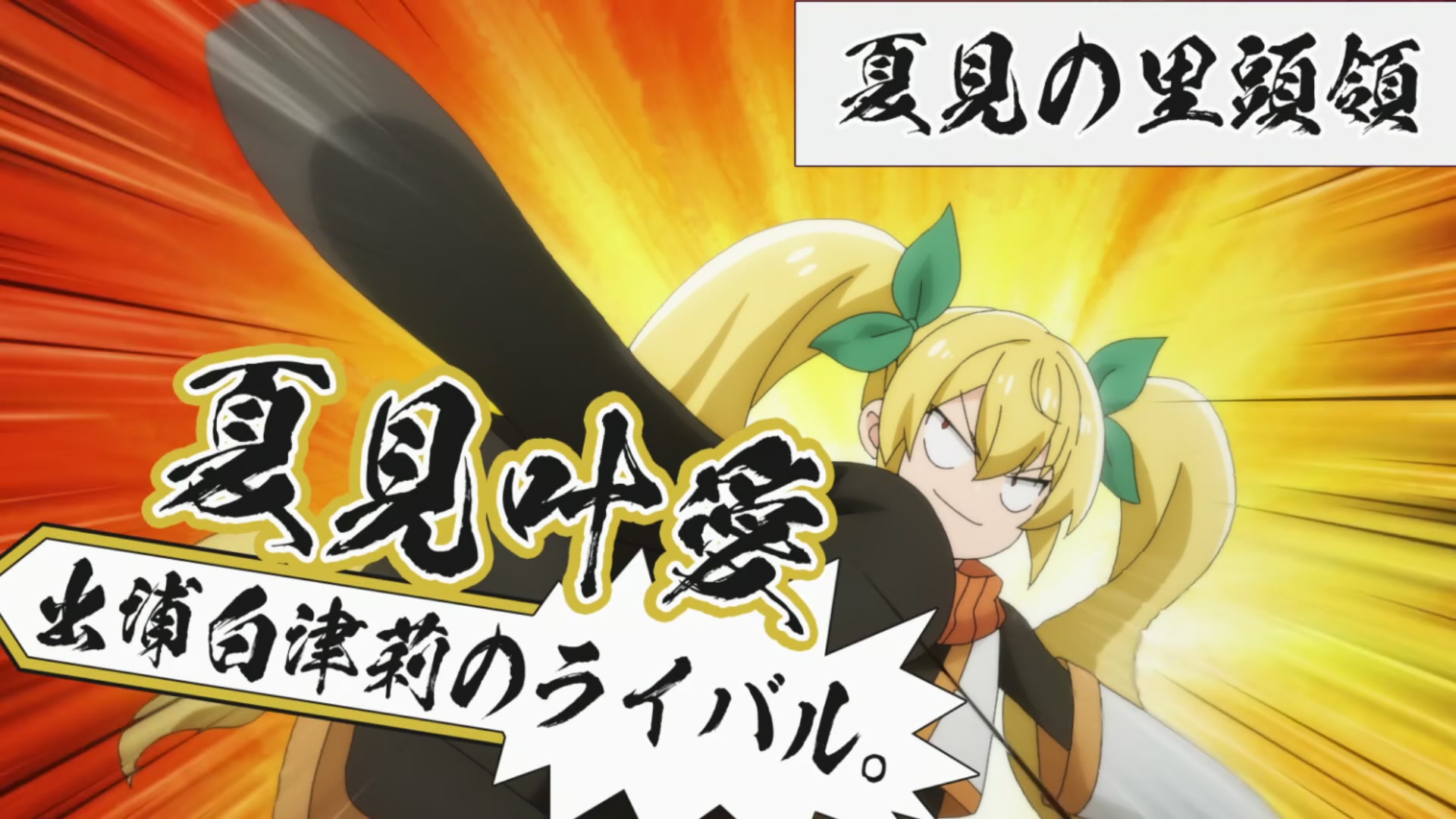
She constantly declares her superiority over Shizuri and the Natsumi Style’s superiority over the Ideura Style, but she has never actually beaten Shizuri in a duel. Her pride as a village leader is genuine. She is dedicated to her people and works hard to provide for them. But she also craves personal recognition. Her discovery that she is the number one maid at the Nin Nin Cafe, and that customers adore her tsundere act, gives her a sense of individual achievement separate from her inherited role.
Her relationship with Yuzu reveals the mechanism clearly. She loves her sister deeply but can only express it through scolding and indirect care. When Yuzu cries, Kanna performs a healing jutsu and calls her “a good girl,” tenderness she would never display to anyone else. The tsundere shell cracks only when the need is too urgent to maintain it.
The maid cafe functions as liberation for Kanna. As a village leader, her achievements are inherited and expected. As “number one maid Kanna-chan,” her success is personally earned. The cafe allows her to be valued for herself rather than her role. When her sister discovers her in a maid outfit and flees in horror, the eventual reconciliation reveals that Kanna has not changed in her essential qualities. She is still the devoted leader who sacrifices for her village. She simply also enjoys being a maid cafe idol.
Hazuki Saya: The Hidden Mother
Saya is a complex figure: outwardly a cheerful, money-obsessed businesswoman who speaks with a “Nin nin!” catchphrase, inwardly a master strategist and a mother who sacrificed everything for her daughter. She is pragmatic to the point of ruthlessness. She forces the kunoichi to work off their debts at the Nin Nin Cafe. She monetizes their beach volleyball brawl by selling beer to spectators. She openly admits she will “boss around” the ronin she shelters if needed.
But her actions consistently serve protective purposes. She gathered runaway ninja and ronin at her building to create a safe haven. She forcibly opened Tsukasa’s Dragon Vein Chakra using a forbidden jutsu, sacrificing her own ninja abilities, to give Shizuri the power to survive. She kept her maternal relationship to Shizuri secret because the Urabu Force she led is “feared and shunned even by their own allies,” and revealing it would have harmed Shizuri’s candidacy for leader.
When Shizuri was put forward as a leadership candidate, their mother-child relationship was officially terminated. Saya became her instructor instead, maintaining proximity without maternal intimacy. She confesses to Tsukasa that she “never truly did a single motherly thing for her.” Her sacrifice of her jutsu is her way of finally acting as a mother, even if Shizuri does not know it. Her request to Tsukasa, “Please, take care of Shizuri… my daughter,” is the first time she openly claims the maternal relationship in the presence of others.
Asakura Himari: The Audience Surrogate
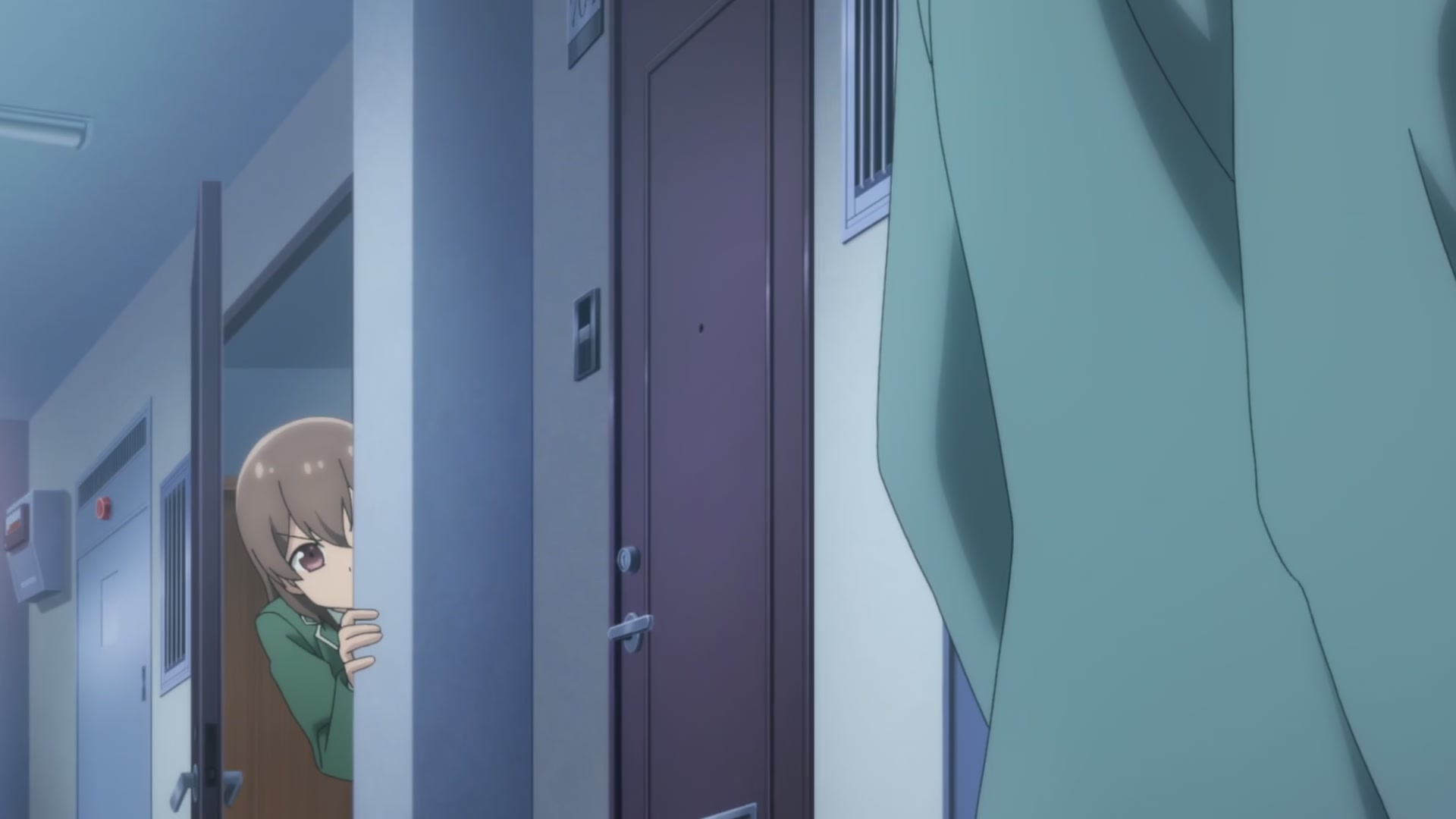
Himari is a high school girl who lives two doors down and has been observing her neighbors’ love lives with the intensity of a rom-com fanatic. She evaluates couples using a “love sensor” and tropes from romantic media. She initially rates Tsukasa and Shizuri’s “power of love” at a mere 5, dismissing their relationship as “more like he’s living with his mother than with a lover.” She is far more impressed by Hina and Tooru’s demonstrative affection.
Her arc involves expanding her definition of love beyond the tropes she consumes. She gradually recognizes that Tsukasa and Shizuri’s quiet, mutual-support-based relationship is equally valid. Her final assessment, “decadent love where they’re both in too deep is also good,” represents an expansion of her understanding. She does not abandon her love of conventional romance. She simply adds new categories.
Her decision to directly confront Shizuri about suspected cheating (she saw Tsukasa visiting Saya’s apartment and misinterpreted it) is a significant character moment. Despite her self-description as a “fainthearted disciple of love,” she gathers her courage and enters the apartment of someone she barely knows to deliver a warning. Shizuri’s grateful response establishes a tentative friendship between them. Himari, who has been watching from the shadows, is now acknowledged by the subjects of her observation.
Killa Wenthol and Clena: Antagonists Turned Tenants
Killa and Clena’s integration into the apartment community represents the series’ ultimate extension of its found family theme. Former enemies become neighbors. Battle lust finds outlet in gaming. The Youma are revealed as individuals with their own family dramas and personal frustrations.
Killa is explicitly constructed as a Youma parallel to Shizuri. Both are daughters of powerful fathers whose expectations constrain them. Both are warriors who find their primary satisfaction in combat. Both are exiled or self-exiled from their home realms. Both discover gaming as an alternative arena for competition. When Shizuri introduces her to ranked matches as “the real world of carnage,” she is offering Killa the same solution she found: channeling battle lust into a form that does not require actual violence.
Killa’s emotional vulnerability, her tears when defeated, her frustration at her father’s restrictions, her genuine distress at exile, humanize her beyond the “advanced-level Youma” designation. Clena, her companion, is cheerful, food-obsessed, and serves as the natural bridge between the Youma and the human characters. Her “Fried Chicken Beam” maid routine is absurd, but it is also a genuine expression of her personality. The series’ willingness to let former enemies become comic neighbors is a statement about the possibility of coexistence.


Visuals and Animation
Art Style and Character Design
The character designs are rooted in a clean, contemporary aesthetic with lean silhouettes and thin, uniform digital linework. The series employs a sophisticated hierarchy of detail that shifts depending on the emotional register of the scene.
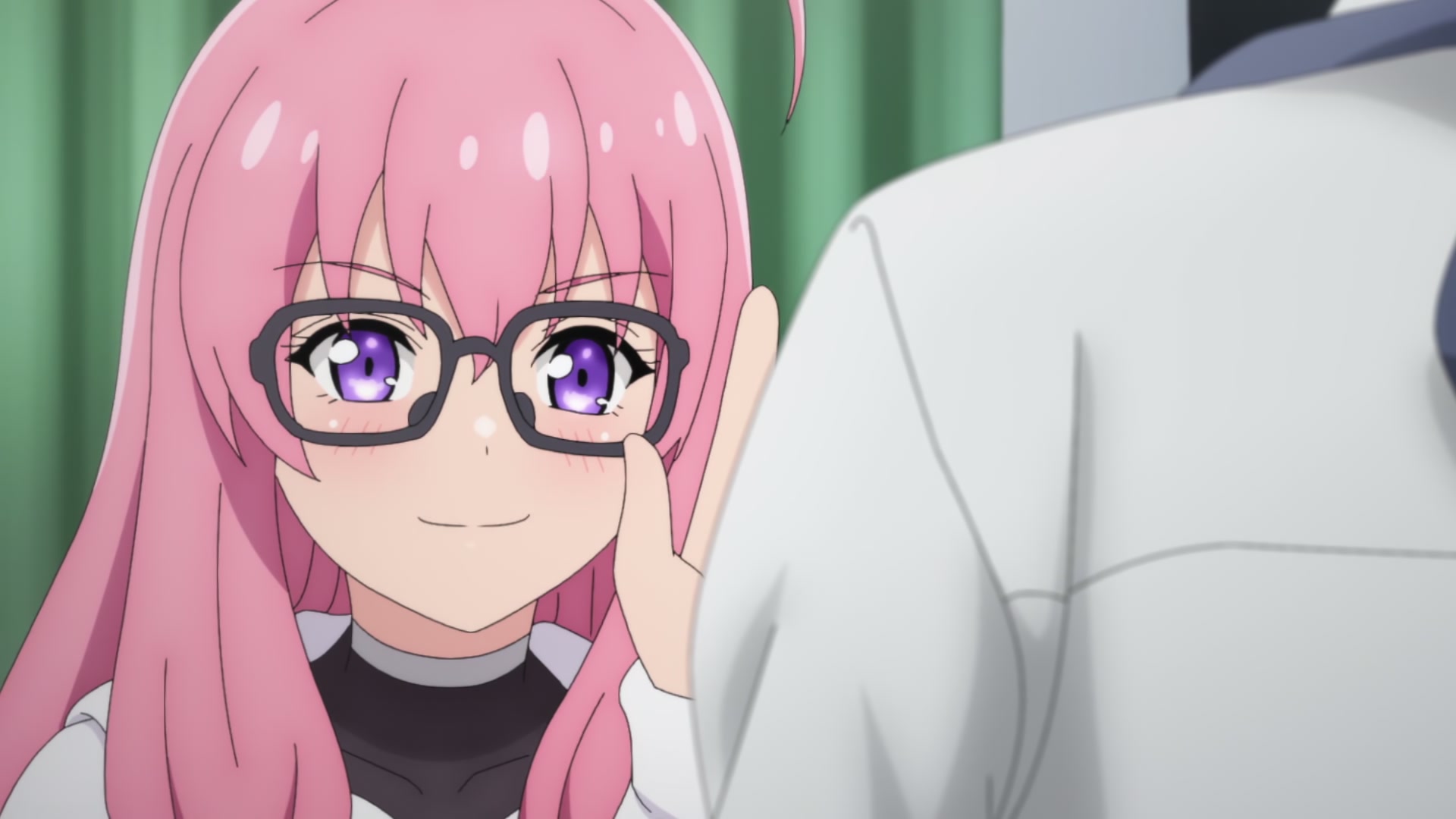
During pivotal romantic or dramatic moments, the detail levels spike, particularly in the eyes. Irises are rendered with complex gradients and multiple specular highlights, creating a luminous quality that draws the viewer into the character’s internal state. Tsukasa’s confession on the balcony, Shizuri’s reaction to the boyfriend hoodie, the mutual “I love you” exchange, all benefit from this treatment. These “beauty shots” are deployed strategically for maximum impact.
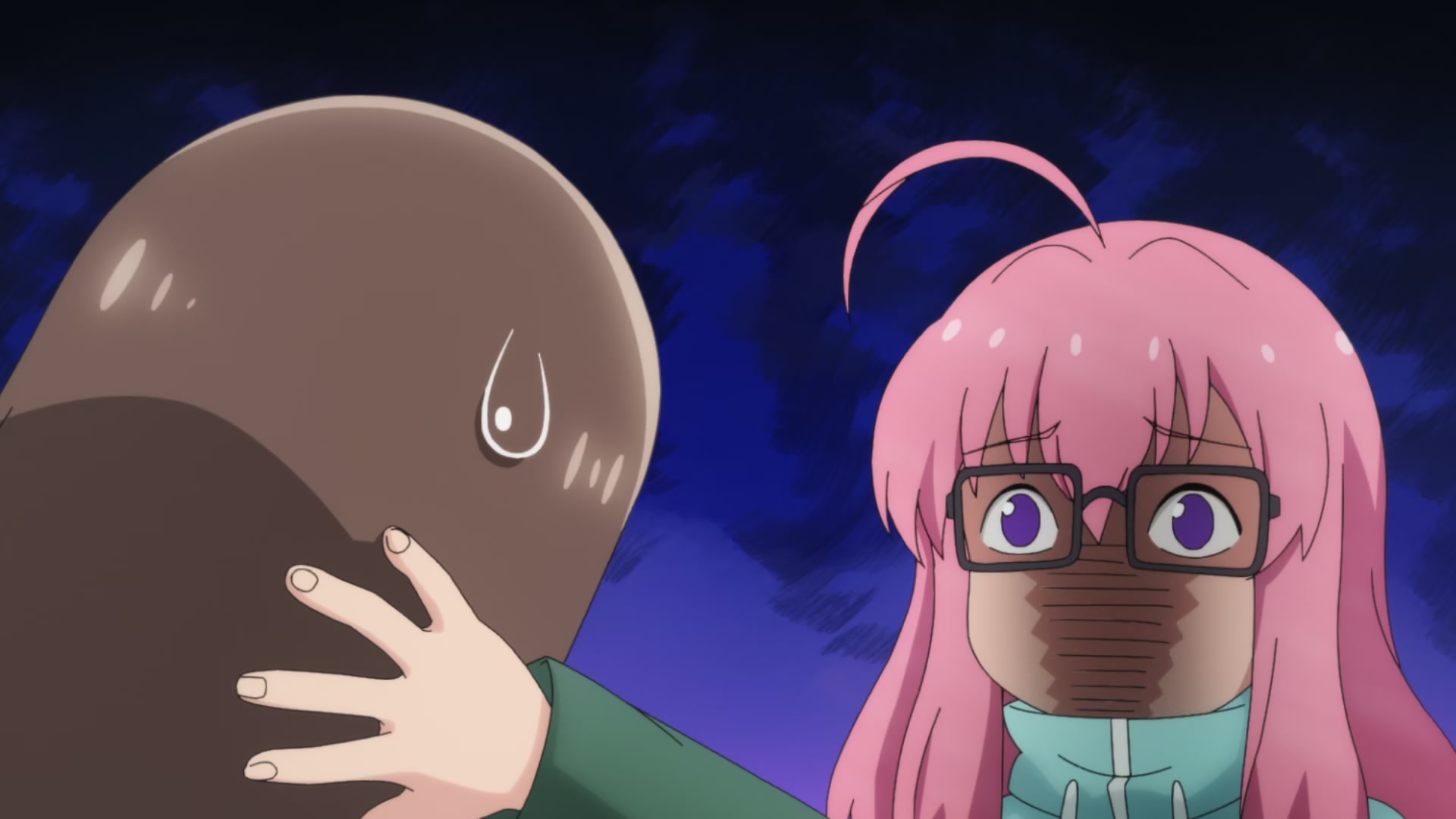
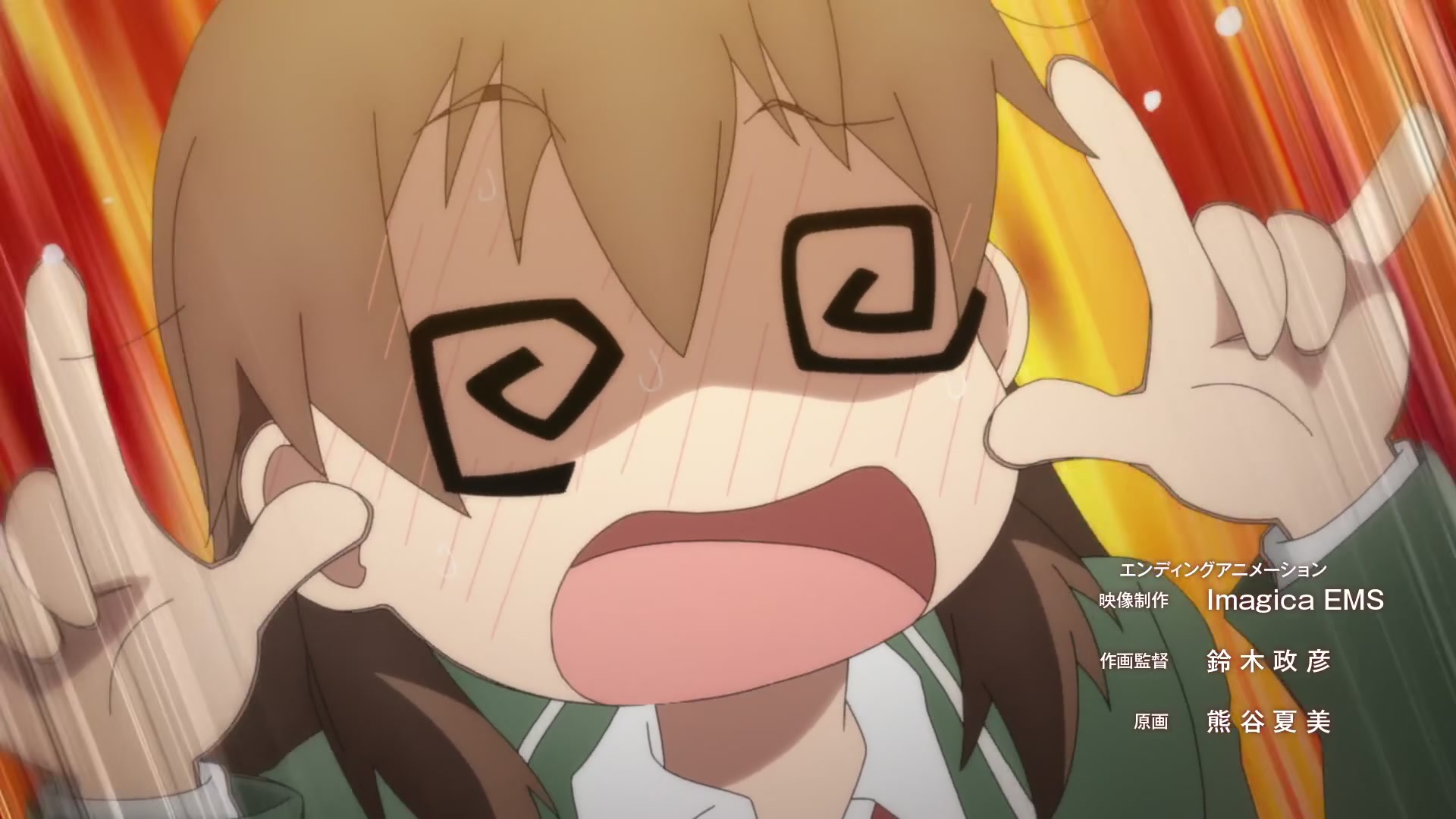
For comedy, the art style is intentionally broken. Character models transform into simplified chibi forms, bean-like shapes, or distorted, jagged-lined figures to emphasize panic, clumsiness, or shock. Shizuri’s drunken “boink-boink” head-bumping against Tsukasa, Hina’s panic-induced distortions, Ayame’s transcendent bliss faces, all use simplified, exaggerated forms that communicate emotional extremes more effectively than realistic rendering could. The willingness to sacrifice model consistency for expressive impact is a mark of confident direction.
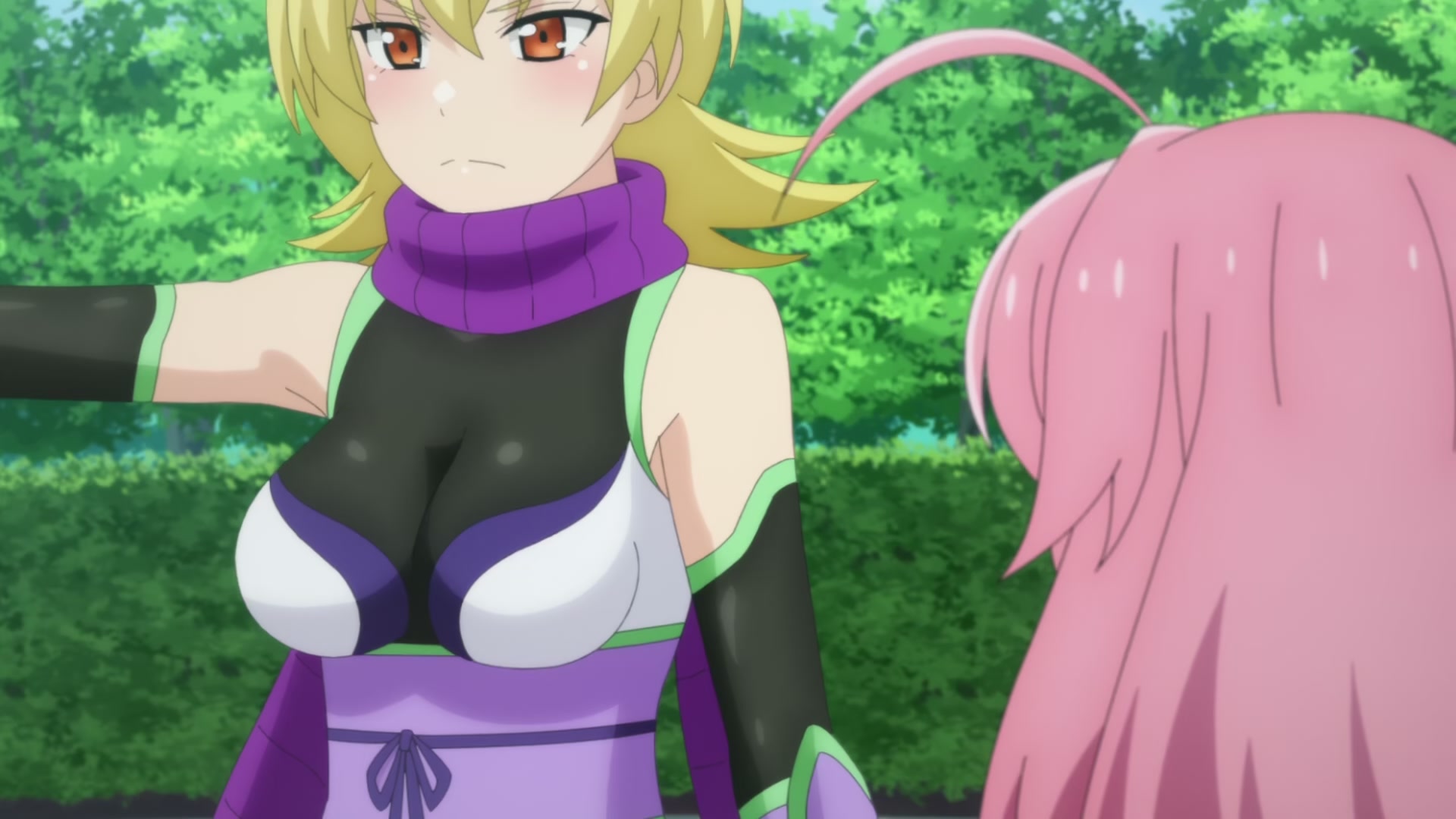
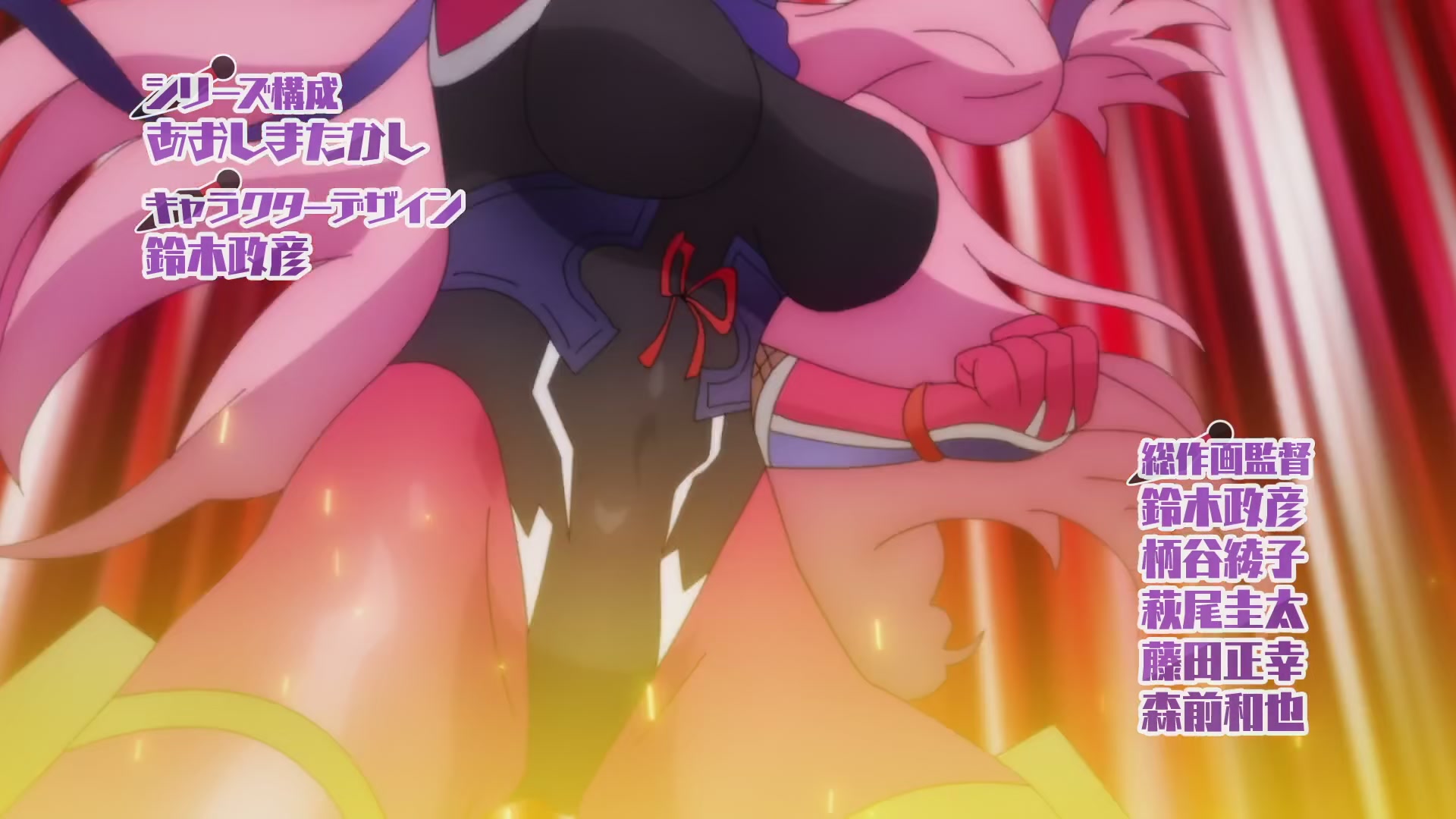
In combat sequences, the linework becomes sharper and more intricate, often accompanied by complex costume designs featuring metallic accents and decorative ribbons. The ninja suits, with their flowing sashes and layered armor elements, are rendered with care that communicates the shift from domestic comedy to supernatural action.
Digital Compositing and Atmosphere
The series uses digital post-processing extensively to establish mood and signal genre shifts. Distinct “lighting kits” are employed for different emotional registers.
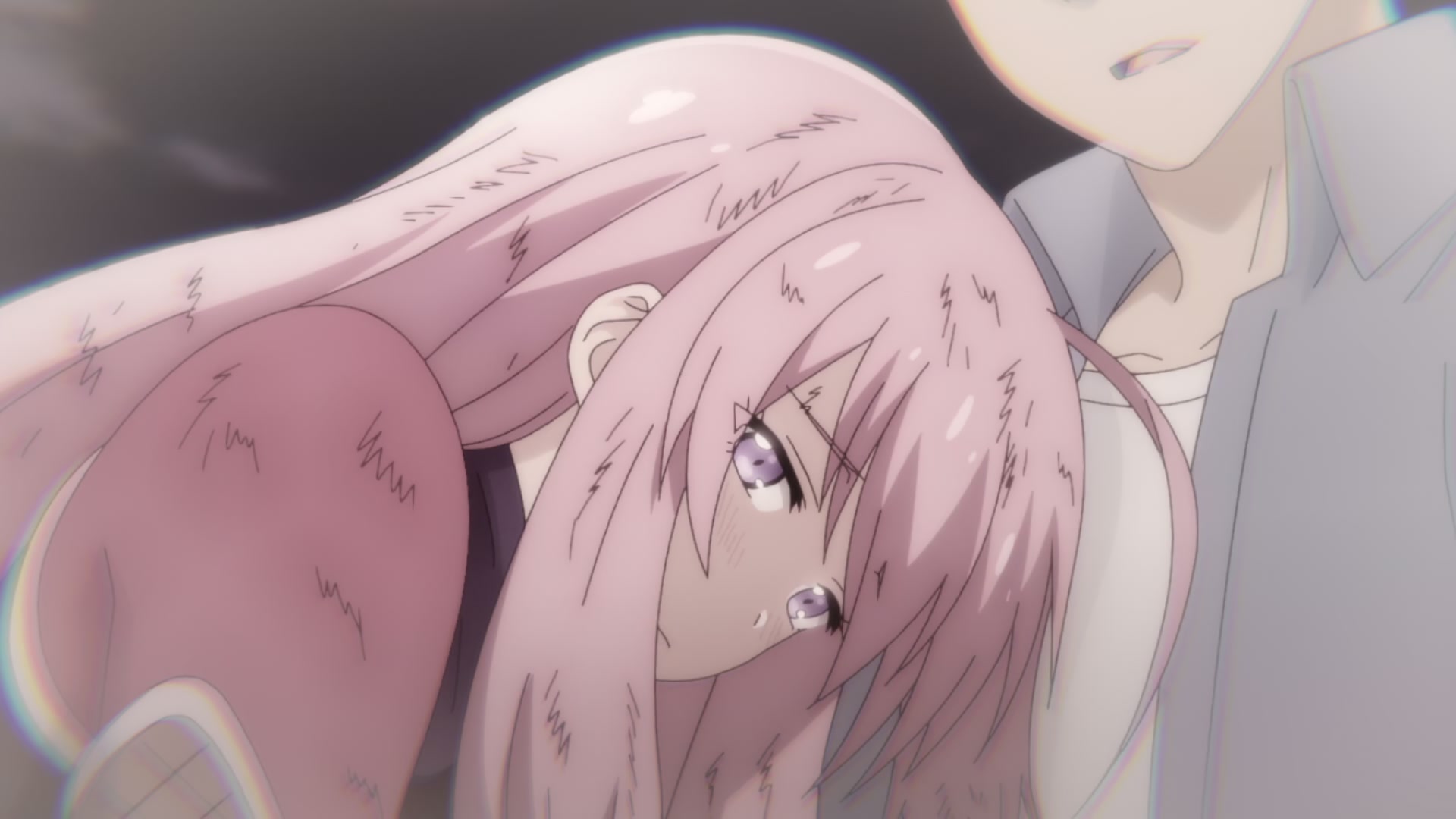
Romance and drama scenes employ a dreamy digital veneer: soft-focus bokeh, floating sparkles, and noticeable chromatic aberration around the edges of characters. The balcony confession sequence benefits particularly from this treatment, the visual softness reinforcing the emotional intimacy.
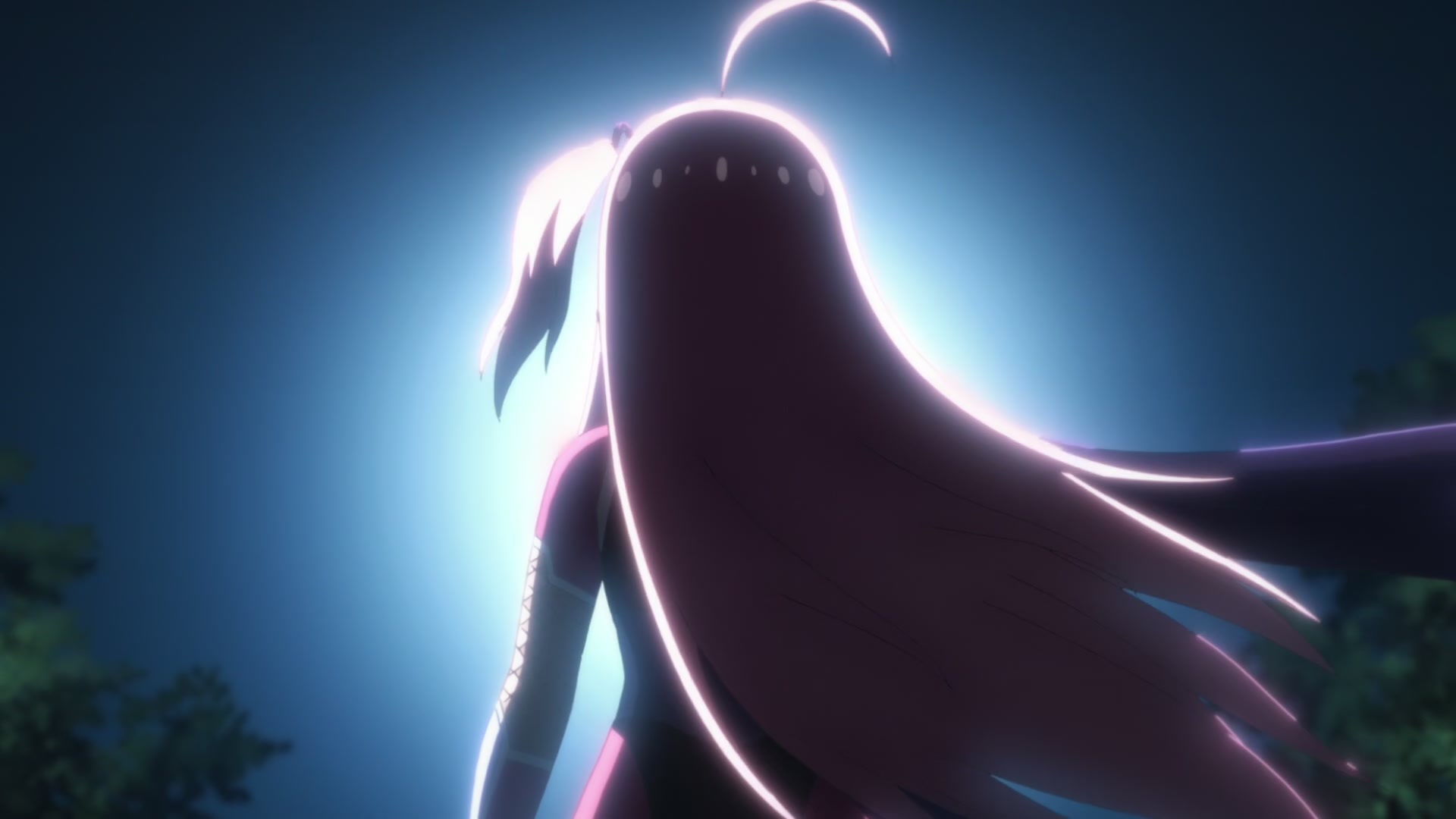
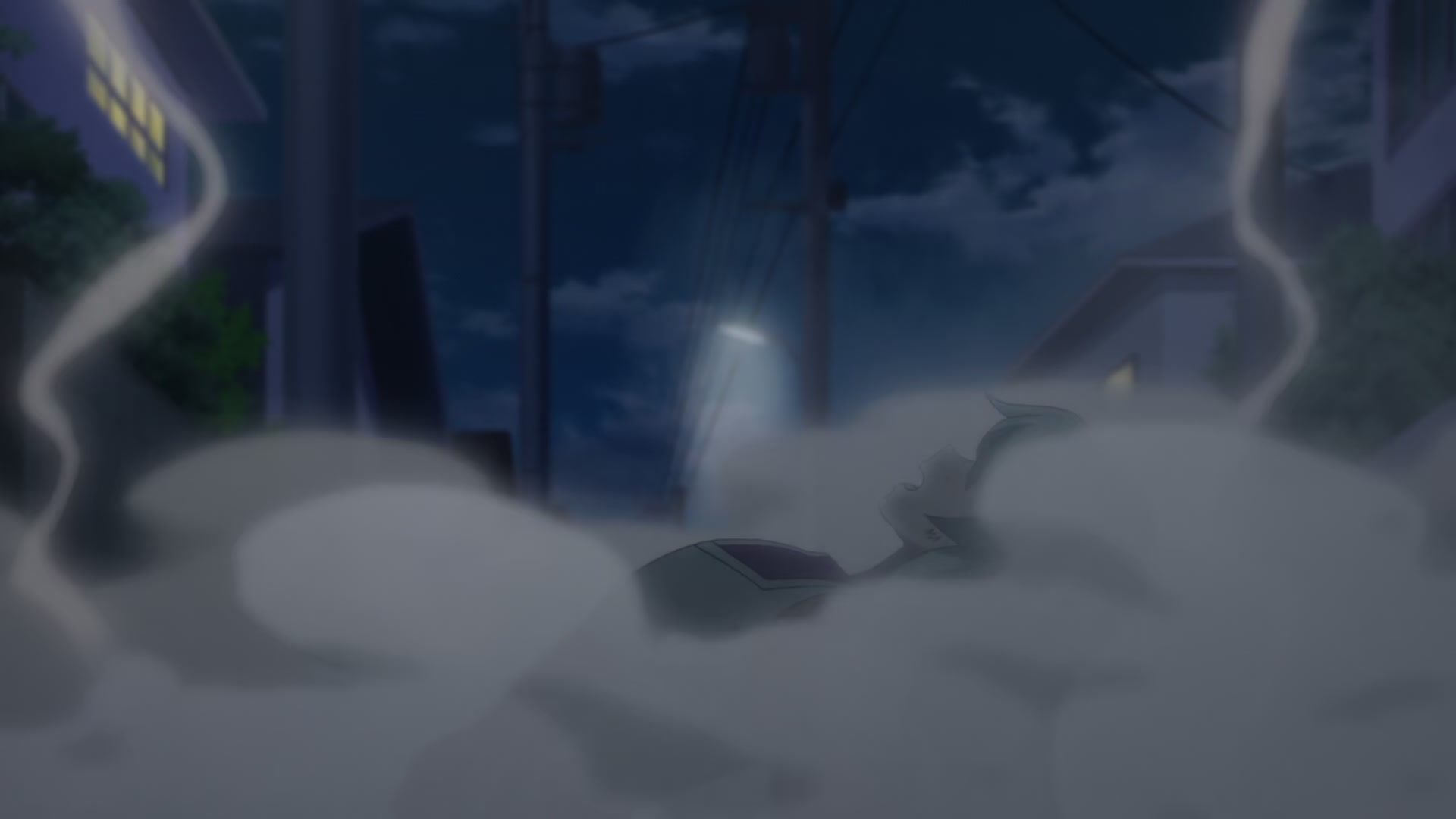
Supernatural and action sequences shift to deep blues, greys, and teals. Heavy use of digital smoke, fog, and aggressive rim lighting separates character silhouettes from dark, textured backgrounds. The Mirror Barrier sequences, with their otherworldly color grading, effectively communicate that normal reality has been suspended.
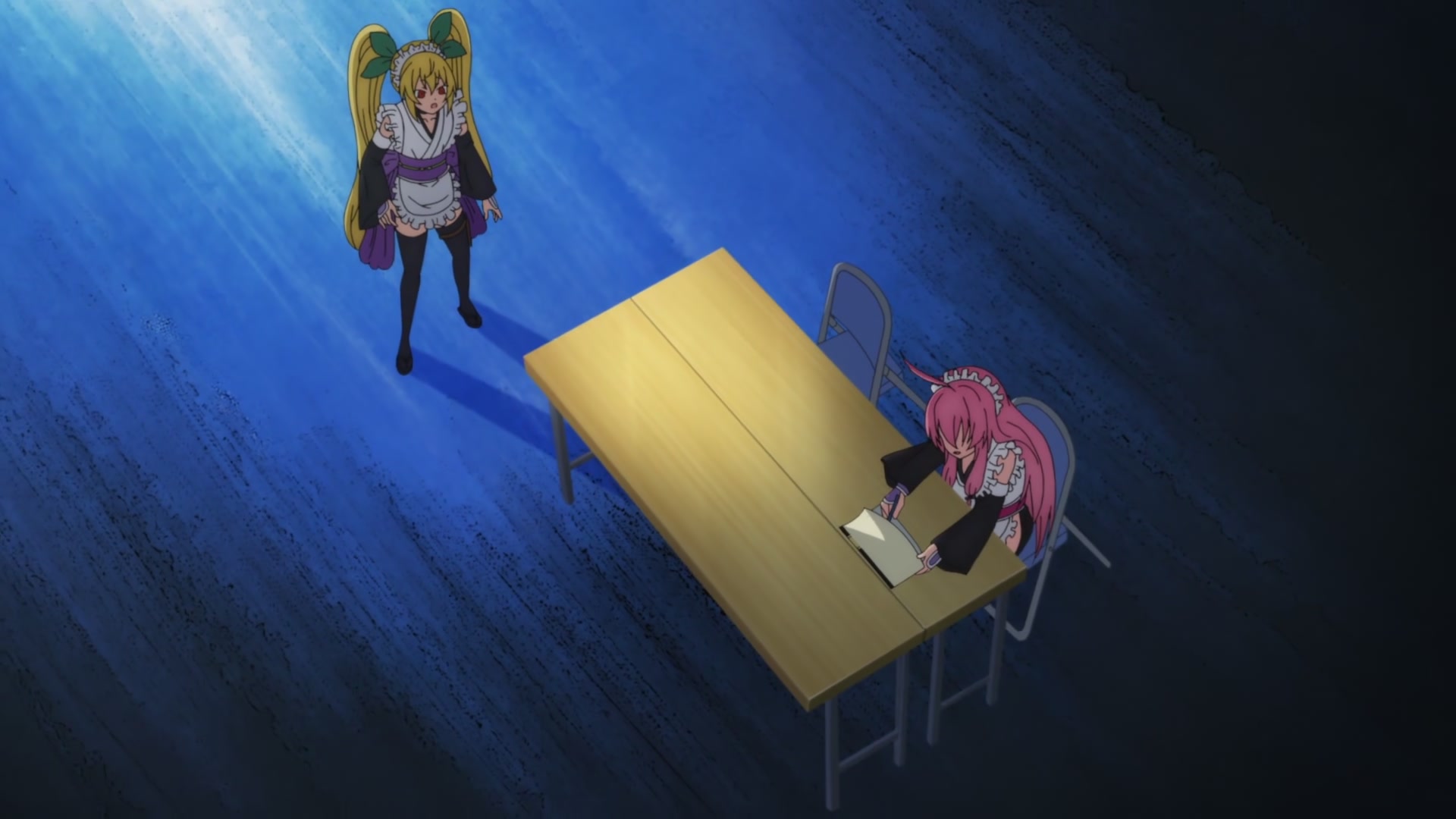
The series occasionally breaks from naturalism to use theatrical “stage-light” compositions, casting harsh spotlights on characters while leaving the rest of the frame in deep, textured shadow. Saya’s confrontations with Shizuri use this technique to emphasize the power imbalance between them.
However, the compositing has a notable weakness. In ordinary daylight scenes, particularly exterior shots, characters sometimes lack the environmental shadowing and color bleed that would integrate them into the scene. This creates a subtle but persistent sense that the characters and backgrounds exist in separate visual planes. The background art itself is often detailed and attractive. The character art is clean and expressive. The problem is in the integration layer, the digital equivalent of matching lighting temperatures on a film set. It is not ruinous, but it is noticeable to viewers attuned to visual coherence.
Environmental Design and Background Art
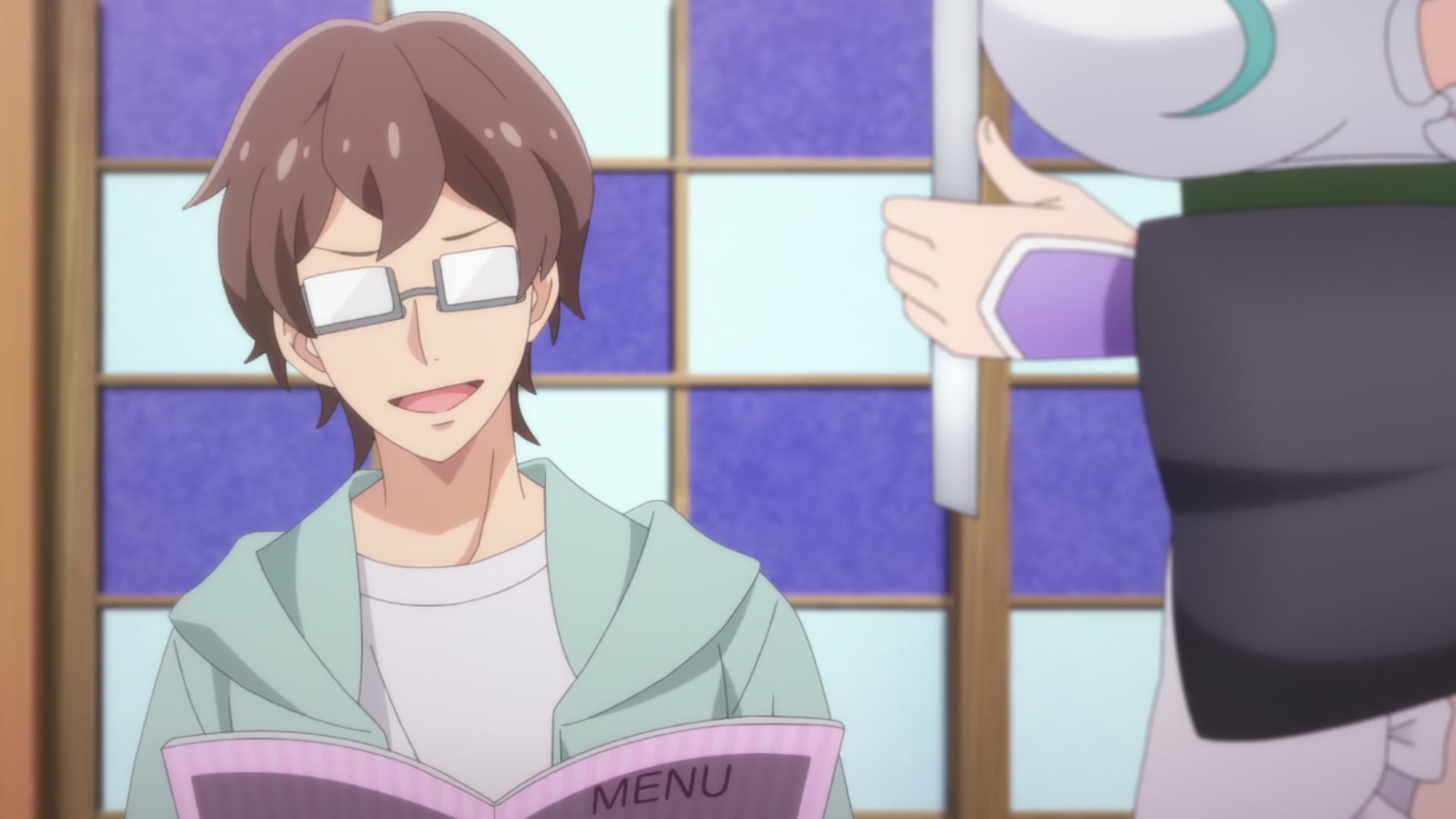
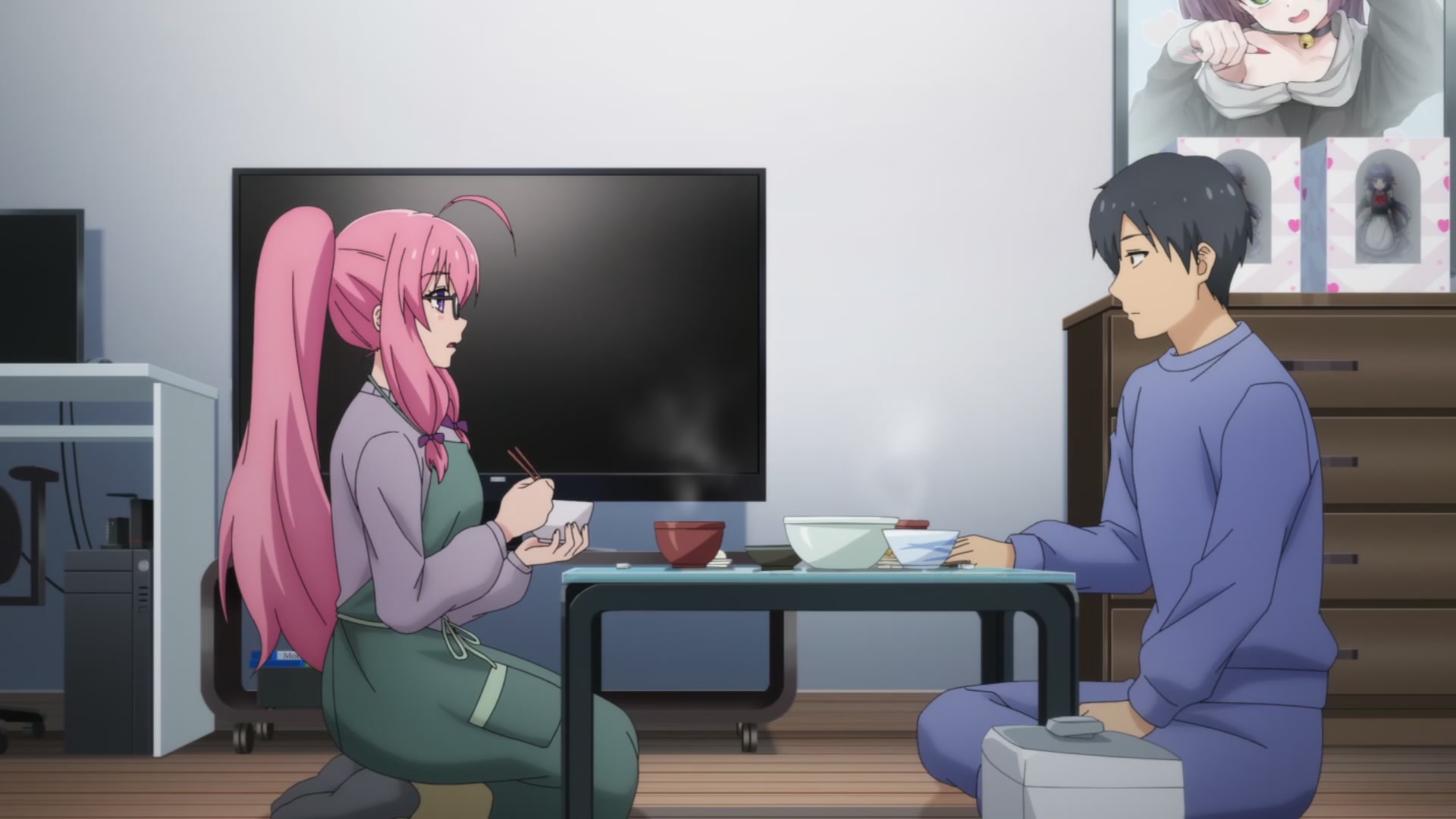
The domestic interiors are the series’ strongest environmental work. Tsukasa and Shizuri’s apartment is lived-in in ways that communicate character without dialogue: messy computer cables, specific anime merchandise like the Nemu figure and game cases, cluttered dressers. These details establish the reality of their shared life more effectively than exposition could.
The Nin Nin Cafe is rendered with appropriate whimsy, a fantasy space within the otherwise grounded urban setting. The contrast between the cafe’s colorful, frilly interior and the muted tones of the apartment building reinforces the cafe’s function as an escape from normal identity. The beach house location, appearing in the OVA episode, extends this aesthetic to a summer setting with appropriate adjustments.
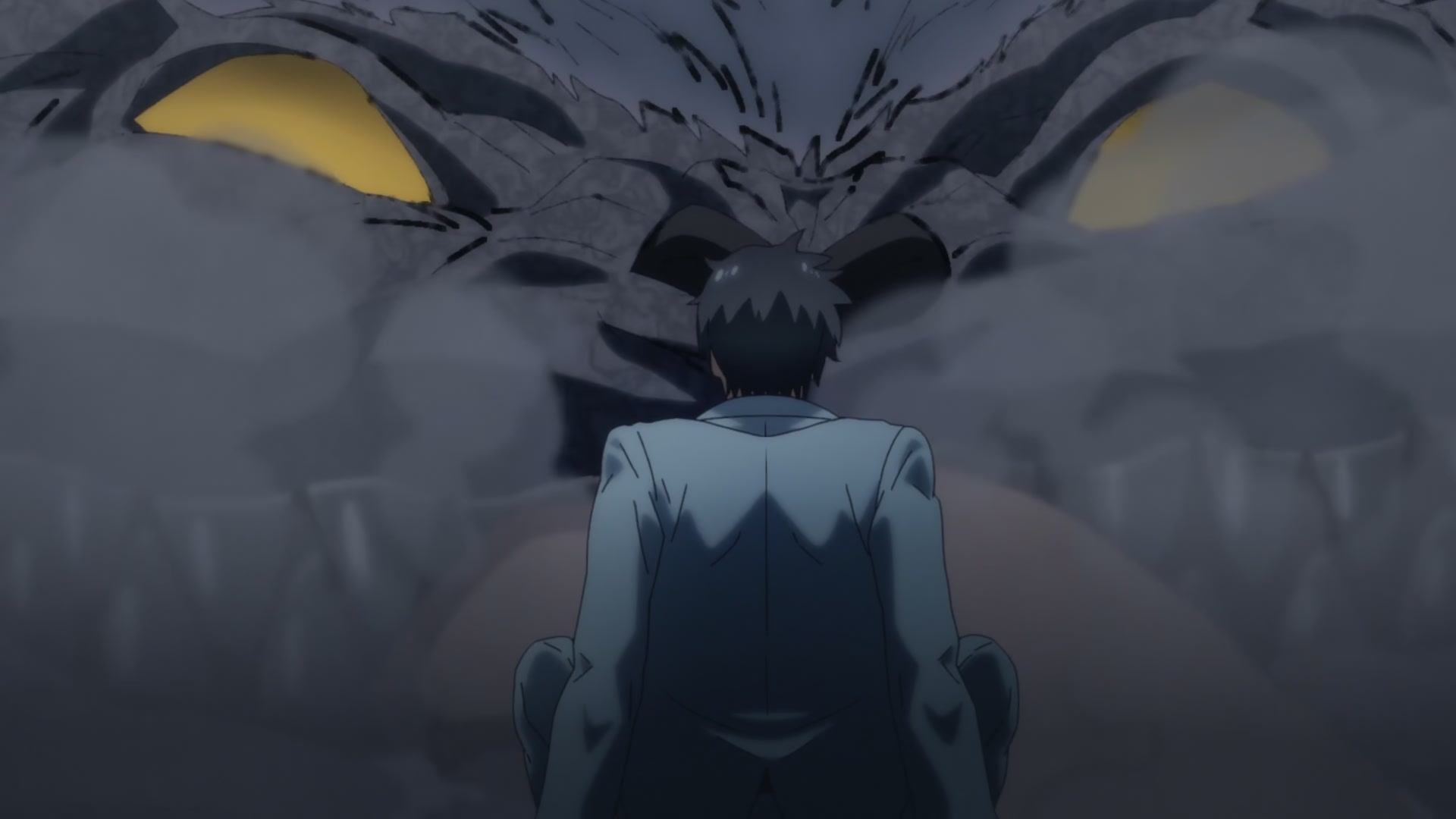
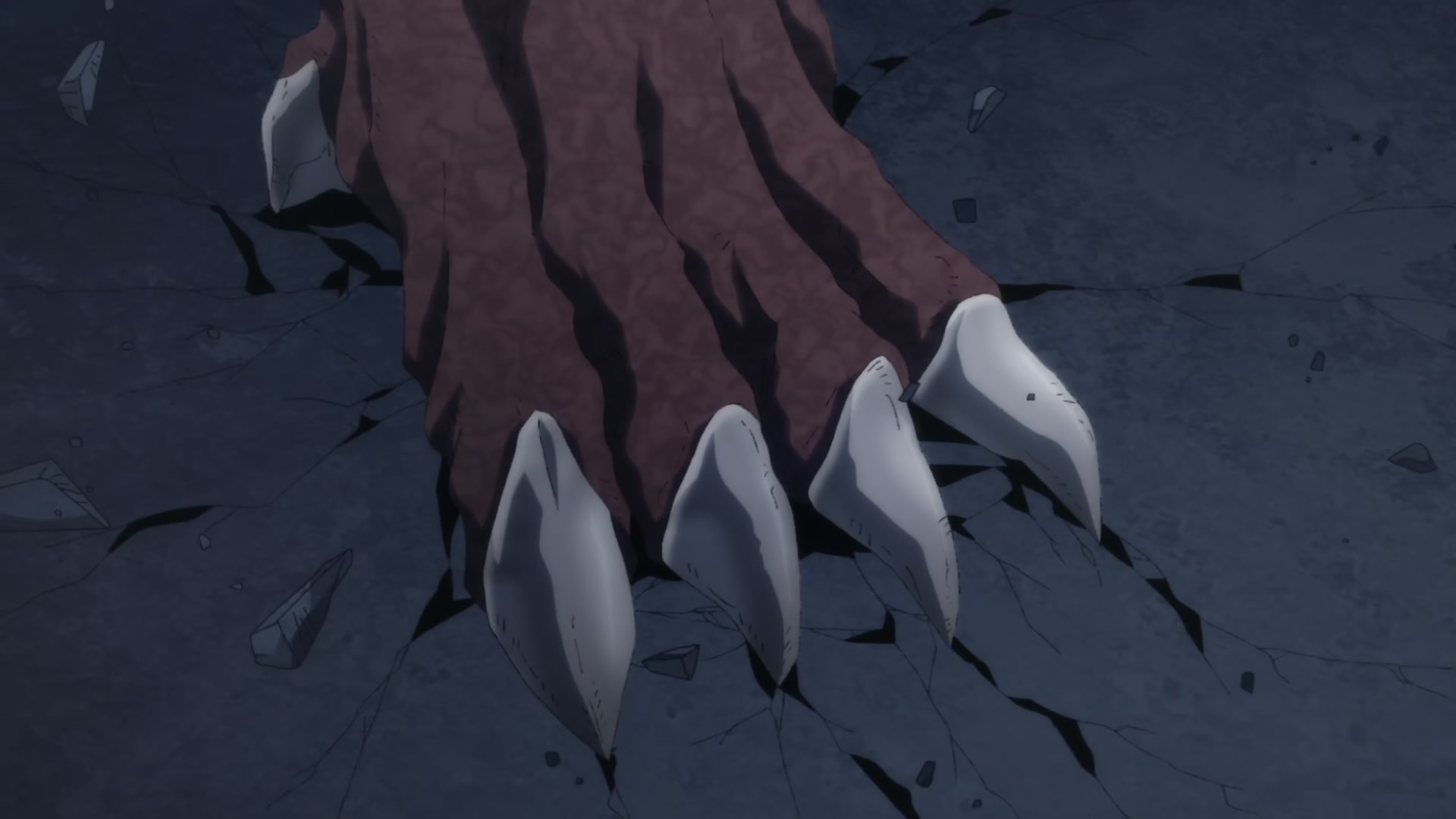
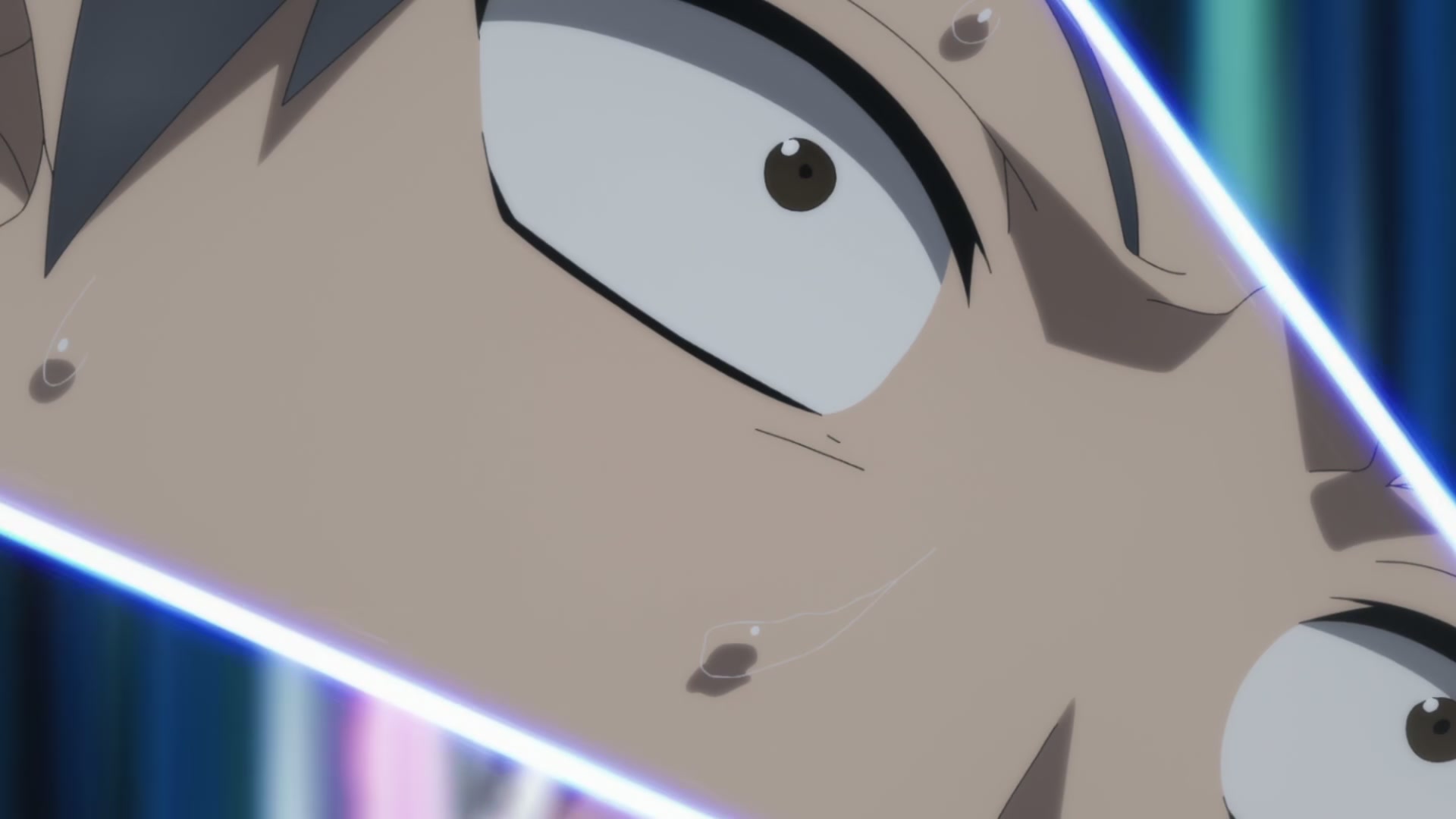
Compositionally, the series makes effective use of framing to establish scale and mood. Low-angle, over-the-shoulder shots during Youma confrontations emphasize a “David vs. Goliath” dynamic. Killa’s first appearance, towering over Tsukasa, uses this technique to communicate threat. High-angle “god’s eye” views punctuate comedic defeat: Shizuri collapsed after a gaming all-nighter, Ayame face-down after a failed perversion attempt. Extreme close-ups, often framed by stylized glowing slashes, focus attention on subtle physical tells like sweating, hand positioning, and eye movement.
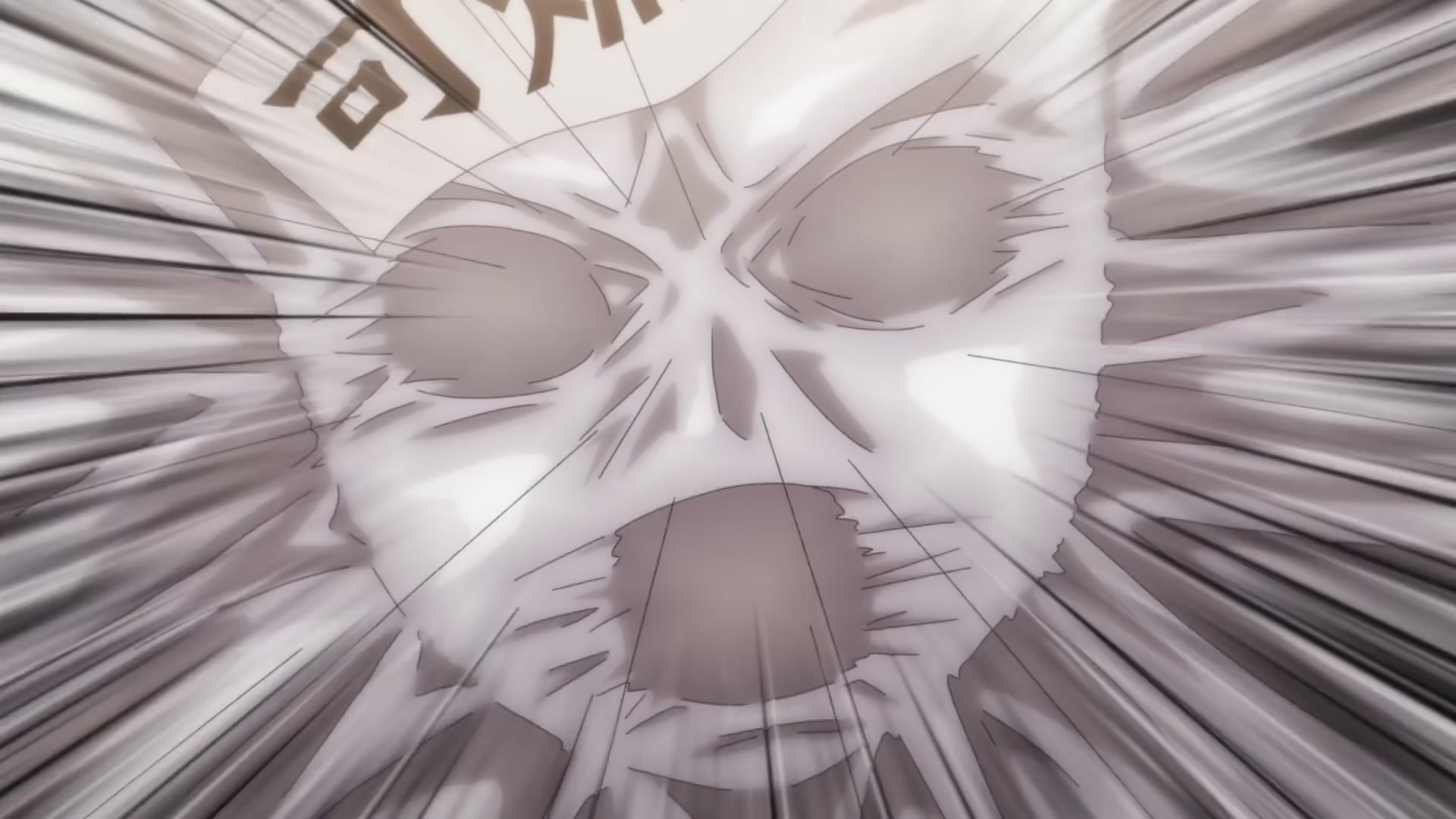
During high-energy gags or action peaks, detailed backgrounds are often replaced by abstract patterns: radial speed lines, checkered screens, the “Shizuri-vision” gacha pull animation. This keeps focus on movement and reaction without distracting environmental detail.
Animation Quality and Movement
The series operates within a limited animation framework typical of mid-budget seasonal anime. Character models are significantly simplified during high-motion sequences, with detail migrating to key frames while in-betweens use reduced linework and flatter shading. This is standard practice, and for the most part, the series manages it competently. The strong key art carries the emotional weight even when motion is minimal.
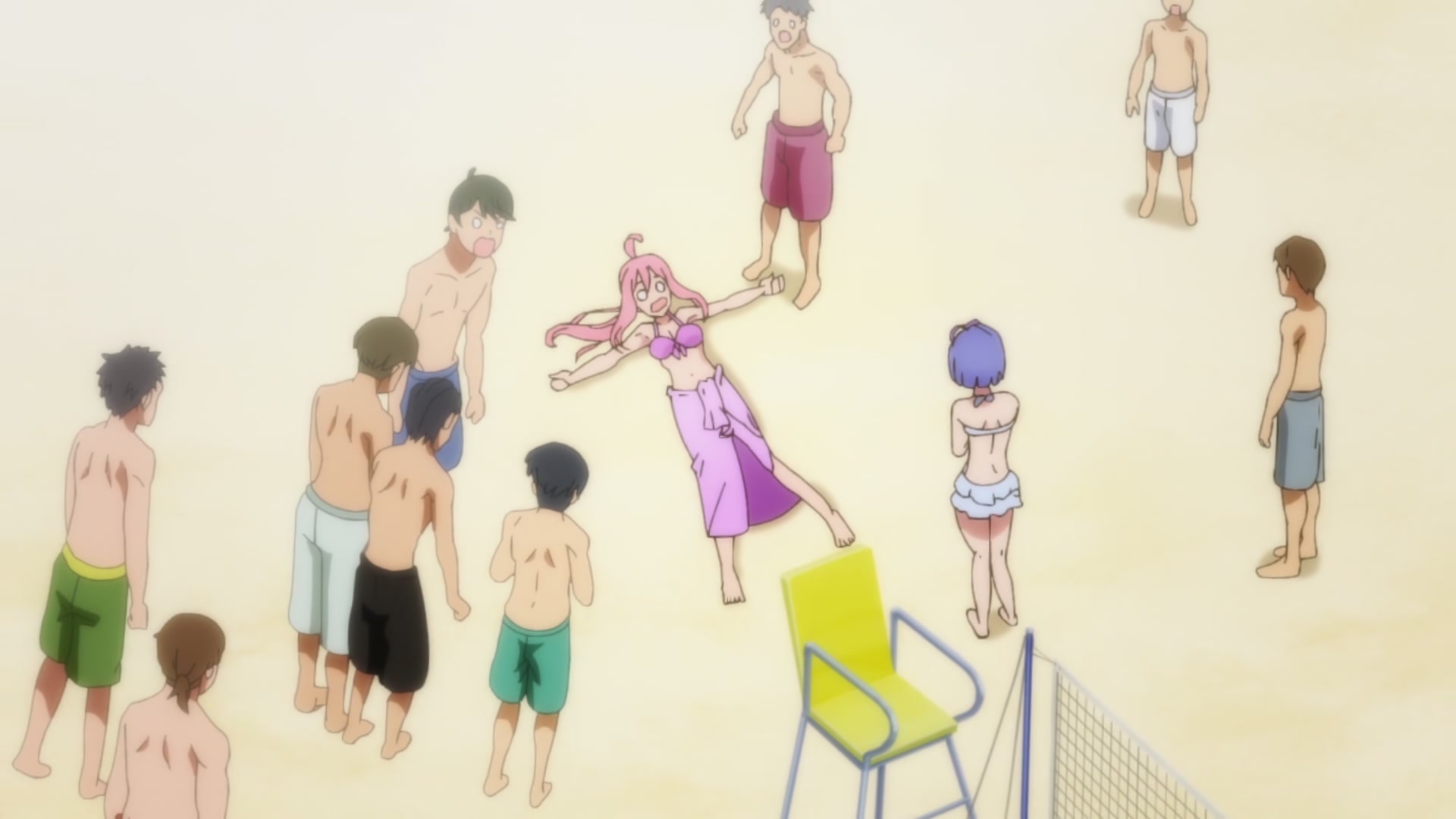
However, there are moments where the limitations become noticeable. Crowd scenes at the beach episode use simplified background characters that contrast awkwardly with the more detailed main cast. Some action sequences rely on speed lines and impact frames to imply motion rather than animating it fully. This is a legitimate technique, but it can feel like a shortcut when overused.
It is important to distinguish between scenes that are intentionally static and those that are static due to resource limitations. Many of the series’ domestic scenes are deliberately still, using locked-down compositions and minimal movement to create a sense of comfortable routine. Tsukasa and Shizuri gaming together, eating meals, or sitting on the balcony benefit from stillness. The lack of camera movement communicates stability and intimacy. This is not weakness. It is appropriate directorial choice.
Some dialogue scenes, particularly exposition-heavy ones, use static shot-reverse-shot patterns with only mouth flaps animated. This is standard television anime practice, but in a series that elsewhere demonstrates compositional creativity, these sequences can feel perfunctory. The scenes where characters explain ninja mechanics or Youma hierarchies sometimes lack the visual invention that characterizes the emotional and comedic material.
The action sequences are competently staged but rarely exceptional. The series’ strengths are in character expression and emotional timing, not in fluid combat animation. Battles rely on impact frames, speed lines, and post-processing effects to create excitement rather than on complex choreography or smooth motion. This is not a criticism per se. The series is a romantic comedy with action elements, not an action showcase. The most successful action sequences are those that integrate character beats: Shizuri pulling gacha mid-battle, Ayame demanding to be treated as “burnable trash,” Hina’s full-power blast accompanied by her emotional commitment. When action and character comedy intertwine, the limitations of the animation become less relevant.
Facial Expressions and Character Acting
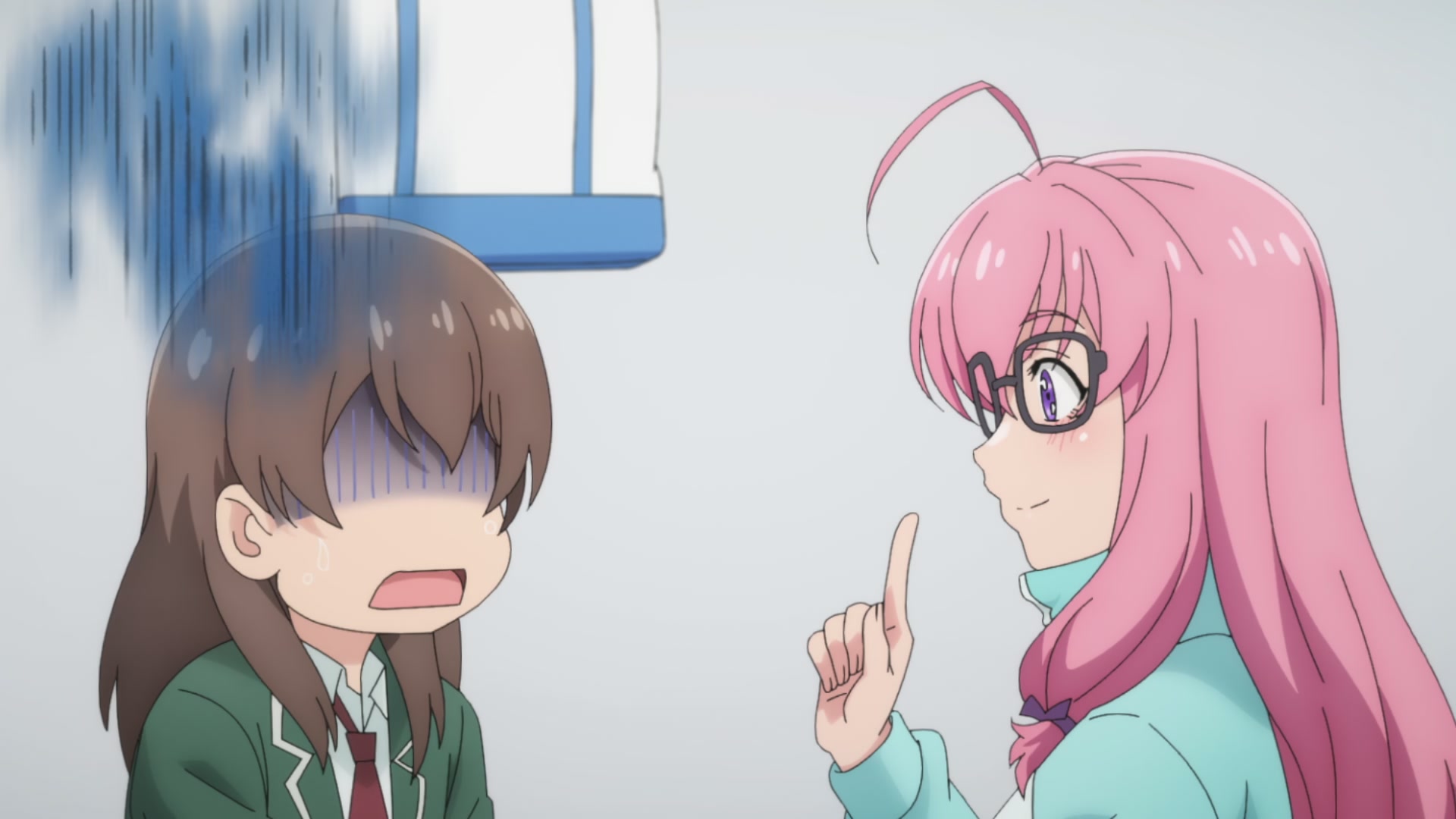
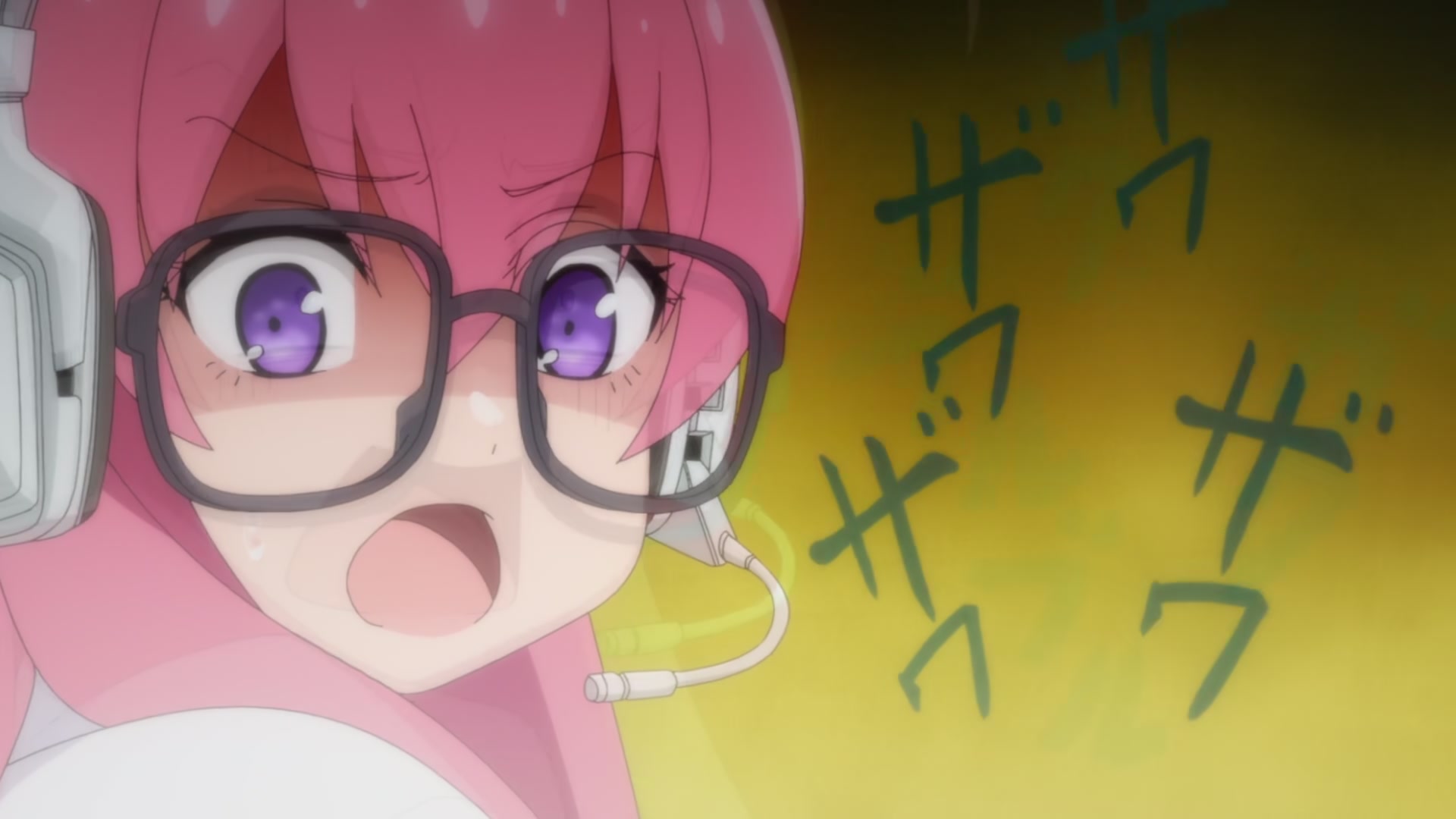
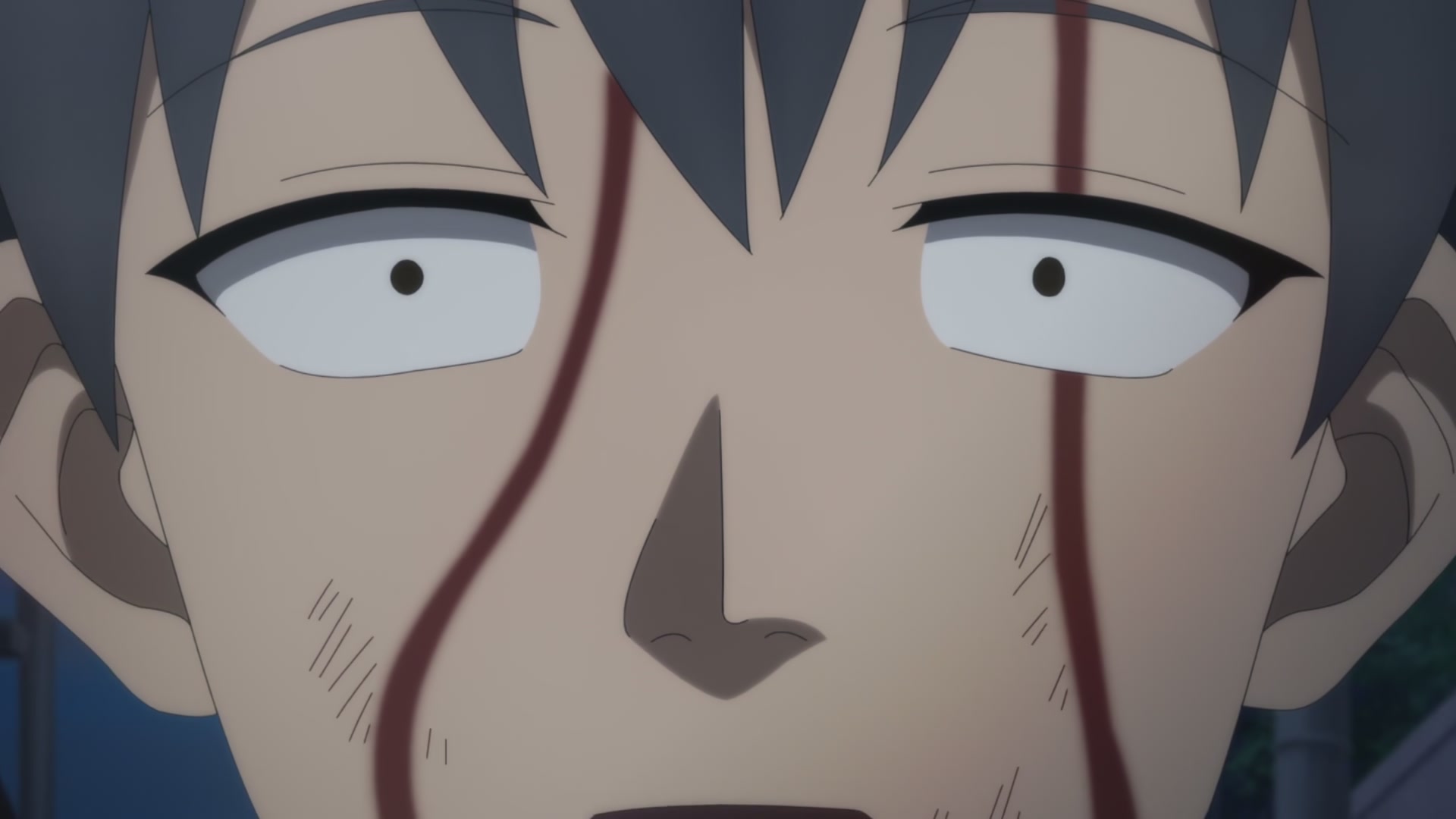
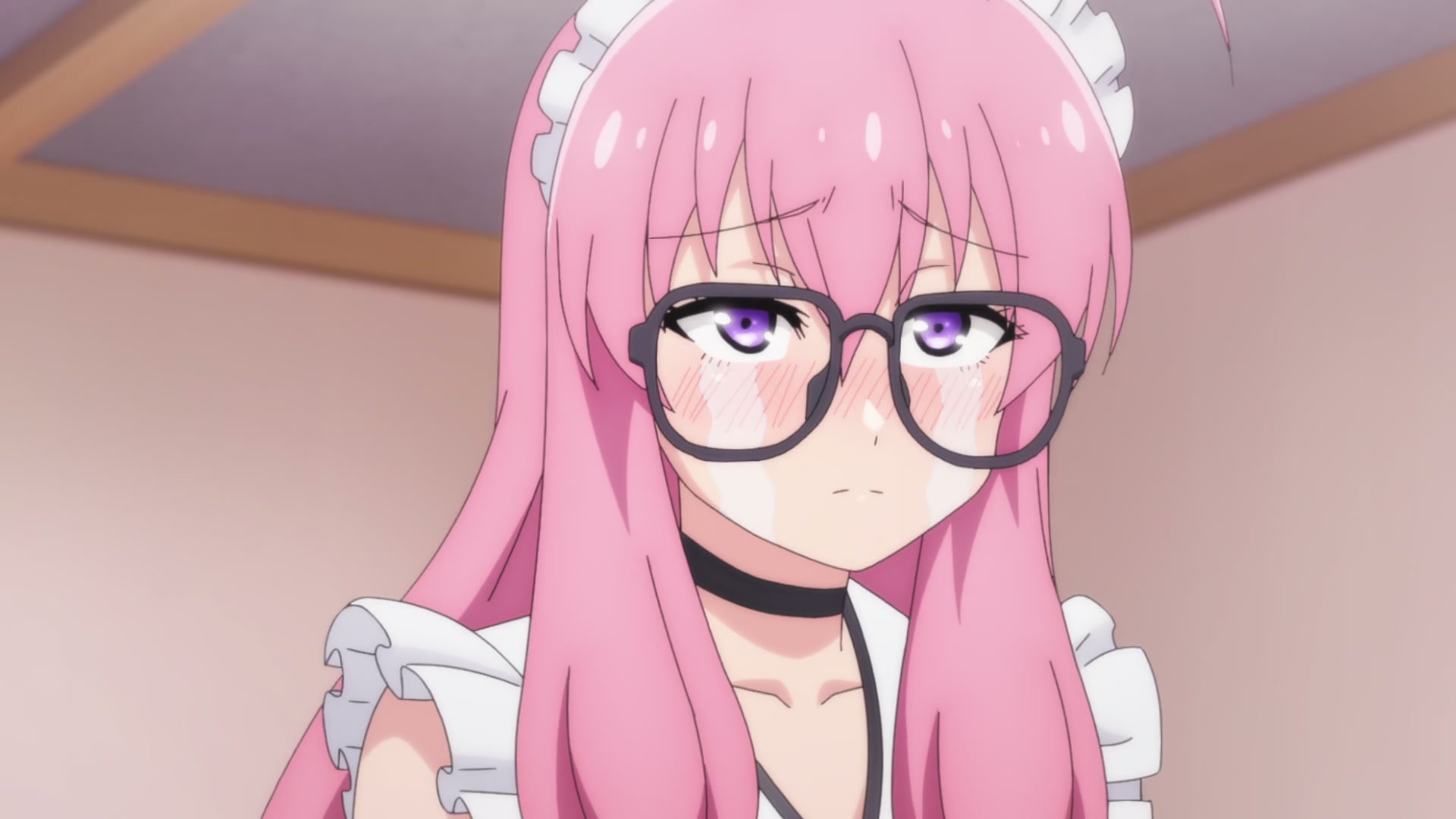
The series demonstrates a sophisticated understanding of how facial expressions communicate internal states. The emotional range is bolstered by classic anime shorthand: “zawa zawa” visual metaphors, radial gloom lines, shrunken pupils, and exaggerated sweat drops. These are deployed with good timing and appropriate restraint.
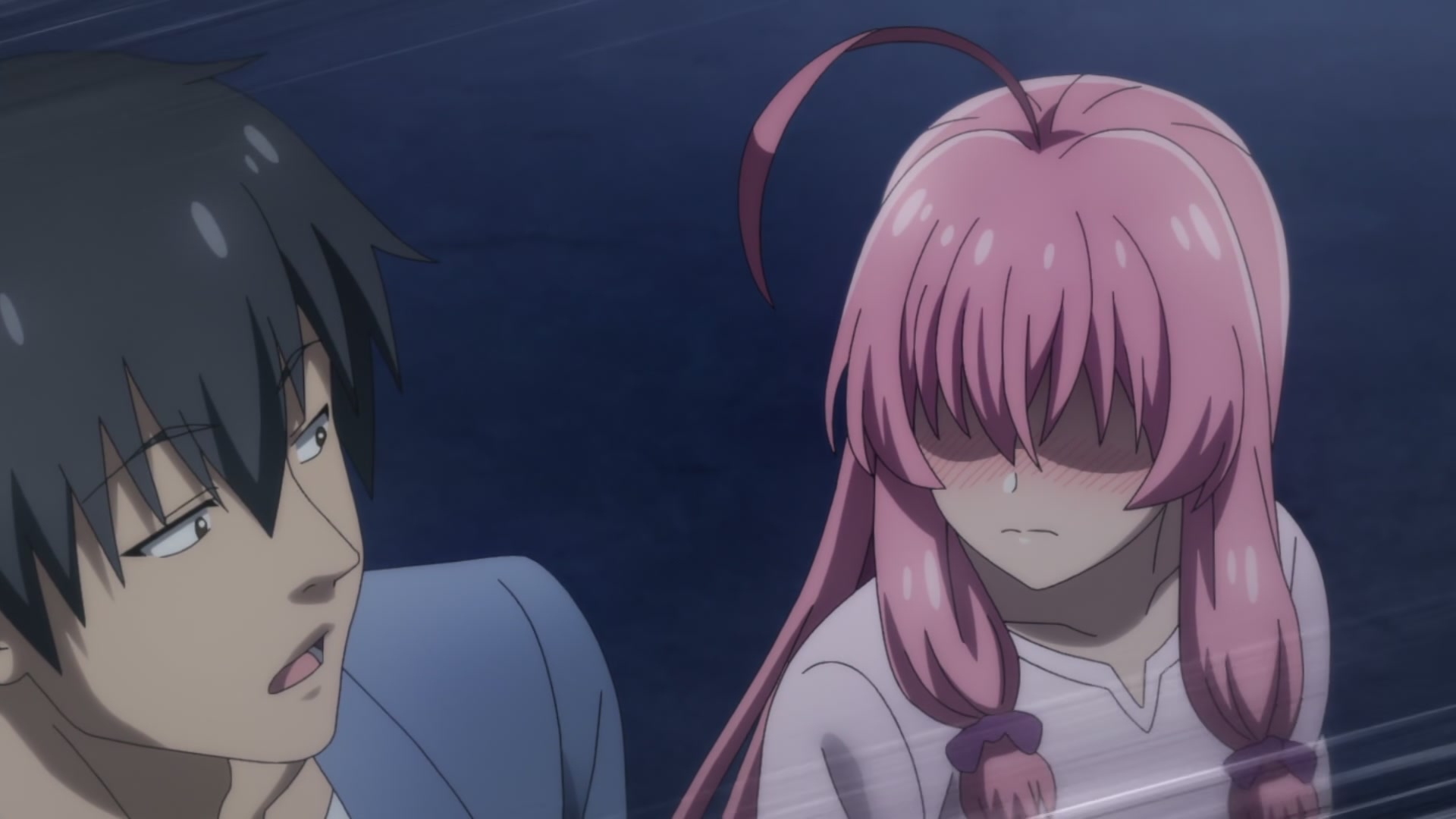
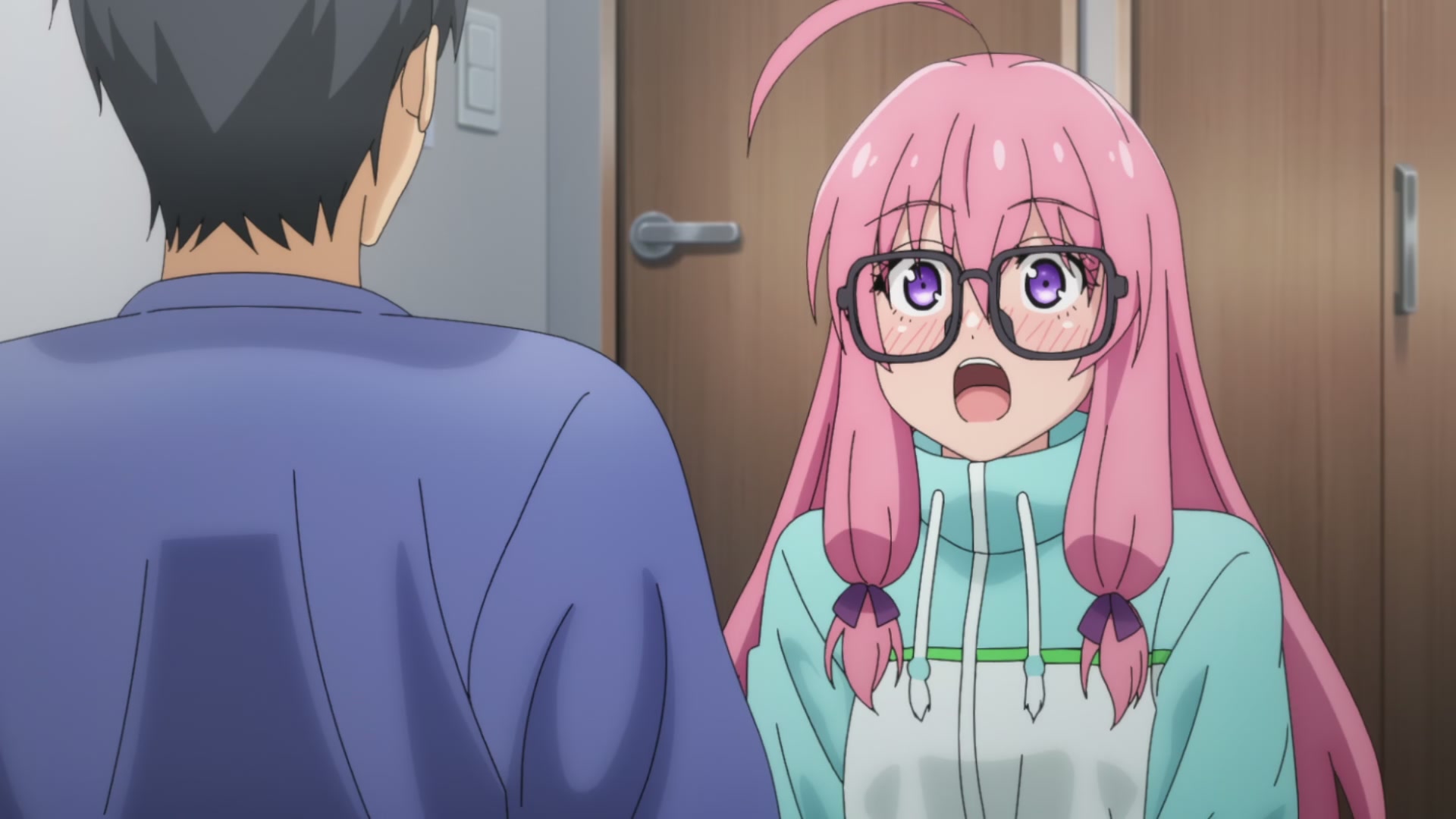
Shizuri’s expressions are particularly well-handled. Her “totally helpless in romantic situations” panic is communicated through full-face blushes, averted eyes, and simplified chibi forms that contrast sharply with her cool battle demeanor. The gap between her combat expression (focused, cold, sharp-eyed) and her domestic expression (flustered, avoidant, soft) is a visual representation of her divided self.
Ayame’s expressions operate on a different register entirely. Her transcendent bliss faces, with spiraling eyes and ecstatic blushes, are deliberately over-the-top, pushing into parody territory. But the series also gives her moments of genuine vulnerability, where her expression simplifies and her eyes lose their manic quality. These moments, often when Shizuri thanks her or acknowledges her loyalty, are effective precisely because they contrast with her usual exaggerated mode.

Sound and Music
Opening and Ending Themes
The opening theme establishes the series’ tonal mixture effectively. It balances the supernatural action elements (ninja poses, combat sequences, Youma silhouettes) with the domestic comedy (gaming, eating, lounging around the apartment) and the romantic throughline (Tsukasa and Shizuri’s quiet moments together). The character introductions within the OP sequence efficiently communicate each major player’s personality: Shizuri’s dual battle/NEET identity, Hina’s klutziness, Ayame’s perversion, Kanna’s tsundere pride.
The ending theme provides a softer counterpoint, focusing on the domestic intimacy that is the series’ emotional core. The visual accompaniment typically features the characters in quiet, everyday moments, reinforcing the theme that the ordinary shared life is what matters most.
Voice Acting and Seiyuu Performance
The voice cast delivers strong work across the board, handling the series’ rapid tonal shifts with skill. Shizuri’s performer must navigate the widest range: cool efficiency in battle, lazy entitlement in NEET mode, flustered panic in romantic situations, drunken clinginess, and genuine emotional vulnerability. The transitions between these registers are handled smoothly, and the comedic timing, particularly in Shizuri’s deadpan dismissals of Kanna’s challenges and her explosive reactions to embarrassment, is consistently effective.
Tsukasa’s performer has a more restrained role but executes it well. His character’s emotional flatness in early episodes is communicated through a deliberately uninflected delivery that gradually warms as his feelings develop. His confession on the balcony is delivered with quiet sincerity rather than dramatic intensity, which suits the character perfectly.
Ayame’s performer commits fully to the character’s extremes, from ecstatic masochistic bliss to genuine distress at gender exposure. The shift between Ayame’s female voice and Ilm’s male voice is handled as a clear but not cartoonish distinction. Kanna’s performer nails the tsundere rhythm: aggressive declarations followed by flustered retreats, with moments of genuine tenderness breaking through at key points. Hina’s performer communicates her anxiety and earnestness effectively, making her moments of confidence feel earned.
Sound Direction and Atmospheric Audio
The sound design supports the series’ genre shifts competently. Combat sequences feature appropriate impact sounds, whooshes, and supernatural effects (the Mirror Barrier deployment, jutsu activations). Domestic scenes use ambient audio (cooking sounds, game console noises, the rustle of tracksuit fabric) to ground the supernatural premise in ordinary reality.
The soundtrack navigates the series’ tonal range with appropriate flexibility. Light, bouncy tracks accompany comedic and domestic sequences. More intense, driving pieces underscore action scenes. Softer, melodic compositions support romantic and emotional moments. The music is functional rather than standout, serving the scenes without drawing attention to itself, which is appropriate for a series whose emotional weight is carried primarily by character writing and performance.
Overall Verdict
NEET Kunoichi to Nazeka Dousei Hajimemashita is a series that knows exactly what it is and executes its vision with confidence. It is a romantic comedy with supernatural action elements that uses its absurd premise to explore genuine emotional territory. It is about finding value in oneself through being valued by another person. It is about the validity of unconventional lives. It is about the families we build when our original families cannot accommodate us.
The series will resonate most with viewers who enjoy domestic comedy with supernatural framing, appreciate character-driven storytelling over plot-driven narratives, are comfortable with anime’s visual and narrative conventions, have affection for otaku culture and its spaces, and value emotional sincerity even when packaged in absurdity. It may frustrate viewers who demand high-quality animation throughout, are hostile to fanservice or tropey character types, prefer clear genre boundaries over tonal mixture, or want resolution that conforms to conventional social norms.
The animation has real limitations. The compositing is inconsistent, with daytime scenes sometimes suffering from flatness where characters feel pasted onto backgrounds. Some action sequences rely on shortcuts rather than fluid choreography. But these weaknesses are offset by the series’ strengths: strong key art, expressive character acting, intelligent use of digital post-processing for atmosphere, and a willingness to break its own models for comedic impact.
The character writing is the series’ strongest element. Tsukasa and Shizuri’s relationship develops with patience and sincerity, earning its emotional payoffs through accumulated domestic detail. The supporting cast is well-differentiated, each character having distinct conflicts and growth arcs that intersect with the central couple’s journey without overwhelming it. Ayame, in particular, is a surprisingly nuanced treatment of gender complexity for a comedy series, allowed to be both ridiculous and genuinely admirable.
The thematic position, the validation of Shizuri’s NEET lifestyle as compatible with love and responsibility, is quietly radical. When Tsukasa asks her to continue being a NEET for his sake, the series is making a statement. It is saying that the life she wants, gaming, eating, sleeping, being provided for, is not a failure state. It is a valid preference, and it is compatible with being essential to another person. That is not a message anime delivers often, and this series delivers it with charm, humor, and genuine warmth.
The found family that accumulates in the apartment building, runaway ninja, gender-complex perverts, tsundere leaders, exiled Youma, rom-com obsessed high school girls, is a community of people who could not fit elsewhere and found space together. The series’ closing image is not of a couple alone but of a building full of interconnected lives. That is its argument: the life you want, however unconventional, can be shared. And sharing it is what makes it matter.
I recommend this series to anyone who can meet it on its own terms. It is not a masterpiece, but it has heart, humor, and something to say. In a medium full of shows that play it safe, that is worth celebrating.

Gallery